Killingly Town Hall // 1876

The economic center of the town of Killingly, Connecticut is the village of Danielson, which is located at the confluence of the Quinebaug and Five Mile rivers. The area developed as an industrial village and prospered as the town’s center through the late 19th and early 20th centuries. The present-day town hall building was originally constructed in 1876, not as a civic building, but as a multi-purpose music hall and G.A.R. Hall. The Victorian/Ruskinian Gothic style building was constructed of brick with stone trim. The building was later acquired by the town in 1906 and has served as the town offices ever since. Besides the unfortunate replacement windows, the building is well-preserved by the town.

St. Mary’s Roman Catholic Church Priory // 1907

Located next to the St. Mary’s Roman Catholic Church on Hillhouse Avenue in New Haven, Connecticut, you will find one of the finest Neo-Gothic style buildings in the city that was not built by Yale University. This structure was constructed in 1907 as the Priory for the Catholic Church next door. Historically, the church had been under the care of the Dominican friars of the Province of St. Joseph, based in New York City, and the church needed a residence for the friars (a Priory). Due to dwindling attendance at churches all over the country, area churches were consolidated under the Hartford Archdiocese, who replaced the friar residents of this building with Dioscesan priests in late 2021.

Yale University – Yale Art Gallery Building // 1928

One of the most visually stunning and unique buildings in New England is the 1928 Yale Art Gallery building, which is connected to Street Hall (last post) via a skybridge over High Street. Completed in 1928, the Yale Art Gallery was designed by relatively little-known, but significant 20th century architect, Egerton Swartwout. Swartwout graduated from Yale College in 1891 with a B.A. degree and with no formal architecture training, was hired as a draftsman at the illustrious firm of McKim, Mead & White in New York before running his own office, Tracy and Swartwout. Built in a Gothic Renaissance style inspired by Italian buildings such as the Bargello in Florence, the sandstone masonry structure commands the prominent site with a corner tower and facade fronted by five gothic arched windows. Inside, visitors are transported to a historic Italian art museum within the Gallery Wing, with the full-height Gothic windows with walls, floors and ceilings restored and lined in stone.

Yale University – Farnam Hall // 1870

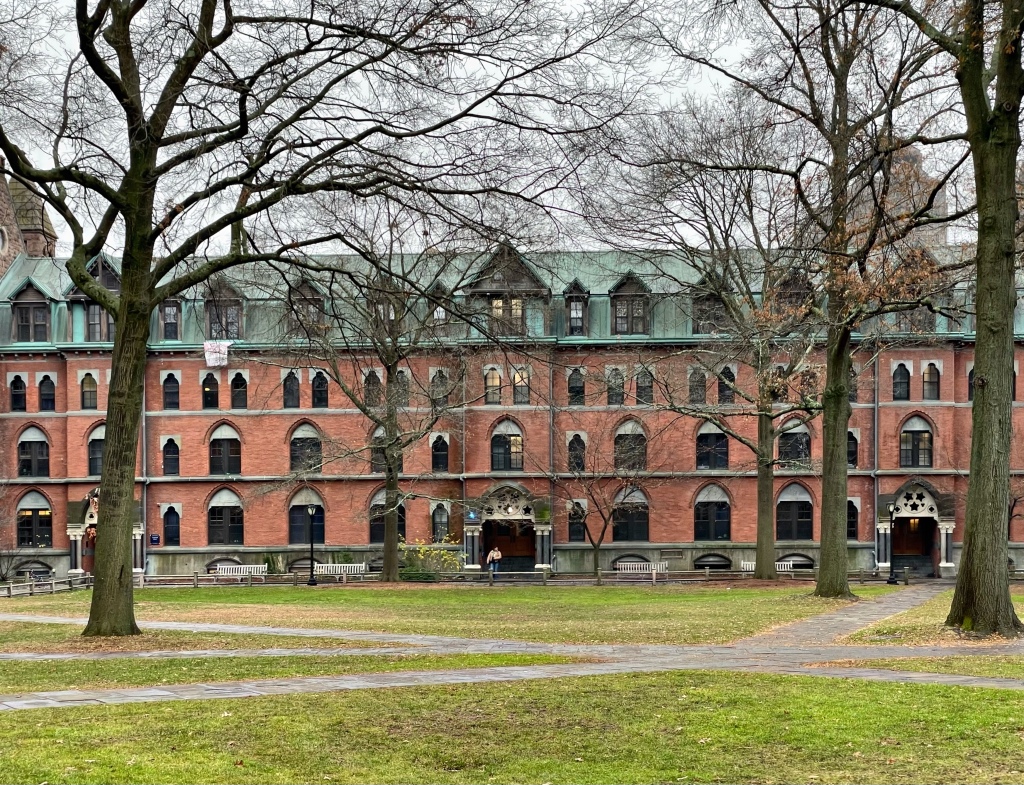
Farnam Hall is Yale University’s oldest dormitory still in use. Designed by New York architect Russell Sturgis in a Ruskinian High Victorian Gothic style, Farnam Hall is considered Sturgis’s most important work and was completed in 1871, marking a new direction toward an enclosed campus, shielded off from the surrounding downtown district of New Haven. Named for Henry Farnam, its construction required the removal of the Second President’s House and a section of the Yale Fence, which was met with some trepidation. The red brick, four-story building originally consisted of twenty suites and ten common rooms on each floor. Sturgis, who was influenced by John Ruskin’s ideals put forward in his Seven Lamps of Architecture, used a variety of brick and stone on the facade all with hand carved detailing. Farnam Hall was renovated in 1977 by architect Edward Larrabee Barnes and today serves as a dormitory for first-year students belonging to Yale’s Jonathan Edwards College.

Yale University – Dwight Hall // 1842

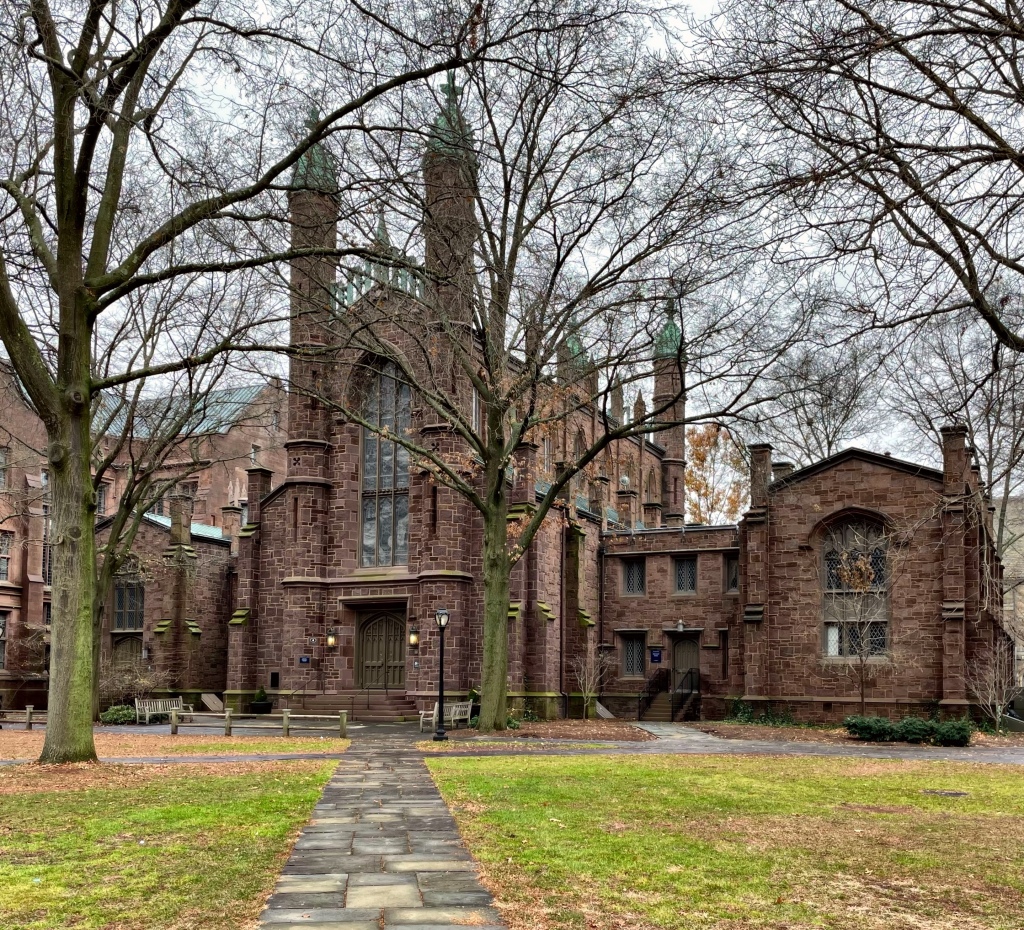
One of the most architecturally significant college buildings in the United States, Dwight Hall was designed to house the growing book collection of Yale College as its library. The former Yale College Library, now Dwight Hall, represents a significant shift in Yale’s campus architecture from Georgian and Federal brick buildings to the Gothic mode which the campus is largely known for today. Dwight Hall was designed by local architect Henry Austin with the guidance of esteemed architects Ithiel Town and Alexander Jackson Davis, both experts in early high-style Gothic buildings in America. The design, to me, resembles the 1443 King’s College Chapel in Cambridge, England. The structure is constructed of brownstone from Portland, Connecticut, and it is composed of a central block with two smaller flanking wings on either side connected by smaller linking spaces. At the yard facade, two octagonal towers with domed copper roofs rise, flanking a large, pointed lancet arch window that extends above the doorway. The library was outgrown fairly quickly, necessitating an annex next door and eventually collections were transferred to Sterling Memorial Library in 1930, the Old Library was converted to a chapel and community service building and is known as Dwight Hall.

Yale University – Vanderbilt Hall // 1894

Like many other buildings on campus, Vanderbilt Hall is named for its wealthy sponsors, but its foundation is one of family tragedy. One of Yale’s stunning Collegiate Gothic structures, the building is named after William Henry Vanderbilt II (1870-1892), who attended Yale in the early 1890s. William contracted typhoid fever from a water pump while touring the western United States and died during his junior year. His father, railroad tycoon Cornelius Vanderbilt, constructed Vanderbilt Hall in 1894 as a memorial to his son and donated it to the University. The highly prized Vanderbilt room, which is located above the archway, is apparently one of the finest residential spaces on the campus. Architect Charles C. Haight designed the building which enclosed the southern edge of the yard, created a gateway, and is one of the early architectural statement pieces for the campus in the Collegiate Gothic style. Haight would receive later commissions at Yale based on his work on Vanderbilt Hall.

Dorset Congregational Church // 1909

Arguably the most high-style building in the quaint village of Dorset, Vermont is the Congregational Church, which appropriately sits on Church Street. The original congregational church in Dorset was located in nearby Maple Hill Cemetery. When the wood structure burned in 1832, an new wooden church was built on this site. The second wooden building burned in 1907, and then this church was built, but of fireproof construction. Jordan Greene, an architect from New York, designed this Neo Gothic Revival style in the historic district. The church was constructed by the contracting firm of O. W. Norcross, partner in the Norcross-West Marble Company, which donated the building stone from its South Dorset quarry. The design is dominated by a massive square central tower that ascends its facade and is capped by pinnacles. Behind the tower, the gable-roofed church is built of rough-faced Dorset marble laid in patterned coursed ashlar and trimmed with dressed stone. How many other marble churches can you think of?

Immaculate Conception Catholic Church // 1896

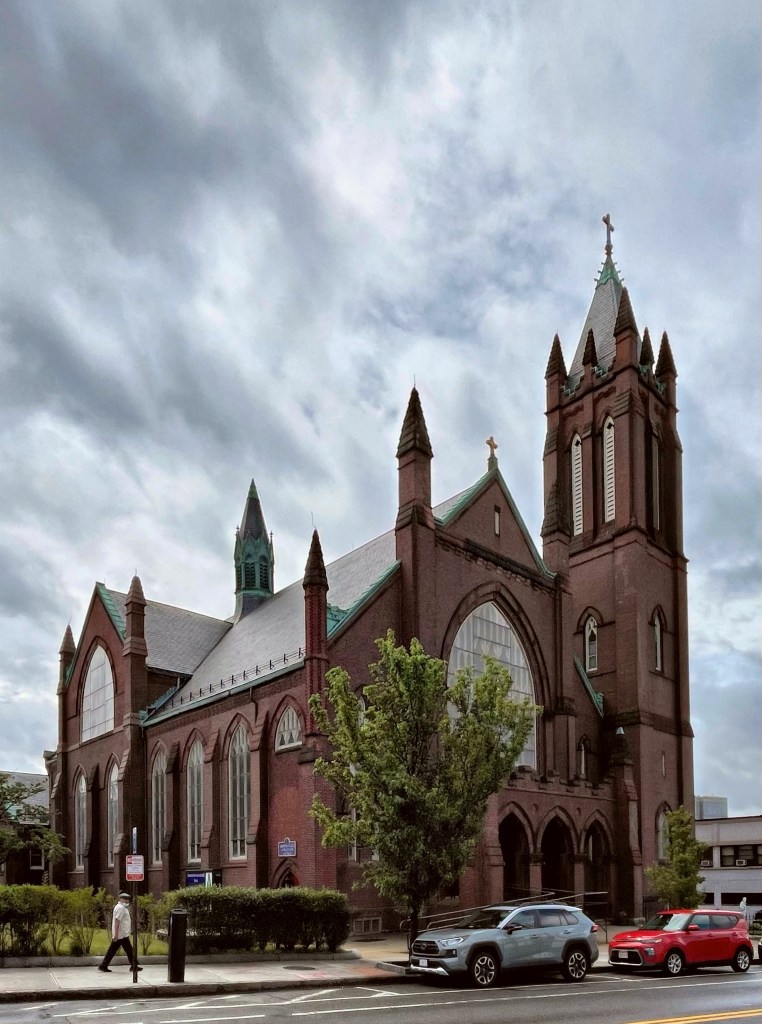
The Immaculate Conception Roman Catholic Church in Everett, Massachusetts, is an imposing Gothic Revival building, that shows how the church spared no expense to build imposing and awe-inspiring edifices all over New England. Constructed of red brick with Longmeadow brownstone trim, the church was designed by preeminent Catholic Church architect Patrick W. Ford and the cornerstone was laid in 1896. Ford was born in Ireland and in 1872, he moved to Boston and opened his own practice. He was widely recognized as an authority on church architecture and his practice focused primarily on designing churches and institutional buildings for the Roman Catholic Church in New England. Ford died suddenly at age 52 in August 1900. Due to a lack of funds, the church was not completed until 1908, so Ford did not see this church completed in his lifetime. The work was completed by architects Reid & McAlpine and is stunning with its square corner tower topped by a pyramidal spire with smaller pinnacles marking the corners of the tower. The projecting entry porch has three, pointed arch openings and is topped by crenellation. The congregation appears pretty active to this day.

Glimmerstone // 1845

What a treat it was to stumble upon one of the most beautiful homes in Vermont, and all the best houses have names! Glimmerstone is located in the small town of Cavendish, and is possibly the finest Snecked Ashlar constructed home in the state. The house was built in 1845 for Henry Fullerton, manager of the Black River Manufacturing and Canal Company mill in Cavendish. The stone used to build the house was quarried less than a mile away, and hauled to the site. The construction style consists of stone facing on either side of rubble fill, with slabs and snecks sometimes laid across the fill to provide strength, a method brought to the region by Scottish immigrant masons. The house’s design is by a local carpenter, Lucius Paige, and is based on designs published by Andrew Jackson Downing, who depicted many Gothic style designs in pattern books which were built all over the country. The house has had a number of owners after Mr. Fullerton died. During the prohibition era, Art Hadley, who would later become extremely wealthy as the inventor of the expansion bracelet, used the home as part of a rum running operation. Glimmerstone was purchased in 2010 by the current owners, who underwent a massive restoration of the home, converting it into a bed and breakfast, allowing the public to experience the property as well.

Brookline Baptist Church // 1836

Brookline, Vermont is home to just 540 people but has one of the most beautiful brick churches in the state! The Brookline Baptist Church sits along a quiet road in town and is an excellent example of vernacular Gothic Revival architecture in the Vermont. Brookline’s first organized church congregation were Baptists, who established a formal organization in 1785 out of local homes and barns. By 1836, enough funds were gathered to erect a church, but of brick, a more substantial building material than traditional wood-frame buildings. The church remained active throughout the nineteenth century, and the vestry addition was constructed off the rear in 1895 to provide space for community gatherings and meals. Dwindling membership led the church to become mostly used for weddings, funerals, graduation ceremonies, and craft fairs by the second half of the 20th century. The Town of Brookline presently owns the significant structure, and while preserved, it does not appear to get much use.