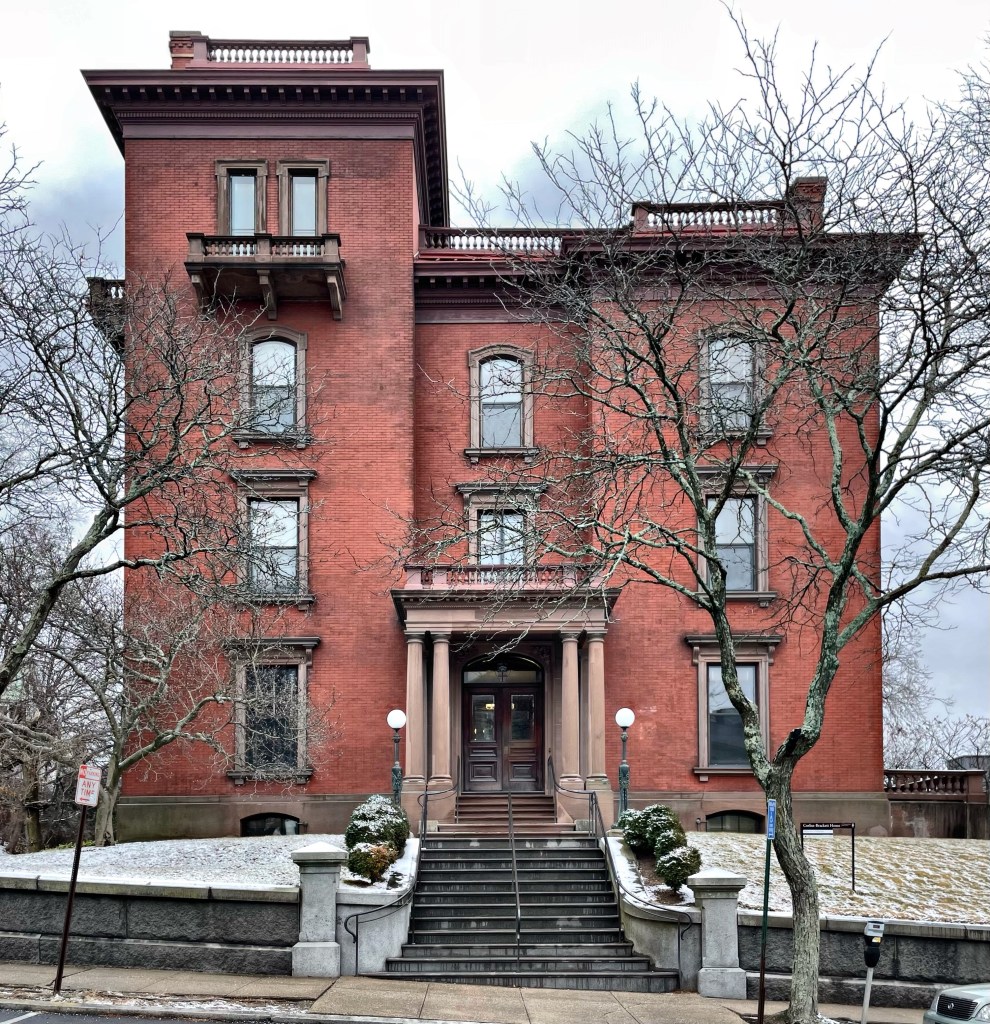
Samuel B. Wheaton House // 1850

Another Italianate mansion on Angell Street in Providence is the Samuel B. Wheaton House which is presently occupied by Brown University’s English Department. Samuel Burr Wheaton (1807-1863) was a merchant who also served as president of the Phenix Bank. The building is capped by a shallow hip roof which is not visible from the street and wide, overhanging eaves supported by brackets. The house is a Villa in plan as it features irregular massing and not a symmetrical form, just sans tower. The Wheaton House was acquired by Brown University who has since added onto the rear of the house for the English Department offices and classroom spaces. LLB Architects is credited with the contextually designed additions which utilizes lead-coated-copper clad connectors that are recessed between sensitively-scaled brick pavilions that preserve the integrity of the original house by letting it stand proud of the later additions.

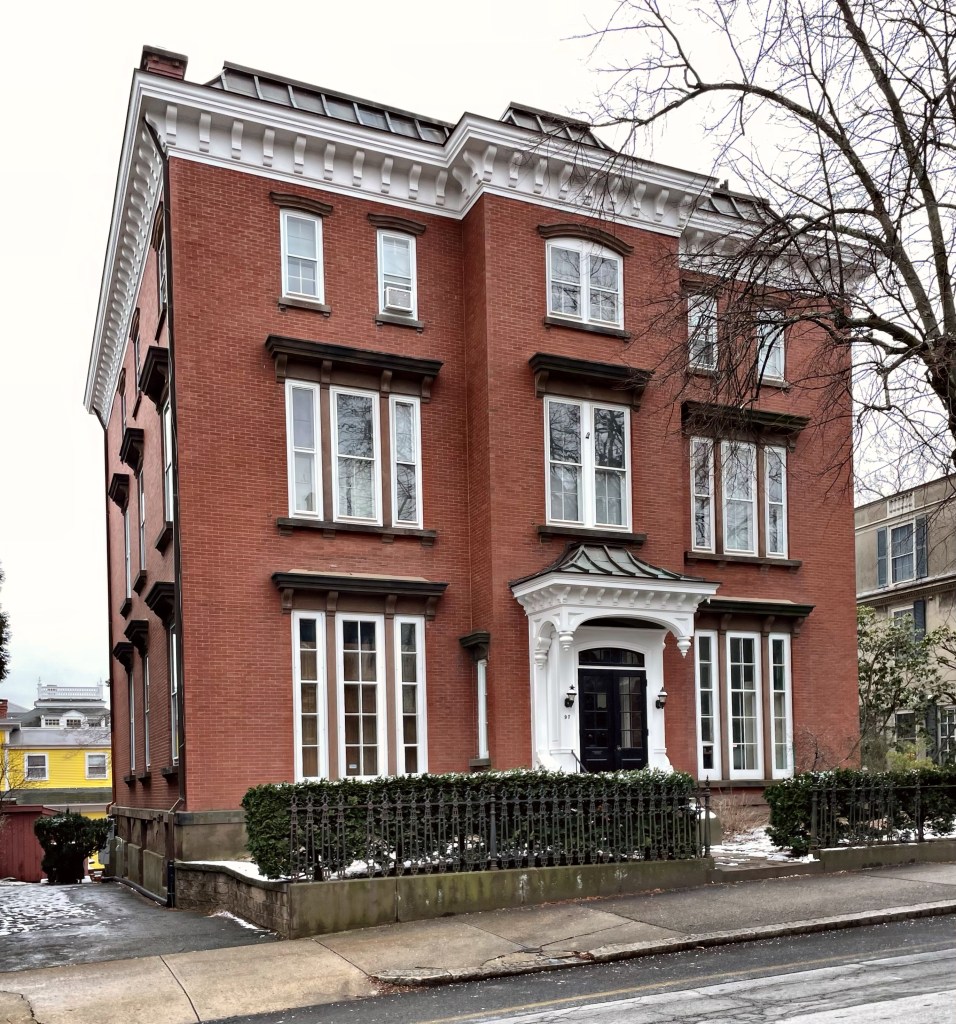
Watson-Knight Mansion // 1854

No town does Italianate architecture quite like Providence! Case in point, the Watson-Knight Mansion, a relatively overlooked example of the style found on Angell Street in College Hill. In 1854, a house lot here was purchased by an elderly Matthew Watson (1786-1857), who possibly lived in half of the house for a few years until his death. Directories also list his son Robert as living in the home in 1854. The three-story brick mansion has a boxy form with symmetrical facade. Brownstone hoods and sills are located at the windows and add depth to the otherwise blank facade. A projecting wooden door hood with hanging pendants covers the large entry. The home remained in the Watson Family until it came under the possession of Robert Brayton Knight (1826-1912) a businessman and mill owner who became the largest individual owner of cotton mills in the world, with upwards of twenty distinct establishments under his personal control. He co-founded what became the Fruit-of-the-Loom brand with his brother in the 1850s. The building has since been divided into apartment/condominiums.

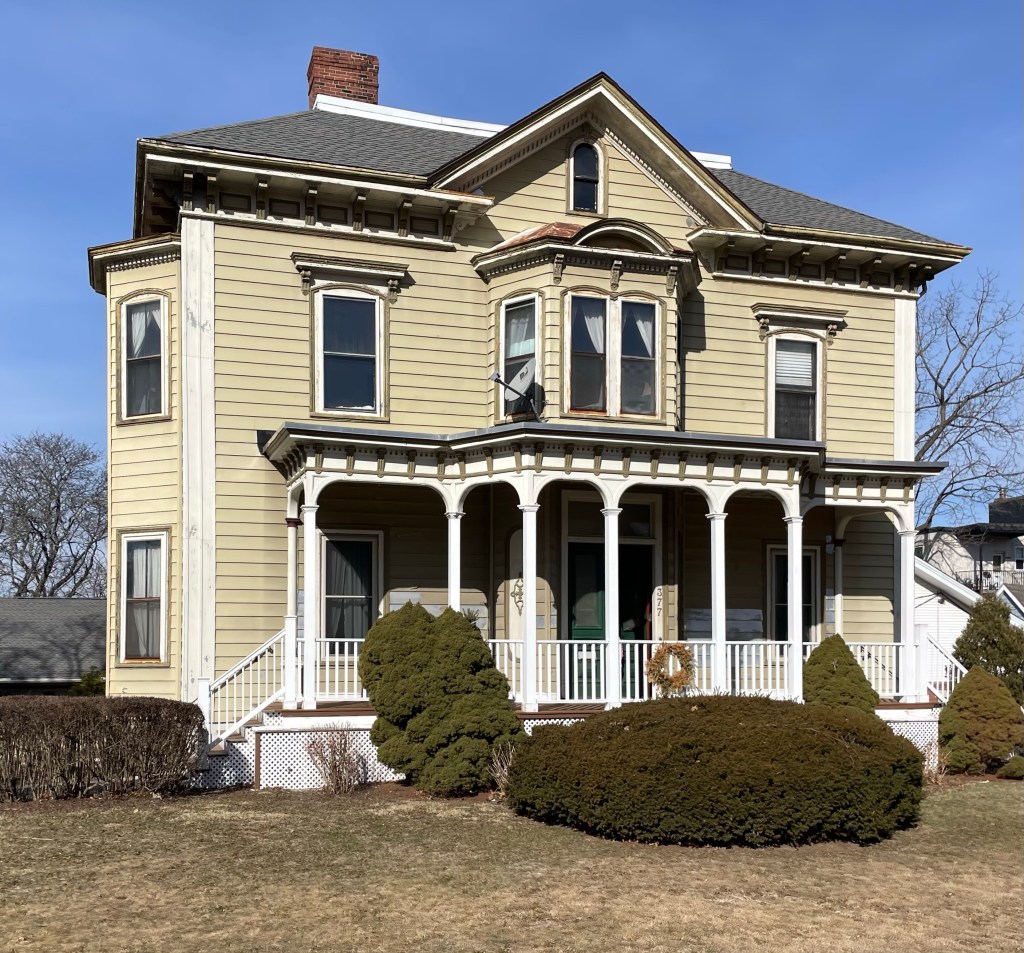
Howard House – St. Mary of the Angels Rectory // c.1867

Moving north from the Stonybrook section of Jamaica Plain, Boston, I explored around Roxbury, an area often overlooked by tourists, but has a lot of history and great buildings with rich stories! This old Victorian-era house was built around 1867 for Joseph W. Howard and his wife Lillie about the time of their wedding. The large Italianate style mansion was built in a period and location where wealthier Boston merchants could build large mansions with space in the inner suburbs of the city. The area remained fairly bucolic until the turn of the 20th century when housing development really picked up in Boston’s neighborhoods. By this time, owner Samuel Shuman sold his property on the busy corner lot to the Roman Catholic Archdiocese of Boston. In 1907, construction of the basement church on the site of the former Shuman Estate began. The original plans called for building a larger, upper church at a later date. However, due to a number of factors over the years, the upper church was never built. After WWII, Roxbury saw a demographic change and the church is largely home to a Black and Hispanic congregation to this day. The former Howard House is still owned by the Archdiocese as the rectory.

Isaac Cary Estate // 1850

Isaac Harris Cary was born in the North End neighborhood of Boston, Massachusetts on November 3, 1803, the seventh child of Jonathan and Mary Cary. In 1824, Isaac and his brother William formed a partnership and ran a fancy goods imports business, Isaac H. Cary & Co. on Washington Street in Boston. The brothers opened a store in New York and William moved there full-time. In 1831, Isaac married Phebe P. Pratt of Roxbury and they would have three children, two of them living to adulthood. After doing business in New York City and later in New Orleans, Isaac and his family settled in the Jamaica Plain section of Boston, purchasing large land holdings and developing real estate. One of the finest lots he owned was developed for his country estate in 1850, an Italianate/Second Empire-style mansion perched atop an outcropping of Roxbury puddingstone. The large home with a rear three-story tower remained in the Cary family under his single daughter Susanna’s ownership until her death in 1913.

George M. Harding House // 1868

Architect George M. Harding built this boxy Italianate style house as his personal residence on Deering Street in Portland, Maine. Harding was very busy in the late 1860s after the destructive Great Fire of Portland in 1866. He designed some of the finest commercial blocks Downtown, including the Rackleff Block and Woodman Block, both excellently preserved landmarks in town today. For his own residence, he pulled out all the stops, with bold proportions, carved trim details, and a center tower capped with a mansard roof. The tower was removed in 1956, but the rest of the house is just stunning. Architect-designed houses for their own residency are always fun to find!

Francis Waldron House // 1867

Francis Ashby Waldron (1816-1898) was born in Buckfield, Maine to an old New England family. He moved to Portland for job opportunities and worked as a merchant, eventually establishing Waldron and True with business partner Samuel True. The firm was engaged in dealing grain, salt, corn, and more. After a few years of profits, Francis had this Italianate style mansion built on the fashionable Deering Street just west of Downtown. The property was passed down to his children after his death in 1898, and it remained in the family until 1950. The house originally had a prominent belvedere at the roof, but it was eventually removed. The former Waldron House is now maintained as a law office.

Smith’s Corner Store // c.1865

One of the largest and most stunning buildings in the town of Franklin, Connecticut is this Italianate style structure along the Hartford-Norwich Turnpike. The building appears to have been built soon after the conclusion of the American Civil War by brothers John Owen Smith (1819-1896) and Prentice Orrin Smith (1817-1898) who possibly operated the building as a tavern or inn along the route between Hartford and Norwich. The three-story, five-bay facade structure featured round arched windows at the top floor, a raised belvedere at the roof, bracketed cornice with overhanging eaves, and later storefronts at the facade. The building is occupied today by Victorian House, a furniture store.

Tillinghast Tompkins House // 1854

This large frame house in Newport, Rhode Island was built for Tillinghast Tompkins in 1854. The house is a formal example of the Italianate style of architecture, of which many great examples can be found in the coastal town. Character-defining features of the style on this house include the elaborate round-arch bargeboard with acorn pendants, tripartite round-arch windows in façade’s attic, and the important wide cornice with large triple-arch paired brackets with acorn pendants. The house was occupied by Tillinghast for just a few years until his death in 1860. His widow, Charlotte owned the property until her death in 1899, upon which time it was inherited by their son, Hamilton Bullock Tompkins, a historian and author.

Eliza Starbuck Barney House // 1873

Another of the less common Victorian-era houses on Nantucket is this beauty located right on Main Street, named after its first owner. Eliza Starbuck was the third child of Joseph Starbuck and Sally Gardner, a Nantucket family that had become wealthy in the whale oil industry. At 18, Eliza married Nathaniel Barney and despite their wealth, the couple shared a home with Eliza’s sister, Eunice, and her husband William Hadwen. The husbands became business partners, opening a whale oil refinery on the site of the current Nantucket Whaling Museum. This house was built around 1873 for Eliza Starbuck Barney after the death of her husband. Mrs. Barney is best known as an abolitionist, a temperance and women’s suffrage advocate, and a local genealogist. The home is a fine example of Italianate-style architecture. Note the round-arch or Roman windows and bracketed cornice typical of the style.

Otis Company Agent’s Residence // 1870

This house in Ware, Massachusetts was built after the Civil War by the Otis Company, the major employer in town, for use as an agent’s house. Crazy I know! Historically, it was a common practice for New England textile companies to provide housing for employees (though agents got the nicest dwellings). Many of the agents were brought from Boston and a comfortable residence was a benefit of the job. The first agent to reside in this house was Sylvester Bowen Bond, agent of the company between 1870 and 1877. Mr. Bond sadly would die in the dwelling of typhoid fever, aged 36. The Italianate style property on a large lot continued to be used as an agent’s residence until the Otis Company left Ware. The property was acquired by the nearby St. Mary’s Church as a convent.