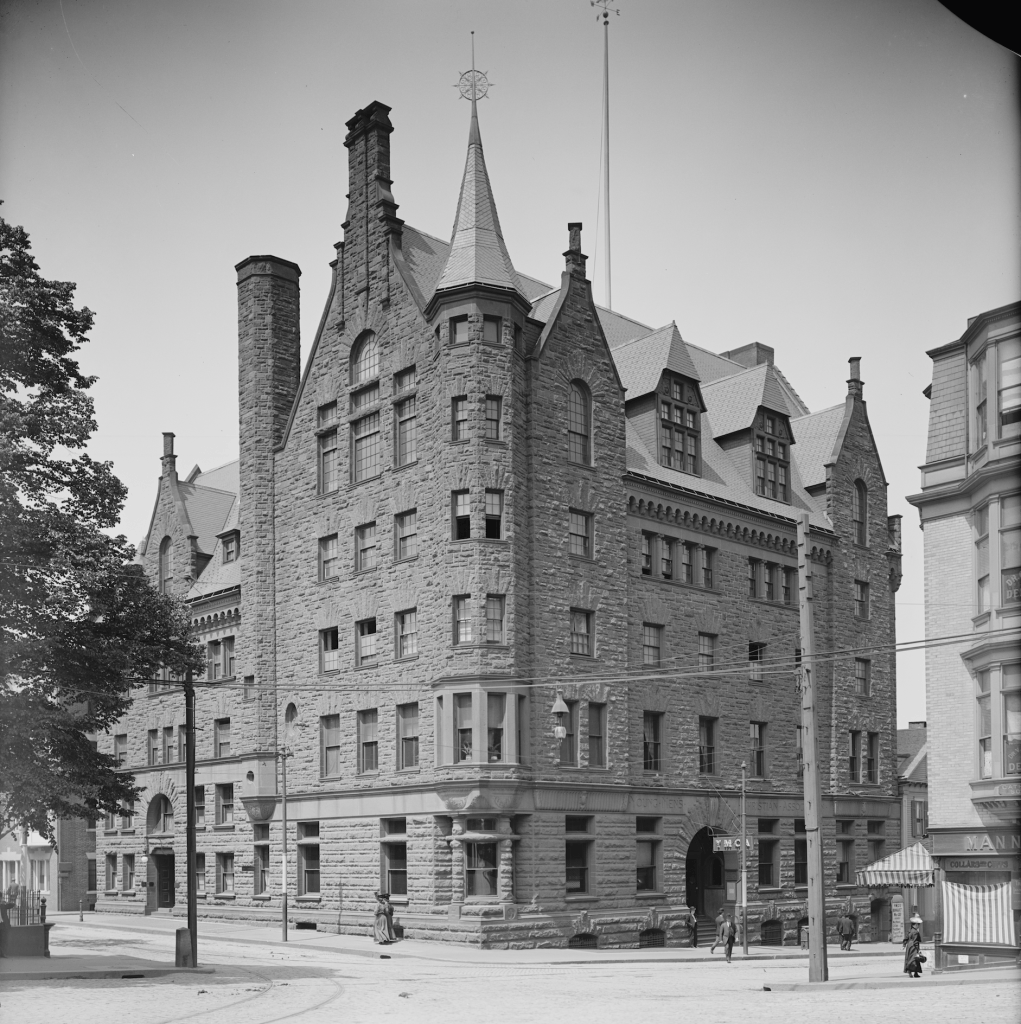
Former Providence YMCA Building // 1889

Founded in 1853, the Providence YMCA holds the distinction of being the second-oldest YMCA in the United States. The YMCA had been born out of anxieties around industrialization and urbanization when young men arrived to the country and were vulnerable to the temptations and sins of alcohol, so a group of evangelical churches created a space for Christian men to spend their time productively at meetings and lessons and have access to recreational facilities. The Providence YMCA was dispersed into three buildings until 1889, when this building at the corner of Westminster and Jackson streets opened to great fanfare. The Young Men’s Christian Association and architects, the Providence firm of Stone, Carpenter & Willson, featured this new Romanesque Revival building in architectural publications showcasing the original proposal and the final approved design, with prominent oriel bays, spires, arched entrances and intricate roofline punctuated by dormers. The building contained a gymnasium, auditorium, classrooms, libraries, parlors, and reception areas. The 1889 building proved obsolete within a generation, and it was torn down in 1913 to make way for a new office block as the neighborhood commercialized. The YMCA responded by building larger, more purpose-built quarters further west on Broad Street, which was completed in 1915, a structure that still stands today, now repurposed to serve the city’s homeless population through Crossroads Rhode Island.

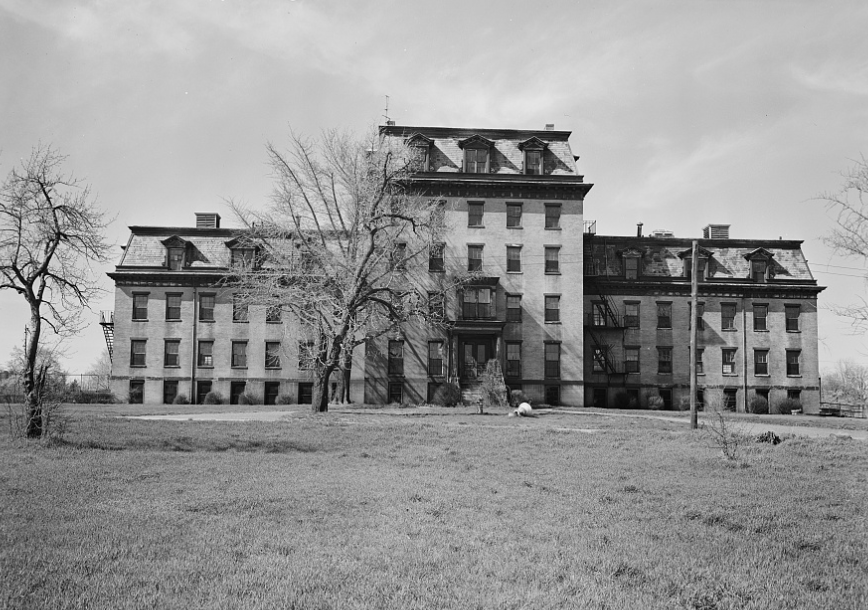
Dexter Asylum // 1828-1958

C.1958 photo before demolition. Courtesy of Library of Congress.

Built in 1828, Dexter Asylum was a “poor farm,” an institution housing the indigent, elderly, and chronically unemployed, located in the East Side of Providence, Rhode Island. Poor farms were common before the introduction of Social Security and welfare benefits in the United States, considered a progressive method for dealing with poverty. Ebenezer Knight Dexter (1773-1824) was a wealthy mercantile trader in Providence, who in 1800, built Rose Farm, a gentleman’s farmhouse on what was then, the outskirts of Providence. Upon his death in 1824, he bequeathed to the town 40-acres of the farmland to the north for use as a poor farm or almshouse site. The building was completed by 1828 and was originally three stories, and later expanded with a mansard roof and dormers sometime later in the 19th century. Dexter also stipulated that a stone wall would surround the site, and parts of it remain to this day. As with many poor farms and almshouses of the period, residents worked farmland and cared for pigs and a herd of dairy cows; they lived in this large building, strictly segregated by sex. Residents were essentially inmates, indentured for periods of six to twelve months, and could not leave the property without a ticket of permission. In the interwar period, “inmate” population there declined and changing views on how to assist the poor caused the City to abandon the facility. After decades of legal troubles and stipulations of the Dexter will, in 1956, the plot was auctioned off, and Brown University purchased the site. The grounds are now used by some of the Brown University athletic facilities. The city set aside the money from the sale to create the Dexter Donation, which gives annual grants to assist the city’s poor, providing an enduring legacy of Dexter’s Asylum.