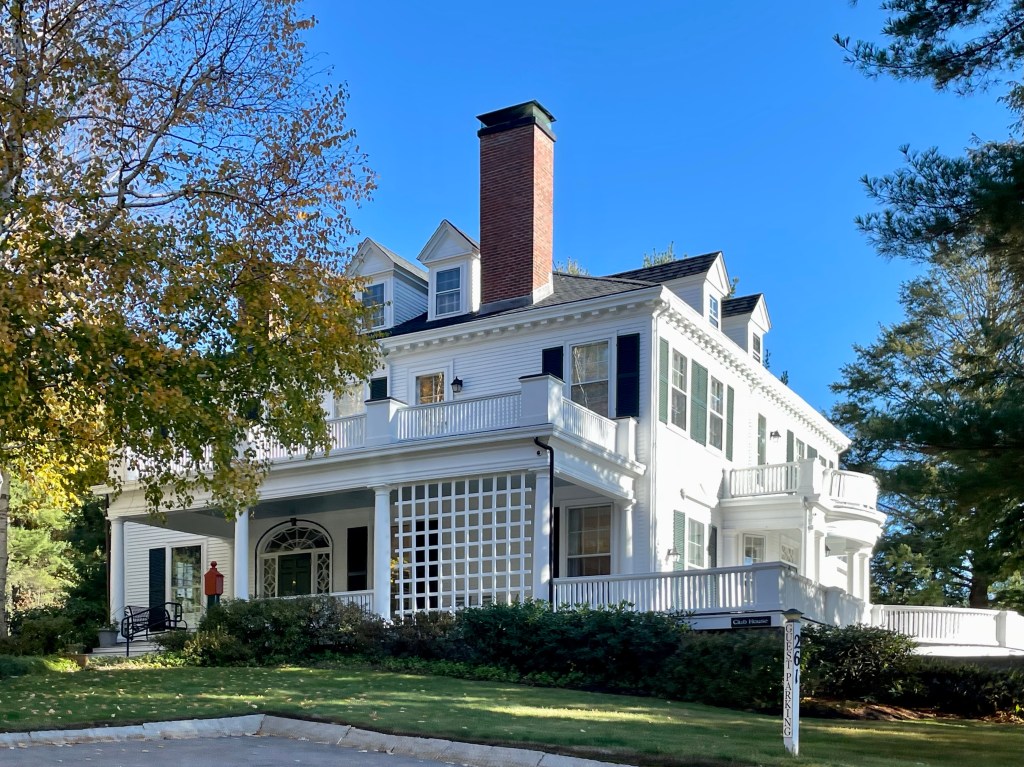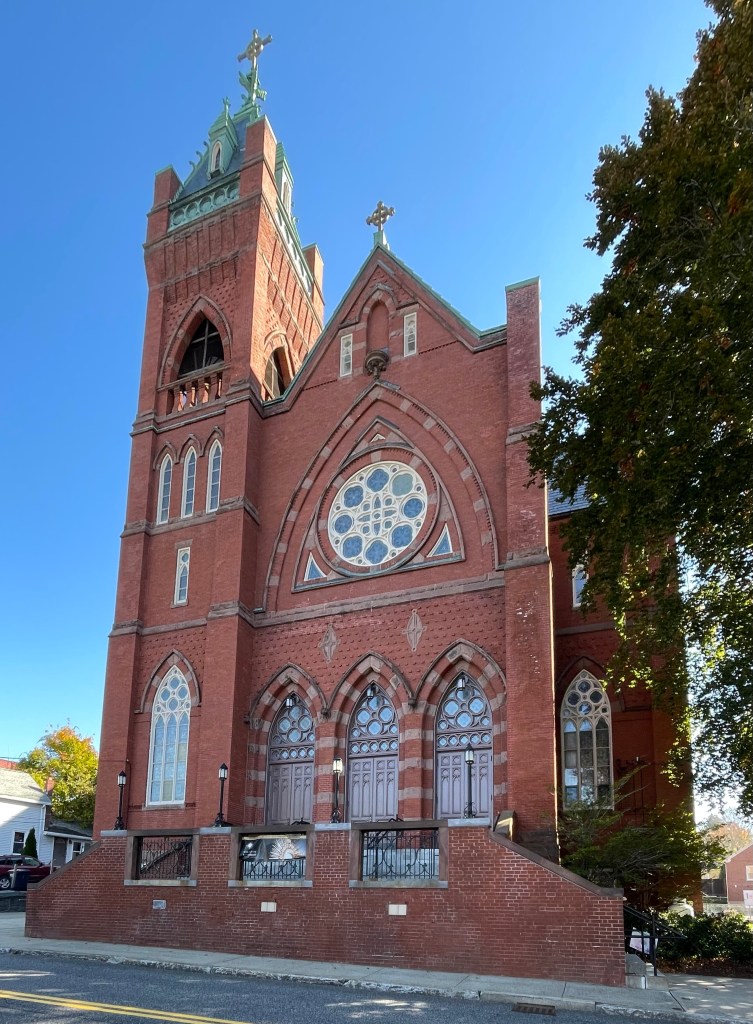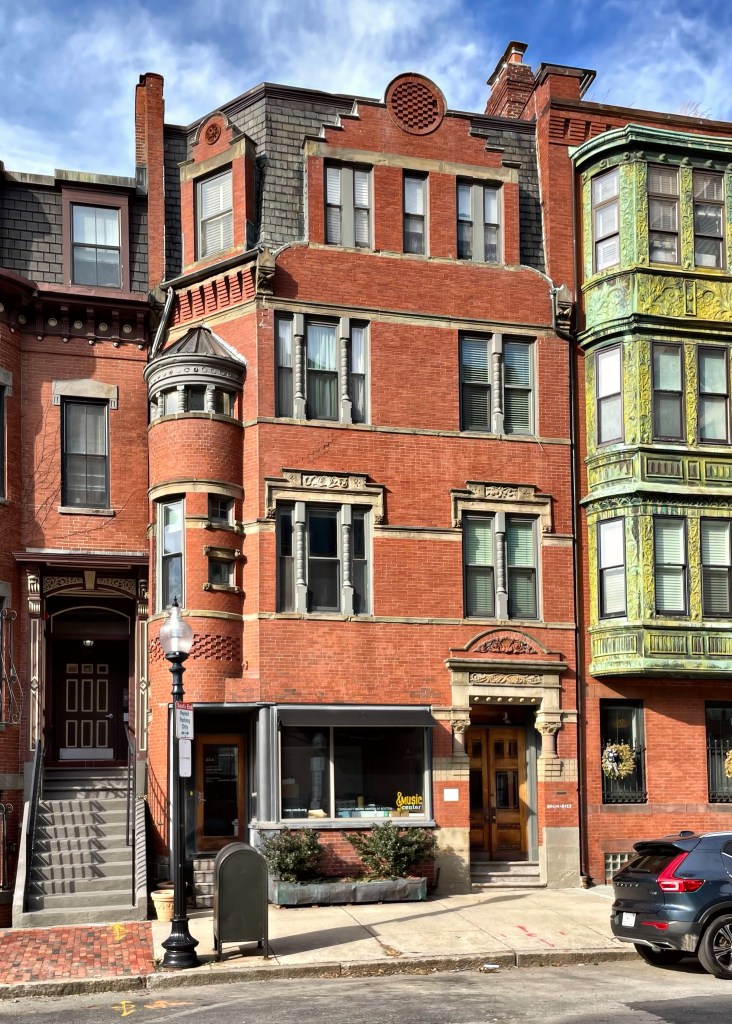
In 1852, Beacon Street in Newton was extended westward from Chestnut Hill through Newton Centre. The village’s suburban development accelerated through the activities of real estate developers as the city became connected to Downtown Boston by roadways and rail. This home was built in 1893 for Andrew and Ann Kistler. Andrew Kistler worked as a leather dealer in Boston, and commuted into the city daily. The Kistler House is an excellent example of Colonial Revival with some added oomph.
Happy Halloween! To celebrate I wanted to feature one of the more creatively decorated houses in the Boston area, which blends spookiness with architecture! This is the Barrows-Goddard House, so named after its first two owners. The house is located in Newton and was built in 1898 as an eclectic Queen Anne/Shingle style home. The original owner was Joseph Barrows, who developed the property and sold it within a year, relocating to a new home on a less busy street. The property was owned next by Christopher Goddard, an insurance agent with offices in Boston. Architecturally, the gable roof of the main block is intersected by an over-scaled gambrel cross-gable clad in patterned cut wood shingles. The focal point of the design is the Syrian-arched entrance porch of coursed, dressed fieldstone which this time of year, eats trick-o-treaters!
The Old Jail in Barnstable is a historic wooden jail, resembling a colonial domestic residence, which was built by order of the newly established Barnstable County, which separated from the Plymouth Colony on in 1685. It served as the Barnstable County jail from 1690 to 1820 and is the oldest extant wooden jail in the United States! By 1702, prisoners were being held in the jail while awaiting trial at the Court Sessions held in Barnstable. In 1716, the jail imprisoned Mehitable “Goody” Hallett, the lover of pirate Samuel Bellamy, later known as the Witch of Wellfleet, as well as the two survivors of Sam Bellamy’s flagship Whydah Gally which wrecked at Wellfleet, and the seven pirate survivors of his consort ship Mary Anne which wrecked ten miles south. The jail house is considered one of the most haunted in America, supposedly containing the spirits of these pirates and lost loves. The jail building was attached to a barn by the 19th century, when a new jail was constructed. This building was later removed from the barn and restored, and moved to the present site next to the old Customs House in 1968.
The original section of this building was the second dwelling house of Rev. John Lothrop (1584-1653), one of the first European settlers who settled in present-day Barnstable in 1639. The oldest part of this structure, built in 1644 (yes you read that correctly), is possibly the oldest extant house in the Town of Barnstable. The home was constructed as 21 feet long and 29 feet deep with a chimney on the west side of the house. Perhaps John Lothrop’s principal claim to fame is that he was a strong proponent of the idea of the Separation of Church and State (also called “Freedom of Religion”). This idea was considered heretical in England during his time, but eventually became the mainstream view of people in the United States of America, because of the efforts of Lothrop. His descendants today include six former presidents, Louis Comfort Tiffany (of the stained glass fame), J. P. Morgan, Clint Eastwood, Henry Wadsworth Longfellow, and many more recognizable names! The house was eventually owned by Isaac Chipman in the 19th century, and he modified the house close to its current conditions, adding on numerous times.
Captain William Sturgis, a mariner, businessman and politician, who was born in the house, purchased the property in 1862 from the heirs of Isaac Chipman. Sturgis left $15,000 along with this property in a trust to be gifted to the people of Barnstable for a public library. The library opened in 1867 in his honor, with 1,300 books. As the old Lothrop House is incorporated in the building, it makes the Sturgis Library the oldest building housing a public library in the USA. A great claim to fame for this town!
This historic building was constructed in 1763 as the Barnstable County Courthouse replacing an even earlier courthouse building that was outgrown in the village. The building served primarily as a courtroom with jury deliberations carried out in one of the nearby taverns. Additionally, large town meetings were sometimes held in this building until it too was outgrown. This courthouse was the site of a mass protest on Sept. 27, 1774, after Britain revoked Massachusetts Bay’s 1691 charter — one of a series of Coercive Acts intended to punish the colonists for the Boston Tea Party the previous year. As a result of the protest, all Barnstable county officials agreed to ignore Parliament’s new rules, effectively freeing Cape Cod of British control. The significance of this building cannot be understated as the building is one of only two remaining Massachusetts colonial-era courthouses where such protests occurred. The county dedicated its new courthouse in the 1830s, consolidating all court functions in a large, granite structure closer to the present center of Barnstable Village (featured previously). This building was acquired by the Third Barnstable Baptist Church, who renovated the building at the time and again in 1905. After the church was disbanded in 1972, the building was purchased by Tales of Cape Cod, a nonprofit volunteer group committed to preserving the Cape’s history. What a building to be based out of!
Appropriate infill construction can be a very difficult thing to accomplish, with some developments hitting the mark and others adversely impacting the historic neighborhoods where they were built. Boston is home to many examples of both occurrences, but I wanted to share a very successful infill project in the South End neighborhood, Langham Court. As the South End resurfaced as a desirable neighborhood, long-time residents were priced out, which led to the Boston Redevelopment Authority to fund projects to provide much-needed housing for the local community. This site which once housed over 20 townhouses, was razed by the 1960s in a period of urban renewal where existing housing was deemed unsafe and inadequate. The local design firm of Goody/Clancy was hired, and they masterfully designed a U-shaped complex of 84 mixed-income units that fits well within its surroundings. The design exhibits dormers, bays, arched and vaulted entries, a combination of mansard and flat roofs, stringer courses and textured brickwork, and a palette of well chosen materials all at a scale that blends in the 1990s building to its surroundings which came nearly 150 years prior. The complex remains as a testament to good-quality design even for affordable housing, which notoriously gets the short end of the stick design-wise.
One of the more iconic theater buildings to ever stand in Boston was the Howard Athenaeum, later the Old Howard, which stood on the former Howard Street in Downtown Boston. The origins of the building begin in 1843, when a flimsy, tent was built to serve as a church for the small Millerite sect. The small but loyal congregation eventually abandoned the site following disappointment with the minister’s promise that the world would end in 1844. After Armageddon failed to materialize, the founder of the sect, William Miller, an ex-Deputy Sheriff from Poultney, Vermont, was discredited and the Millerites moved on. After running their former minister out of town, several church members (who had given up all their worldly possessions in preparation for their trip to heaven,) decided to recoup some of their losses by selling the property to Messers Boyd and Beard, who opened a theater here in 1845. A fire destroyed the structure, and it was replaced by a larger, fireproof building that same year. The new building was constructed in 1845 and was designed by architect Isaiah Rogers in the Gothic Revival style with massive granite blocks from Quincy.
The Howard Athenaeum saw many iconic performers and historical events in its 100 years. A young John Wilkes Booth, played Hamlet at the Howard before becoming famous for a more nefarious deed in Washington in 1865. Also, Sarah Parker Remond, a Black anti-slavery activist and lecturer with the American Anti-Slavery Society (and later a medical doctor), had bought a ticket through the mail for the Donizetti opera, Don Pasquale, but, upon arriving, refused to sit in a segregated section for the show. She was forcibly removed and pushed down a flight of stairs. She eventually won a desegregation lawsuit against the managers of the Howard Athenaeum and received $500 in a settlement.
The theater was quickly deemed obsolete and second-tier compared to more modern theatres built nearby. By the mid-20th century, the Old Howard was largely featuring burlesque shows. To keep bringing in audiences, the burlesque performances got more risqué with each year. As a result, the Boston vice squad made the Old Howard the object of their attention. The Boston Vice squad made a 16 mm film during one of their raids in 1953 and captured on film the performance by “Irma the Body”. This film footage resulted in an indecency hearing which eventually led to the closing of the Old Howard in 1953. A fire a few years later along with Urban Renewal led to the demolition of the Old Howard by 1962. Like the former Suffolk Savings Bank (featured previously), the present Center Plaza Building is on the site.
Another of Boston’s Lost buildings is the King’s Head Tavern, an old establishment that was built in the early days of Boston and rebuilt following a fire in 1691. It stood on the corner of Lewis and North Streets, in the North End near Scarlett’s Wharf. Due to its proximity to the harbor and wharfs, it became the first place weary sailors stopped to get a drink on solid ground. The two-story, brick tavern was capped with a gambrel roof, which was later filled with wooden additions giving the structure a boxy look. The establishment was named the King’s Head Tavern after a popular London tavern of the same name. Like much of the North End, surging immigrant populations put immense strain on the built environment and many older buildings were demolished in the late 19th and early 20th centuries for tenement housing. The old King’s Head Tavern was demolished in 1870, just two years after the photo was taken.
In 1907, William F. Lamont and his family moved into this beautiful turn-of-the-century home in the rapidly developing Waban Village in Newton, Massachusetts. The extension of the circuit railroad connected this part of Newton (which had previously been farmland) to Downtown Boston, opening up the area to development for middle-income families who sought land and fresh air in the suburbs. The first house on Alban Road in Waban was built for the Lamont Family, and it perfectly blends multiple architectural styles under a gambrel roof.
This tiny building next to the John Palmer House featured previously was built in 1854 by Thomas Snow as an income-producing property. According to the sign, Snow was a grocer in town and must have rented the small building, which was developed on a small sliver of land, formerly a side garden. I’d guess that the building was originally 1 1/2-stories with the brick first floor added underneath sometime later. The house is vernacular Greek Revival in style and the scale is exactly what makes Marblehead so charming to get lost walking in!