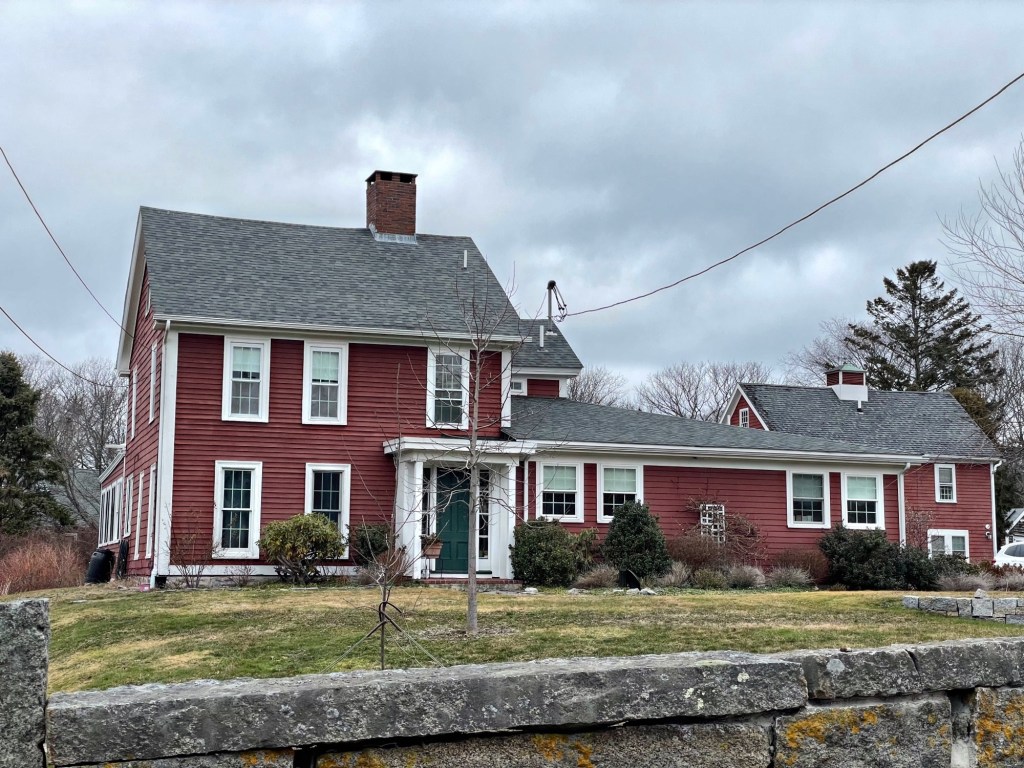
Andrew Myrick House // 1755

Nantucket is an old house lovers dream. A large part of the reason for this is that much of the island was designated as a local historic district in 1955, making it one of the earliest historic districts in the United States! This means that since 1955, the Nantucket Historic District Commission has been overseeing the island’s preservation, demolitions and alterations to historic buildings. This is the Andrew Myrick House located on Orange Street. The Georgian dwelling was built in 1755 by Andrew Myrick (1704-1777), a shipbuilder and storekeeper who was born in Charlestown, Massachusetts and eventually settled on island, constructing this home for his family. He and his wife Jedidiah had over 16 children, some of which died in childhood. Myrick would eventually hang himself at the age of 71. The home remained in the family until 1827. Fun fact: Andrew’s grandson, Peter Myrick was said to have set sail from Nantucket in 1833 in search of sea serpents. He came back empty handed.

Folger Block // 1831

Built the same time as the stately brick, Folger House on Main Street (last post) in Nantucket, owner Philip H. Folger (1792–1865) in 1831 erected these rowhouses quickly selling them for profit. Each of the five connected dwellings were sold to private owners, and have seen alterations over time adding to the intrigue on this block. The Folger Block is comprised of five Federal-style, 2.5-story, wood-frame buildings with wood-frame party walls between each unit. Each row house sits atop a raised brick basement and has a side-gable roof pierced by twin front-gable dormers. Charming door surrounds include sidelights and transoms to allow light into the entries.

Folger House // 1831

Located in the middle of the commercial Main Street on Nantucket, the 1831 Folger House stands as a fully developed example of the Federal style in masonry construction. The house’s double bow front, brownstone lintels and Ionic portico, guilloche frieze, and cast-iron railings are the finest of their type in the community. Although the house was turned into commercial use in the mid-19th century with the addition of storefronts and the removal of its original hip roof, it retains substantial architectural elements of a more decorated design than was customary even among Nantucket’s wealthiest merchants in this period. The house was built for Philip H. Folger, a merchant and it was inherited by his son upon Philip’s death in 1865.

Pacific National Bank // 1818

Whaling captains and crew upon returning to the island of Nantucket, would be flush with cash and goods and needed a safe and secure institution to hold their earnings. By the late 18th century, the depletion of the whale population in the Atlantic required whaling vessels to travel further and further in search of oil to fill the barrels in their holds. Ships began sailing to the Pacific and due to the distance, would be out at sea for years rather than months. Money from the Pacific voyages flowed back to the island, which soon required real banking facilities, and the Pacific Bank was established in 1804 and immediately prospered. The bank erected this stately brick building at the end of Main Street Square. Details such as the blind arches filled with sandstone panels that surround the building’s windows, the semi-circular Ionic entry portico and the high brown sandstone stoop with wrought-iron railings are unique on Nantucket and among the finest examples of their type in the region. Also interesting about the building is the fact that it contained living quarters for the cashier whose presence was intended to provide security. The building is now (of course) home to a Bank of America.

Joshua Coffin House // 1756

Nantucket in the off season is just as magical as the peak of summer. Quiet streets, gray shingled buildings, and the smell of the ocean is the perfect medicine! This is the historic Joshua Coffin House on the island of Nantucket. The house is one of the best examples of a mid-18th century sea captain’s residence on the island and it is in a great state of preservation. The dwelling was built in 1756 for newlyweds Joshua Coffin and Beulah Gardner on land given to them by Beulah’s father as a wedding present. The couple raised their children here until Joshua died at sea in a hurricane while on a whaling trip in the West Indies. The house remained in the family since at least 1971 and has been lovingly maintained by its stewards.

Second Church of Christ, Scientist, Roxbury // 1915

Breaking ground in 1915, this early Modern church building must have turned heads when it was being built in Roxbury! In October, 1907, a fine lot of land with a house on it, at the corner of Elm Hill Avenue and Howland Street, was purchased for eighteen thousand dollars by a group of Christian Science followers. In October, 1911, a building committee of five was elected by the church, and by the summer of 1914 the building fund had made such satisfactory growth that ground was broken and work for the new structure begun in September. The congregation hired the illustrious architectural firm of Shepley, Rutan, and Coolidge to design the edifice of classic and imposing design. Constructed of gray tapestry brick with limestone trimmings, the auditorium seated upwards of one thousand members, under the dome roof. Today, the building is occupied by Grace Church of All Nations.

Johnston-Sullivan House // c.1894

One of the more exuberant and ornate homes in Roxbury’s Washington Park neighborhood is this charmer on Howland Street. The eclectic house was built in around 1894 for Ellen S. Johnston from plans by local architect Timothy Edward Sheehan and stands out for its preserved exterior in a neighborhood where many homes are covered in later siding, obscuring the ornate details underneath. Details include: swag and garland applied ornament, two bays at the facade (one polygonal and one rounded), a Colonial Revival style porch, and central rounded dormer. Wow!

William Lloyd Garrison School // 1910

Tucked away in a residential neighborhood, the William Lloyd Garrison School in Roxbury’s Washington Park neighborhood is among one of the more successful school building designs of the early 20th century. Built in four stages between 1910 and 1929 to service a growing neighborhood over time, the school is named for abolitionist William Lloyd Garrison, who formerly lived in a home relatively closeby. The school complex consists of several different sections organized around a central courtyard and joined by passageways, all designed by the extremely underrated architectural firm of Newhall & Blevins in the Tudor style. Following the period of Urban Renewal in the neighborhood, the school district built contemporary schools and deaccessioned older schools. Today, the former William Lloyd Garrison School houses apartments.

Westminster Court Housing // 1967

As populations boomed in the decades following the conclusion of WWII and suburbs drew wealthier residents to single-family neighborhoods, city governments were desperate to keep tax dollars in city limits. As a result, many cities instituted a policy called Urban Renewal, where neighborhoods (often with higher percentages of minority or immigrant populations) and historic housing were demolished as a form of “slum clearance” and modern housing centered around the automobile sprouted up in their place. The Washington Park section of Roxbury in Boston was one of the hardest-hit neighborhoods in the 1960s as part of a series of neighborhood plans by the Boston Redevelopment Authority. This housing development, called Westminster Court, was developed on one of the new Urban Renewal parcels in Washington Park. Designed by famed modernist architect Carl Koch, the Mid-Century Modern buildings were constructed in modular units to cut costs and expedite construction time. The buildings utilize precast frames with contrasting exterior panels of brick, exposed aggregate concrete, and aluminum. While many dislike these buildings, it is important to understand the history behind them and how they are part of the complex history of many cities.

Hutchings-Pfaff Gatehouse // c.1884

Once located at the entrance to the Hutchings-Pfaff Mansion, this small stone gatehouse is all that remains of a great Roxbury estate. Built of locally quarried Roxbury Puddingstone decades after the main house was completed, the Victorian Gothic style cottage surprisingly survived the subdividing of the large property and was sold as a private home in the early 20th century. It is uncommon to see these types of outbuildings survive into the 21st century, so I hope to see this charming cottage survive another 150 years!