Crandall-Peirce House // 1890

Talk about a statement! This pink, Shingle style house is located at 140 Brown Street in the fashionable College Hill section of Providence, Rhode Island. Built in 1890 for William and Katherine Crandall, the Shingle style residence stands out for its cantilevered two-story tower and corner rounded porch at the corner, and of course the continuous shingled facades. William T. Crandall was the president of the Union for Christian Work, a religious charitable institution which provided aid to needy children in Providence. Augustus R. and Ida W. Peirce would board in the home for decades, and were likely family, inheriting the property upon Katherine’s death in 1932. The architect could not be located.

Cushing Apartments // 1902

Apartment buildings get a bad rap, largely because of the cheaply built monstrosities built after WWII through today; but apartment buildings can be dignified and fit within their surrounding context, it just takes good design. These are the Cushing Apartments at Thayer and Bowen streets in Providence’s College Hill neighborhood. The building was constructed in 1902 for owner, Stephen Cushing Harris, from plans by young architect Frederick Ellis Jackson (1879-1950), who would have been in his mid-20s when he designed it! While not an academic example of the Tudor or Colonial Revival styles, the building blends both in a unique U-shaped form. The building is supposedly wood-frame and was eventually purchased by Brown University in 1963. The college renovated the building in 2012 to serve as an upperclassman dormitory with LBB Architects and Gilbane Construction overseeing the project. The building adds a subtle density to the block without being overbearing with the courtyard design.

Francis and Sarah Cranston House // c.1895

The Francis and Sarah Cranston House is located on Bowen Street in the College Hill section of Providence, Rhode Island. Built circa 1895 for Francis Augusta Cranston (1837-1909) and his wife, Sarah (Hill) Cranston, the house is one of the best residential examples of Colonial Revival architecture in the city. Francis was the son of Barzillai Cranston, a descendant of Gov. Samuel Cranston, who held office from 1698 to 1727, being elected to office 30 times; serving as governor longer than any other individual in the history of Rhode Island. Francis worked as cashier of the Old National Bank of Providence for over fifty years and built this residence to settle into retirement. The residence is unique for its high-sloping hipped roof with two layers of dormers, corner quoins, Palladian window, and Ionic portico. I could not locate the architect, but if anyone knows, I’d love to give them their deserved credit!

Avon Cinema // 1938

There are fewer and fewer historic movie theaters in America, largely due to the proliferation of larger theaters at the end of the 20th century and the more recent trend of streaming. Smaller, family-owned theaters are becoming rare, so if we value the charm and character of these spaces, we have to support the arts at these spaces! The Avon Cinema is located in Providence’s East Side neighborhood and premiered on February 15, 1938 with the French film Beethoven’s Great Love (titled “The Life and Loves of Beethoven” in the U.S.) The theater was originally constructed in 1915 and operated as the Toy Theater for a few years before it closed. After decades, the building was purchased by the Dulgarian Brothers, who reopened the theater, naming it Avon. The Dulgarian family has owned and operated the theater to this day and have made a point to restore the building and maintain the historic charm.

Smith Owen Mansion // 1861

You honestly cannot beat Providence when it comes to brick Italianate mansions… The Smith Owen Mansion on College Hill was built in 1861 for jeweler and silversmith Smith Owen (1809-1889) and is one of the finest homes in a neighborhood full of historically and architecturally significant properties. Mr. Owen was in business with his brother George, and they manufactured and sold some of the best jewelery in the region, largely from their commercial block downtown (featured here previously). He hired Alpheus C. Morse and Alfred Stone, local architects who furnished the plans for the colossal home. Owen lived here until his death, which occurred less than a week after his wife’s passing. His daughter Lydia Dexter Owen Beckwith (1850-1947) inherited the property and lived here with her family until her death. It was under Lydia’s ownership that the Colonial Revival entrance details were added with projecting vestibule with columns and urns and central fan transom. It is really something special!

William Binney House // 1859

Another of Providence’s stunning monumental Italianate mansions on College Hill is this, the William Binney House, which was built in 1859 from plans by local architect Alpheus C. Morse. In the mode of an Italian Renaissance palace, it features a strong, symmetrical facade, molded string course, classic trim detail at the windows and doors in brownstone, and a shallow hip roof. The original owner, William Binney (1825-1909) was born in Philadelphia and became a prominent attorney and became involved on various boards, building more wealth. Additionally, he was elected as member of the Rhode Island Assembly and the Providence City Council continuously 1857 to 1874. The house’s rear ell and wooden bay would provide sweeping views to Downtown Providence even today from the aptly named Prospect Street.

Walter and Kate Hidden House // 1901

I love a good high-style Colonial Revival home with big proportions and warm red brick! This example on College Hill in Providence is a great example. The 2 1/2-story dwelling is five bays at the facade with a center entrance under a hollow pediment hood with an enframement which reads much in the Palladian-realm. Owners Walter and Kate Hidden hired local architect Wallis Eastburn Howe to design their elaborate Colonial-inspired home in 1901, they moved in within a year. Mr. Hidden worked at his father’s business, and in 1875 became a member of the firm of H. A. Hidden & Sons. He did well for himself and became a member in many social and outdoors groups including the Audubon Society, the Squantum Association, the Hope Club, and for five years was president of the Agawam Hunt Club.

Eliza and Samson Almy House // 1859

The College Hill neighborhood of Providence has some of the finest residential architecture in New England, and some really fun stories of those who built these grand homes. In 1859, the house was built with a concave mansard roof punctuated with dormers and a bold bracketed cornice below. The use of round headed windows on the second floor is a really great design detail. The residence was first owned by Eliza Talbot Almy (1808-1886), who held the title to the property. Wives holding the title of properties in this period was fairly common as it would protect their personal property and residence from financial risk if the husband was met with lawsuits or financial hardship. Eliza’s husband was cotton broker and manufacturer Samson Almy (1795-1876), who had already been sued in a case heard before the United States Supreme Court in 1851. After Eliza’s death in 1886, her daughter, Susan Smith (1837-1917) and husband, Amos Denison Smith (1835-1912), a Civil War veteran, occupied the house into the early 20th century.

Congdon Street Baptist Church // 1875

The Congdon Street Baptist Church on College Hill is extremely significant as part of the rich history of Providence. Its origins began in 1819, when Moses Brown, an abolitionist, industrialist and member of the Brown Family (who profited on the institution of slavery) gave land to “the people of color” of Providence for a schoolhouse and meeting house. The original building stood slightly north of the present structure and it was built in 1821. The structure provided the first schoolhouse for Black children in Providence. In 1869 the building was torn down, without the approval or knowledge of the congregation by white neighbors because “its proximity displeased them”… Eventually the congregation arranged an exchange of lots with one of the church’s neighbors and architects Hartshorn & Wilcox were commissioned to design the new church building. Hartshorn was the successor of Thomas A. Tefft and this church echoes many of his designs in the Italianate style. The new building was completed in 1875 at the cost of $16,000. It was renamed the Congdon Street Baptist Church. The church has since 1875 served as an important landmark and gathering place for many Providence’s Black residents past and present.

Welcome Congdon House // c.1820

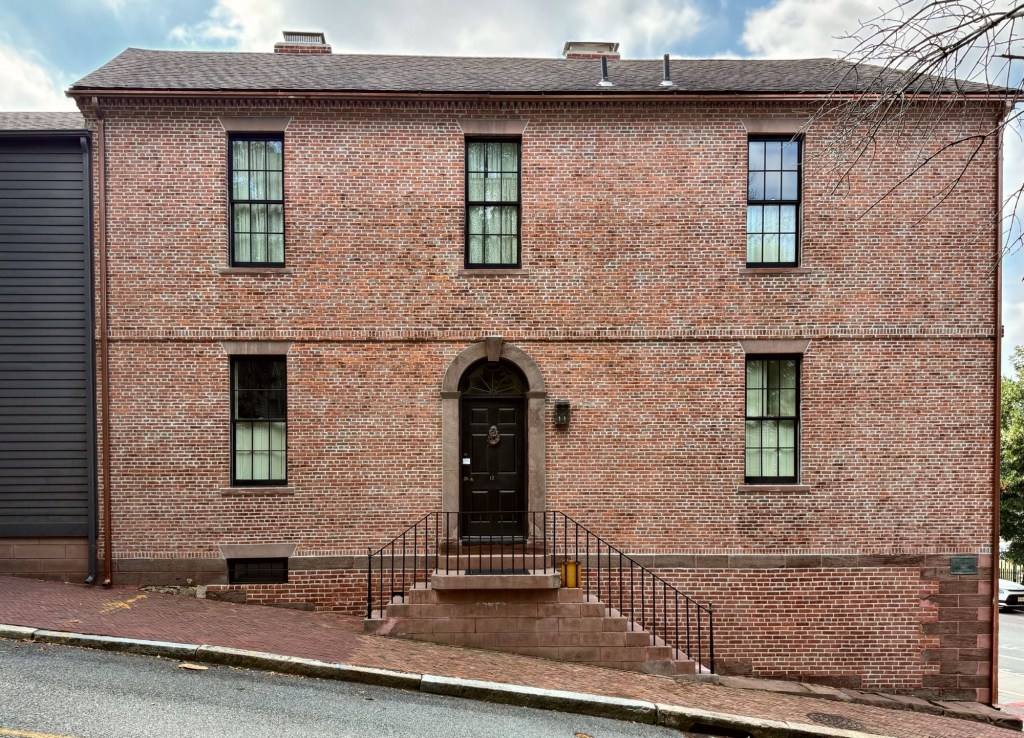
In 1820, Joseph Dorr, a trader, purchased this house lot in Providence’s East Side overlooking present-day Downtown. He had this Federal style house built with a symmetrical five-bay facade with fanlight transom over the door. He occupied the house until 1827 when he sold the property to a Charles Hadwin. In 1832, the property was acquired and soon after purchased by Welcome Congdon (1794-1874) who lived there until his death. The house was more recently added onto with a Modern addition on the side, to provide additional, private space for the owners who live directly next to a public park.