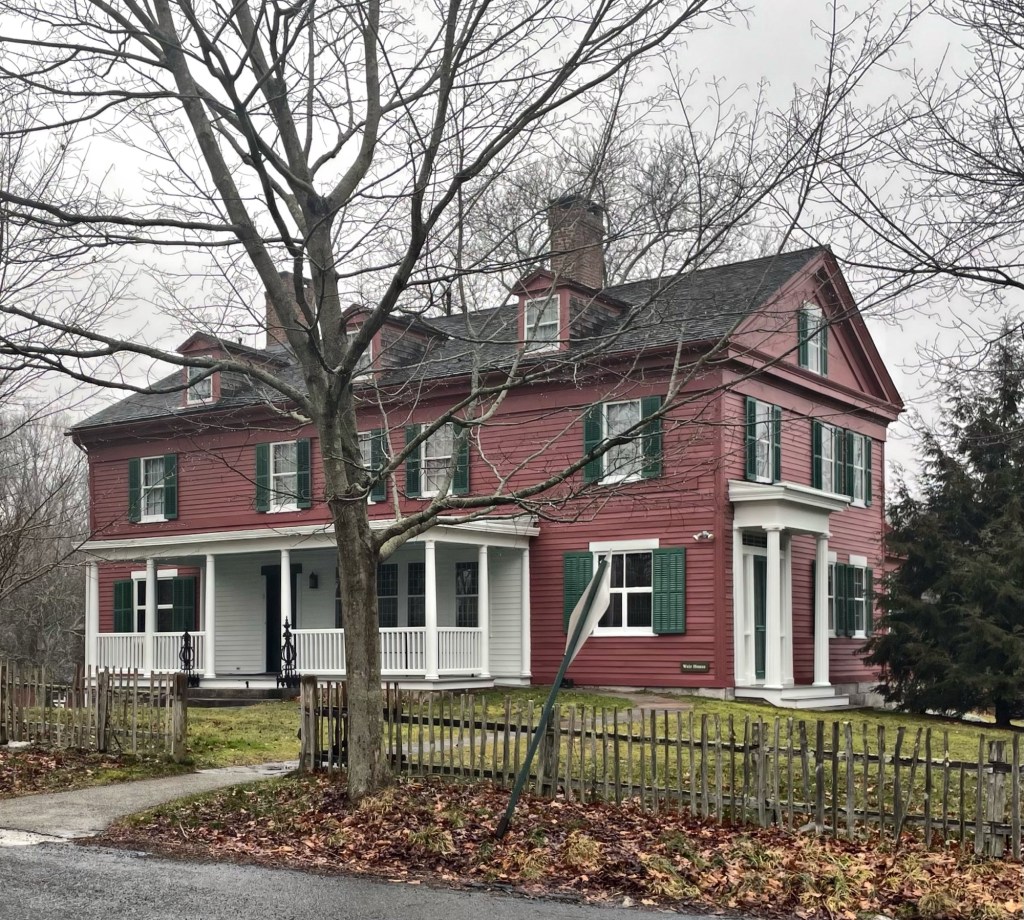
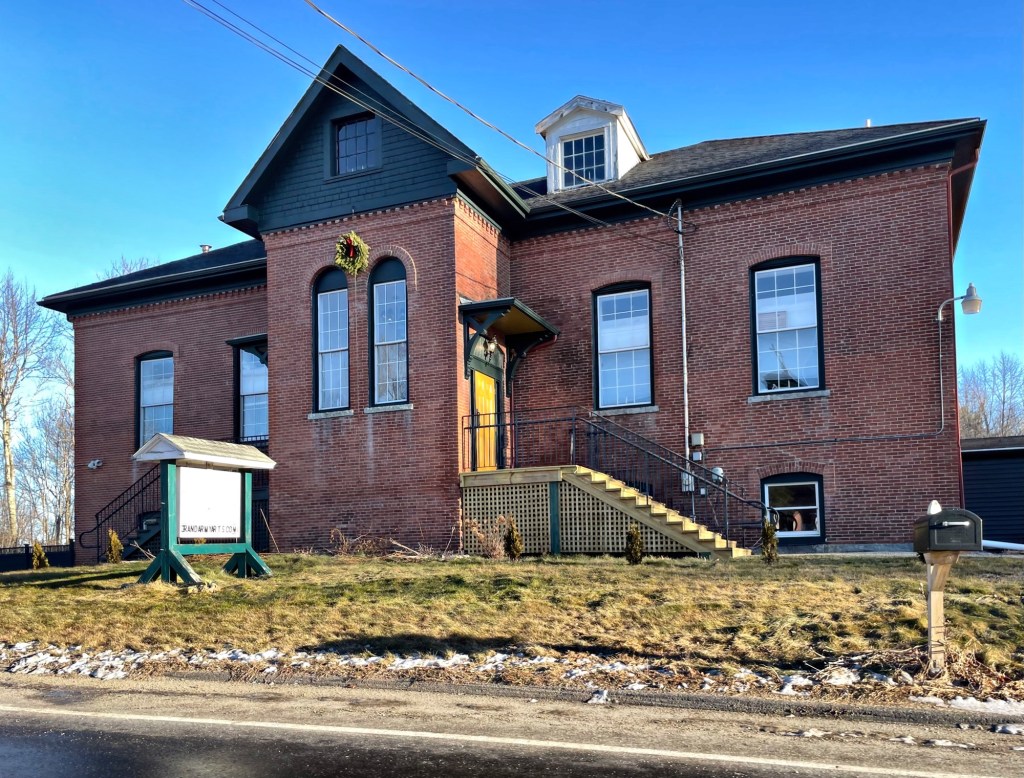
Weare Town House // 1837

Weare, New Hampshire has a pretty cool history. Located at the northern edge of Hillsborough County, the land presently known as Weare was granted to veterans of the Canadian wars in 1735 by Governor Jonathan Belcher, who named it “Beverly-Canada” after many of the veteran’s hometown, Beverly, Massachusetts. After various disputes over the settlement and naming of the town, it became known as “Weare’s Town” before being incorporated by Governor Benning Wentworth in 1764 as Weare, after Meshech Weare, who served as the town’s first clerk and later went on to become New Hampshire’s first Governor. The town grew slowly during the 18th and 19th centuries around five major villages, with farmland and forests connecting them. Near the geographic center of town, this Town House was built in 1837 to be a government and religious center of the town. Originally, town meetings were held on the first floor and the Universalist Church met on the second floor and the local high school was installed on the second floor in 1919. The building remains the town offices with event space for rent inside today. The building is a great example of a vernacular Greek/Gothic Revival town house of the period with a two-stage tower with pinnacles at the corners of each stage and a louvered belfry at the bell.

Yale University – Trumbull Gallery // 1832-1901

Pre-1869 image of Trumbull Gallery, Yale Archives

Before there was Street Hall or the Old Yale Art Gallery Building, there was the Trumbull Gallery, the first college-connected art museum in the United States. This building was erected in 1832 by artist and collector, John Trumbull (1756-1843), who specialized in Revolutionary-era works, and was known as the “Painter of the Revolution”. In his later years, Trumbull sold 28 paintings and 60 miniature portraits to the Yale College, and helped establish the college-affiliated art museum. He is said to have designed this Classical style building, to house his collections, all with minimal windows to protect his collection from direct sunlight. The gallery also housed a crypt for Trumbull and his wife, hence its tomb-like appearance. When Street Hall was built, the collection and tombs were relocated there, and again in the late 1920s when the Art Gallery was constructed. In 1869, Yale College added windows to the building and operated the school treasury from here until it was demolished in 1901. The Trumbull Gallery stood just in front of the Old Library.

Elisha T. Loring House // c.1840

Elisha T. Loring (1804-1889) was born on Cape Cod and began his career in the Chilean tin and copper trades, moving to Boston in 1839. His house at 21 Mill Street in Dorchester’s Harrison Square neighborhood was built in the early 1840s, showcasing his wealth and stature in the community. Based out of this house, Loring made a large fortune in the Lake Superior mines, also known as the Calumet and Hecla mines. By 1862 he was the treasurer to the Pewabic and Franklin Mining Companies, and a decade later is listed as “President, National Dock Company.” Loring’s Dorchester mansion is Greek Revival in style and consists of a three bay by three bay main block and a substantial rear ell. The house’s original clapboards were replaced by wood shingles sometime in the 20th century. The main elevation’s pedimented center pavilion exhibits a small front porch whose Ionic columns support a heavy, cornice-headed entablature. The porch’s roof is set off by an ornate cast iron railing. The side elevation is unusually wide and culminates in broad pedimented attics containing elliptical lunette windows.

Albert T. Stearns Lumber Company Office // c.1855

The Stearns Lumber Company, which eventually covered forty acres, was opened by Albert Thomas Stearns in 1849 at Port Norfolk, in Dorchester, Massachusetts. The location was ideal for transportation as wood could arrive by ship via the harbor or by rail. Stearns made everything from greenhouses, to water tanks, to millwork, but they specialized in wooden gutters, a necessary component in housing construction, and even invented a machine just for this purpose. Stearns’ machine removed the core of the gutter in one piece with a cylinder saw, which allowed the leftover product to be reduced into moulding, trim, ect. Stearns specialized in Cypress lumber and erected a saw mill in Florida, having it shipped up to his lumberyard in Port Norfolk. He became known as the Apostle of Cypress. The company eventually closed in 1968, after decades in losses of national lumber production and an increase in the use of cement and steel in building. The former Stearns Lumber Company yards were redeveloped and is now the site of Joseph Finnegan Park. The brick company office building is the last extant building from the historic A. T. Stearns Lumber Company, and its future is uncertain. The building is currently owned by the Massachusetts Department of Conservation and Recreation (DCR), who asked for the building to be demolished, causing the local neighborhood to speak out for its preservation. This is one to watch out for!

Dixmont Corner Church // 1834

Dixmont, a small rural town in central Maine was originally originally a land grant by the Commonwealth of Massachusetts (of which Maine was then a part) to Bowdoin College, which sold the first settlers their land for profit to build on their campus. As a result, the town was originally called “Collegetown”, which was obviously short-lived. Dr. Elijah Dix (1747-1809) of Boston, who never lived there but took an interest in its settlement, encouraged others to settle there, and when the town was officially incorporated in 1807, it named itself after Dix, as Dixmont. A “malignant fever” broke out among the settlers in the early years, also killing Elijah Dix while in Dixmont on a trip there in 1809, he was buried in the Dixmont Corner Cemetery. Elijah was the grandfather of reformer and nurse Dorothea Dix. The early settlers had this church built by 1834 by Rowland Tyler, a local master builder whose only other documented work is the 1812 City Hall of Bangor. The Dixmont Corner Church is one of Penobscot County’s oldest Gothic churches and also exhibits some Greek/Classical elements.

Troy Meeting House // 1840

Located in the rural town of Troy, Maine, the 1840 Troy Meeting House is a classic example of a type of meeting house or church that was built by some rural communities in the state in the decades prior to the Civil War. Built as a Union Church, without a specific denomination, the building served the members of the Troy Meeting House Society, and by extension as the only church in the town. The building features both Greek Revival and Gothic Revival stylistic details on the exterior and its design is similar to others in the surrounding towns, likely being from the same builder.

Gouldsboro Townhouse // 1884

Welcome to Gouldsboro, Maine! The town is a charming community made up of many small fishing villages and neighborhoods dotting the rugged Maine coastline. Land in what was then part of Massachusetts, was given to Colonel Nathan Jones, Francis Shaw and Robert Gould in 1764 by the General Court of the Commonwealth of Massachusetts. Francis Shaw and Robert Gould were both merchants from Boston. Francis Shaw had worked hard to develop Gouldsboro, and reportedly died broke because of it, and his son Robert Gould Shaw returned to his parents’ native Boston. Development in the area was slow and never really took-off due to the distance from Boston, but fishing, mills, and villages were built and remain to this day. Now, much of the area is home to summer residents flocking to the area from urban areas. This building was Gouldsboro’s second townhouse. It was constructed in 1884, soon after the first townhouse burned a year prior. The structure was used for town meetings and elections until 1983. It is now owned by the Gouldsboro Historical Society. It is a late, vernacular example of a Greek Revival townhouse.

Smith-Pierce House // c.1829

This transitional Federal-Greek Revival style house sits on the main street in South Britain, Southbury, Connecticut. The based on the style, the house was likely built around 1829 for Samuel Smith (1804-1856) who married Caroline Curtiss that year. Federal elements include the entry at the gable end, a pedimented facade embellished with modillions, and a doorway with sidelights and a leaded transom. Some moldings, the six-over-six windows and the simplicity of design are Greek Revival. It is one of the best preserved old houses in this part of Southbury.

Benjamin Downs House // c.1830

Located a stone’s throw from the Judson Manville House (last post) another uncommon brick Greek Revival style house in South Britain, Connecticut, this house stands out for its outstanding proportions and well-preserved exterior. This residence was built around 1830 for Benjamin Downs on the site of his family’s old property. The simple lines, portico at the entry supported by Ionic columns, and the window in the gable are all typical of the period.

Judson Manville House // 1835

Greek Revival style houses in brick are amazing to find “in the wild”, when I stumble upon them! This example is located in the South Britain village of Southbury, Connecticut. The brick house was built for Judson Manville in 1835 and it was constructed of locally manufactured bricks. Judson operated a hat manufacture next door to this property and it clearly made him some money. The property was eventually acquired by the Hawkins Company at the turn of the 20th century and it was operated as the company offices. It was during this time that the 20th century wrap-around porch was added. It is now a private residence.