Isaac Farrar Mansion // 1836

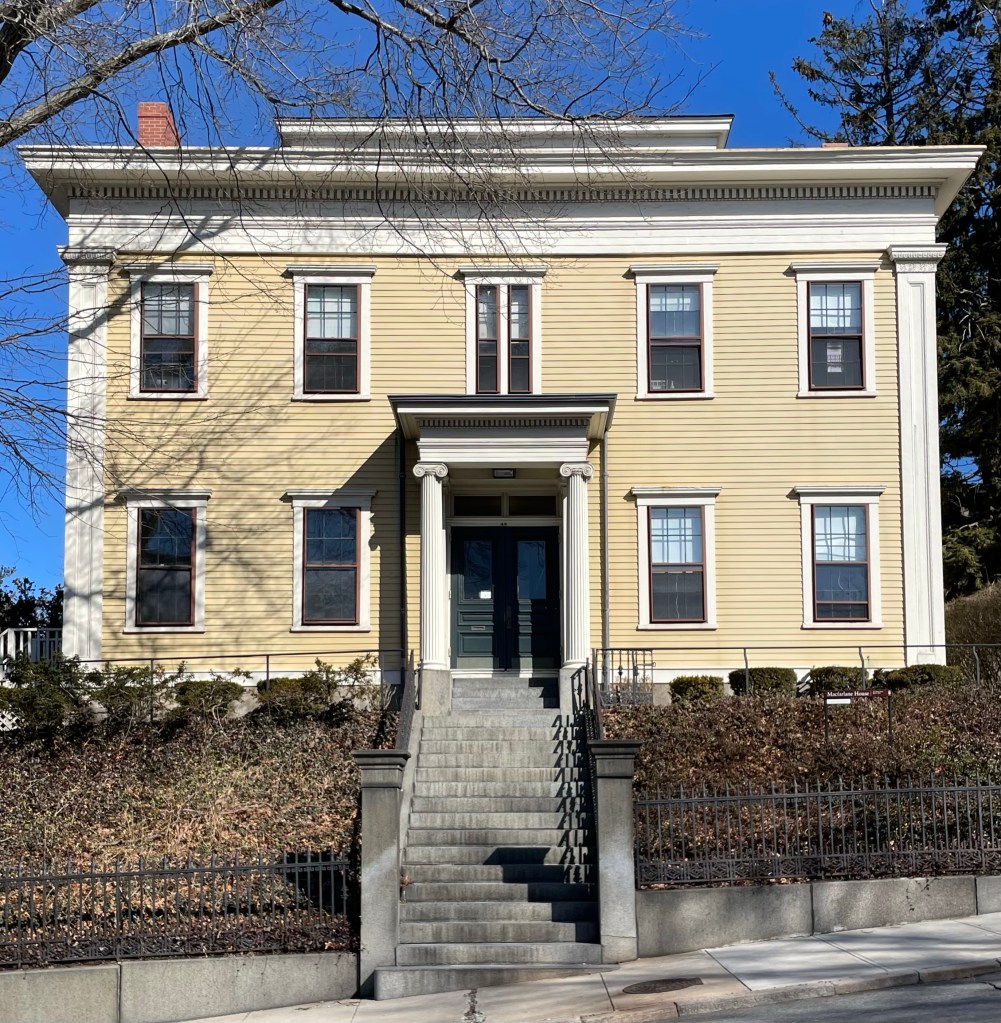
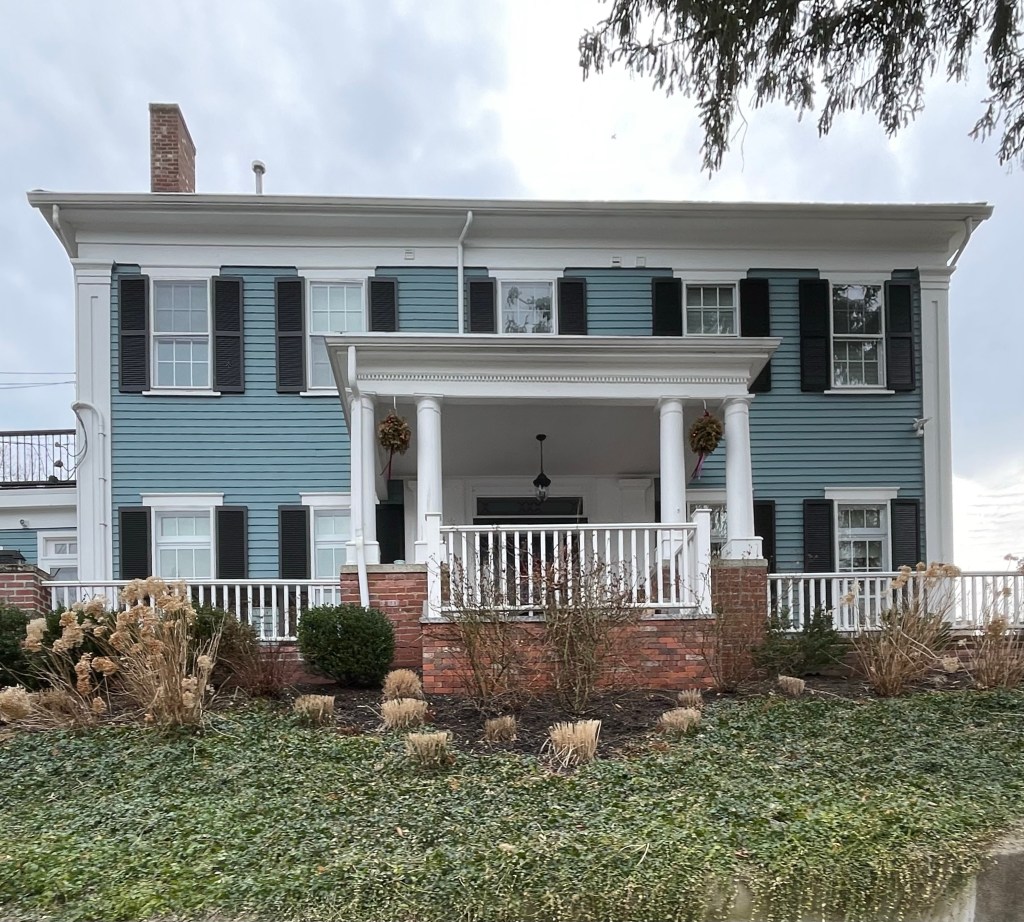
The Isaac Farrar Mansion in Bangor, Maine not only looks gorgeous, it is significant as the one of the first known works of architect, Richard Upjohn. It is important because it shows that English-born Upjohn, who is best-known for launching the popularity of the Gothic Revival style in the United States, began his career by building in the Greek Revival style, the traditional style of the time. This mansion was designed for Isaac Farrar, a lumberman and merchant, and later, President of the Maritime Bank of Bangor. Charles B. Sanford, who lived in the house from 1865-1878, was proprietor of the Sanford Steamship Lines. The home had a few more subsequent owners until 1911, when it was acquired by the University of Maine Law School, which used it as a residency until 1929. It was soon after purchased the Bangor Symphony Orchestra, who renamed it “Symphony House”, and operated the Northern Conservatory of Music on the premises, also hosting the music branch of the Bangor Public Library. In 1972 the school closed, and the symphony sold the building the following year to the local YMCA, which now uses it as an exhibit and reception space. While some aspects of the house look to be from the early 20th century, it retains much of the Greek Revival design by Upjohn. Talk about a full history!

Mathes House // c.1835

Benjamin Mathes built this stone home around 1835 for his family, of the same stone he used to build a store across the street. The Federal/Greek Revival building has amazing granite quoins (stone blocks at the corners) and lintels (blocks above the windows). Even though there are later alterations, including the bracketed door hood and massive central dormer at the roof, the home remains one of the most visually stunning buildings in town.

Newmarket Manufacturing Company Complex // 1823+

In 1823, the Newmarket Manufacturing Company built its first mill along the Lamprey River, dominating the waterfront and the economy of Newmarket, New Hampshire. Harnessing water power at the base of the falls, the cotton textile manufacturing community grew to include seven textile mills, with factory buildings, a machine shop, office, storage buildings, and corporate boarding houses; totaling some 140 buildings in all. During its peak production, 700 employees made up to 300,000 yards of cotton products each week, and 2.7 million yards of silk cloth each year. The mills operated continuously at this site until 1929 when a dispute between mill owners and workers erupted leading to their closure. Between 2010 and 2012, eight large mill buildings within the Newmarket Manufacturing Company property underwent a conversion to mixed use, including residential, retail, and office units, thanks to Historic Preservation Tax Credits, and many professionals who worked together with the vision to see such a large project through. Today, the complex is a excellent case-study on the power of adaptive reuse and historic preservation.

Granite Engine Fire House // 1853

In 1852, the Newmarket Manufacturing Company, who operated a massive mill complex along the Lamprey River in Newmarket, realized the need of adequate fire service to protect their investments and goods. They leased land on Main Street to the town and funded a new fire station, providing engines as well that could be pulled by horse to fires in town. The old station is a surviving landmark in town and retains much of its architectural integrity.

Old Stone School, Newmarket // 1841

Perched high on a hill, next to the Stone Church (featured previously), the old Stone School in Newmarket is one of a handful of iconic stone buildings in the town. Built in 1841, its stonework executed by William and Robert Channel, local farmers and stonemasons, who likely got their skill from building stone walls on farms. The building was used continuously as a school until 1966, when it was given to the Newmarket Historical Society, which now operates it as a local history museum.

Mathes Store // c.1835

Next door to the Mathes Block (previously featured) this stone commercial building is one of many such buildings that make Newmarket so beautiful and unique. Stone was harvested from the shores of the Lamprey River nearby and the beautiful coloring made them perfect for buildings in town. This building was constructed in the 1830s for Benjamin Mathes, a developer and businessman in town. The structure was occupied by the town post office in the early years, and now houses a restaurant.

Mathes Block // 1840

Right on Main Street in Newmarket, the Mathes Block is one of the best-preserved examples of a brick commercial building in town. The structure was seemingly built for Benjamin W. Mathes, who operated a grocery and dry goods store out of the storefronts. Above, he likely had offices or a dwelling for workers. The building stands out for the contrast of granite at the storefront with the brick elsewhere. The building is now home to The Riverworks, an aptly named restaurant/pub with great food.

Old Newmarket Town Hall // 1847-1989

Incorporated in 1727, Newmarket, New Hampshire, is one of six towns granted by Massachusetts in the last year of the reign of King George I (when it was a part of the Massachusetts Bay Colony). Newmarket started as a parish of nearby Exeter, and was granted full town privileges by the legislature in 1737. Newmarket was a center of the New England shipping trade with the West Indies and also saw financial success as a shipbuilding center for the Royal Navy. By the 19th century, the town thrived as a mill town with great water power from the Lamprey River. With the growth of industry and immigrant population increasing due to labor necessity, the town outgrew its older Town Hall. In 1847, the town purchased land adjacent to a prominent mill site on Main Street, and built this beautiful Greek Revival building. The building was updated in the late 19th century with a tower and additional detailing. A massive fire gutted the old building in 1987. Two years later, the building was demolished and town offices moved to a former school building. The site today is a surface parking lot.

North Rochester Congregational Church // 1841

The North Rochester Congregational Church is located in a distinctly rural, area in the northwest corner of the largely pastoral town of Rochester, Massachusetts. This church, built 1841, is locally important to the development of religion and community in North Rochester. In Rochester as in other early New England towns, the building of a church symbolized the founding of a community. North Rochester’s first church was built in 1748, about 1 mile west of the present building, and was served by traveling ministers from other communities. The church congregation was formally organized in 1790, and a new church was built at that time, serving a larger area. The current church building was built in 1841 by Solomon K. Eaton, a noted regional builder whose credits include several other area churches. The church is of the Greek Revival style, which was frequented in the designs of hundreds of churches all over New England in the mid-19th century.

Rochester Academy // 1838

In the early 19th century, the schools in the town of Rochester, Massachusetts (and many other rural towns in New England), were under the control of a district system. This system divided the town into districts, with each district having its own schoolhouse and an elected committeeman. The committeeman selected the teacher to run his district school and was responsible for providing school equipment. Each district had to provide its school with a building that included a hall or closet, desks and benches on three sides with 10 square feet of open space in the center for recitations. The schools held two terms (winter and summer) and each term averaged a length of 3 months, much of the “off-time”, students would assist their families on farms. By 1859, Rochester had 11 districts, each with its own schoolhouse that stood throughout the town. Rochester Academy was built at the town center, and educated the “older” students in the town. The school later admitted younger students to ease congestion in the smaller rural schoolhouses. The Greek Revival building, constructed in 1838, presently serves as a community space for the town, but is in need of some maintenance!

Snell House // 1849

Amasa Snell (1794-1850) and his son Nelson built this house, just a year before his death. The house is yet another example of the vernacular snecked ashlar construction method, which Chester, Vermont is known for. This house is located in the rural Trebo section of town, an area where many of the masons who built these snecked ashlar homes lived. It stands out for the use of light and dark stone laid in alternating rows. This house is perfect!

Emery Bolles House // 1841

Next to the Israel Moore house (last post) in Chester, VT, the Emery Bolles house is yet another beautiful example of a snecked ashlar building in central Vermont. The town of Chester has the largest concentration of these buildings in the state in the north village, now known as Stone Village. The building method was so popular that even a couple examples sprouted up in the larger Chester Village nearby. Erected for Emory Bolles (who operated a wagon shop next door), this 1841 house possesses a 5-bay facade and a later, distinguished Victorian-era full-width porch. The porch incorporates turned posts with a central gable above the steps that carries an openwork screen.

Israel Moore Snecked Ashlar House // c.1846

Located on Main Street in Chester, Vermont, you can find this perfect little Snecked Ashlar home. The building technique is very local and can be found in just a handful of towns in central Vermont. Scottish-born masons from Canada introduced the technique to local masons while erecting a mill in nearby Cavendish in 1832, and within a few years, the first stone structure in North Chester village was built by local masons. Soon after, the local school, church and other homes were all constructed the same way. This home outside the Stone Village district was built later than almost all other examples in town. It features Federal and Greek Revival detailing with a central fluted fan at the door and large gable-front roof.

Have you heard of Snecked Ashlar before?

Gingerbread Apartments // c.1850

Built in the mid-19th century this former home in Chester, VT, exhibits the range in tastes seen from the Classically inspired Greek Revival style to the ornate and over-the-top Queen Anne style. The original 1850 Greek Revival design of the house survives in its temple form and classical details, augmented by a visually dominant overlay of Queen Anne features. The house was acquired sometime after 1870 by the Haselton family, whose daughter Hattie married John Greenwood. The Greenwoods undertook a major renovation of the building about 1900, adding the elaborate front porch and other features, giving it the wedding cake or lace-like appearance we see today. The home was converted to apartments in the 1960s, but retains much of its architectural details, it is best known as the Gingerbread Apartments.

Chester Town Hall // 1884

The town of Chester, Vermont, was originally chartered by New Hampshire Governor Benning Wentworth as Flamstead, in 1754. The terms of the charter were not met and the town was re-chartered as New Flamstead in 1761. In 1766, a patent was issued by New York that changed the name of the town to Chester, after George Augustus Frederick, the Earl of Chester and the eldest son of King George III. Vermont in the 18th century was contested land claimed by both New Hampshire and New York, unsettled until the colonists in the area decided to petition for their own statehood. The town of Chester voted to keep their name. The town grew with two distinct villages, Chester Village and Stone Village. Both villages were very distinct in terms of politics, religious affiliations, and architecture. When the railroad cut through the town, the route passed between Chester’s North and South villages, and Chester Depot village emerged right in the middle. The establishment of a third village by the railroad depot, offered neutral ground on which to erect a town hall, as before 1884, town meetings were held alternately each year in the two opposing villages. The large town hall building in Depot Village is a late example of Greek Revival and Italianate design.