Bethshan Cottage // 1884

Bethshan Cottage is one of Newport’s (many) “hidden” gems that gets far too little attention from publications! Located on Gibbs Avenue, down the block from Eveherdee and William Barton Rogers‘ summer cottage, “Morningside”, Bethshan was built in 1884 on land purchased by Major Theodore Kane Gibbs. Theodore was the son of William C. Gibbs, the 10th Governor of Rhode Island, and served in the Union Army during the American Civil War, mustering out as a Major in 1870. Newport-based architect Dudley Newton designed this cottage for Gibbs, which blends nearly every major architectural style of the late 19th century under one, beautiful gambrel roof. The red granite stone walls, red brick trim, red fish-scale slate roof, even the rust-colored mortar, all work together to create a lovely composition, unlike anything else seen in Newport. According to Newport’s Assessor, the house is presently an apartment house.

Eveherdee Cottage // c.1889

This Queen Anne style “cottage” is located on Gibbs Avenue, one of the lesser-visited streets for house-stalking in Newport, Rhode Island, but wow is she something! The summer cottage here was built by 1890 for Ogden Hoffman Burrows, a merchant who went into business with his father and brother in San Francisco, shipping goods from East Asia to America. He purchased two adjacent lots here on Gibbs Avenue in 1884 and 1889, having this house built as a summer residence, where he could mingle with other wealthy neighbors. The Queen Anne style house was reportedly designed by local architect, John Dixon Johnston, who incorporated all the hallmarks of the style: varied siding types and materials, turned post porte-cochere, applied ornament, and complex, asymmetrical form. Burrows would sell this house by the turn of the 20th century. Later owners, Herbert E. Stride and Daisy Thompson Stride, who would reside here with Daisy’s mother, Eve. The Stride’s named the home “Eveherdee” an amalgamation of their individual names: Eve (Eveline), Her (Herbert), and Dee (Daisy). The home was most recently owned by television producer, Vin Di Bona, who restored the house to its grandeur we see today.

Frederick & Arabella Holden House // 1893

The Frederick & Arabella Holden House sits on Aspinwall Avenue in the Brookline Village neighborhood of Brookline, Massachusetts. Built in 1893, the excellently designed Shingle style dwelling was actually built on speculation by developers, and sold upon completion to the couple. Fred G. Holden (1858-1927) was a marble dealer who managed the Boston Marble Company and had connections in his home state, Vermont for the highest quality marble to sell around Boston, largely for building products and grave memorials. Arabella Proctor Holden (1859-1905) was born in Cavendish, Vermont, as the eldest daughter of Redfield Proctor, 37th Governor of Vermont and the founder of the Vermont Marble Company, the largest such company in the world. I could not find the architect of the house, so any more information, let me know. I’d love to solve the mystery!

Dr. Thomas J. Shanahan House // 1892

Dr. Thomas Joseph Shanahan (1873-1929) was born in Lawrence and graduated from Harvard Medical School in 1896. He practiced medicine in Brookline and Boston and was engaged in local organizations. He purchased this 1892 house on Aspinwall Avenue in Brookline in 1911, which had previously been rented to families. Two generations of Shanahans would own the house until the 1970s. After Dr. Shanahan’s death in 1929, the widowed Margaret Shanahan remained in this house with their daughter, Mary Margaret Shanahan, who was employed in 1940 as a medical secretary for a hospital. Mrs. Shanahan transferred title to the property in 1947 to her daughter, who converted the house to a two-family dwelling in 1953 for supplemental income. Architecturally, the house is Queen Anne and Shingle styles with continuous shingle siding, complex form with bays and oriels, and a unique arched opening in the gable over the entrance filled with a spindle screen. Architects were William Langley Morrison and Peter J. McEwen.

Dr. Ralph Fogg House // 1893

Built in 1893, this house in Norwood, Massachusetts, was built for Dr. Ralph Fogg, a leading dentist in the Boston area with offices in Boston, Norwood, and Quincy. Dr. Fogg was dissatisfied with nitrous oxide gas as an anesthetic, as it failed to protect the patient against pain; and, in trying to find some harmless compound to accomplish the desired results, he produced the “Boston Vegetable Vapor,” an anesthetic to compete with nitrous oxide in markets. In 1885, the Boston Vegetable Anesthetic Company was formed for the purpose of placing the vapor in the market, and it was used by leading dentists across the country. With his dental practice growth and success of his new invention, Dr. Fogg and his new wife, Anna Saville, hired architect, Herbert Mosely, to design a stately home for their family. The Queen Anne/Shingle style house features a sophisticated use of stone, clapboard and wood shingle materials. It’s main facade is dominated by a broad gambrel gable with the main entrance set within a rusticated stone arch which is edged with large voussoir blocks.

William Dexter House // 1899

One of the best examples of the eclectic architecture designed at the of the 19th century in Norwood, Massachusetts, can be found on Beacon Street in the William Dexter House. Built in 1899 for William W. Dexter (1827-1911), who in 1852, married Harriet Blake, later settling in Massachusetts. Tragedy struck the family in 1871, when on the same day, his wife and daughter died; two days later, his sister-in-law, and six days after that, his other daughter Carrie died, all of bacterial infections. All that remained of the family was William and his only surviving daughter, Nellie. William remarried and built a blended family until his death in 1911. This house was built by Dexter, who worked as a contractor and painter, and George F. Bagley, a local builder. The complex form, rooflines, varied siding types, corner tower, and intact historic windows all add to its beauty. If only it had a historically appropriate color scheme to compliment it!

Oliver J. Barr House // 1908

Built in 1908 as a late example of the Queen Anne and Shingle styles, the Oliver J. Barr House is one of the finest Victorian buildings in Norwood, Massachusetts. The residence was built for Oliver J. Barr (1863-1935), who served as the General Manager of the Norwood Press in town, following his company from Boston to Norwood. The house was designed by Eugene Clark a Boston-area architect who specialized in suburban houses in the late 19th and early 20th centuries. The dwelling is noteworthy for its distinctive form, intact and rough textured wood shingle siding, and complex roof configuration. Particularly noteworthy is the verandah which encircles its northeast corner and rounded conically capped tower.

Point O’ View Cottage // 1892

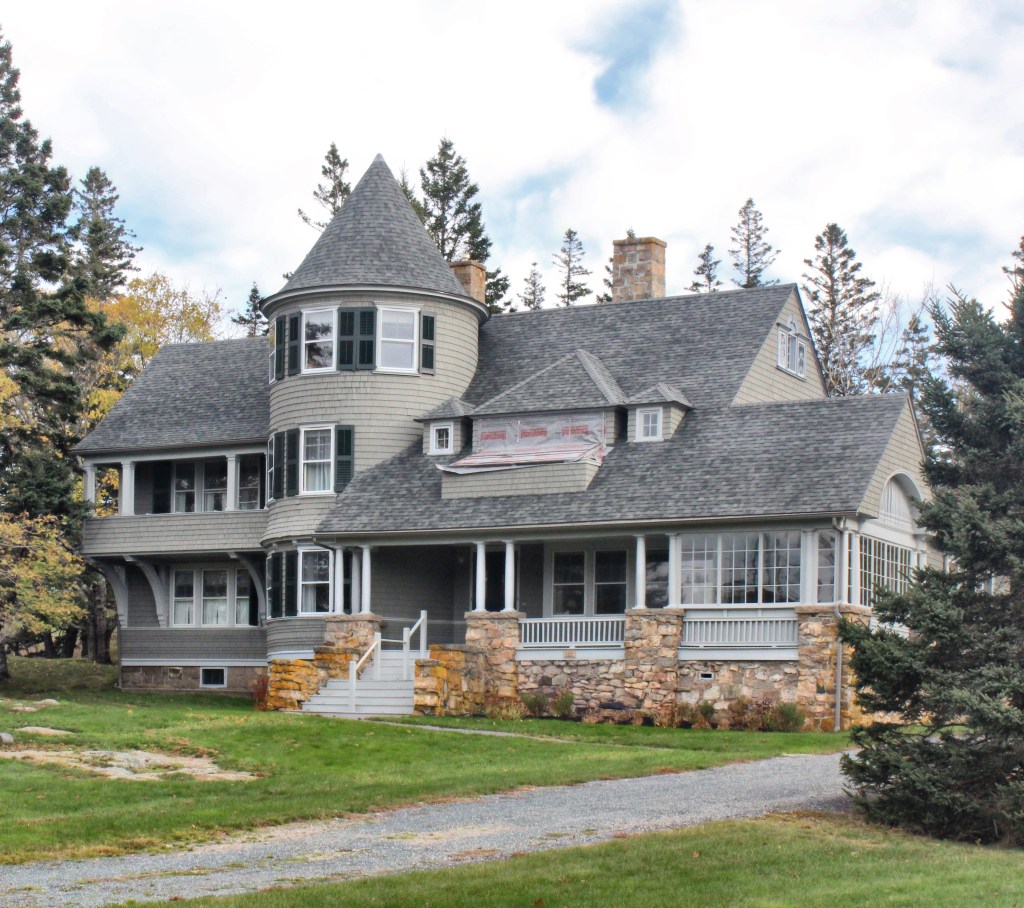
The Point O’ View Cottage in Kennebunkport sits on a large lawn on the rugged Maine coast, with sweeping views of the Atlantic Ocean. Built in 1892 by Burleigh S. Thompson as a rental property (he rented it for $1,500 for the summer) the nine-bedroom “cottage” was designed in a Tudoresque version of the Queen Anne architectural style and originally named Fort Bradford. The cottage (like others built for Mr. Thompson) was designed by Henry Paston Clark, THE architect for the Cape Arundel Summer Colony in the 1890s, who also designed St. Ann’s Episcopal Church and other cottages nearby. The cottage was renovated more in keeping with the Shingle style and was entirely clad in cedar shingles, but it retains its perfect, rustic stone foundation and rounded porch. It is now known as Point O’ View Cottage. What a view it has!

Kewaydin Cottage // 1900

Every good summer cottage needs a name, and this charmer in the Cape Arundel Summer Colony of Kennebunkport, Maine, is no exception! This is “Kewaydin” a massive summer home built for Eben Caldwell Stanwood Jr. (1856-1906) a merchant and later banker of Boston, Massachusetts. Stanwood hired the Boston firm of Chapman & Frazer to design the cottage, which blends Shingle style and Queen Anne elements in a rustic composition that has such great curb appeal! The use of cedar shingles and rubblestone chimneys, paired with the vergeboards and complex roofline with dormers, makes this one of the gems of Kennebunkport!

Pine Haven Cottage // 1902

Pine Haven Cottage sits on a rise overlooking the Atlantic Ocean in the Cape Arundel summer colony in Kennebunkport, Maine. Built in 1902 for Thomas Brodhead Van Buren, Jr., a silk importer in Manhattan as a summer home, the cottage was designed by Henry Paston Clark and his partner, John W. Russell in an eclectic example of the Shingle style with gable roofs, vergeboards, stone foundation, and a prominent porch that has since been enclosed.