Ridgefield Train Depot // 1870

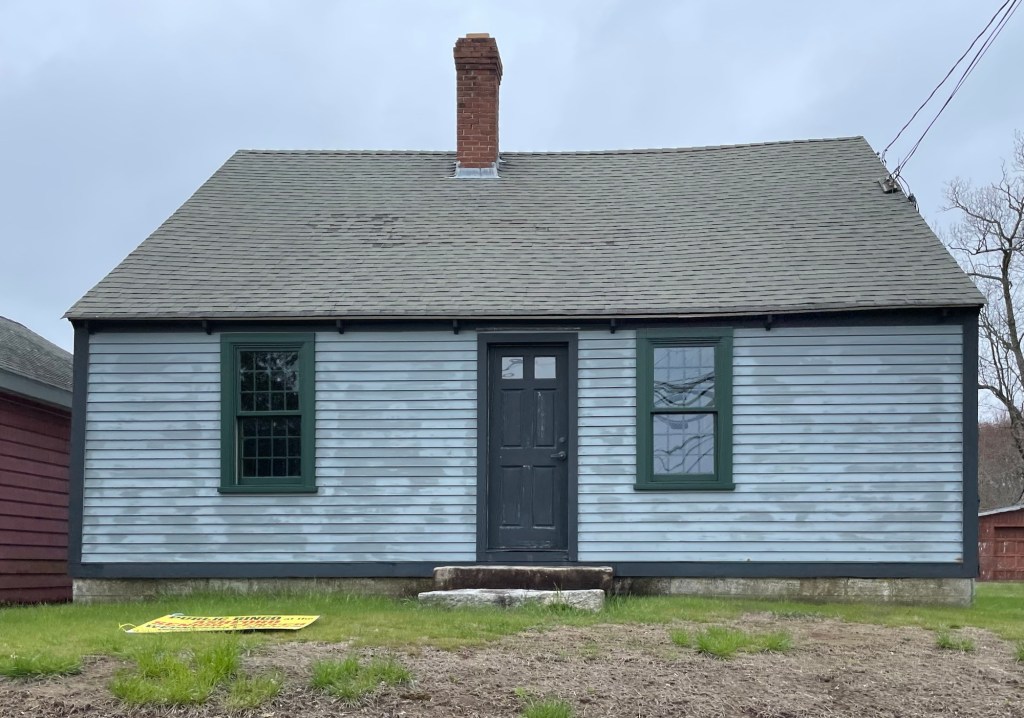
In 1870, the Ridgefield Branch branch line of the Danbury and Norwalk Railroad and later the New York, New Haven and Hartford Railroad was built connecting the sleepy village of Ridgefield to Branchville train station via the main line. The line was an early risk, built to offer service to the wealthy New Yorkers who began arriving to spend their summers in Ridgefield. Many of these “summer people” had their own private railroad cars, with chauffeurs meeting them as they arrived, driving horse and buggies to bring them and their luggage to their estates located throughout the town. As travel shifted to personal automobile, ridership dropped in the early 20th century, and the branch was replaced by bus service in 1925. Freight service was scarce, and lasted longer, to 1964. The depot was sold to the Ridgefield Supply Company, who used the 1870 building as storage for decades until it was disassembled, moved and rebuilt by the Ridgefield Supply Company in 2015, as part of their expansion. The historic station today provides an important link to Ridgefield’s past.

Ridgefield Public Library // 1901

The Ridgefield Public Library is an intriguing Beaux Arts style building from the turn of the 20th century. Built in 1901, the brick structure replaced the Smith Tavern, a 1798 frame structure built by Amos Smith right on Main Street. In 1900 the Smith Family sold the property to James N. Morris who had this library built in memory of his wife, Elizabeth, donating it to the town. Architect Raleigh G. Gildersleeve is credited with the design which is comprised of a one-story building constructed of brick with cast stone trim details and ironwork at the door. The library was given later additions, which are recessive in location and detailing to let the original building shine, as it should!

Former Ridgefield Savings Bank Building // 1930

Historically, bank buildings were built with architecture at the forefront to show members and prospective investors that their company instilled prosperity and longevity. Today, many new bank buildings are cookie-cutter designs and lack ornamentation or intrigue… The interwar Ridgefield Savings Bank on Main Street in Ridgefield, Connecticut, was built in 1930 from plans by architects Ralph Hawes and Ernest Strassie in the Neo-Classical style with Art Deco rounded corners and undecorated planes. Dominated by its Classical Ionic portico the bank building is a lasting commercial landmark on the town’s charming Main Street. It is now occupied by the Fairfield County Bank.

Ridgefield Town Hall // 1896

Ridgefield, Connecticut was settled in 1708 when 24 families from Long Island purchased land from Chief Catoonah of the Ramapo tribe. The Fundamental Orders adopted by Connecticut in 1639 directed would-be settlers, able to support a minister, to establish a settlement, build a Congregational church and farm the land. This is exactly what was done in Ridgefield, beginning in 1708. The original 24 proprietors received 7½-acre home lots drawn by lottery, with a 25th reserved for the minister. The lots were located up and down Main Street from a Common where a Meeting House was built. The town grew and for much of its three centuries, was primarily comprised of old farms. By the late 19th century, spurred by the connection of the railroad, Ridgefield was “discovered” by wealthy New York residents, who assembled large estates in town, a trend that has only picked up in the 21st century! Population growth and a large fire on the town’s Main Street in 1895 necessitated a new Town Hall building. The present Town Hall building was constructed in 1896 from plans by architect Philip Sunderland. Colonial Revival and Romanesque in style, the two-story brick building features a pedimented central bay also containing the entrance with fan light transom, round arched windows, brownstone trim, and narrow pilasters of brick. The building houses town offices today.

Yale University – Warner House // 1887

Originally known as Cloister Hall, this ornate building on Hillhouse Avenue in New Haven, Connecticut is one of the most interesting I have seen. The building was constructed in 1887-8 as a residence hall for members of the Book and Snake, a secret society at Yale University. Architect H. Edwards Ficken designed the ornate brownstone Cloister which was completed in 1888. At the time, it was considered “one of the most picturesque buildings on the Yale campus.” The society added a matching rear addition in 1915, which is a heavier mass, but compliments the original structure. Yale University would eventually acquire the building after the society no longer needed a separate lodging house for members. Today, the building is called Warner House, and Yale does a great job at maintaining this beauty.

Yale University – Alpha Delta Phi Hall // 1895

Completed in 1895 for the Alpha Delta Phi fraternity at Yale, this stunning example of the Richardsonian Romanesque style on Hillhouse Avenue was such a treat to see in person. This building was designed by local architect William H. Allen who designed the building to provide student members dining and socialization space, but no dormitories. The group was active as a Junior Society, but disbanded by 1930, and the building was sold to Yale University. Yale has since occupied the building with the Morris Steinert Collection of Musical Instruments and it recently underwent a restoration. The longer I look at the building, the more amazing details I can find. The proportion of the Syrian arch with squat engaged columns is really remarkable.

Yale University – Mason Laboratory // 1911

On Hillhouse Avenue, one of the finest streets in New Haven, you will find a great collection of historic homes and large institutional landmarks. Adjacent to St. Mary’s Roman Catholic Church, the Sheffield Scientific School of Yale College built this structure, the Mason Laboratory between 1910-1911 for Mechanical Engineering and related departments. The building was designed by architect Charles C. Haight, who was responsible for a number of other Neo-Gothic buildings at Yale. The limestone building properly holds the streetedge and blends in well with its surroundings.

St. Mary’s Roman Catholic Church Priory // 1907

Located next to the St. Mary’s Roman Catholic Church on Hillhouse Avenue in New Haven, Connecticut, you will find one of the finest Neo-Gothic style buildings in the city that was not built by Yale University. This structure was constructed in 1907 as the Priory for the Catholic Church next door. Historically, the church had been under the care of the Dominican friars of the Province of St. Joseph, based in New York City, and the church needed a residence for the friars (a Priory). Due to dwindling attendance at churches all over the country, area churches were consolidated under the Hartford Archdiocese, who replaced the friar residents of this building with Dioscesan priests in late 2021.

St. Mary’s Roman Catholic Church // 1870

The second oldest Roman Catholic parish in Connecticut can be found in New Haven, at the St. Mary’s Roman Catholic Church. The parish was originally established in 1832, largely by Irish immigrants who settled in the area for work. The current St. Mary’s church building, located on Hillhouse Avenue near Yale University, was designed in 1870 by ecclesiastical architect James Murphy, and it was dedicated in 1874. The construction of a Catholic church on Hillhouse Avenue was strongly opposed by the Protestant elite who lived in the area, but the congregation prevailed. The Victorian Gothic style church is constructed of local blue stone and granite and while plans by Murphy originally included a corner spire for the building, it was not built until 1982 when the building was restored courtesy of the Knights of Columbus. The Knights of Columbus fraternal organization was actually founded in 1882 in New Haven by Father Michael J. McGivney, who originally held meetings in the basement of this church.

Yale University – Kirtland Hall // 1902

Yale has such great architecture. Walking around the campus, you can find examples of buildings of every time period and architectural style, it is like a living museum of architecture in that sense. Located on Hillhouse Avenue, Kirtland Hall is arguably Yale’s best example of Beaux Arts/Neo-Classical architecture, but it stands out for its use of local East Haven and Longmeadow sandstone. The building was the first laboratory to be built at Yale in the 20th century and was named after Jared Potter Kirtland (1793-1877), the first medical student enrolled at Yale. After graduation, Dr. Kirtland practiced medicine throughout Connecticut until 1823, when his wife died and he moved to Ohio. During his life, Dr. Kirtland also developed an interest in natural history and assisted in the first geographical survey of Ohio. In the early 20th century, Lucy Hall Boardman, a philanthropist and niece of Dr. Kirtland, not only donated funds for scholarships at Yale, but also donated a building, Kirtland Hall. As part of her gift, Ms. Boardman stipulated that her nephew, architect Kirtland Cutter, would be commissioned to design the building, and of course, Yale obliged. The building originally housed the Geology Department and became an integral part of the Sheffield Scientific School.