Located in Agawam Center this interesting architectural example of a late-Tudor Revival school building really caught my eye. The building replaced a 1870s town hall and two-room schoolhouse which were both outgrown as Agawam’s population increased due to the proximity of nearby Springfield. The architect was Paul B. Johnson, who was based out of West Springfield and ran a small architectural office there. He attended Cornell and MIT for architectural training and worked primarily around Springfield. The school building is constructed of a deep red brick, laid in varied relief for a rough faced surface and a cast stone Tudor arch around the main entrance for contrast. The school was later renamed after Benjamin Phelps, the first superintendent of schools in Agawam.
This stunning home on Main Street in Agawam, MA, was built in 1805 as a high-style Federal home. The property was developed for Captain Charles Leonard (1764-1814) who purchased twenty-five acres of land on the eastern side of Main Street at the center of town. Leonard was a graduate of Harvard University who later turned to farming. He attained the rank of Captain while serving in the local militia, and was known by that title thereafter. It was in 1805 that Leonard constructed Agawam’s fourth tavern on the western end of his property to serve travelers as the first stop on the Hartford to Boston stage run. He likely hired a local builder who took inspiration from Asher Benjamin’s early plan books. The home was later converted to apartment units until it was purchased and restored by Minerva Davis, a wealthy citizen from town, who then created a board of trustees to operate the building as Agawam’s Community House.
This church in Agawam was built in 1927, replacing the first Catholic church in town, which was established in 1873. The earlier church was destroyed by a fire in 1925, causing the congregation and Archdiocese to fund construction of a new, fireproof church building. The Neo-Gothic Revival building features lancet windows, buttresses, and a central steeple. The building is now occupied as the Moldovian Baptist Church.
Built by the Boylston Market Association, replacing the former Boylston Market (1810-1887) in Downtown Boston, the Boylston Building is a great example of late 19th-century commercial design in Boston. The Association hired German-born architect Carl Fehmer (who alsodesigned the amazing Beaconsfield Terrace housing in Brookline) to design a structure that would stand up to the architectural landmarks along Boylston and Washington Streets nearby. Fehmer’s design exhibits many features of the emerging Commercial style (also known as Chicago school style) of architecture which promoted new technologies of steel-frame construction in commercial buildings with masonry cladding, while clearly showcasing the Romanesque round arch windows. In the mid-20th century, this area of Downtown Boston became known as the ‘Combat Zone‘, Boston’s Red Light District, flooded with prostitution, drugs, and adult video stores. The Boylston Building was occupied by an adult video store and dive pizza shop. The building and area surrounding are different today, but you can always find some characters nearby!
One of the biggest architectural losses in Boston has to be the demolition of the Boylston Market formerly at the corner of Boylston and Washington Streets. A new market house in Boston was desired by many of the city’s elite, and when John Quincy Adams (who lived on Boylston Street and was elected President of the United States 15 years later) gathered capital for the new structure it was so built. The group hired Charles Bulfinch, who at the time was THE architect of Boston, to design the new brick market. When opened to the public in 1810, the market was considered far out of town, but the neighborhood quickly developed around it with new Federal and Greek Revival homes popping up all around it, with commercial buildings soon after. The market featured stalls for the “sale of provisions” on the first and second floors, and Boylston Hall on the third floor, which featured musical and theatrical productions. The market building was sadly demolished in 1887 for a larger and more modern market of the same name. The belfry atop the former market was disassembled and given to a church in Arlington, MA, who now displays it on their own church building.
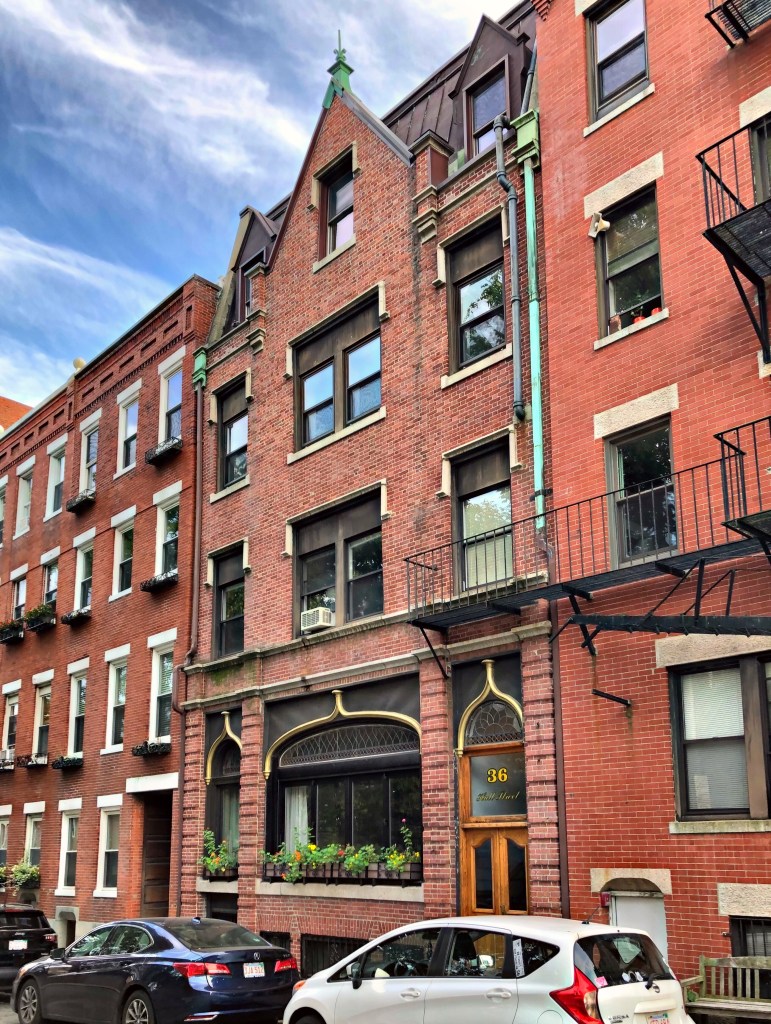
Constructed for the Woman’s Home Missionary Society of the Methodist Church of New England, this building was associated with the Hull Street Medical Mission from the time of its construction, in 1901, to about 1950. The mission was one of a number of church-related social service programs established in the North End in the late 19th and early 20th centuries to address the needs of recent immigrants, namely the Russian Jews, Italians, and Portuguese residing in this area of the neighborhood. In 1909-1910 alone, 14,574 treatments were given in the clinic, providing a huge medical service to the widely low-income immigrant community of the North End [29th Annual Report, 154]. The Medical Mission closed in the early 1950s and the property was later sold and converted to apartments. It was designed by architect Walter Forbush, who utilized ogee arches and leaded glass windows, adding much flair to the building’s design.
One of the most visited buildings in New England is the stunning Old North Church in the North End of Boston. Old North Church (originally Christ Church in the City of Boston) was established when the cramped original King’s Chapel, then a small wooden structure near Boston Common, proved inadequate for the growing number of Anglicans in the former Puritan stronghold. Subscriptions for a new church were invited in 1722. The sea captains, merchants, and artisans who had settled in Boston’s North End contributed generously to the building fund, and construction began in April, 1723. The church was designed by William Price, though heavily influenced by Christopher Wren’s English churches.
Before the American Revolution, both Patriots and Tories were members of the church, and often sat near each-other in pews, clearly adding to bubbling tensions. The enduring fame of the Old North began on the evening of April 18, 1775, when the church sexton, Robert Newman, and Vestryman Capt. John Pulling, Jr. climbed the steeple and held high two lanterns as a signal from Paul Revere that the British were marching to Lexington and Concord by sea across the Charles River and not by land. This fateful event ignited the American Revolution.
A full scale restoration of Old North was carried out in 1912-14 under the direction of architect R. Clipson Sturgis and a number of 19th century alterations were then eliminated. In this work, floor timbers and gallery stairs were replaced, the original arched window in the apse at the east end was replaced, and the old square box pews and raised pulpit were reconstructed. Additionally, the interior woodwork was incorrectly repainted white rather than the rich variety of original colors described in the early documents of the church, clearly submitting to Colonial Revival sensibilities. The iconic white steeple is also not original. The original steeple of the Old North Church was destroyed by the 1804 Snow hurricane. A replacement steeple, designed by Charles Bulfinch, was toppled by a hurricane in 1954. The current steeple uses design elements from the original and the Bulfinch version. Even with all these differences, Old North lives up to her name and stands proudly as a symbol of freedom and revolution.
One of the most photographed buildings in North End is arguably this tenement block, built in 1895 at the corner of Prince and Salem Streets. As the North End continued to redevelop into a diverse immigrant community, tenement houses were constructed by those with the means, providing housing at low cost to those who arrived to Boston in the late 19th and early 20th centuries. Max and Etta “Ethel” Lebowich, Russian Jews, immigrated to Boston, settling in the Jewish quarter of the North End and opened up a dry goods store at the corner. The business did well, and the couple redeveloped their land and hired Swedish-born architect Charles A. Halstrom, to design the prominent apartment house. The Renaissance Revival building features massive pressed metal oriels and brick and stone construction. I am unsure if the oriels are truly copper, which would have been fairly expensive for a tenement building, or if they are pressed tin. Any insight would be much appreciated.
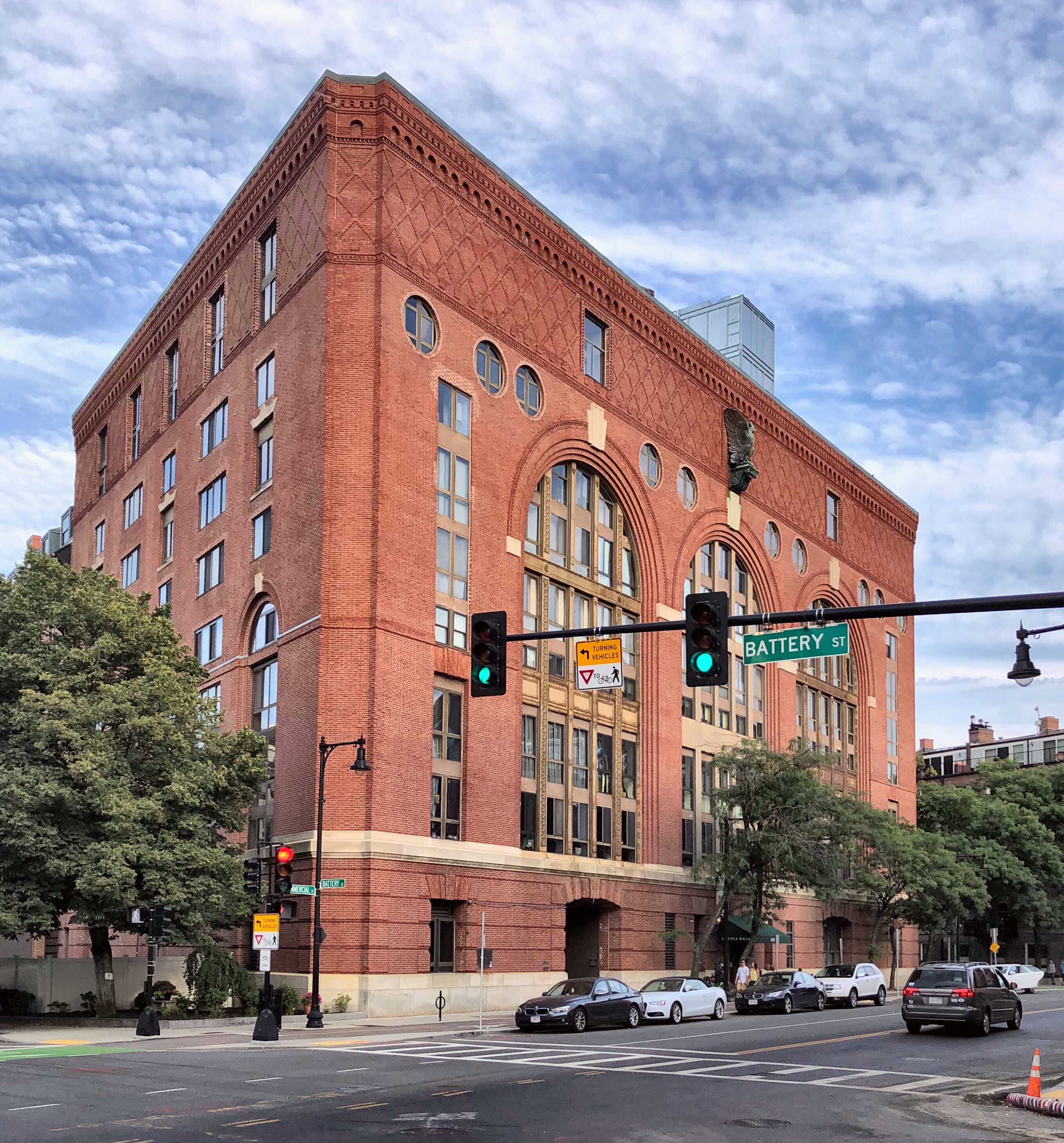
Back in the day, even power stations were gorgeous!
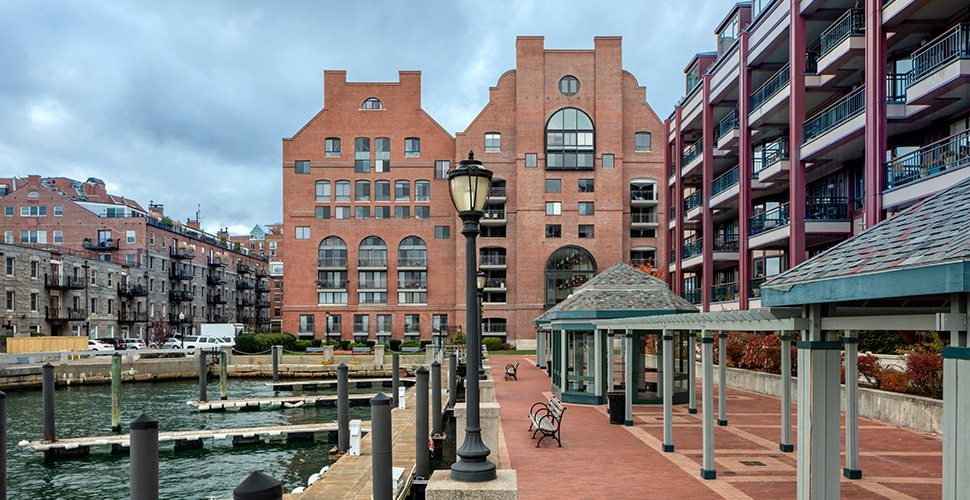
The Boston Elevated Railway Company, and its successor, the Massachusetts Bay Transportation Authority (MBTA), operated Lincoln Wharf Power Station from 1901 to 1972. The Boston-based engineering firm of Sheaff & Jaastad, specialists in electric power and lighting plants, designed this 1901 power station to serve the Atlantic Avenue Line and provide supplementary power for the Downtown Boston elevated and surface lines. Due to increased demand in 1907, a massive addition was constructed at the rear, facing Commercial Street, which now is the main orientation of the large structure. By 1971, all elevated tracks powered by this station were removed and the power station was sold by the MBTA to a private developer for housing. Eventually, San Marco Housing Corporation, hired the Boston Architectural Team, Inc., to renovate the power station in 1987 for low- to moderate-income housing. The result is an innovative and stunning example of adaptive reuse providing much-needed housing, while retaining historic fabric of old Boston.
After the American Civil War, the North End of Boston saw a massive phase of redevelopment, replacing the dilapidated wooden dwellings with larger brick tenements to house the neighborhood’s growing immigrant population. Nearly all of the North End was replaced with these dwellings, which has now added so much to the appeal of the neighborhood. One of the earliest and notable examples is this building on Endicott Street. Built around 1875, the tenements were owned by George T. McLauthlin (also spelled McLaughlin), who owned the engineering and machinery company on Fulton Street, housed in one of the last remaining cast-iron facades in Boston. The tenement house was later owned by George’s son Daniel, likely providing housing for the company’s employees and/or providing additional income for the family. The building also appears to have always had commercial use on the ground floor, allowing merchants to also rent the space. The late-Italianate panel brick block is modest in design, but contributes to the diverse population and worker’s housing in the North End.





 Buildings of New England