Tudor Barn // c.1845

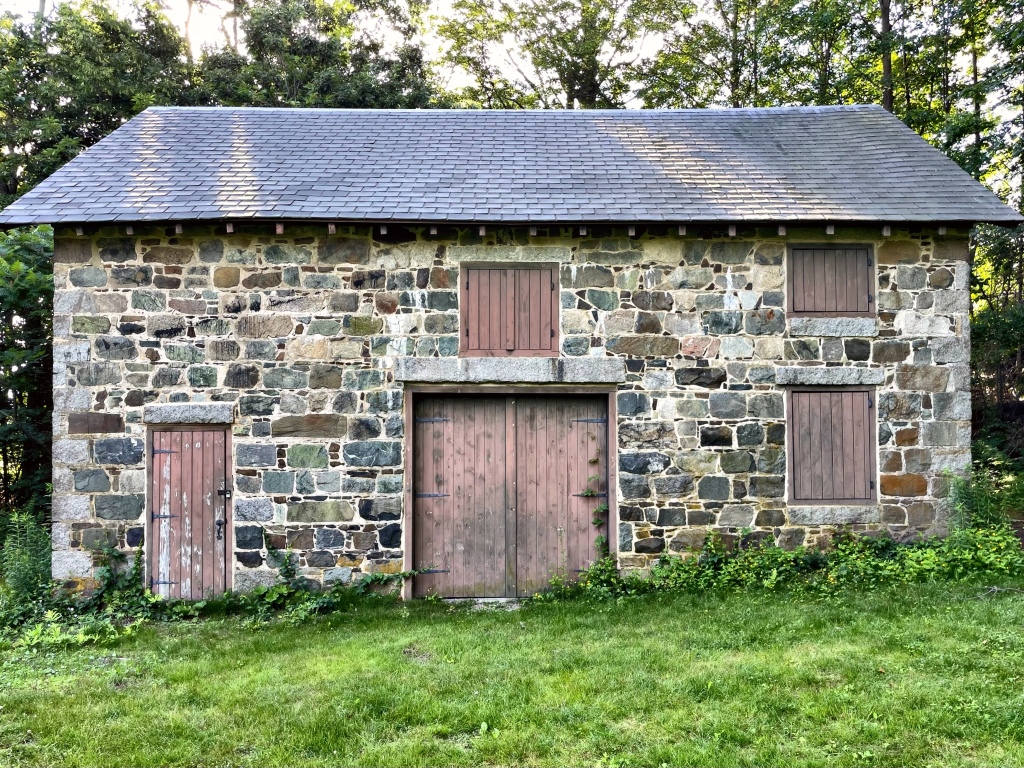
Built in the 1840’s as a carriage barn, and once attached to a nearby mansion now gone, this barn sits near the eastern shores of Spot Pond, a major feature in the Middlesex Fells Reservation, just north of Boston. The barn sits in Stoneham, Massachusetts, and was a part of Frederic Tudor’s rural estate out in the “country”. Frederic Tudor is best known as Boston’s “Ice King”, he was the founder of the Tudor Ice Company and a pioneer of the international ice trade in the early 19th century. He made a fortune shipping ice cut from New England ponds to ports in the Caribbean, Europe, and as far away as India and Hong Kong. After the turn of the 20th century, many of the buildings surrounding Spot Pond were razed as to secure the watershed, protecting the surrounding town’s drinking water. Frederic Tudors large estate was razed, but the barn survived. Years of deferred maintenance and lack of preservation by the late 1990’s made the old barn threatened with demolition. This was exacerbated by a fire damaging the roof and in 2003, a wall collapsed. Local preservationists rallied together to acquire funding (both private and public grants) to restore the building. It remains a highlight on the walks around Spot Pond and Middlesex Fells Reservation, and is a visual link to the earlier days in what was once remote “Boston”.

Old Platte Clove Post Office // c.1885

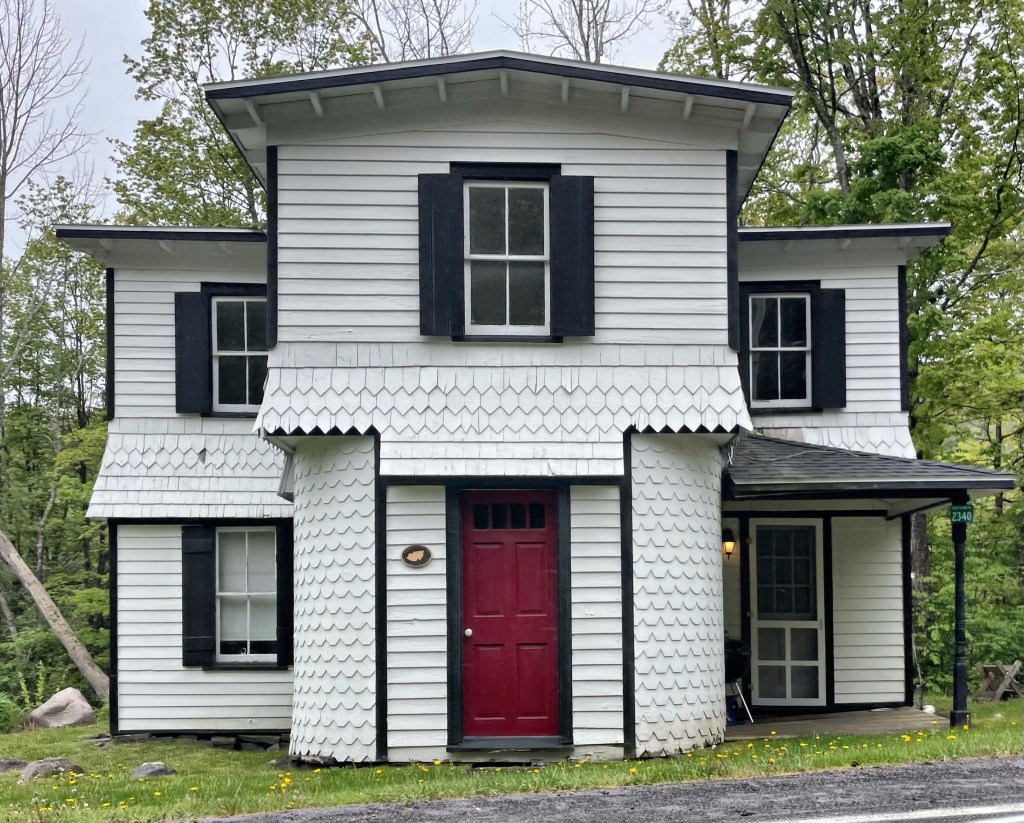
Believe it or not, but I occasionally venture out of New England, and a favorite place of mine to explore is Upstate New York. On a recent trip, I ended up driving through the tiny town of Hunter, New York, located in the middle of the Catskills. This charming little building was constructed c.1885 as the Platte Clove Post Office. The building was constructed to serve a rural portion of the town and was built as an early mixed-use building with the post office at the ground floor and small residence upstairs for the postmaster to live. The exterior cladding features both shingle and clapboard siding with overhanging eaves. The post office here ceased by 1911 and the use reverted solely to residential.

Oliver Walker House // c.1809

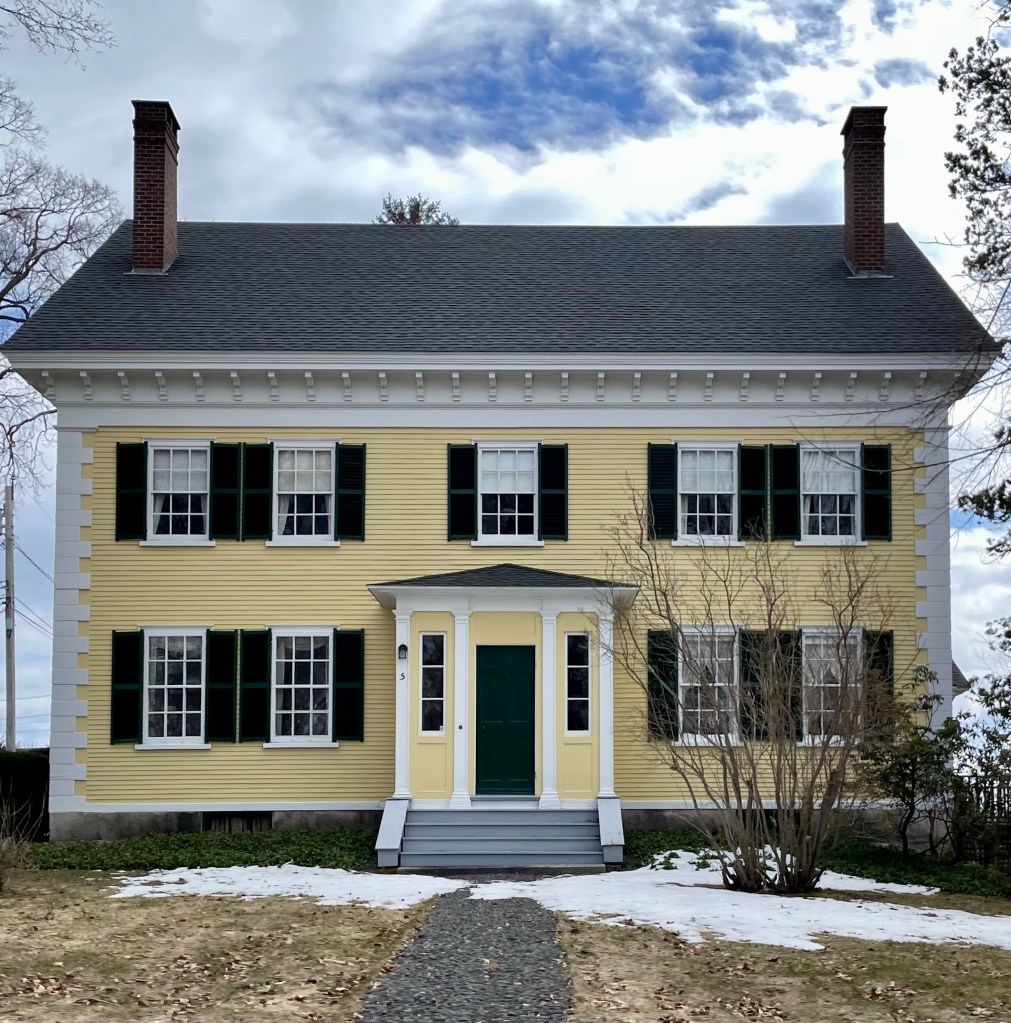
The Oliver Walker House in Kennebunkport Village is one of the better examples that shows how overlapping architectural styles can work really well on an old house (when done right)! The original house was constructed around 1809 for Oliver Walker (1788-1851), a sea captain who later accepted the call and became a deacon for the South Congregational Church in Kennebunkport. Walker died in 1851 and the Federal style property was inherited by his only surviving child, daughter Susan, who had married Portland native, Captain John Lowell Little. Under their ownership, the traditionally designed Federal house was modernized with fashionable Italianate style modifications of the decorative brackets and an enclosed round arched window in the side gable. A later Colonial Revival projecting vestibule adds to the complex, yet pleasing design. I have a feeling the interiors of this house are just as spectacular as the exterior.

William Binney House // 1859

Another of Providence’s stunning monumental Italianate mansions on College Hill is this, the William Binney House, which was built in 1859 from plans by local architect Alpheus C. Morse. In the mode of an Italian Renaissance palace, it features a strong, symmetrical facade, molded string course, classic trim detail at the windows and doors in brownstone, and a shallow hip roof. The original owner, William Binney (1825-1909) was born in Philadelphia and became a prominent attorney and became involved on various boards, building more wealth. Additionally, he was elected as member of the Rhode Island Assembly and the Providence City Council continuously 1857 to 1874. The house’s rear ell and wooden bay would provide sweeping views to Downtown Providence even today from the aptly named Prospect Street.

Jethro Coffin House // 1686

Here it is… The oldest house in Nantucket! The Jethro Coffin House dates to 1686, and when it was built, Nantucket’s English population totaled several hundred, and the native Wampanoag outnumbered them by at least three to one. The home was built seemingly as a wedding gift from twenty-three-year-old Jethro Coffin (1663–1727) to his new sixteen-year-old wife Mary Gardner (1670–1767). The marriage merged two of the old Nantucket families and was built on Gardner family land out of lumber transported to the island from Exeter, New Hampshire, where Jethro’s father, Peter Coffin, owned timberland and a saw mill. The First Period house has small windows of small panes of glass as the material was shipped from England at high cost. The large central chimney would heat the entire home on cold winter nights. Mary and Jethro sold their Nantucket dwelling to Nathaniel Paddack in 1708 and moved to Mendon, Massachusetts, when Jethro inherited property there. By the late nineteenth century, the house was abandoned (for some time it was used as a barn) and had fallen into disrepair. A Coffin family reunion held on the island in 1881 renewed interest in the property and off-island members of the family bought the old Coffin House. The Nantucket Historical Association acquired the house in 1923, and four years later, Historic New England), commenced an extensive reconstruction in an attempt to return the house to its historic appearance. It remains a location of pride for residents and visitors to the island to this day.

Hyde-Richardson House // c.1728

The Hyde-Richardson House is one of roughly twenty remaining pre-Revolutionary War homes in Newton. The home was built for Timothy Hyde (1689-1756) after he inherited the property including 36 acres and a house from his father John Hyde. Timothy had two wives: Rebecca Davis who he married in 1718 and died in 1724 (seemingly in childbirth); and his second wife Sarah Whitmore, whom he married in 1727. The home was likely built soon after his second marriage. It is possible that parts of the original home on the site were reused for this structure. He served as Surveyor of Highways and Constable and in 1710 was drafted to serve with the militia in the successful siege of Port Royal in Canada. In 1761, Jeremiah Richardson bought the property and married his wife Dorcas Hall that same year. Richardson was a deacon and like Timothy, served as Surveyor of Highways. The property remained a farm until the 1930s when the automobile and suburban expansion reached the Oak Hill section of Newton. The farmland was ultimately was subdivided to create the surrounding neighborhood in the mid 20th century.

John Palmer House // c.1683

In 1682, John Palmer acquired a small piece of land in Marblehead, soon after building this First Period home. The house is said to have framing timbers made of English walnut, salvaged from a sailing vessel off shore, with one timber formerly a mast and still displaying rope marks. The house was willed to his son after his death, who built a larger home soon after nearby. This house was “modernized” with double-hung windows which likely replaced the smaller, diamond pane casement windows typical in homes of this period.

Atherton Farmstead // c.1840

This beautiful farmhouse in Cavendish, Vermont is located along a winding dirt road and has ties to one of the town’s original family’s. A home was built here in 1785 and changed hands numerously over the first few decades of its existence. The farmhouse that was built also served as a tavern for travellers along the newly laid out Wethersfield Turnpike. It is possible that the cheap land and rural character of the new town was appealing to some, but reality away from true commerce may have made many sell the farm after a few years, which could explain why the property was bought and sold so often early on. The property was purchased by Jonathan Atherton, a Revolutionary War veteran, farmer, surveyor and lawyer, who acquired large landholdings in Cavendish. In 1821, Jonathan Atherton was sued in court by his neighbor, Jedediah Tuttle for beating Tuttle’s wife Lydia. In order to finance the bonds, Atherton mortgaged all his real estate in Cavendish to his brother Joseph, and Elihu Ives, Jonathan Atherton Jr.’s father-in-law. Atherton St. lost the case and had to pay a fine. The property was eventually inherited by Stedman Atherton, the youngest son of Jonathan, who seems to have demolished the old homestead and constructed the present home on the site. The original dwelling was also the childhood home of Henry B. Atherton, a staunch abolitionist and soldier in the American Civil War, who later served as a lawyer and state legislator for New Hampshire, and his sister Eliza (Atherton) Aiken, a Civil War nurse who has been referred to as America’s own “Florence Nightingale”. The old Atherton farmstead was recently renovated.

Windham County Courthouse // 1825

When the Windham County courts were transferred from Westminster in 1787, they were housed in the village known as Newfane on the Hill. Four decades later, influential residents convinced their townsmen to shift the village down to their land in a flat part of town, a location better suited for waterpower and commerce and ease of travel in the winter months. The first two buildings constructed were the courthouse and jail on a common. The village center grew rapidly as people moved old buildings down the hill and remodeled them or built anew, establishing a particularly unified townscape. This courthouse building is very stately for such a small town and packs an architectural punch. The two-story building is capped with a belfry and was designed in the Federal style with fan motifs over the windows and door. In the 1850s, nearby Brattleboro tried to usurp Newfane’s county seat status, so they in turn expanded the courthouse, raising the ceiling on the upper floor and adding the monumental Doric portico and pediment to give the building a decidedly Greek Revival appearance.

Naulakha // 1893

Located on a hillside in rural Dummerston, Vermont, you will find Naulakha, one of the most significant properties in the region. Naulakha (pronounced now-LAH-kuh) was built in 1893 for Rudyard Kipling an english journalist and author born in British India, an upbringing which inspired much of his professional work. In 1892, Kipling married Caroline Balestier, who was born into a prominent New England family. The couple honeymooned in Vermont near Carrie’s family home. The couple would settle in Vermont in a cottage which was soon outgrown, leading the couple to buy 10 acres of land from Carrie’s brother Beatty Balestier and built their own house. The new Shingle-style home they had built was named Naulakha after a book written by Rudyard and Caroline’s late-brother Wolcott. Kipling wanted a home that merged the distinctive qualities of the Indian bungalow with those of the American Shingle Style and he worked closely with his architect, Henry Rutgers Marshall of New York City, a Balestier family friend to achieve this.

The rectangular mass of the home parallels the contours the hill upon which its sited, and sits atop a raised fieldstone basement salvaged from stone walls on the property. From the home, Kipling wrote some of his most influential work, including the Jungle Books (1894, 1895), Captains Courageous (1896, The Seven Seas (1896), and The Day’s Work (1898). Sadly, the Kipling’s moved out of Naulakha after just a few years, largely from familial disputes with Caroline’s brother, Beatty. The family removed to England where they settled, though Rudyard always mentioned how much he missed his secluded life in Vermont. The property was then purchased by the Holbrook family, who made slight modifications to the property, but all maintaining the original design and feeling. In 1992, the British-based Landmark Trust acquired Naulakha as its first American building, later creating the Landmark Trust USA to maintain the property and more. The Landmark Trust USA rents out Naulakha and the adjacent carriage house for short-term rentals to provide revenue for maintaining these properties.

For more on my stay at the absolutely stunning Kipling Carriage House, check out my later blog post here.