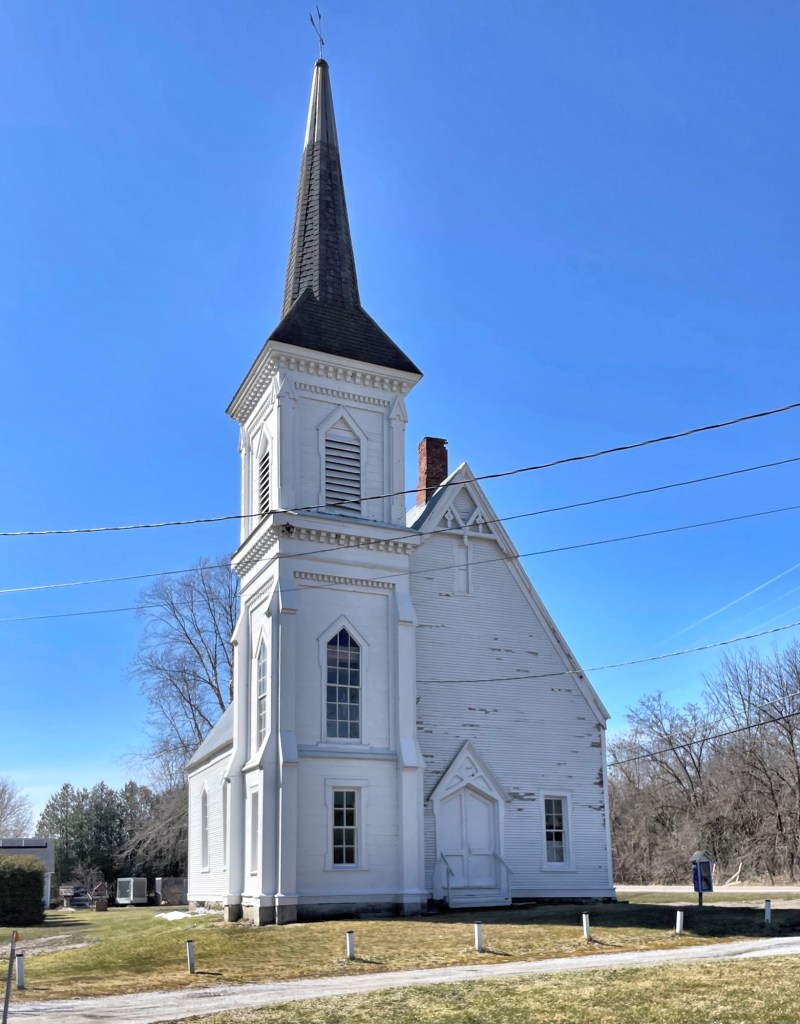
Rural parts of Vermont always surprises me with amazing old buildings. This white wood-frame church is known as the Highgate Springs Union Church, an 1877 edifice which effortlessly blends Victorian Gothic and Stick style details. The building became the village’s union church, providing a worship space for members of all denominations who on their own, could not afford the cost of building and maintaining a building. The small congregations eventually moved out and the church appears to now be largely unused beyond small events or weddings/funerals. I am glad to see it is kept up well at least!
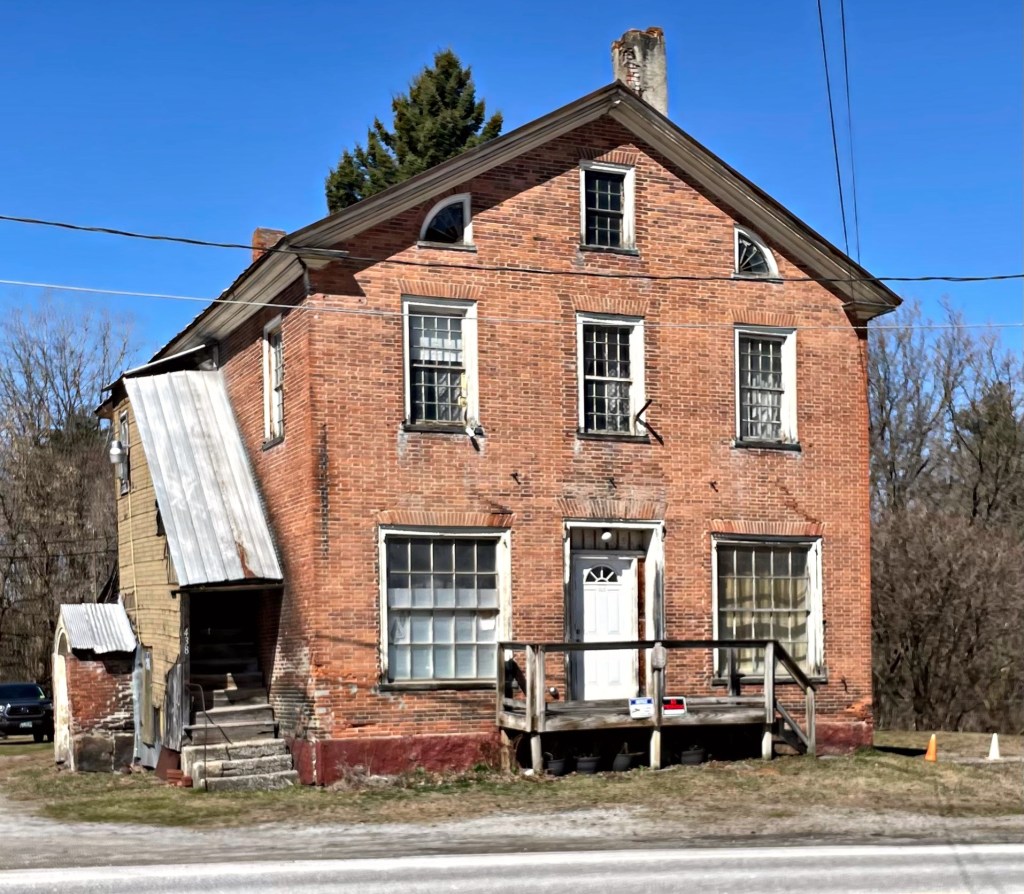
In the small village of Highgate Falls, Vermont you will find this unique Federal period commercial building, and if you are like me, want to know more about it! According to historians, the building was constructed around 1830 and had multiple uses: a U.S. Customs House, a Post Office, and later as a general store for owners Stockwell & Steele. The brick structure suffers from some deferred maintenance, but is a significant piece of vernacular architecture in this sparsely visited part of the state!
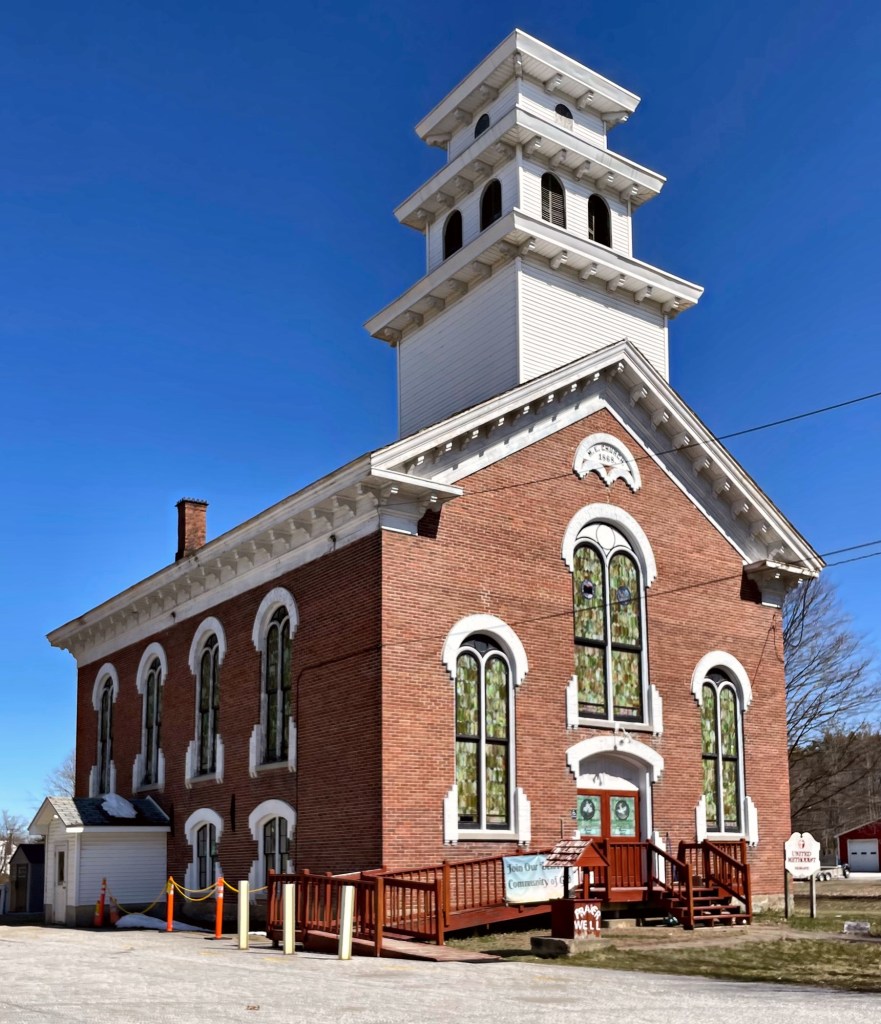
The Highgate Union Methodist Church in Highgate, Vermont was built in 1868 and is a high-style example of the Italianate architecture style in a relatively quiet part of the state. Built of brick, the church’s form is typical for small Vermont churches in the third quarter of the nineteenth century. Here, however, the builders were conscious of Italianate fashion, and they applied its round and segmental arches, corbels, and brackets, painted in a lighter color, with consistency and to remarkable effect.
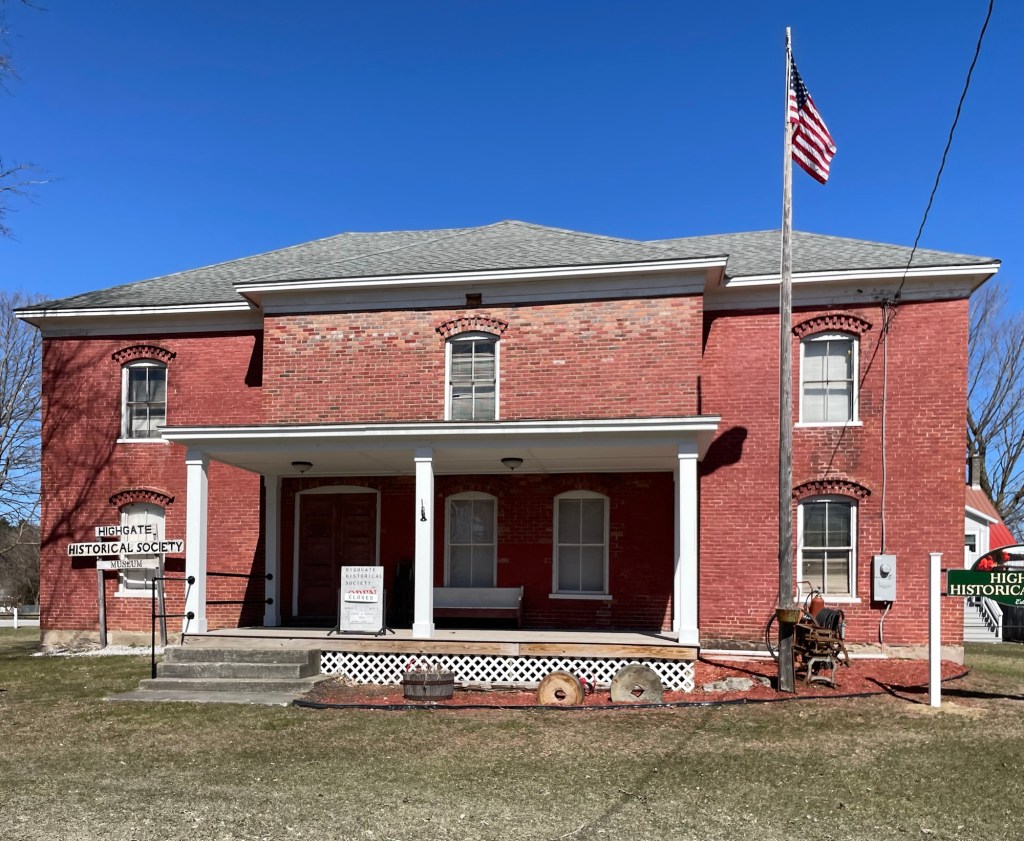
Highgate, Vermont sits at the Canadian border and first white settlement occurred in the 1780s. The new town of Highgate was named after the London suburb of the same name. The town grew in population and was largely a farming town with small industry along the the Missisquoi river. Most houses in town were built in the second half of the 19th century and into the 20th century, like this brick building in Highgate Center. The structure was originally built as a residence for James P. Place (1822-1888), who was employed as Sheriff beginning in 1868. The building may have even included a jail cell! After his death, the building became a catholic school and later became the home of the local Independent Order of Odd Fellows (IOOF) Hall. Today, the former Place House is home to the Highgate Historical Society and used as the town’s museum.
One of the most unique houses in Connecticut is this massive Federal style residence located in the small town of Eastford. Built next to the Congregational Church of Eastford (1829-2023), which burned down in 2023 by arson, the massive house has been known as both the Benjamin Bosworth House and Squire Bosworth’s Castle due to its first owner, Benjamin Bosworth (1762-1850). According to the Bosworth Family, the house was built in 1800 by Bosworth was a wealthy merchant, who hired Vini Goodell, a local carpenter to design and build the large Federal home. The house was completed by 1801 when the local Masonic group met in the building. As Bosworth was also a merchant, he used the basement as a storeroom. The house is also unusual for its monitor roof, a rarity in Federal period construction, which reads like a second structure on the house, due to the building’s size. After Bosworth’s death, the house was occupied by his niece, and was later purchased by Elisha Grant Trowbridge in 1897. Trowbridge was a grand-nephew of General Nathaniel Lyon (1818-1861), a local hero who was the first Union general killed during the Civil War. Trowbridge, an engineer, lived here until he died in 1963 at the age of 96. Later owners have had the monumental task of restoring and maintaining this behemoth of a house, to great success.
Methodists established a small congregation in Eastford, Connecticut by 1826, and by 1831, a new meeting house was built in the center of the village. The meeting house was used jointly by Methodists and Universalists, each having the right to occupy it half the time. By 1847, Methodists here were able to erect their own church, this building, in the Greek Revival style. Originally, the building had two doors on either side of a center window in the façade. There was a steeple and, rare in those days, a pipe organ in the sanctuary. In 1916, the church joined with the nearby Congregational church, requiring them to sell the building ten years later. The town of Eastford bought the structure for $200 in 1926 for use as a town hall. In 1934, the Civil Works Administration provided funds to renovate the building with the town library being installed in a portion of the basement along with town offices and a vault. Town meetings were held in the former sanctuary space upstairs. When the space was outgrown for town offices, a new building was constructed elsewhere and this building transitioned to solely library use. The renovation project was paid for by money bequeathed by Wilmer Glenn, a New York stockbroker who spent summers town. He donated funds in memory of his late wife, Ivy. The present-day name of the building came to be the Ivy Glenn Memorial and the library moved into its new spacious home in 1972.
I don’t think any state does the Federal style as well as Connecticut (Massachusetts is a close second)! This is the Sumner-Carpenter House, a high-style example of a Federal residence that is located on the backroads of the small town of Eastford, Connecticut. The house was built in 1806 for John Newman Sumner (1775-1831) who resided here until just before his death. The elaborate Federal period house was sold out of the family. After trading hands a half-dozen times, the property was purchased by David and Harriet Carpenter in 1881. The property remained in the Carpenter family for generations, and remained as such after Orlo Carpenter (1865-1938) was killed in the collapse of a barn during the hurricane of 1938. Architecturally, the house has all of the hallmarks of the Federal style, with the symmetrical main facade five bays wide, with a center entrance flanked by wide sidelights, and topped by a fanlight transom and corniced entablature. The window above the entrance is in the Palladian style, with a rounded center window flanked by narrower sashes. The house is very well preserved and was listed on the National Register of Historic Places for its architectural quality and preservation.
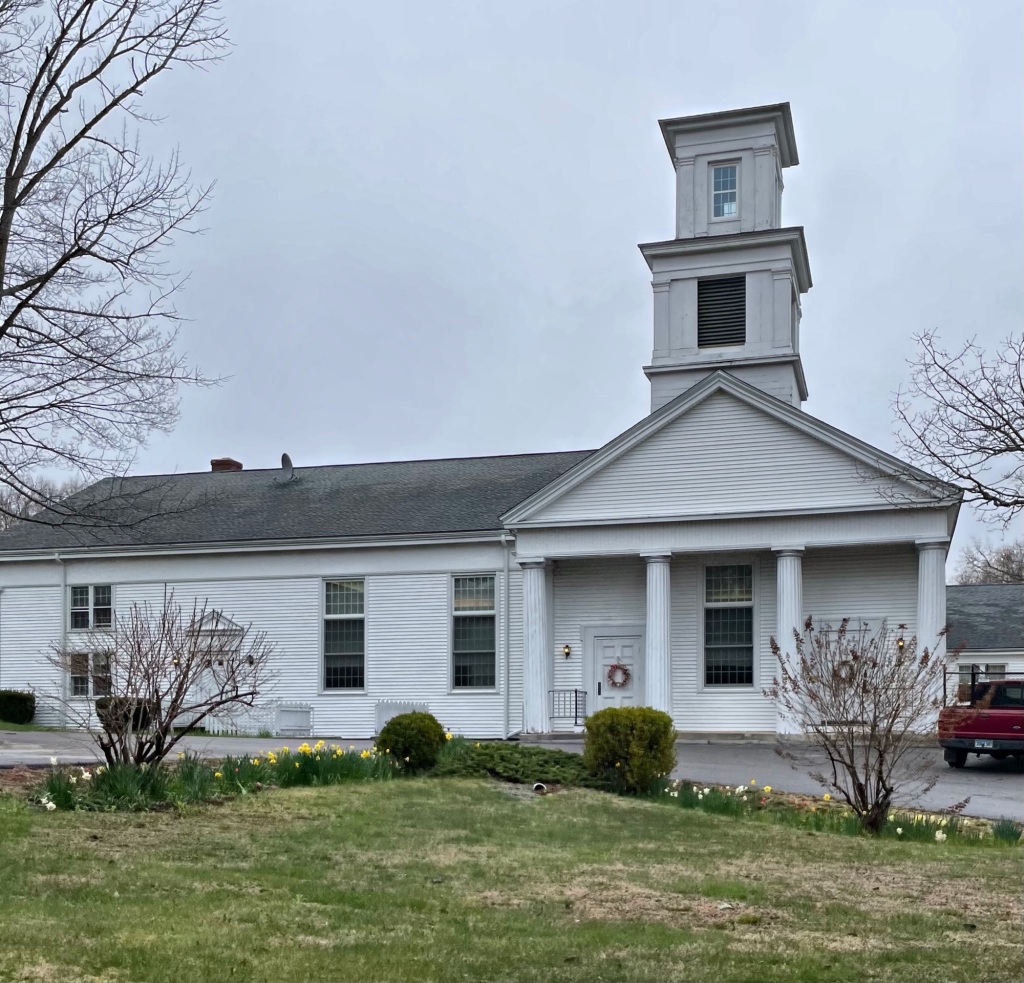
One thing so many small New England towns have are charming wood-frame white churches from the first half of the 19th century, Eastford, Connecticut is no exception. In 1793, a Baptist Society was organized at Northford (then a part of Ashford), and the first pastor, Daniel Bolton, oversaw construction of the first church there. Fifty years later, the congregation grew and their finances allowed for the construction of this Greek Revival style church in 1843. The building was added onto for a Ladies Benevolent Society and a Sunday School, giving the structure its larger appearance today. While the church is today is covered in later siding, the building is well-maintained and the original siding is likely underneath for a future restoration.
We featured Ashford, Connecticut, so now it’s time to explore some of neighboring Eastford! Settled in the early 1700s, the eastern portion of Ashford separated from its parent town in 1847, and became the town of Eastford. Prior to this, light industry, such as the production of cotton batting, twine, and wooden handles, complemented what would remain a predominantly rural agricultural community well into the 20th century. The winding back roads are lined with charming farmhouses bounded by rugged historic stone walls, making the town retain its rural feel. When driving through, I stumbled upon this postcard-worthy historic farm complex. Historic maps show that the property was owned by D. Bartlett in 1869, which appears to be Daniel Bartlett (1812-1898). The Bartlett property is enhanced by two historic barns sited nearby on a bluff overlooking the fields, which were likely once lined with trees or crops. By the 1900s, the property was owned by Nicholas and Clementine Dechand, the small road leading up to the farmhouse was named after the couple.
When the town of Ashford laid out a road across the land of Abner Richmond, he saw it as an opportunity to gift the newly organized plot across the road to his eldest son, Michael and his new wife, Polly as a wedding gift. Michael Richmond (1786-1881) built this Federal style house across the street from his father (see last post), likely employing the same builder, who employed similar design elements for both homes. In early life Michael learned saddle-making and afterward engaged in the manufacture of cloth, also axes. He was also engaged in staging and turnpike building, and in the mercantile business, until he retired at 60 years of age. He was a man of all trades! The house is now home to BOTL Farm, a pasture-based, sustainability-focused livestock farm that raises pigs, lambs, goats, and chickens ethically. Gotta love seeing farming coming back to Connecticut’s “Quiet Corner”!




 Buildings of New England
