Highgate Springs Union Church // 1877

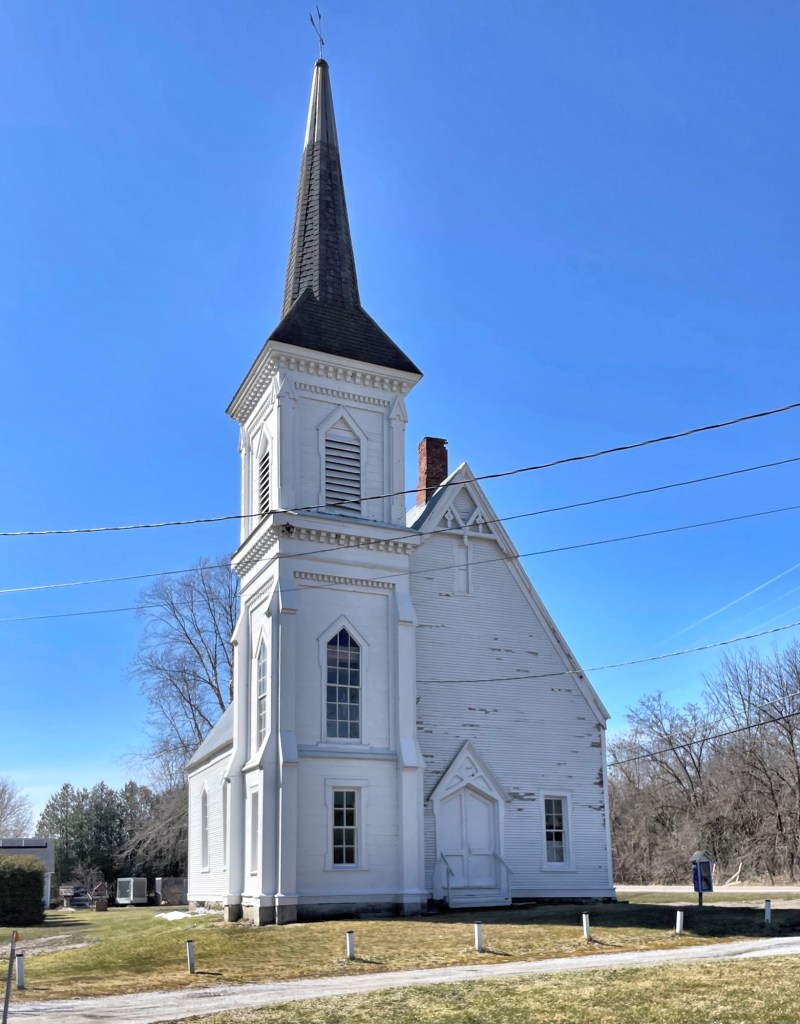
Rural parts of Vermont always surprises me with amazing old buildings. This white wood-frame church is known as the Highgate Springs Union Church, an 1877 edifice which effortlessly blends Victorian Gothic and Stick style details. The building became the village’s union church, providing a worship space for members of all denominations who on their own, could not afford the cost of building and maintaining a building. The small congregations eventually moved out and the church appears to now be largely unused beyond small events or weddings/funerals. I am glad to see it is kept up well at least!
The Congregational Church of Union // c.1841

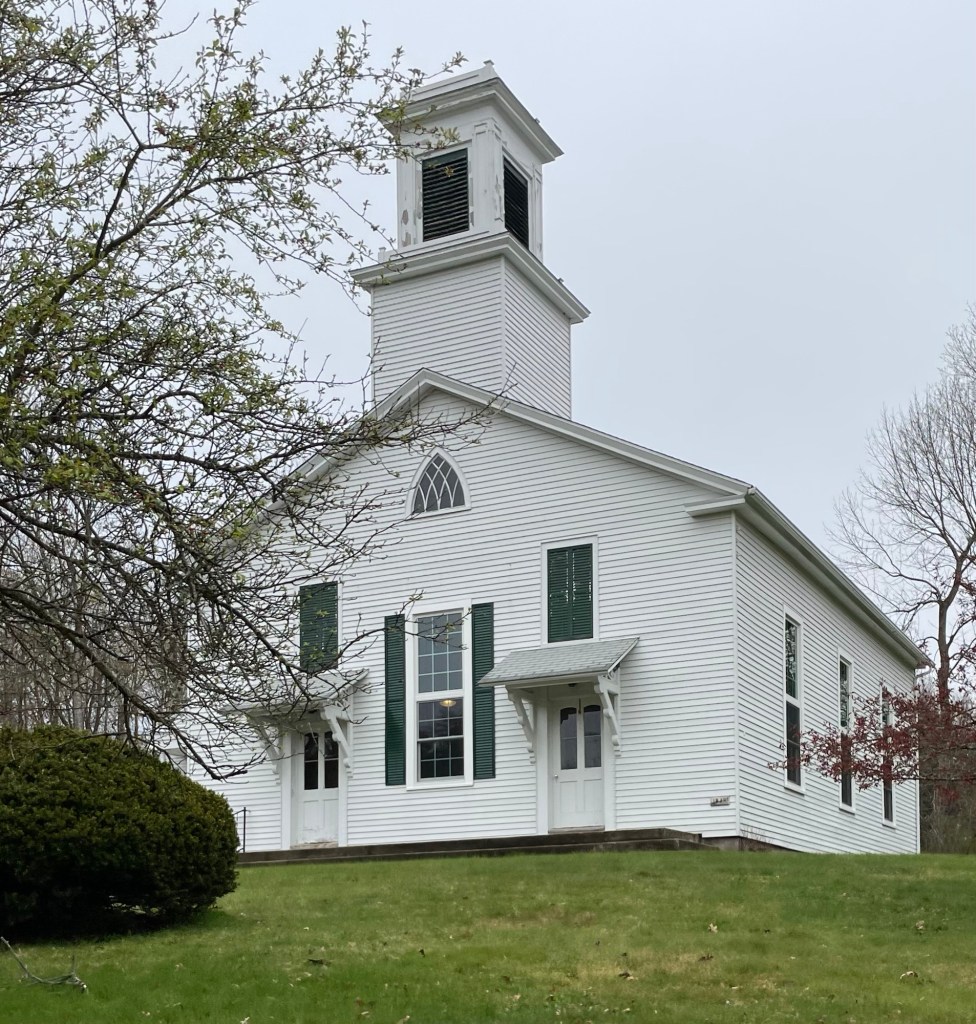
The small town of Union, Connecticut was established in 1734 and as with many towns at the time, religion and community were some of the first things to be codified when settling in a new area. The town’s publicly supported religion, Congregationalism permeated everyday life in Union. Even after disestablishment in 1818, the Congregational church continued as Union’s predominant religious organization well into the twentieth century. By 1841, the members built this edifice, the congregations second, on a hill overlooking the town’s modest green. The vernacular church features a Gothic lancet window, classical belfry, and later pent roof porches over the entrances on the primary facade.

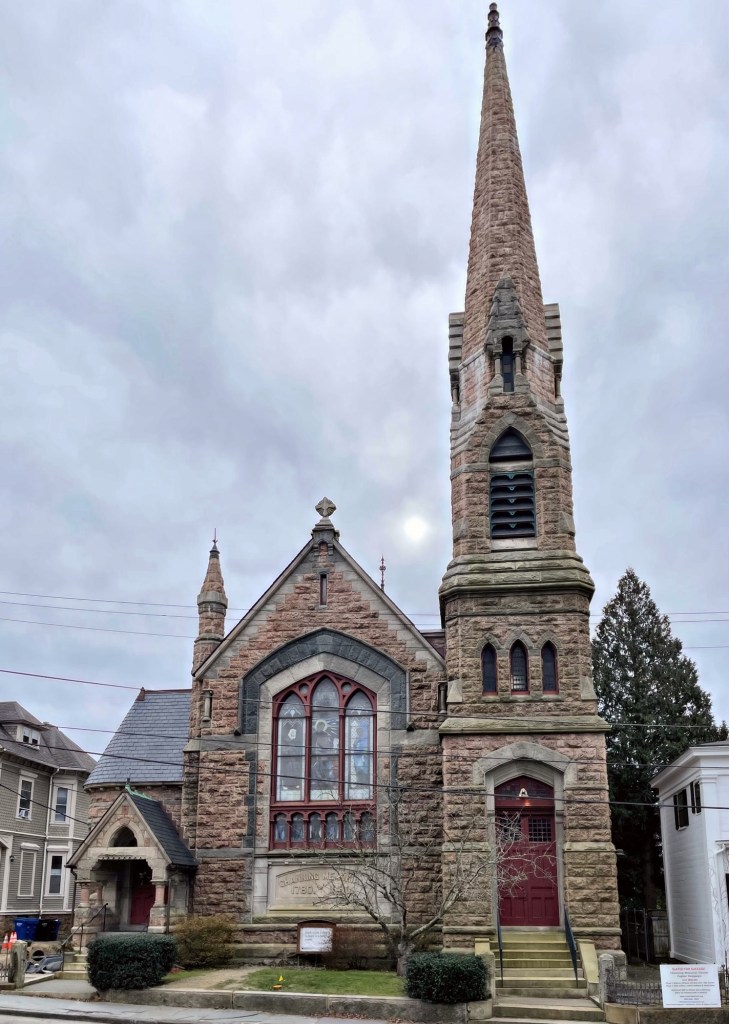
Channing Memorial Church // 1880

The Channing Memorial Church of Newport, Rhode Island was named in the memory of William Ellery Channing (1780-1842), an ardent abolitionist and founder of the Unitarian faith in America. In 1835, ten men formed the first Unitarian Society in Newport in October 1835 and met in the home of Channing’s grandfather, William Ellery, one of the 56 signers of the United States Declaration of Independence. In 1879, the congregation’s minister, Rev. M. K. Schermerhorn, conceived the idea of a memorial to William Emery Channing, whose centenary would be the following year. He decided upon the ambitious project of a new church building and planning began immediately. On Rev. Channing’s 100th birthday, the cornerstone laying ceremony occurred in 1880. The Victorian Gothic stone church designed by Elbridge Boyden took a year to be completed and was was built from granite, cut in Lyme, Connecticut. Inside, two stained glass windows, the first ecclesiastical commission of John LaFarge, flood the interior spaces with warm colored light. The church looks much as it did when completed almost 150 years ago, thanks to an active congregation preserving this great landmark.

Old Swedish Lutheran Church, Newport // 1896

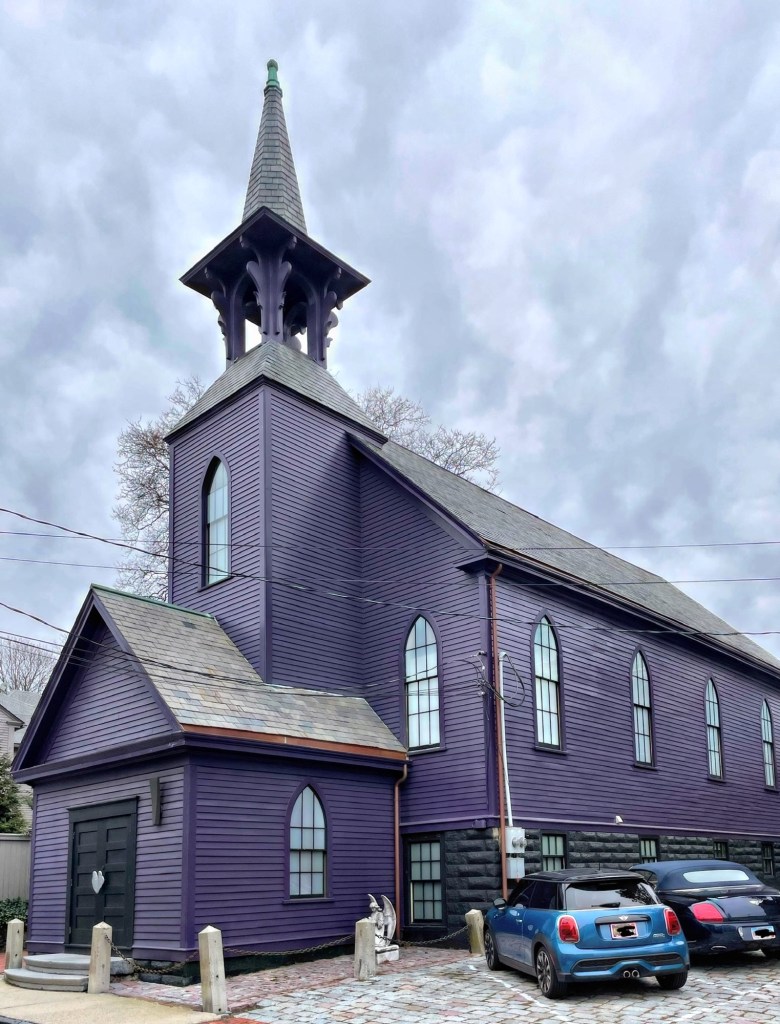
By the end of the 19th century, the summer colony of Newport, Rhode Island continued to see the erection of large summer cottages which required large staffs to maintain them. Scandinavian girls were preferred by the wealthy residents for maids and drivers, and beginning in the 1870s; they joined other ethnic groups, such as the Irish in establishing their own communities in the coastal city. In 1892, organized under the New York Conference of the Augustana Synod, a Lutheran Church for Swedish-speaking residents was established. A small lot on Corne Street was purchased and work began on this small wood-framed church. Completed in 1896, the church was designed by by architect James W. Smith in the Gothic Revival style. It has a central bell tower and a spire and the interior of the church originally had an hourglass pulpit. Gold and white decorations surrounded an oil painting of the risen and ascending Christ. In the 1950s, the congregation purchased land on Broadway in the north end of Newport and built St. Peter’s Lutheran Church. The Corne Street church was sold and is now a private residence.

Second Church of Christ, Scientist, Roxbury // 1915

Breaking ground in 1915, this early Modern church building must have turned heads when it was being built in Roxbury! In October, 1907, a fine lot of land with a house on it, at the corner of Elm Hill Avenue and Howland Street, was purchased for eighteen thousand dollars by a group of Christian Science followers. In October, 1911, a building committee of five was elected by the church, and by the summer of 1914 the building fund had made such satisfactory growth that ground was broken and work for the new structure begun in September. The congregation hired the illustrious architectural firm of Shepley, Rutan, and Coolidge to design the edifice of classic and imposing design. Constructed of gray tapestry brick with limestone trimmings, the auditorium seated upwards of one thousand members, under the dome roof. Today, the building is occupied by Grace Church of All Nations.

First Baptist Church in Newton // 1888

The Boston area has an embarrassment of riches when it comes to Richardsonian Romanesque style buildings, due in part to its namesake, Henry Hobson Richardson lived and worked locally. One of my all-time favorites is the First Baptist Church in Newton Centre. The church was designed by architect John Lyman Faxon, who was clearly influenced by Richardson. The First Baptist Church in Newton is among the oldest Baptist congregations in the state. Baptists were recorded as living in Newton as early as the 1720’s, but growth was slow and marked by persecution. In 1780, a congregation was assembled and the next year a rough, unplastered barn like meeting house was begun alongside Baptist Pond (now Crystal Lake). Fifteen years later, the congregation was finally able to afford a stove; twenty one years later, in 1802, the structure was enlarged. In 1836, the congregation constructed a larger meeting house in a more convenient location, the corner of Beacon and Center Streets. The second building was remodelled in 1856 and 1869 and finally was moved from the site to make way for the present church, the third meeting house, dedicated in November 1888. The First Baptist Church is undergoing some work at the exterior at the time of the photo, but the amazing brownstone trim and the winged creatures on four sides of the octagonal tower still shine!

Sacred Heart Church, Newton // 1899

Built in the Italian Renaissance Revival style by architects Rand & Taylor, the Sacred Heart Church in Newton Centre of 1899 reflects much of the lesser-known history of the affluent suburb of Boston. As Newton’s population nearly doubled between 1870 (12,800) and 1890 (24,000), many Irish Catholic residents who worked in the mills and factories of the Upper and Lower Falls areas of town began to move to the suburbs, taking jobs at households of the affluent class in Newton Centre, as cooks, maids, gardeners and more. Residents of Newton Centre wanted a Catholic Church closer to their homes and work, so they established their own congregation in 1890. As the congregation grew, it was obvious that a new church in Newton Centre would be needed to provide services there. Ground broke on the church by 1891, but it took nearly 10 years until the building was completed. Architect Bertram Taylor of the firm Rand & Taylor, and resident of Newton Centre, is credited with designing the large edifice, which is dominated by twin hipped-roof bell towers. The interior of the church has some of the most elaborate plaster work in the Boston area and stained glass windows lining the walls. Early Pastors of Sacred Heart included two who went on to important posts: Francis C. Spellman (1933-39) became Archbishop of New York; and Richard J. Cushing (1939-44) became Archbishop of Boston.

Head Tide Church // 1838

In the early 19th century, Head Tide was a bustling village within the Town of Alna, Maine, supported by mills at the dam, agriculture and apple orchards, boat building, fishing and forestry. As Head Tide grew in population, village leaders determined to build their own Congregational church so they would not have to travel the three miles to the 1789 Meeting House in Alna Center. The Head Tide Church in Alna, Maine was dedicated in November 1838 and sits on a hill overlooking the village. The Head Tide Church is a handsome rural Maine house of worship which exhibits a combination of Federal style, Greek Revival, and Gothic Revival elements in its design. The facade displays the outline of a Grecian temple front with its six pilasters and strongly accented triangular pediment. The Federal fan motif appears above the two facade windows as well as in the center of the pediment and the Gothic Revival influence is felt in the two pointed arch windows on either side of the church and in the simple pinnacle at the top of each corner of the belfry. The church is a high-style building for the rural Maine village and is kept very well by the community. The congregation disbanded, but the church remains an important part of the town and is rented for memorial services, events, weddings.

Bunker Hill Baptist Church // 1889

The Second Baptist Church of Jefferson, Maine, was organized in 1808 and originally rented a schoolhouse for its services. After eighty years of cramped-quarters, the members of the church had enough funds to erect their own purpose-built church, this stunning edifice on Bunker Hill Road, in West Jefferson. The congregation broke ground in 1889 and the church was dedicated in January of 1890. Apparently, the belfry was originally at the center of the roof, but the heavy bell required a new steeple to be built at the corner, in its present configuration. This well-preserved church building was a treat to stumble upon when driving through the town.

Newport Congregational Church // 1857

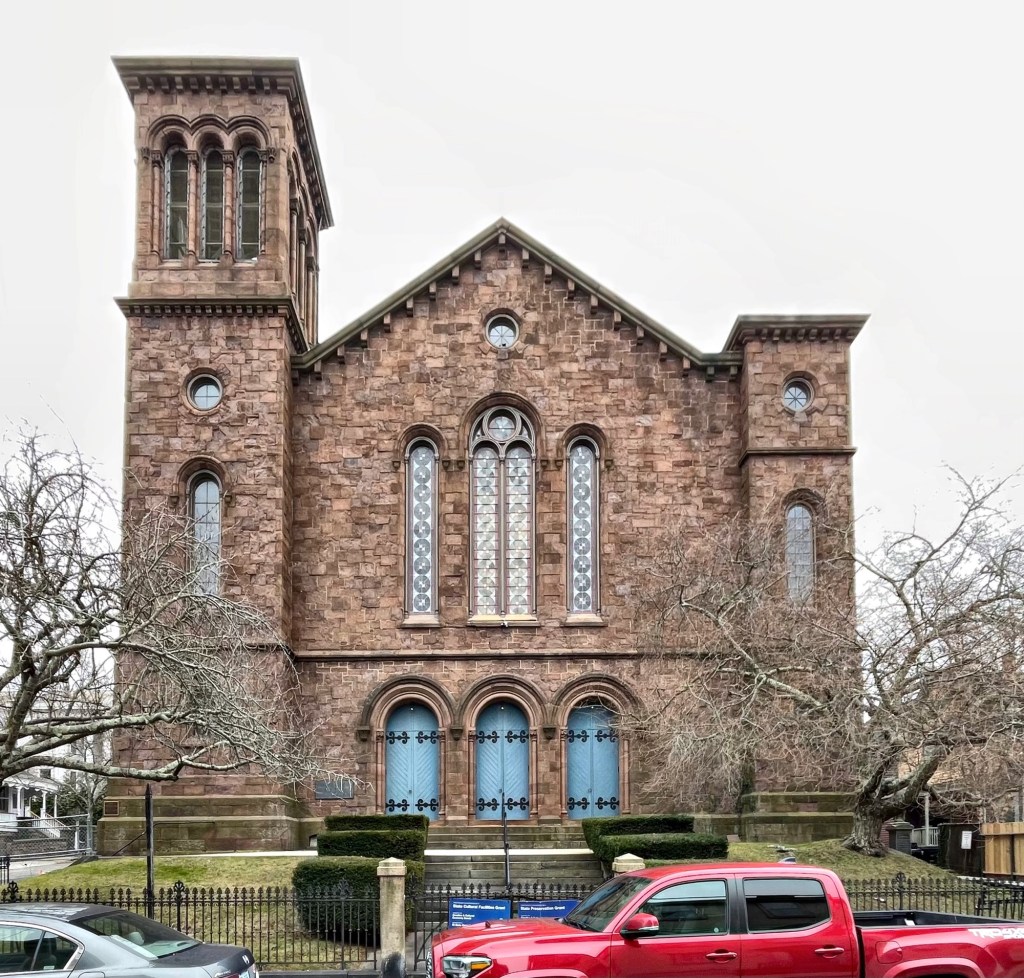
The Newport Congregational Church on Spring Street was built between 1855-1857 and serves the United First and Second Congregational parishes of Newport whose history began in the late 17th century. The building, designed by Joseph C. Wells a New York City architect, and redecorated on the interior in 1880 by John LaFarge, is an interesting and well-preserved example of the Romanesque Revival, brownstone churches of the mid 19th century. LaFarge had recently completed work on H. H. Richardson’s landmark Trinity Church, Boston, and sought to provide a more elaborate interior than he was able to in Boston. He produced twenty stained glass windows and a series of murals, which today, represent the only fully integrated ecclesiastical interior he produced. The congregation has shrunk in recent years and moved to nearby Middletown, but it’s vestry was committed to the preservation of La Farge’s work. The LaFarge Restoration Fund was established and since the 1990s, the nonprofit has spent $3 million on glass and mural restoration, architectural stabilization and systems upgrades for their former building. The building is used occasionally as an arts center.