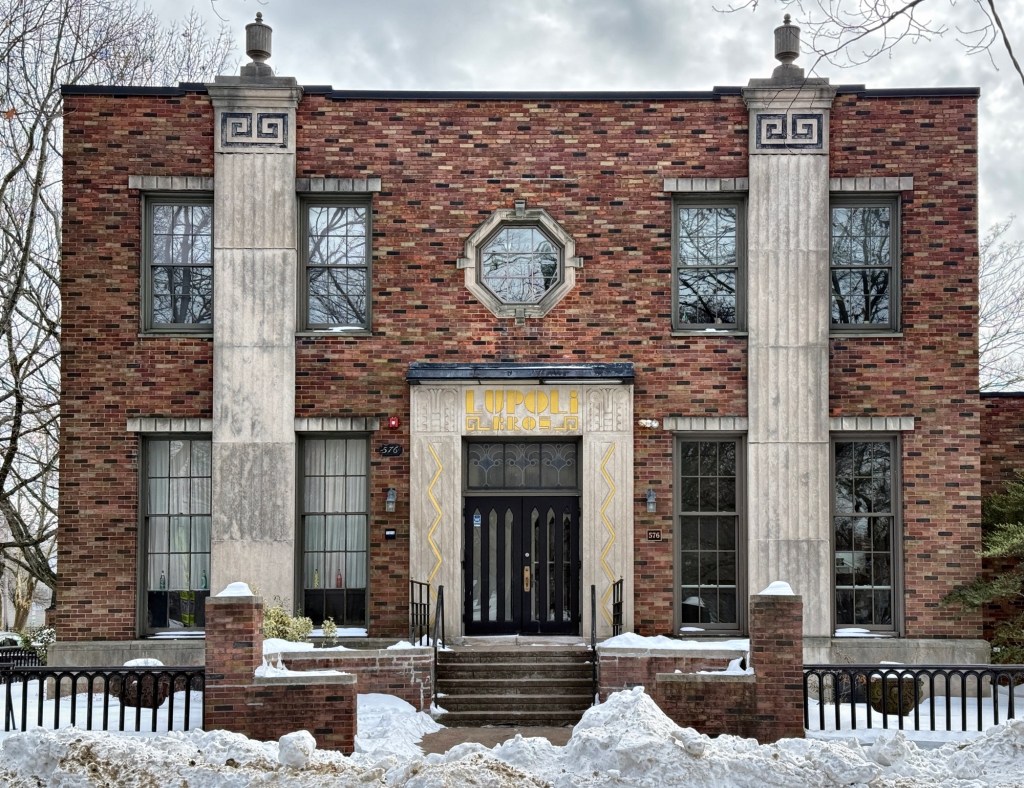
Former Lupoli Brothers Funeral Home – H. L. Hotchkiss House and Stable // 1841 & 1935

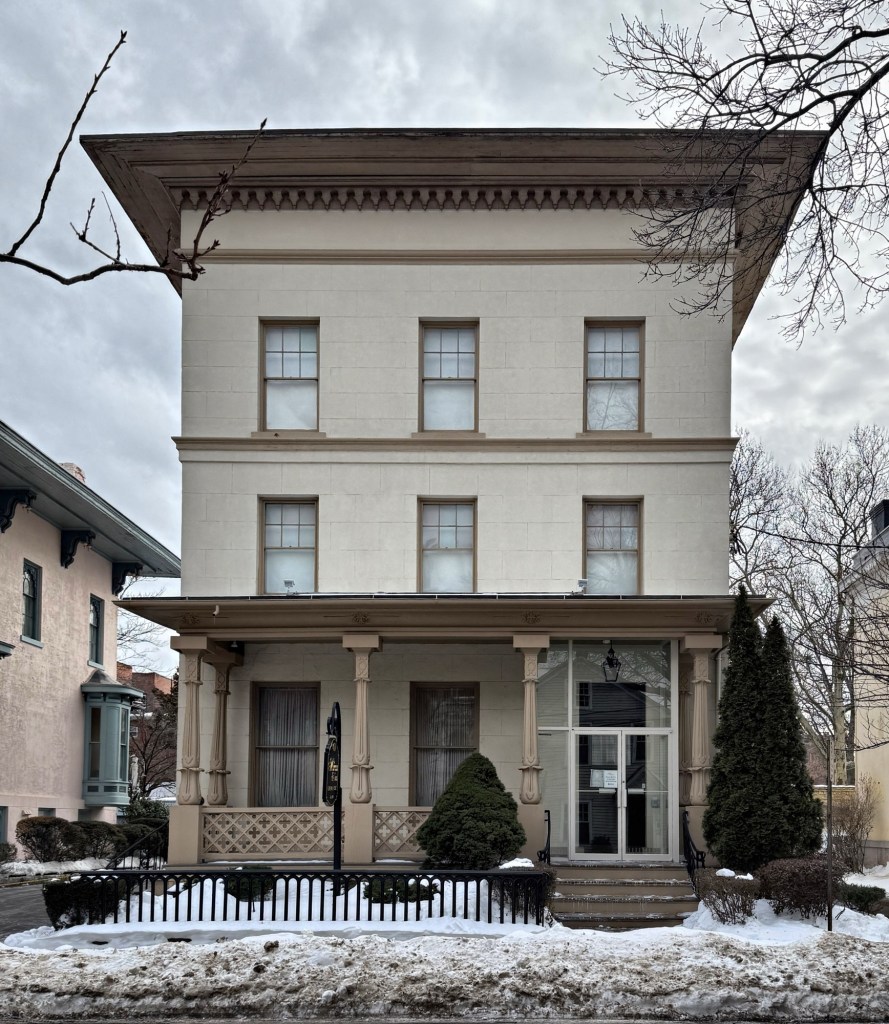
A rare example of the Art Deco architectural style in New Haven, the former Lupoli Brothers Funeral Home on Chapel Street in Wooster Square is more than meets the eye! This Art Deco jewel box was originally constructed in 1841 as a large, single family home and modernized nearly 100 years later in its current design. In 1841, Henry Lucas Hotchkiss (1810-1861), a businessman and president of the L. Candee Rubber Company, had a two-story Greek Revival style home built on this lot for his wife, Lucy. The home was originally two stories, but a third floor was added in the 1860s, around the time the rear stable (still extant) was constructed, for another owner. In the early 20th century, as the Wooster Square neighborhood became a center of Italian-American life and business in New Haven, the property was purchased by Liberato Lipoli (1862-1934) who moved to Connecticut from the Piedmont region of Italy. A year after their father’s death, sons Mario, Gennaro, Antonio and Louis Lupoli, established a funeral parlor catering to the local Italian American community. In 1935, the Lupoli Brothers hired local architect, Lester Julianelle to reimagine the former Hotchkiss House in a modern style. The result is the refaced building with Classical Revival and Art Deco elements including the iconic entry reading, “Lupoli Bros” in the iconic lettering. The Lupoli’s closed the parlor here in 2008 and the building was converted to eight condominium units.
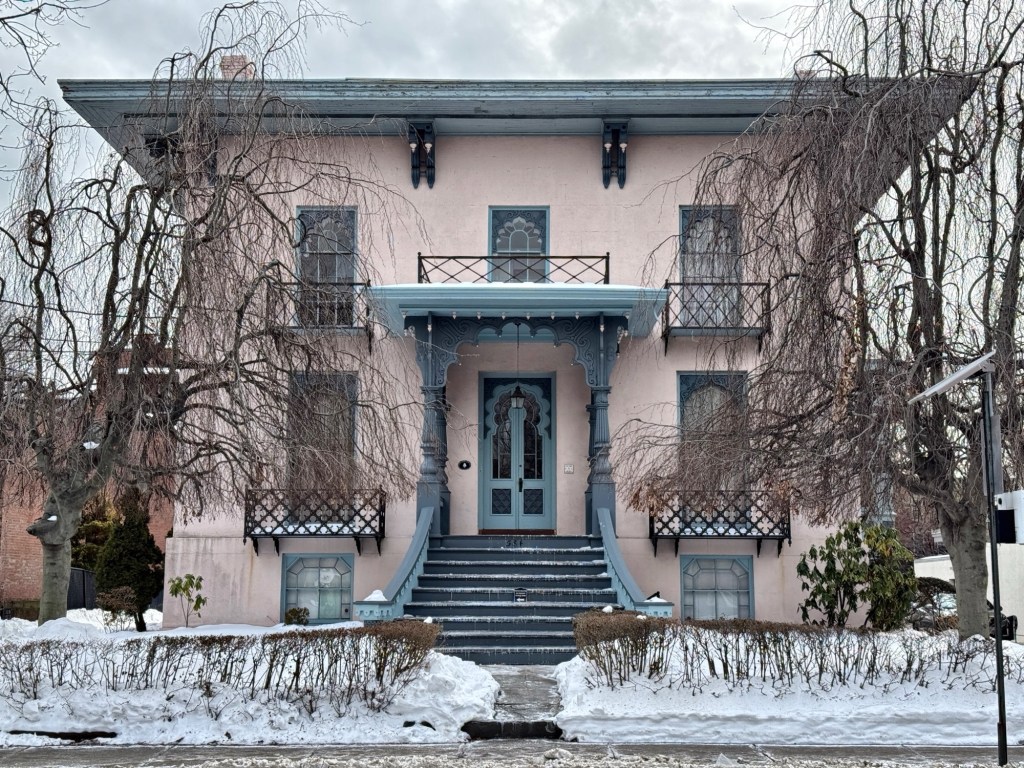
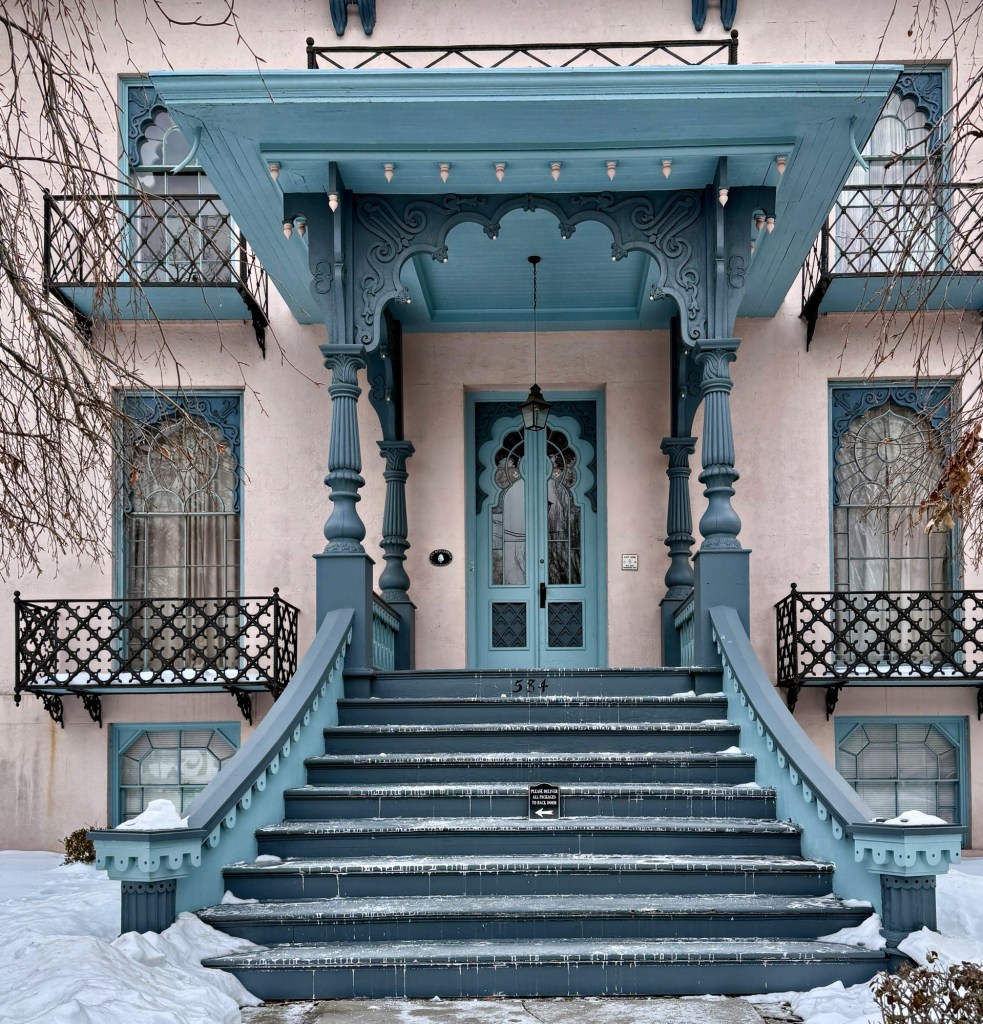
Willis Bristol House // 1845

The Willis Bristol House on Chapel Street in the Wooster Square neighborhood of New Haven, Connecticut, is one of the finest and most architecturally distinctive residences in New England. Built in 1845 for Willis Bristol (1804-1875), a partner in the shoe manufacturer of Bristol & Hall, the home was designed by Connecticut architect, Henry Austin, who designed many of the other great mansions in Wooster Square around this period. The Bristol House is Italianate in style with Exotic Revival detailing which has often been described as Moorish Revival, but it is actually more Indian Revival, an extreme rarity in 19th century New England. It is believed that Henry Austin was influenced by an illustration of columns and capitals at the Ellora Caves in India published by Henry Repton in Designs for the Pavilion at Brighton (1808) and through this worked picked up a fascination with Indian architecture that was to influence his designs in the mid-19th century. Many of Austin’s designs in Wooster Square feature these Indianesque columns on their porches. The Willis Bristol House remained in the family until 1876 and was subsequently used as a congregation house, school, beauty parlor, and presently as apartments. The owners should be commended for preserving and protecting this ornate and unique residence for all to enjoy.

James E. English House // 1845

The oddly proportioned James E. English House stands on Chapel Street in New Haven’s Wooster Square neighborhood and remains one of the most interesting mid-19th century residences in the city. Built in 1845 for James Edward English (1812-1890), a prominent businessman who later became Governor of Connecticut and U.S. Senator. James English started his career as a carpenter and expanded to open the English & Welch Lumber Company. He was a savvy businessman and helped restructure the New Haven Clock Company into one of the largest clock manufacturers in the region. From his success, he purchased property in the new fashionable Wooster Square district and moved into this residence which was designed by architect, Henry Austin, who designed many other homes in the neighborhood. English got engaged in politics and served as the 43rd and 45th Governor of Connecticut and later as a U.S. Senator (1870-1871). Upon returning to Connecticut, James English continued his lumber business and with his own product, expanded his Wooster Square home, vertically. In the mid-1870s, the house, which was originally two stories, was given a third floor, creating the strong vertical proportions we see now. Today, the James E. English House operates as the Maresca & Sons Funeral Home, one of the many prominent Italian-American-owned businesses that helped revitalize the neighborhood in the 20th century.

Wooster Square Brownstone Row // 1871

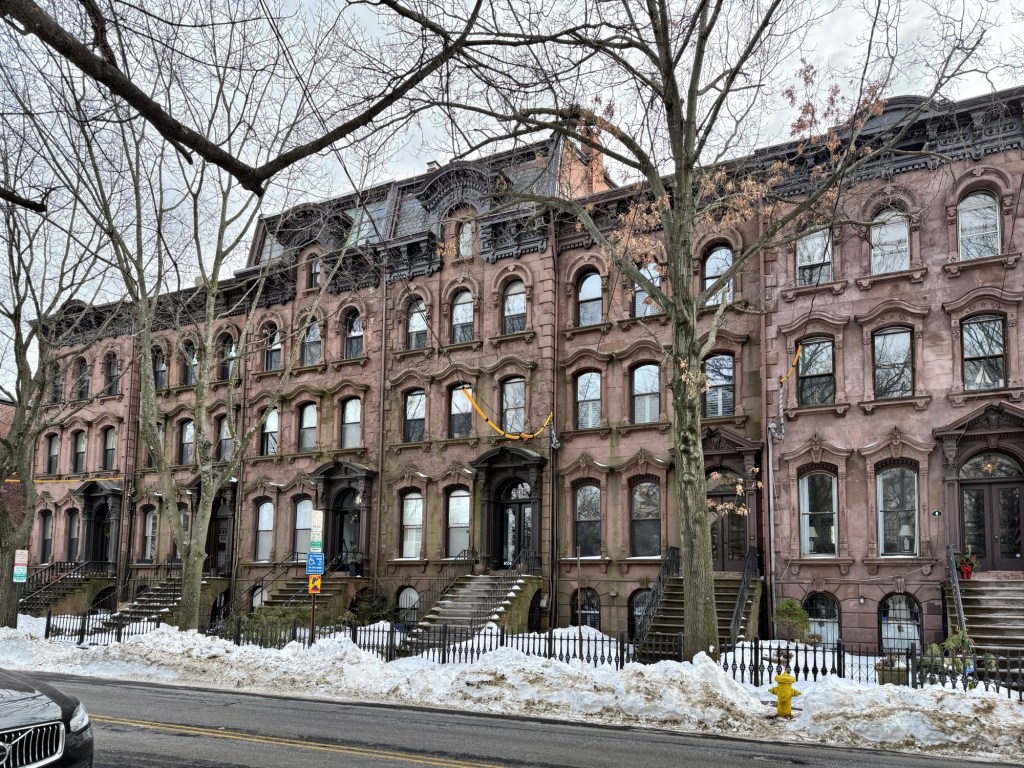
This extraordinary row of brownstone homes is located on Chapel Street in New Haven, Connecticut, and overlooks Wooster Square as its southern anchor. Built in 1871, the symmetrical row of six rowhouses are clad with brownstone facades which read more like Brooklyn townhouses than what is typical in New Haven, which is why these are so special. The row was designed by New Haven architect, David R. Brown, who got his start as an apprentice under Henry Austin, and became a prolific local designer. The row was likely constructed by one owner on speculation and subsequently sold to individual owners, who have maintained the structure over 150 years since. The Brownstone Row is Italianate/Second Empire in style with window surrounds, bracketed cornice and cupolas on the flanking homes with the center two residences capped by mansard roofs.

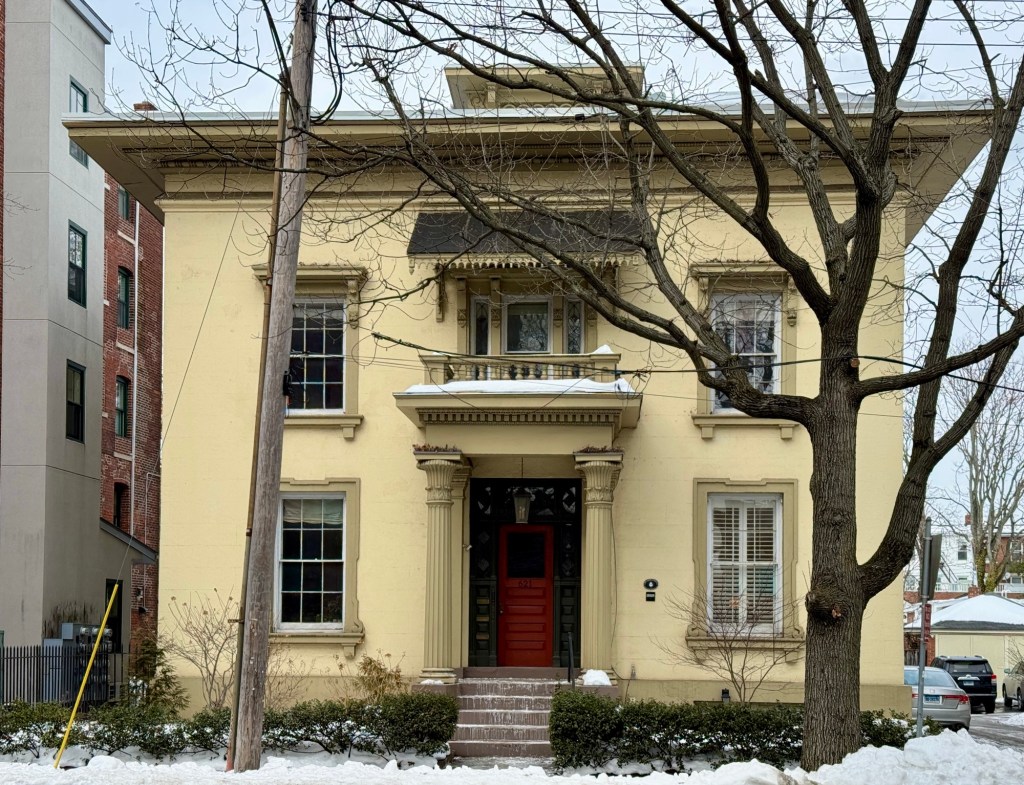
Henry Cowell House // c.1869

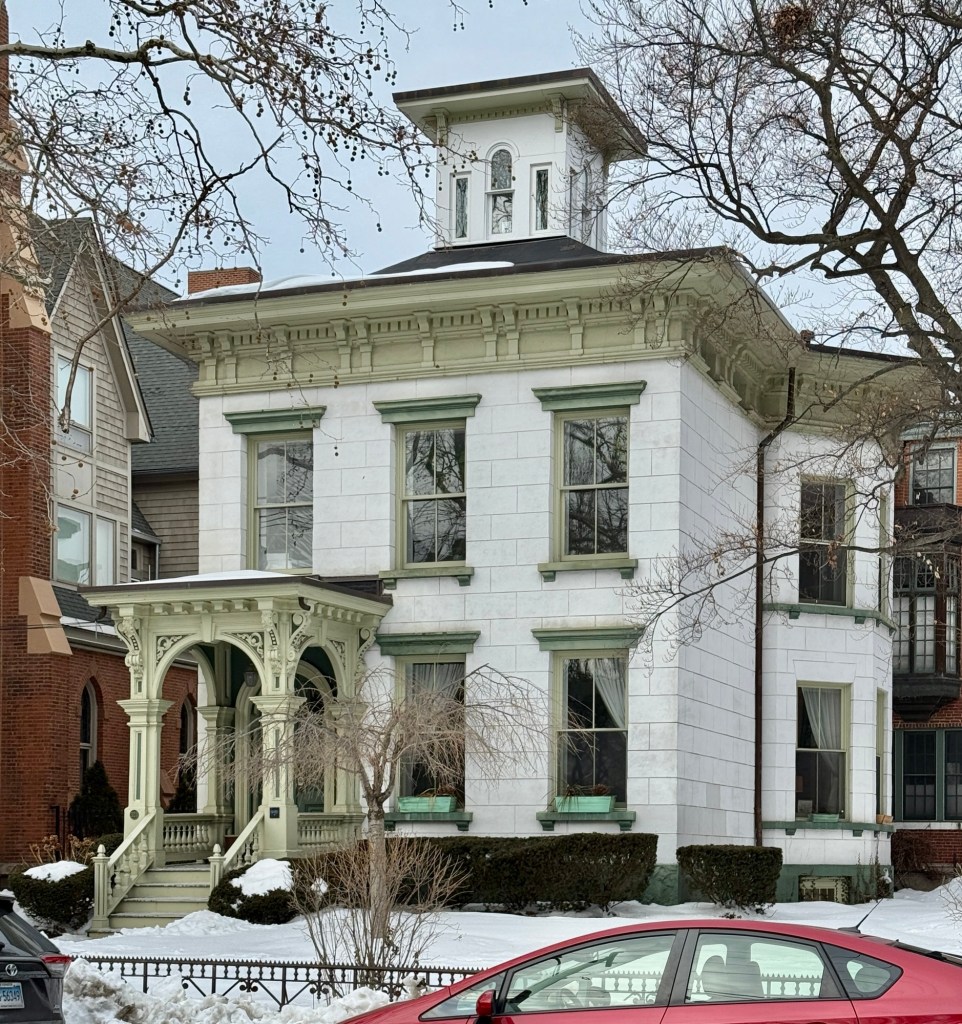
The Henry Cowell House, one of the great Italianate style residences in the Wooster Square neighborhood of New Haven, tells the story of the neighborhood from enclave of wealthy merchants and businessmen to vibrant immigrant area, to reborn middle-class neighborhood. The residence was built for Henry Cowell (1829-1904), a professional photographer and businessman who owned multiple properties in New Haven. The Cowell family, who lived in the house through the turn of the century, bequeathed it to a French order of nuns in 1912 who turned it into the St. Joseph’s Guest House, a residence affiliated with an area church. The Sisters of Holy Ghost managed the Cowell and neighboring Max Adler House, and constructed an addition between the structures to serve as a chapel and classrooms in 1929. The properties, which also served as housing for single women, were sold and converted into condos in the 1980s, with the current condo board taking great steps to preserve the significant buildings. The Henry Cowell House retains its boxy form with cupola at the roof, stucco walls scored to resemble ashlar masonry, and ornate entry porch.

St. Paul’s Episcopal Church, New Haven // 1829

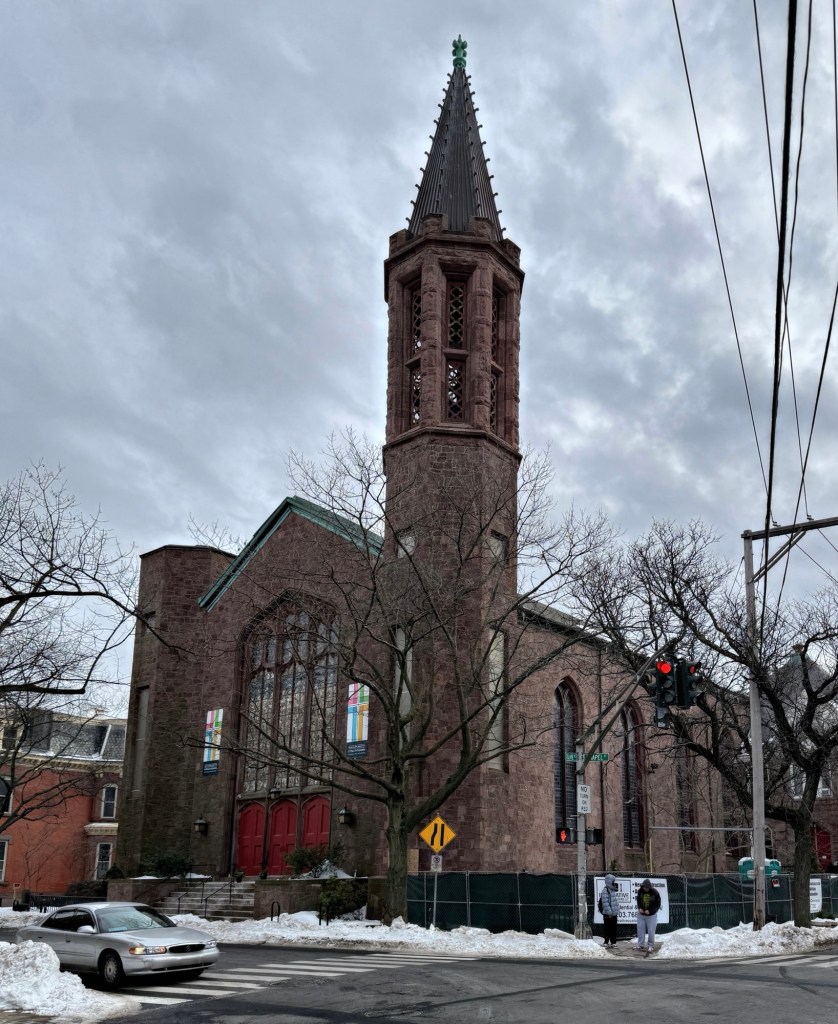
Built beginning in 1829, St. Paul’s Episcopal Church on Chapel Street in Wooster Square, New Haven, Connecticut, was one of the first churches in the nation built in the Gothic Revival style and a visual entrance to the iconic neighborhood. Constructed from local brownstone, the design of the building is attributed to a partnership between master builder and contractor, Sidney Mason Stone, and Sherman Croswell, son of the congregation’s pastor, Rev. Harry Croswell, who possibly consulted with architect, Ithiel Town. St. Paul’s is said to be the first attributed work of Sidney Mason Stone, who went on to build and design over 100 churches, homes, and buildings all over the region. The church originally featured two end towers were built of wood but were ambitiously removed in 1893 to be replaced with stone belfries, which was likely the original design. Sadly, funding ran out and only one tower was rebuilt of stone, leaving the lopsided single-tower look today.

Nelson Hotchkiss House // 1850

Nelson Hotchkiss was a New Haven lumber dealer and developer in the Wooster Square district and had this stately home on Chapel Street built for his family. While the architect is not confirmed, it is probable that the residence (along with neighboring homes also developed by Hotchkiss) was the work of Henry Austin, who partnered with Hotchkiss on developments in New Haven and Trenton, New Jersey. The Nelson Hotchkiss House was built in 1850 and is an excellent example of Italianate style with boxy form, broad overhanging eaves, brick walls covered with stucco and Austin’s signature Greek Doric columns with fluted shafts and foliate capitals. The house maintains a window hood over the upper floor window with delicate carved wood bargeboard.

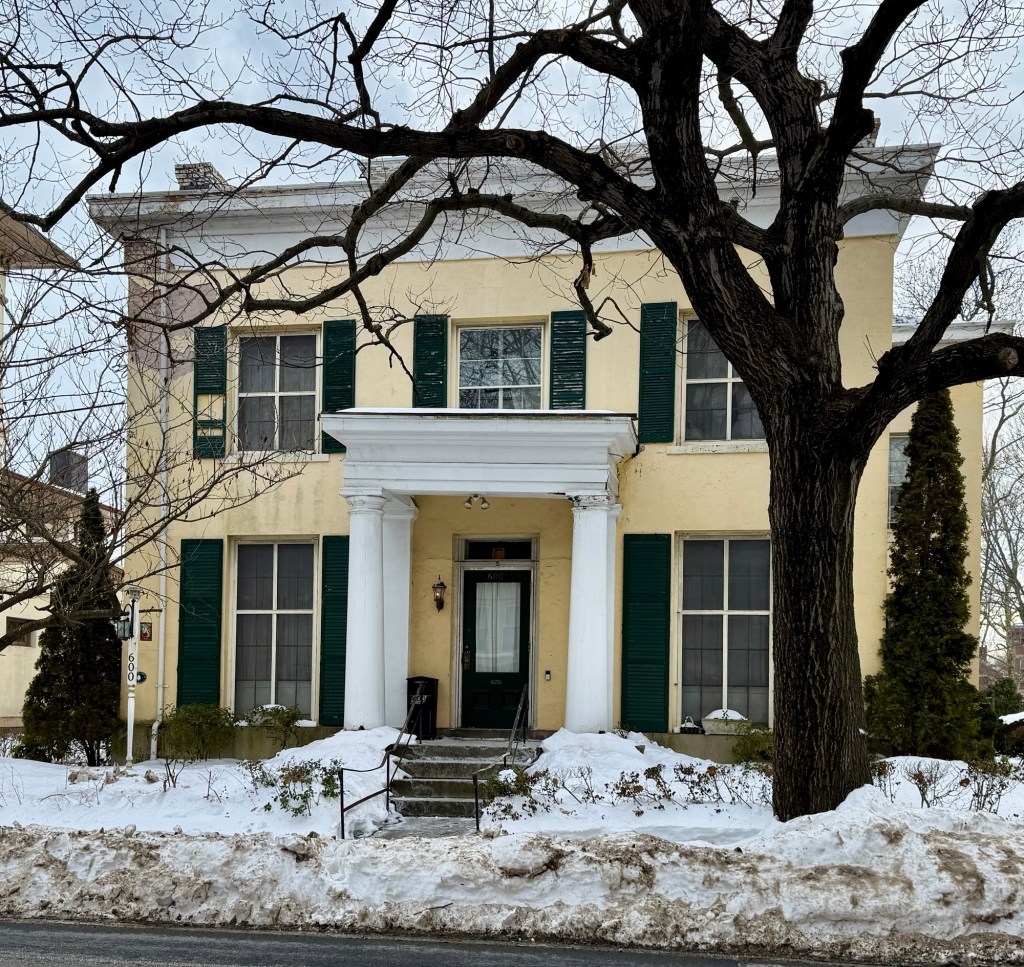
Soule-Parmelee House // 1844

The Soule-Parmelee House on Chapel Street in New Haven’s Wooster Square neighborhood is an excellent example of a mid-19th century Greek Revival style residence though with some deferred maintenance. The stately home was built in 1844 for Henchman Sylvester Soule (1800-1860) a merchant and trader who also partook in the California Gold Rush. After Soule’s death, the stucco Greek Revival style house was purchased by Henry S. Parmelee a piano maker, founder of the New Haven Trolley line and inventor of the first practical automatic sprinkler system, which he is said to have had installed in both his factory and his home here. Today, the Soule-Parmelee House operates as a bed & breakfast as the New Haven Historic Mansion.

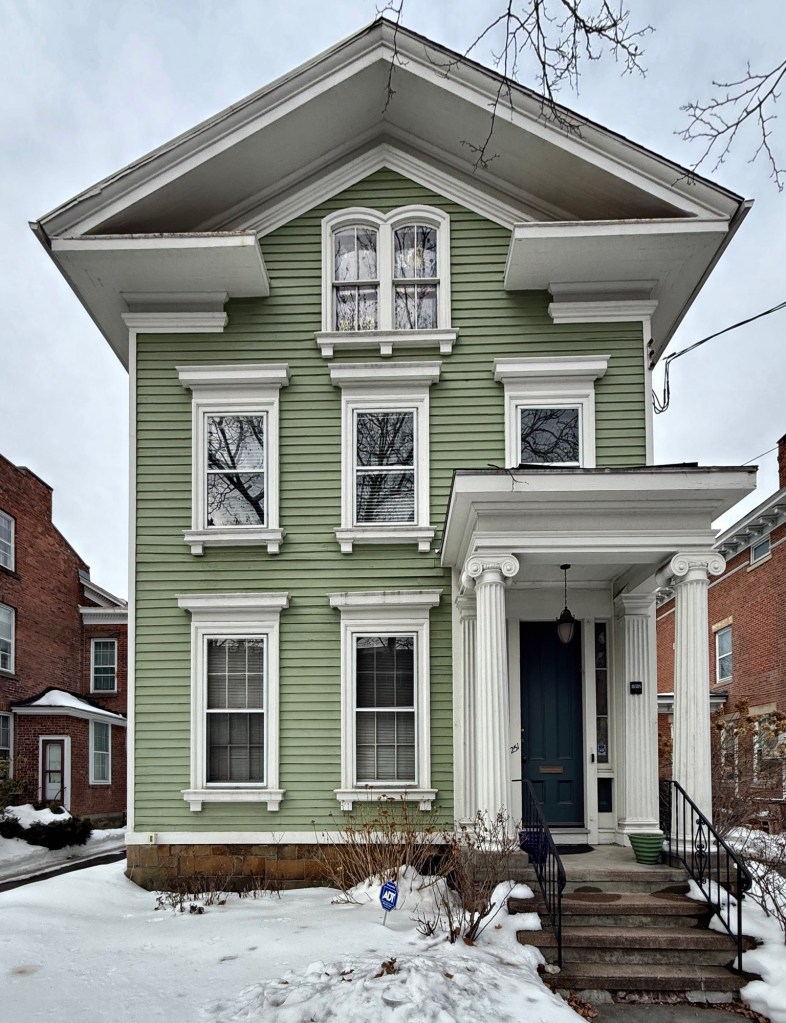
Phebe Wallace House // 1854

The Phebe Wallace House on Greene Street in New Haven, Connecticut, at first glance, may appear as a typical mid-19th century house, but some of the architectural features and details make it stand out! The residence was built in 1854 for Phebe Barney Wallace (1792-1872), a widow of William B. Wallace who died decades earlier. Phebe lived here with her daughter, also named Phebe, and a servant. The house exhibits a traditional Greek Revival form with gable roof oriented towards the street, with an off-center entry with Ionic portico, but the massive overhanging eaves without brackets with paired arched windows in the gable and balcony off the side of the house showcase the emerging Victorian influence in American residential architecture.

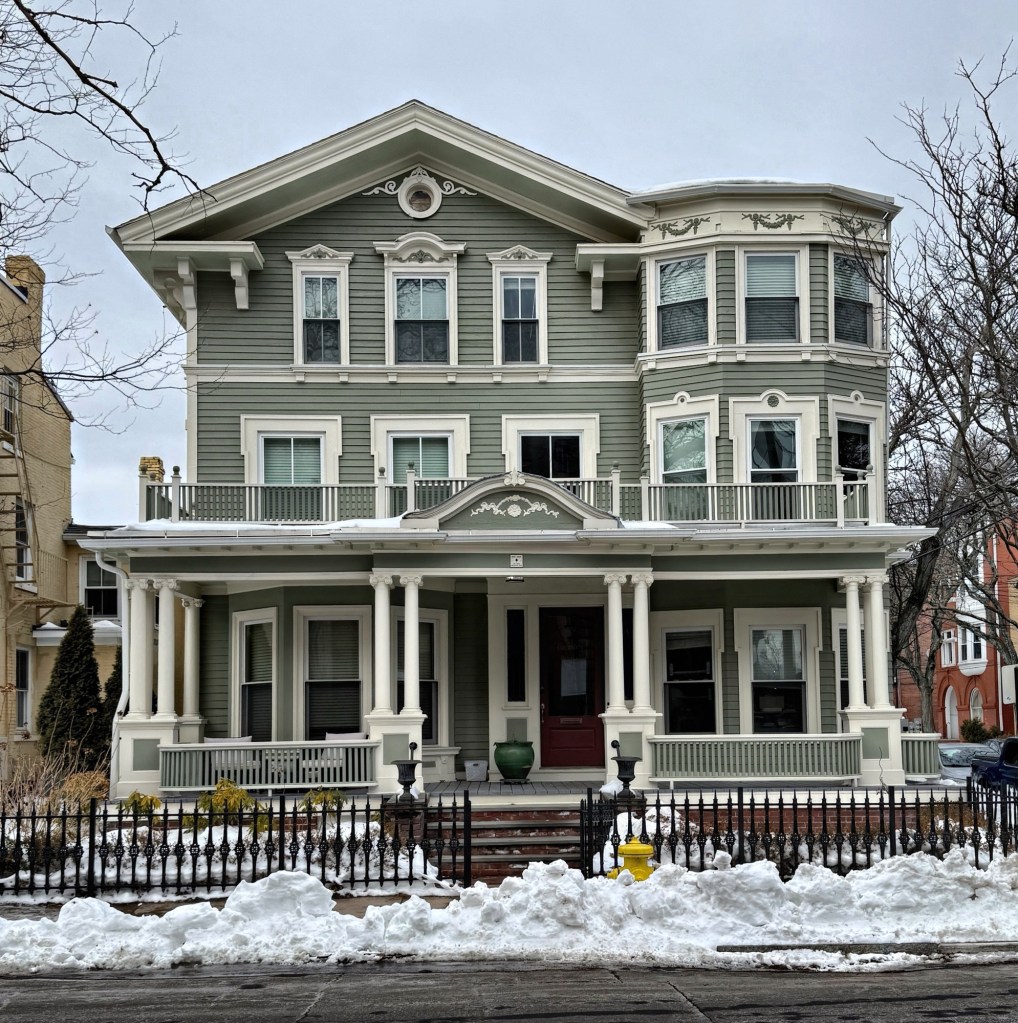
Bromley-Bradley House // c.1850

One of the eclectic mid-19th century residences in New Haven’s Wooster Square neighborhood is the Bromley House, an exuberant blending of architectural styles that have been lovingly preserved. The history is a little murky on this residence but from research, the home was built around 1850 and was possibly a two-story flat-roofed Italianate style design with three-bay facade and off-center entrance. The home was acquired by Joseph Bromley, who appears to have added a third-story with gable roof. After the Civil War, the property was purchased by Lyman Erving Bradley, a veteran of the war who was employed as a police officer and later as private security for an area factory. It appears that Mr. Bradley, before his death in 1901, had the property expanded with a whimsical front porch, three-story side addition, and applied ornament in the Queen Anne style. The home is today a three-unit condominium, similar to the three-deckers found in cities all over New England.