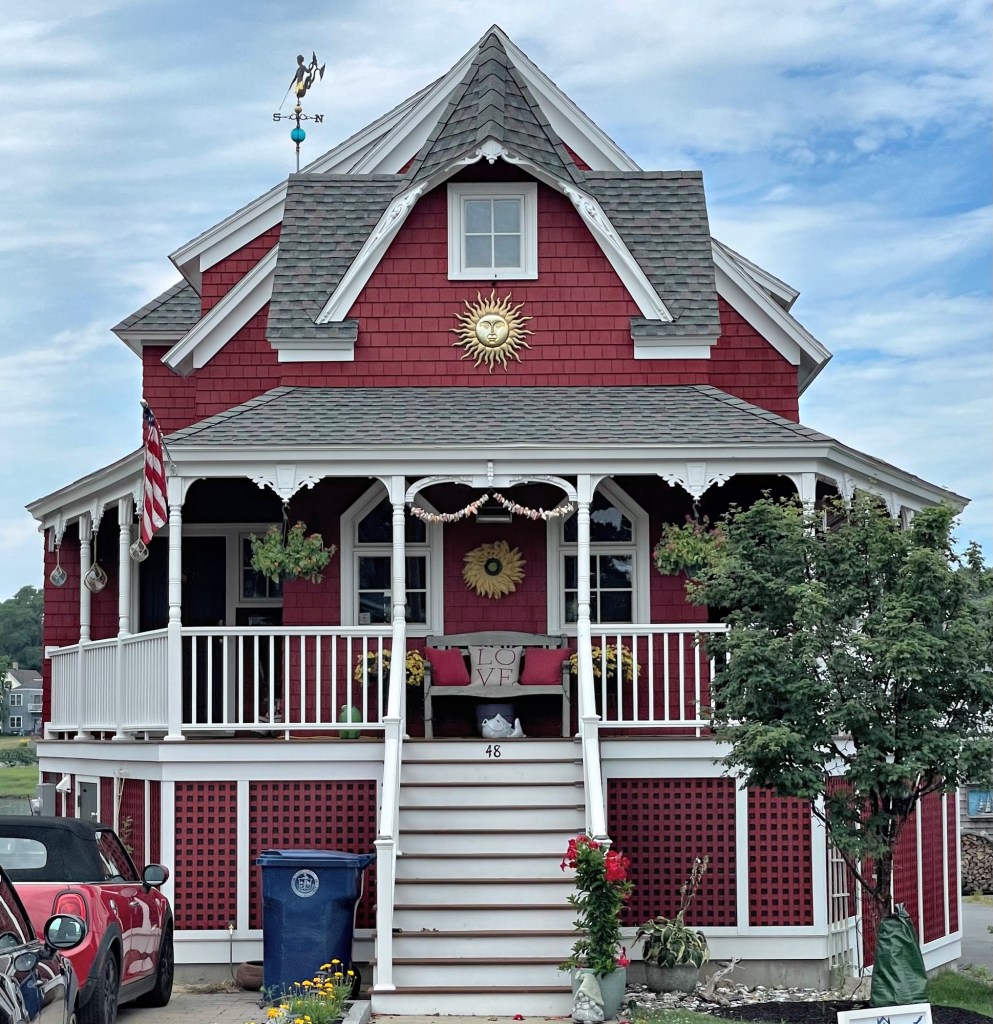
While Salem is best-known for its First Period and Federal style buildings, the Salem Willows neighborhood features some of the finest Victorian summer cottages in the Boston area. This cottage was built in 1885 by William Marston Bates (1820-1912), a Salem-based dentist, as his summer retreat when not in the office. The Stick style cottage has a steep gable roof with jerkinhead clip at the facade and a wrap-around porch with decorative jigsawn bracketed details. The house is a well-preserved example of the style, examples of which are becoming less-and-less frequent in recent years.
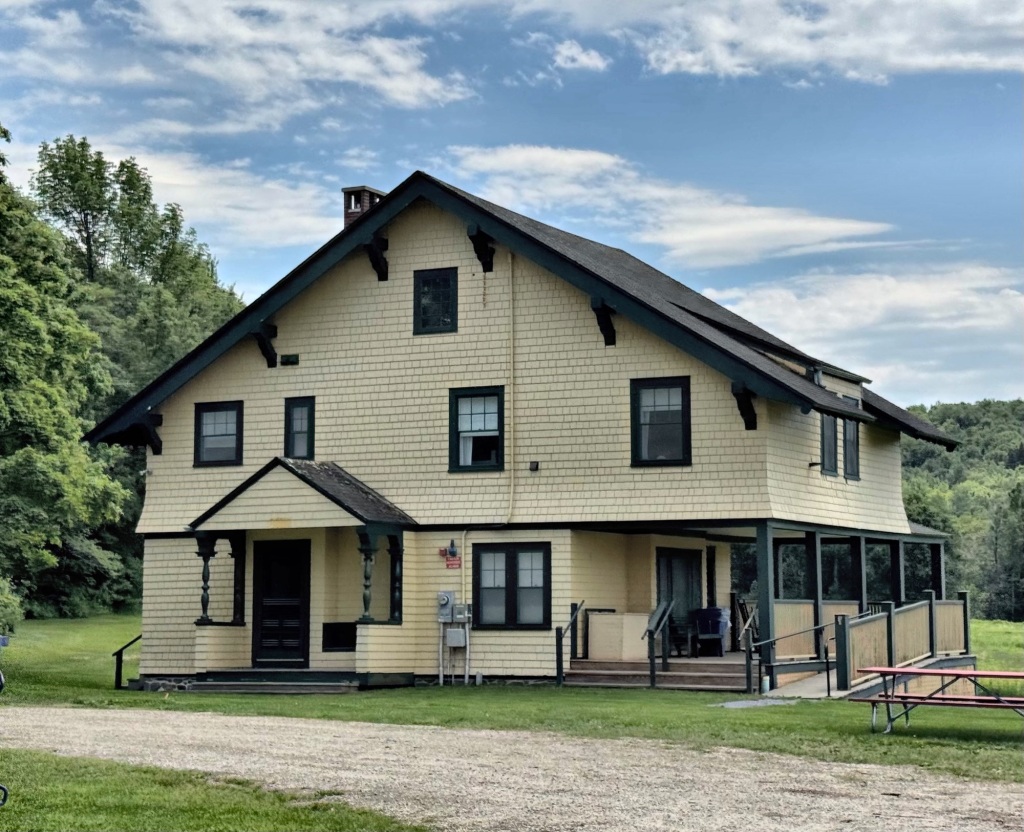
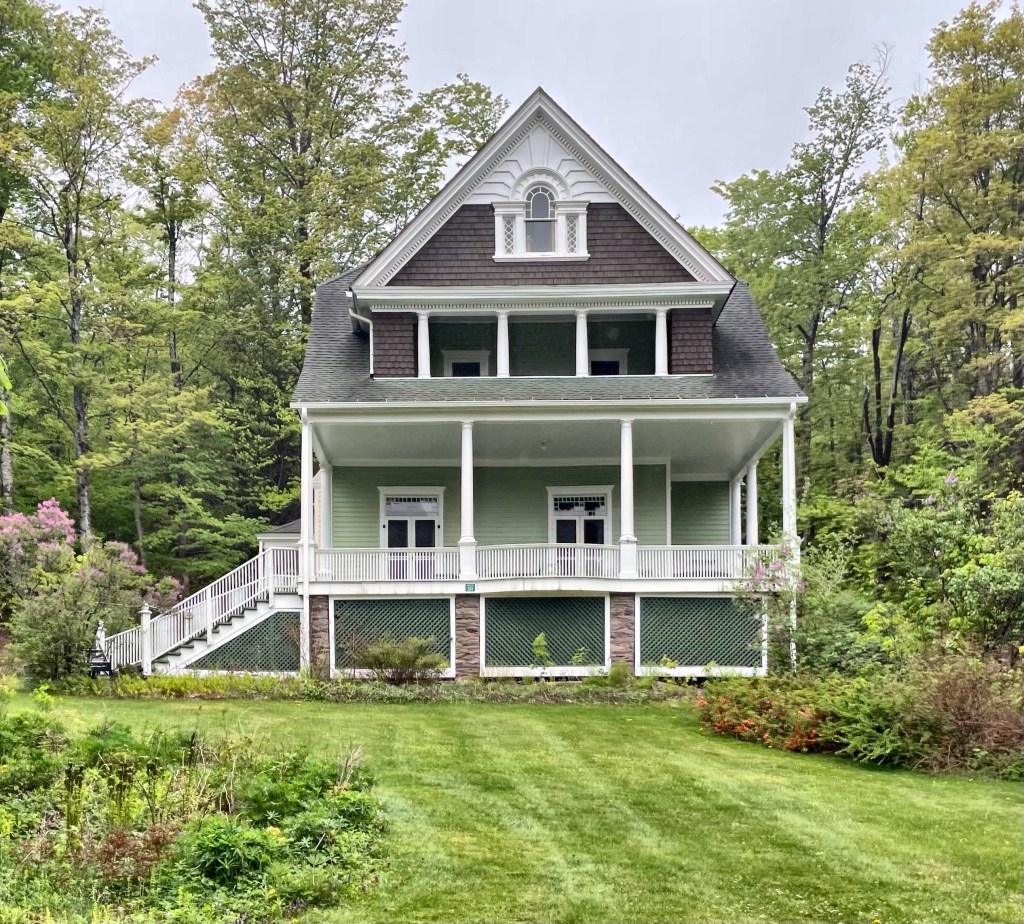
This is the last building to be featured on the Bread Loaf Campus! For more early history and context of the complex, check out the post on the Bread Loaf Inn. By 1900, owner Joseph Battell’s enterprise exceeded the capacity of the original inn, and cottages were added to accommodate more guests visiting his new permanent home in the mountains of Ripton, Vermont. Special friends who summered regularly at Bread Loaf purchased lots with water and sewage rights, and with Battell’s assistance, built their own family cottages to spend their summers. This is Treman Cottage, a shingled beauty which appears to have been built for a friend (though I am not sure who), and has since become the faculty cottage on the campus. As we wrap up this series, here is an interesting fact about the mountain campus: All buildings here that are painted the ochre color were built during Mr. Battell’s lifetime (by 1915), with later buildings painted white.
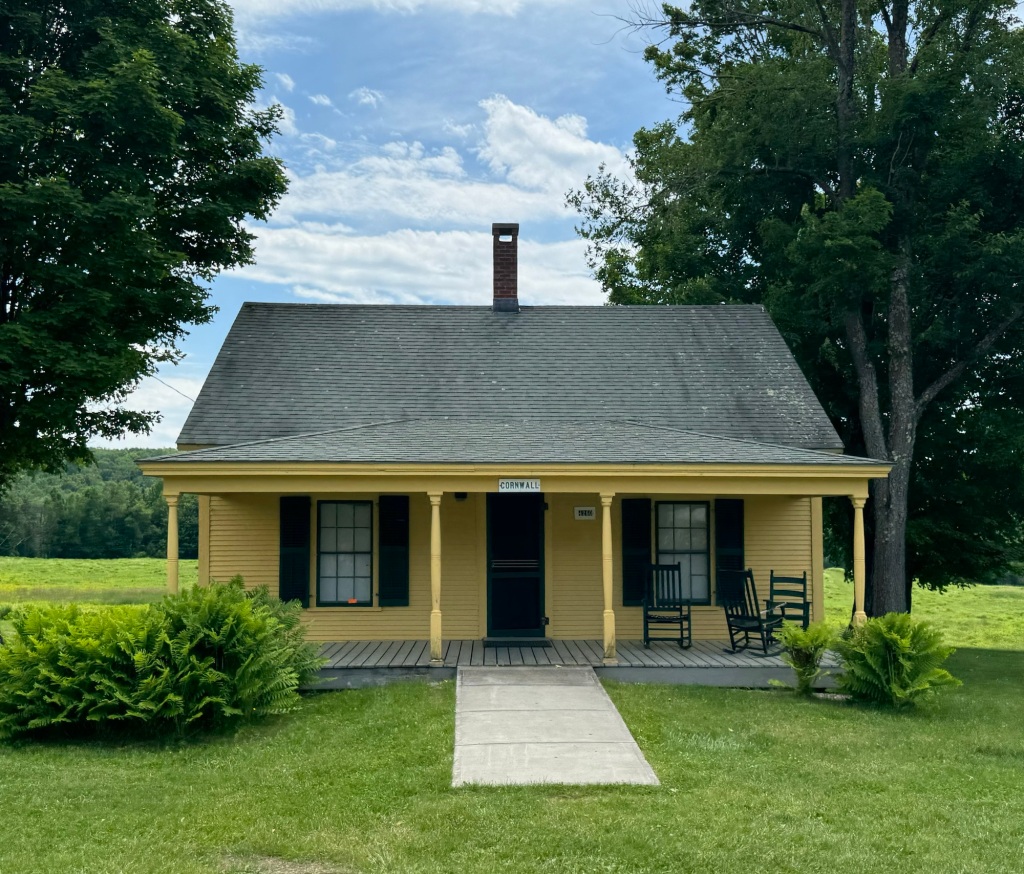
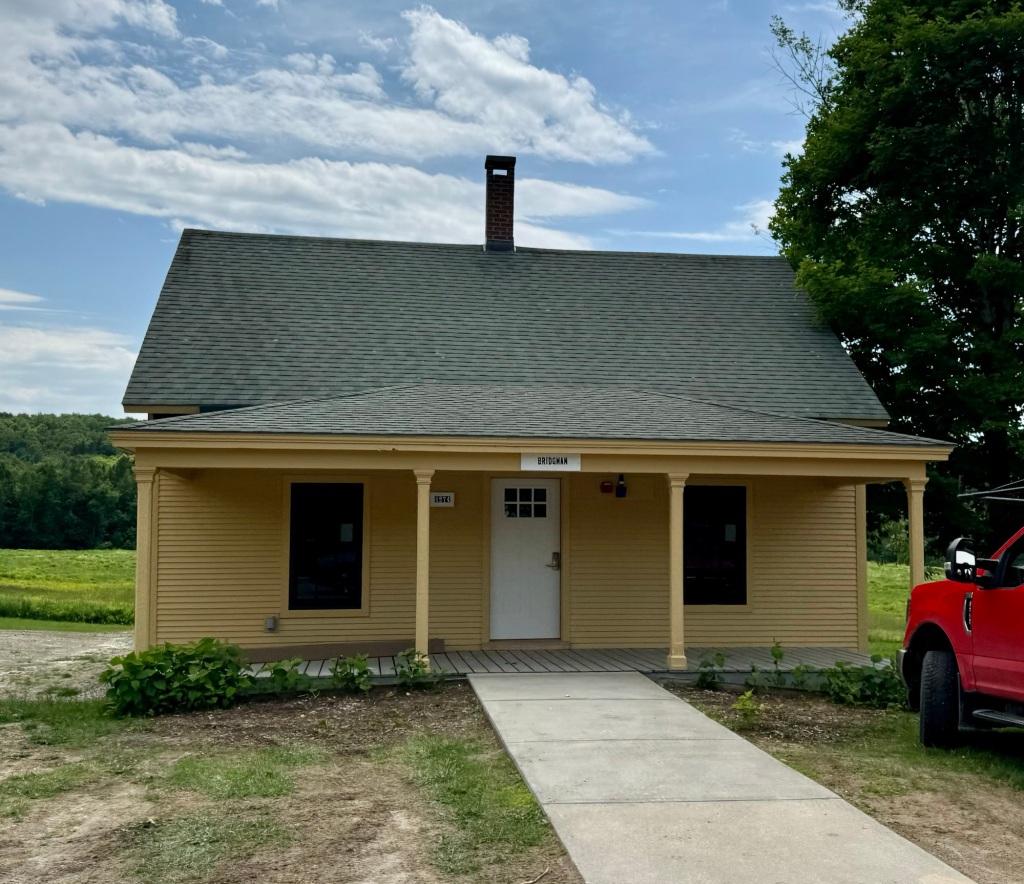
Welcome back to the Bread Loaf Campus! For more early history and context of the complex, check out the post on the Bread Loaf Inn. By 1900, owner Joseph Battell’s enterprise exceeded the capacity of the original inn, and cottages were added to accommodate more guests visiting his new permanent home in the mountains of Ripton, Vermont. Special friends who summered regularly at Bread Loaf purchased lots with water and sewage rights, and with Battell’s assistance, built their own family cottages to spend their summers. The first two, Bridgman and Cornwall, were constructed across the street from the Inn around 1881 and are near-identical, modest vernacular cape houses with full-length front porches. The original owners were Charles William and Ellen Campbell Bridgman and Henry Bedinger Cornwall respectively. Both cottages have since been donated to Middlebury College and are important preserved pieces of its Bread Loaf campus.
Charles Saunders, a carpenter, and his wife Annie Saunders, seemingly built and lived in this Shingle style cottage in the Ocean View summer colony of Rockport. The couple shows up in census records as living here in 1910 while in their 50s. The house likely dates to the 1890s and is a great example of the Shingle style for a middle-class residence. The house features a corner tower and a wrap-around porch with continuous shingle siding and columns. The property was deeded to a Lawrence Regester in 1924 when Annie sold the property after Charles’ death. The shingled cottage has remained in a great state of preservation for its existence!
In 1896, Edward L. Bailey, a carpenter and housebuilder, erected this cottage on Haven Avenue in Rockport, Massachusetts. Bailey resided in the house, likely year-round and ran a store on the nearby main street. His cottage served as both a residence and an advertisement for his skilled carpentry, which likely offered him commissions for other cottages nearby. Bailey was also selected as the builder for the town’s Carnegie Library in 1907. The cottage blends Queen Anne and Shingle styles effectively under one roof.
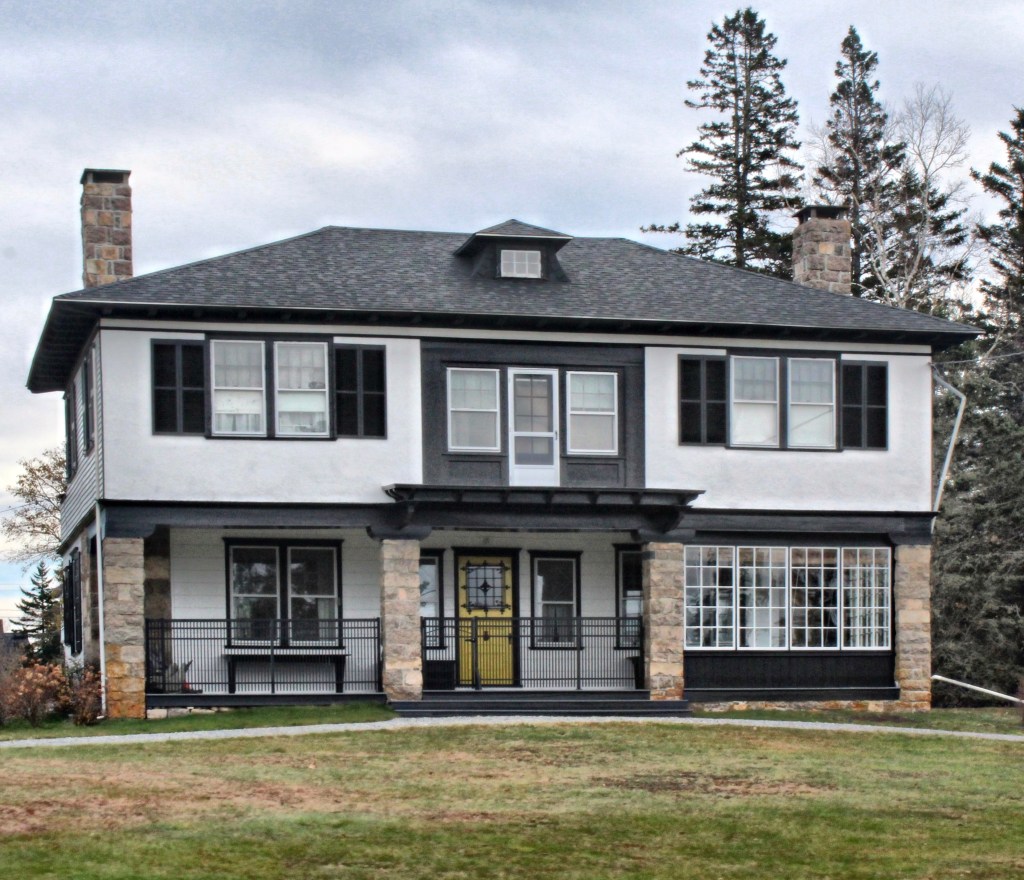
Samuel W. Levis, a real estate agent from Philadelphia built this summer cottage on Grindstone Neck in the enchanting town of Winter Harbor, Maine in 1892. The Levis Cottage was designed by the Gouldsboro Land Improvement Company’s favorite Philadelphia architect, Lindley Johnson, who designed a majority of the cottages and buildings in the summer colony. Samuel does not appear to have ever married nor did he have children. The property was later owned by Frances and Mitchell Rosengarten. The cottage is boxy in form with a stucco facade and clapboard siding on the sides. Local stone was used to construct the large columns at the first floor porch. The former recessed balcony at the second floor has been enclosed, but otherwise, the house looks near-identical to when it was built over 130 years ago!
While Blue Hill has historically been a summer colony for wealthy city-dwellers to escape to experience the beauty of Maine, it has never gotten the coverage as Bar Harbor or the other Mount Desert Island towns. Many of Blue Hill’s summer cottages are more refined and hidden away amongst the trees, and that is how the town likes it, unpretentious. I was lucky enough to take a wrong-turn and stumbled upon this gem of a cottage between the Blue Hill village and East Blue Hill, I had to take a photo! Upon further research, the rambling cottage was built in 1908 for Ellen and Edward J. Brooks of New Jersey. The cottage was named Elwin Cove, possibly as a merge of their children’s names ELinor and WINfred.
Hermann Esser (1845-1908) was born in Elbertfeld Germany and emigrated to the U.S. in the fall of 1866 and settling in Hoboken, NJ. On September 30, 1869, he married Bertha Michelmann of Hanover, Germany, who also emigrated to the U.S. years prior. In the states, Essen joined his old business partner Wilhelm J.D. Keuffel (also a German) and they ran the Keuffel & Esser Company, a scientific instrument manufacturing firm originally founded in New York City in 1867. Best known for its popularization of the slide rule, Keuffel & Esser was the first American company to specialize in the manufacture and sale of drafting and surveying tools. By the early twentieth century, it was one of the largest manufacturers of scientific instruments in the world. Their original store was located at 127 Fulton Street in Manhattan. Esser, with his wealth, decided to build a cottage in summer colony of Elka Park, New York, just north of Manhattan. The enclave was founded and has long been inhabited by wealthy German residents from New York City. This cottage was built for Mr. Esser in 1894, and is decidedly more Colonial Revival than many other cottages here. Esser only enjoyed a few summers here as he moved back to Germany in 1902, and died in 1908.
John Bach McMaster (1852 –1932) was born in Brooklyn, New York to a rich plantation owning father and mother who ran operations in New Orleans until the outbreak of the Civil War. After this, John graduated from the College of the City of New York in 1872, worked as a civil engineer in 1873–1877. Falling in love with the field of American History, he switched careers and in 1883, became professor of American history in the University of Pennsylvania. McMaster is best known for his History of the People of the United States from the Revolution to the Civil War (1883), a valuable supplement to the more purely political writings of earlier years. The book was a huge success and John was able to purchase house lots in the newly established Cape Arundel Summer Colony in Kennebunkport, Maine, a colony populated by many wealthy Philadelphians for summer homes. He first appears to have built “The Kedge”, a chunky, but beautiful cottage on a cliff. McMaster would also have this larger cottage built by the turn of the 20th century, which in design, appears to be a more eclectic Shingle style dwelling. Just a stone’s throw from the Atlantic, the house features continuous cedar shingle siding, sweeping porches to provide views of the ocean, a prominent chimney, and Colonial-inspired fanlight motifs.
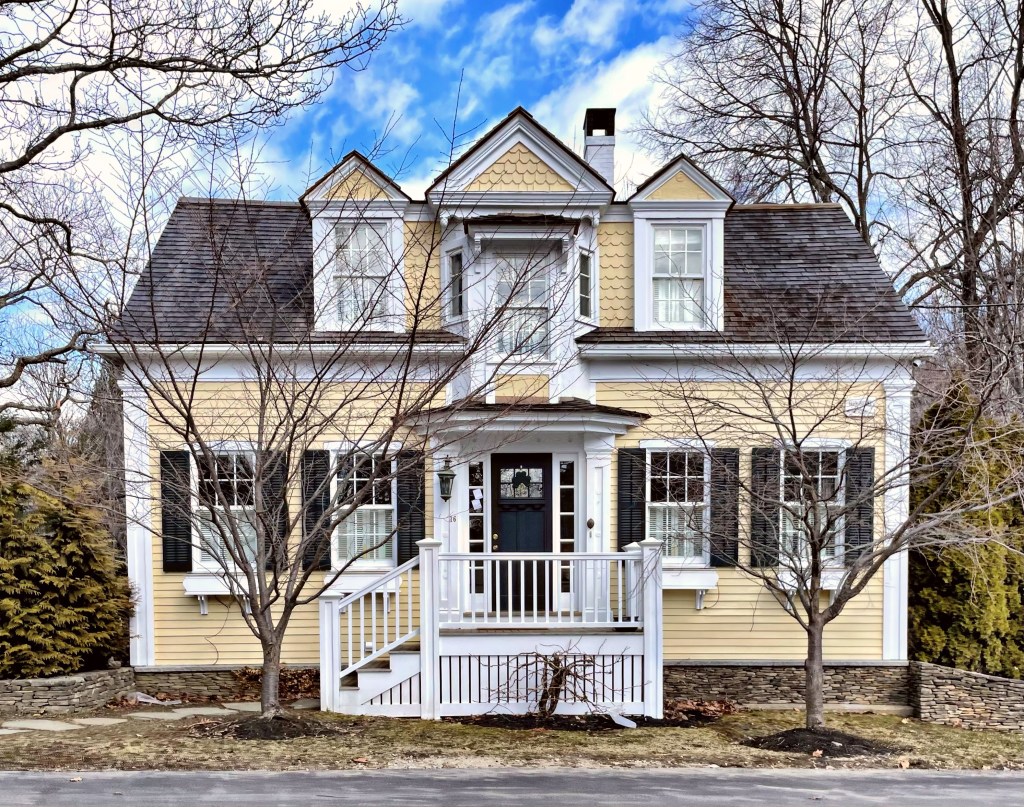
Not all of Kennebunkport’s summer “cottages” are grand, Shingle style mansions… Glen Cottage was originally built in c.1850 as a Greek Revival style cape house. As the town developed into a desirable summer colony for wealthy residents of Boston, New York and Philadelphia, the small cottage caught the eye of a Ms. Garrard. Margaret Garrard purchased Glen Cottage in 1900 and hired Maine architect William Barry to transform the old cape, adding the dormers, octagonal bay, and door hood. Here, she ran the Bonnie Brig Tearoom for twenty years. Tea houses were important social centers for wealthy summer residents Later owners renamed the tea house, “The Old Tree Tea Tavern” and “Periwinkle” but in 1926, the name reverted to The Bonnie Brig Tearoom. Today, the cottage has reverted back to residential use with the owners lovingly maintaining the old cape.




 Buildings of New England
