Liberty Tree Block // 1850

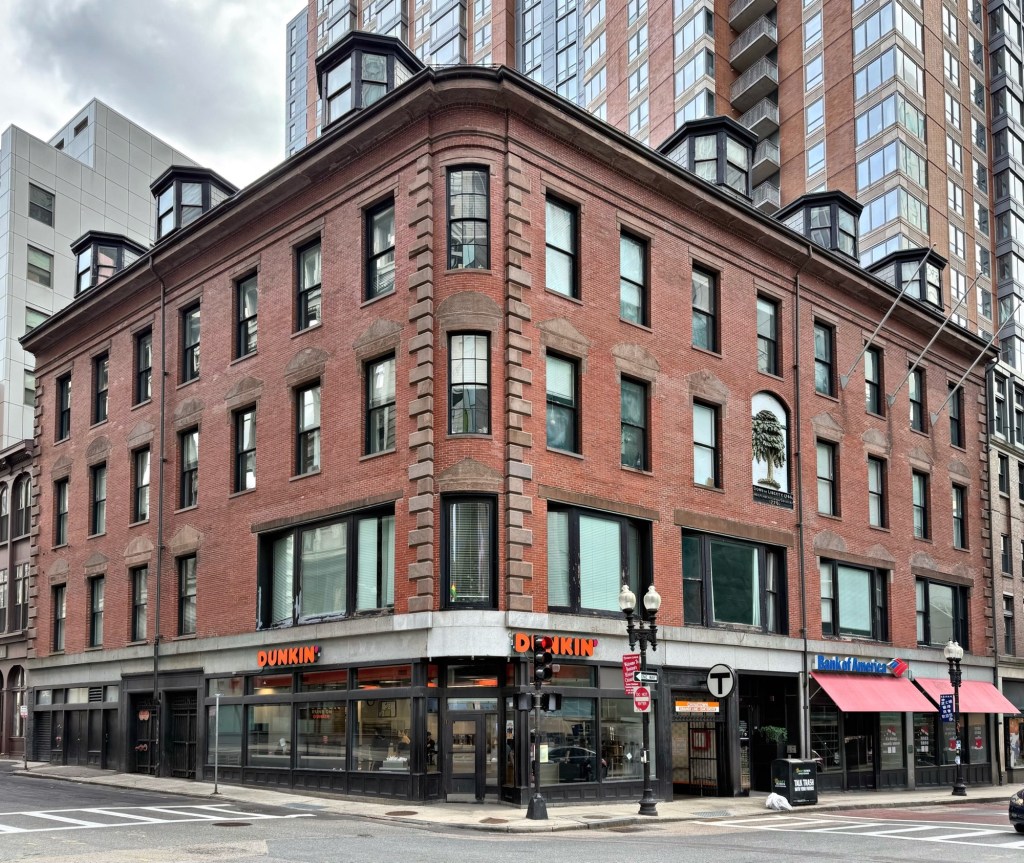
The Liberty Tree Block is located at one of Boston’s oldest and most important intersections, Boylston and Essex streets. It is said that near this site, the Liberty Tree stood, and where in 1765, Patriots in Boston staged the first act of defiance against the British government under its branches, The Stamp Act protests. The tree became a rallying point for the growing resistance to the rule of Britain over the American colonies. The Liberty Tree was cut down by British Loyalists in 1775, but the tree’s symbolism lives on in the building constructed on the site 75 years later. Nineteenth-century real estate developer David Sears had this commercial block built in 1850, which housed stores at the street with ballrooms on the upper floors. The Liberty Tree Block is best-known and named so due to the wooden relief plaque of the Liberty Tree on the Washington Street elevation. The motif stands 8′ high and 5′ wide and was carved by ship carvers. The bas relief is inscribed with “Liberty–1765” across the top, “Law and Order” at its roots, and at the bottom, “Sons of Liberty, 1765. Independence of their Country, 1776.” The building (and its carving) are protected Landmarks in Boston.

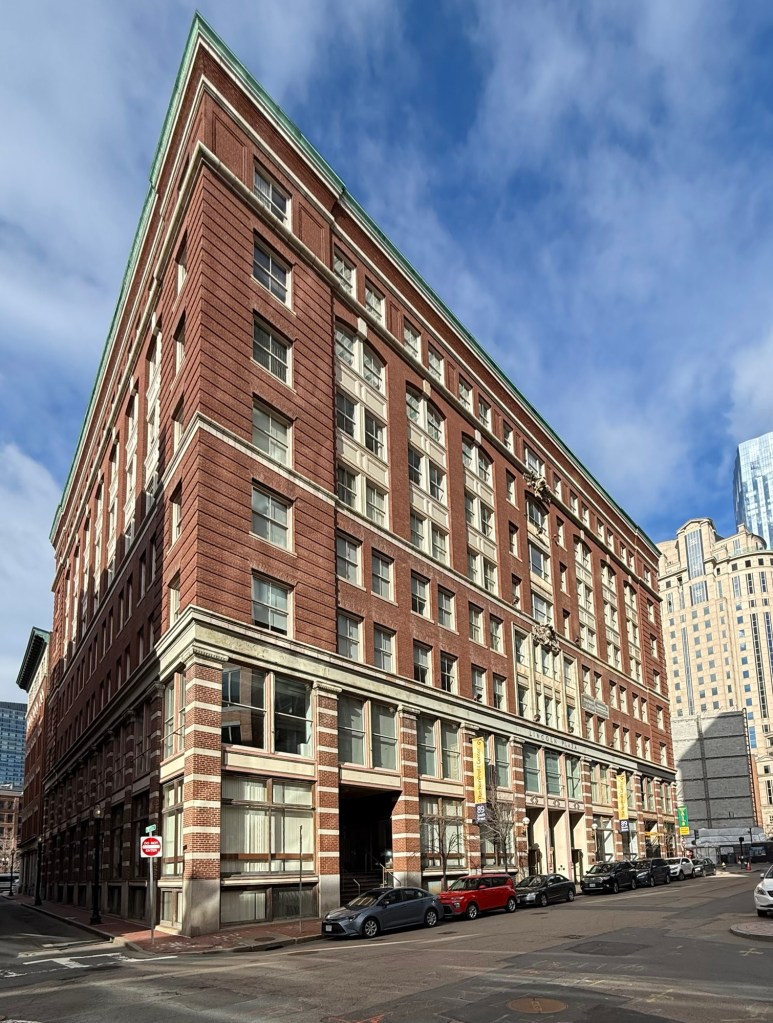
South Street Building // 1899

One of the larger mercantile buildings in the Leather District of Boston is this turn-of-the-century block, historically known as the South Street Building. Bounded by three streets, this eight-story building was constructed in 1899 from plans by Winslow, Wetherill & Bigelow and is a great example of a Classical Revival style commercial block with Beaux Arts motifs to further decorate the facades. In 1901, as expected, the city directories list many leather and soft goods-related occupants in the building, including: The American Calfskin Leather Company, John F. Moore Co., leather dealer, and Charles D. French, leather remnants dealer. The building was renovated in 1990 and rebranded as Lincoln Plaza, becoming a major space for non-profit offices.

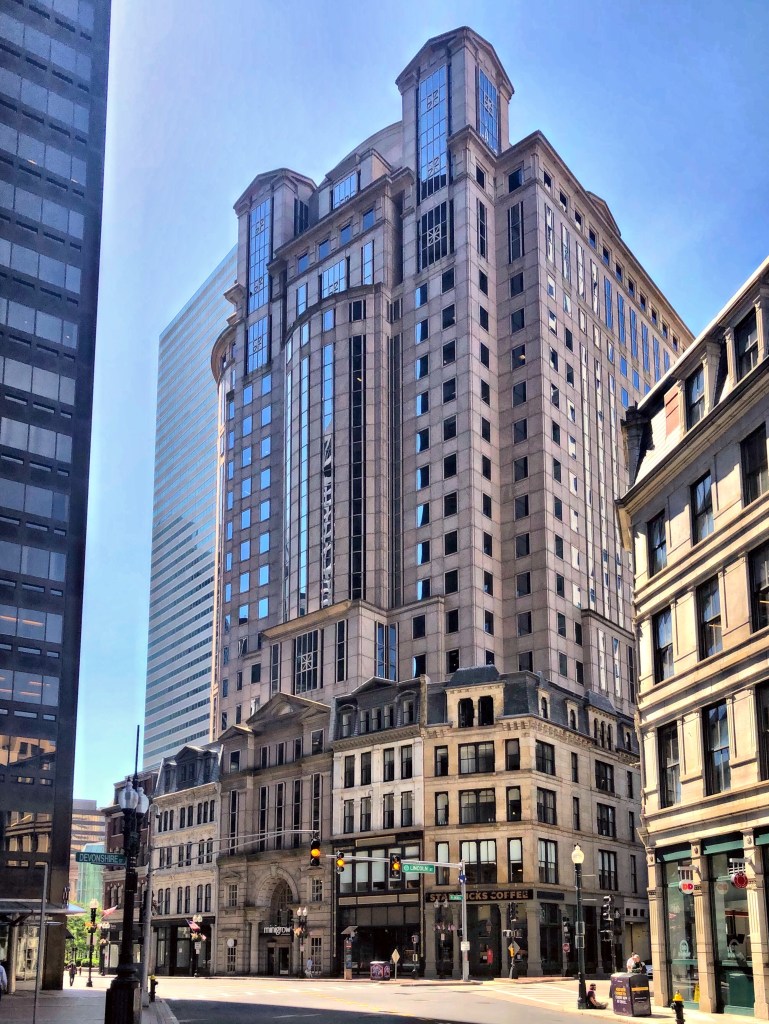
Lincoln Building // 1894

Designed by a prominent architect, Willard T. Sears, the Lincoln Building at Lincoln and Essex streets, is a handsome example of a late 19th century mercantile structure consisting of stores, office & loft space, serving as an important visual anchor the almost uninterrupted neighborhood of the Leather District of Boston. The building is the second of its name, with the first Lincoln Building succumbing to the Lincoln Street Fire of 1893, which started as a small fire in a restroom of a toy wholesaler, eventually spreading to a storage room full of fireworks, which exploded, eventually killing at least five, and forced many others to jump from buildings to seek safety. The replacement building is Renaissance Revival in style with a stone base and classically decorated facades. The recessed entrances set within arches and the series of columned bays at the ground floor are truly special. The building was long-occupied by leather dealers and companies, but was converted to residential use in 2006 with condos on the upper floors and retail spaces on the street.

Tontine Hotel // 1824-1913

Historically, inns and taverns offered short-term stays for visitors to New Haven, Connecticut. As the town developed and Yale College grew, land-owners began to realize the potential for larger, centrally located hotels. Established in 1824 and fronting the Town Green, the Tontine Hotel stood for less than 100 years, but was a prominent establishment in the city. The hotel was designed by architect David Hoadley and it hosted many well-known individuals including Native American chief and orator Red Jacket, who gave a speech here in 1829, and Daniel Webster, who came here in 1832. When more modern hotels were built in the early 20th century, the Tontine saw declining and less fancy clientele. The site was slated for redevelopment and the block was demolished in 1913 for the new Federal Courthouse and Post Office (last post).

Printer’s Exchange Building // 1866

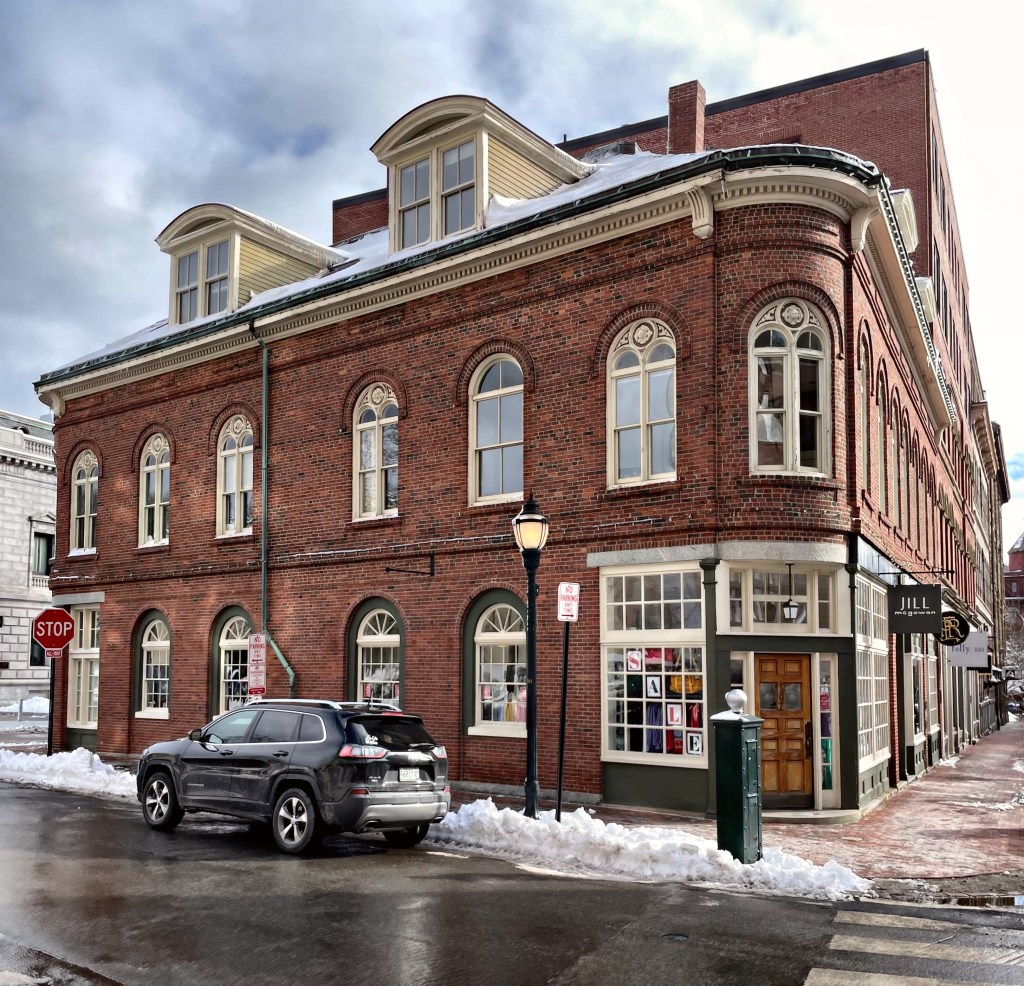
Why is commercial architecture from the second half of the 19th century so perfect? This structure in Downtown Portland is known as the Printer’s Exchange Building and was built in 1866, amongst the ashes of the buildings lost in the Great Fire of 1866. Charles Quincy Clapp is credited as the designer of the structure, which is Italianate in style with the paired round arched windows set into larger openings. The rounded corners are a really subtle but splendid touch in the design. The building got its name as it was home to the Eastern Argus and the Portland Daily Press, among other newspapers who rented the space from owner, Horatio Nelson Jose. I really like this one!

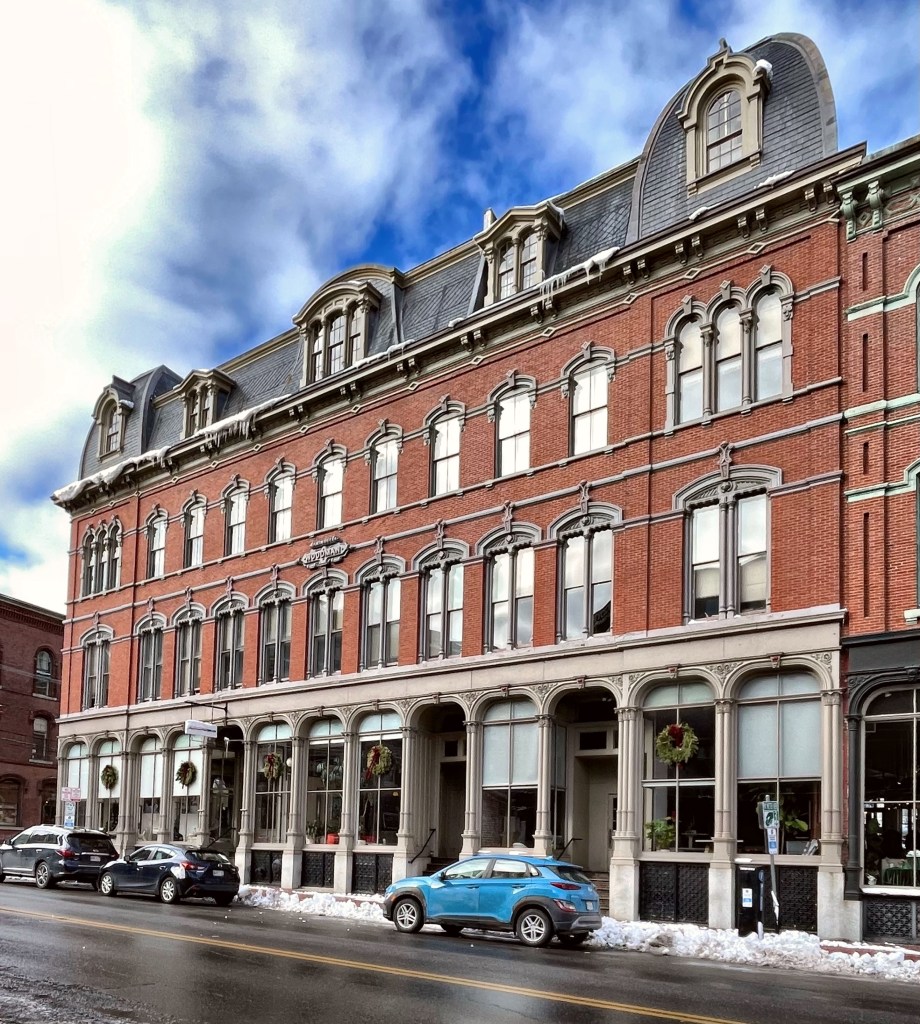
Woodman Block // 1867

Located next-door to the Rackleff Block, this high-style Second Empire commercial block in Downtown Portland, Maine really turns heads. The Woodman Block (like its neighbor) was built in 1867 from plans by architect George M. Harding, who designed the building for George W. Woodman, a drygoods dealer. This stunning commercial block originally housed Woodman’s dry goods firm, Woodman, True, and Company. It later held a druggist and medicine company. The building retains much of its original architectural character minus the iron cresting which once capped the mansard roof. They don’t make them like they used to!

Richmond Building // 1876

The Victorian Gothic style Richmond Building in Downtown Providence always catches my eye for its polychrome brickwork. The building was constructed in 1876, seemingly as an investment property for Dr. F. H. Peckham, a surgeon. The Richmond Building was used for many years for offices and retail use. Also, look at that amazing curved sash window!

Exchange Bank Building // 1845

Founded in 1801, the National Exchange Bank built this structure in 1845 in what would become Downtown Providence, an area with more residential quality than the much-developed East Side. The bank likely knew what was to come in terms of development here, so invested in a new masonry building to serve as the new headquarters of the bank. The northern half of the building is more typical Greek Revival in style with granite base and clean proportions. In 1887-8, the southern portion of the building was redesigned in the academic Queen Anne style to designs by Stone, Carpenter & Willson. This section of the building has amazing oriel windows, brownstone trim, slate mansard roof, and a clock.

Beneficent House // 1967

Located on the same block as the Arnold-Palmer House (last post) in Downtown Providence, this apartment building is the work of one of the most prolific Modernist architects of the 20th century, Paul Rudolph. During Downtown Providence’s period of urban renewal, which saw the demolition of much of Cathedral Square (much of which remains surface parking lots), planners sought a high-rise apartment building to house displaced elderly residents and others who hoped to reside close to downtown shopping and amenities. Architect Paul Rudolph, who was at the time Dean of Yale’s Architecture School, designed the brick building which employs horizontal bands in concrete which marks off floor levels and provides some breaks in the materiality. The building was originally designed in 1963, but after years of delays and budget cuts from rising construction costs, the balconies and other design features were removed from the final product, leading to its present simplicity. While simple, the building retains intrigue, especially with the projecting window bays and offset openings, a departure from the block apartment buildings at the time.

Arnold-Palmer House // 1826

The Arnold-Palmer house (not related to the drink), a handsome brick single residence of the Federal period, was built about 1826 by Daniel Arnold, a wealthy Providence merchant who did well in the economic expansion of the 1820s and 30s. The home is attributed to John Holden Greene, a Providence architect who commonly incorporated a monitor roof in his designs. Daniel Arnold focused his wealth on flour trade, but he speculated in cotton as well, as did many of the merchants in Providence at the time. The connection of Providence with southern states and plantations demonstrate how tightly bound Rhode Island’s industrial economy was with Southern cotton and the enslaved people who produced it, with manufacturing and cotton mills all over Rhode Island. By the 1850s, Arnold’s house was sold to Joseph Palmer, who, through the firm of Palmer & Capron, manufactured gold rings in Providence’s growing jewelry business. The house was built in Cathedral Square a part of Downtown and was moved to its present site when that part of Providence was nearly entirely razed in urban renewal. While the siting is less than desirable, this rare surviving Federal home in downtown shows how the wealth and prosperity of Providence was not only restricted to College Hill.