Cross-Kimball House // 1804

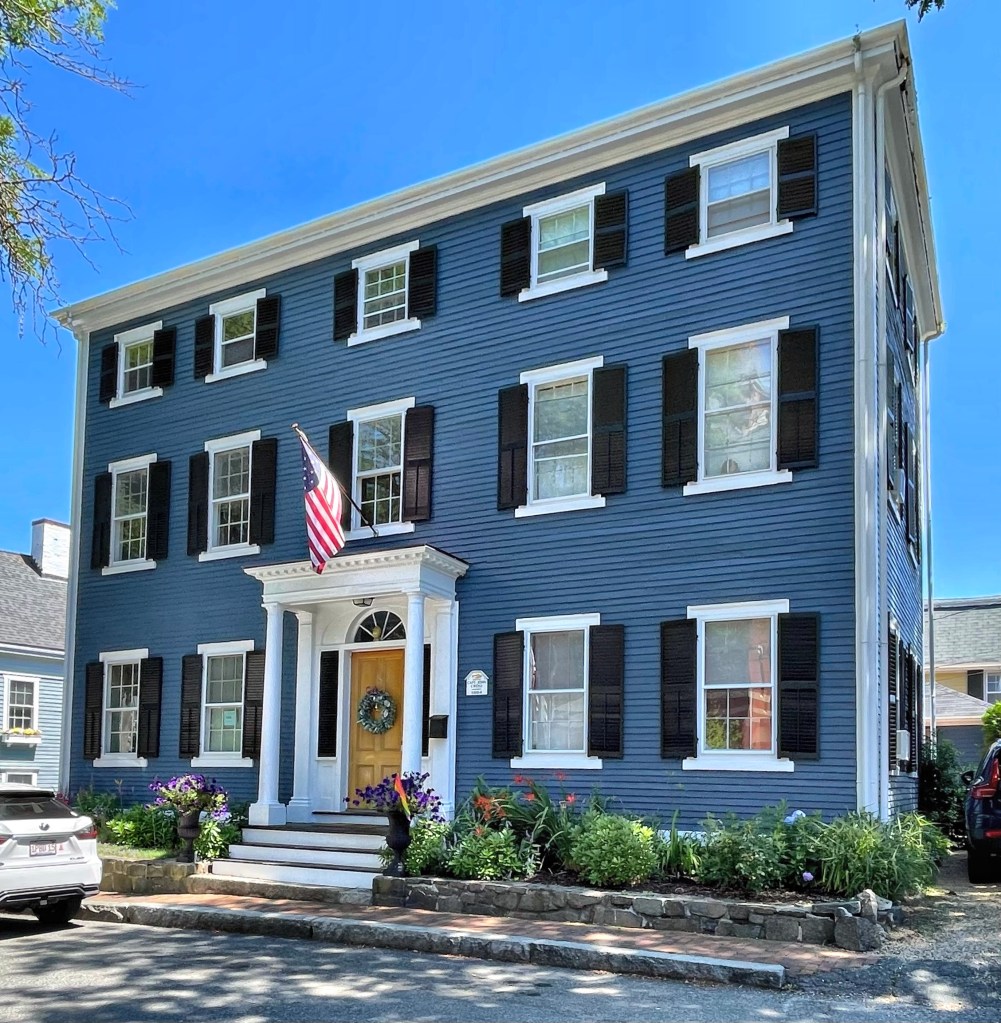
In 1803, sea-captain John J. Cross (1768-1804) began building a large Federal style house on land he purchased from his success on the open sea, largely working for the Hoopers. Sadly, before the home was finished, Captain Cross and all his men aboard his ship, the “Traveller” died at sea. The home, which was to be finished by the time of his return was left abandoned when news got back to the shore of the ship’s loss. His wife and three children were devastated and likely sold the property not long after. The property was owned later by Edmund Kimball, a sea-merchant who married into the Hooper Family. Kimball did well for himself and eventually owned multiple vessels. After his first wife, Mary Hooper Kimball died bearing him six children, Edmund remarried to Lydia Mugford Russell. The family home across from the town’s common has been very well preserved since and is an excellent example of a vernacular three-story Federal home on the North Shore.

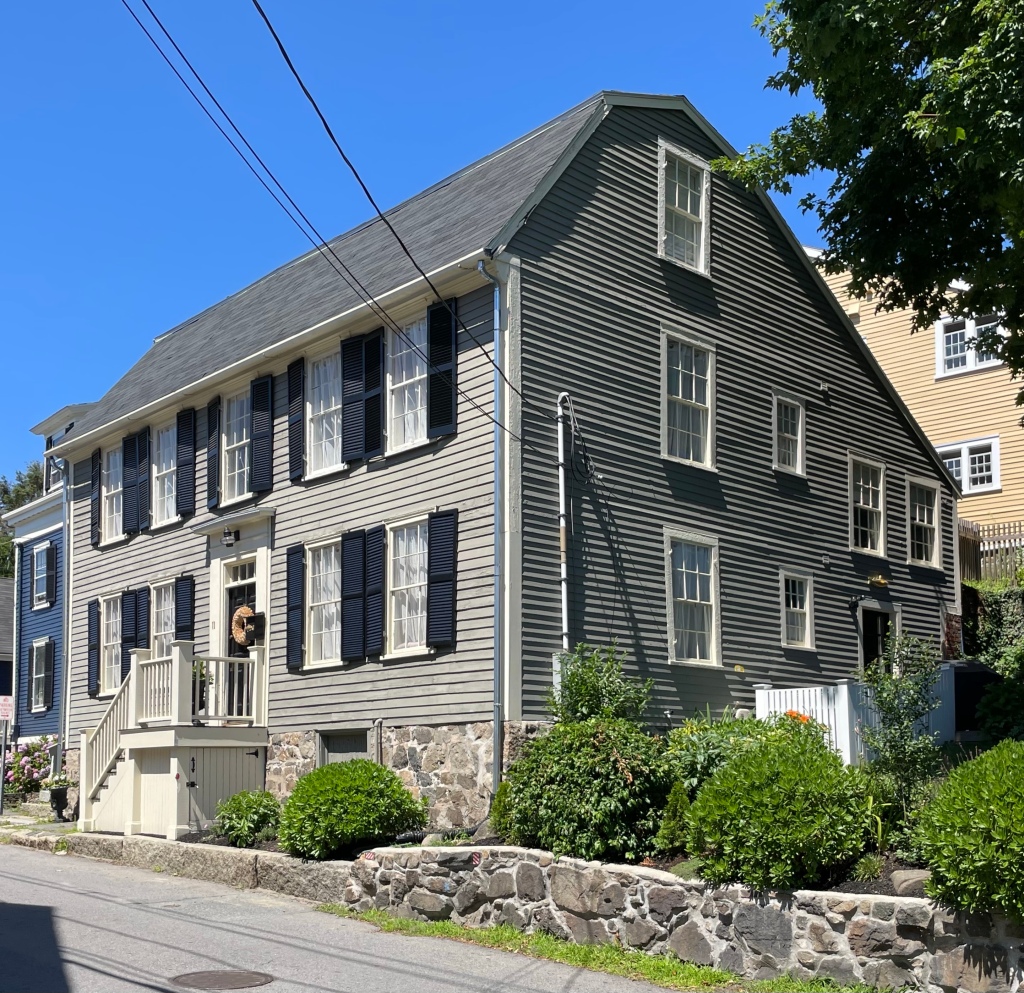
Pearson-Bessom House // c.1720

In 1720, James Pearson acquired a house lot on Windmill Hill in Marblehead, and he soon after built a house in the bustling harbor town. He lived in the house until 1734, when it was sold to a Giles Irwin. After Mr. Irwin’s death, it was conveyed to John Patton and John Bailey, both mariners, who likely split up the home inside. From this, fireplaces were punched into the central chimney inside, totaling 10 fireplaces in the home! John Bailey also worked as the Captain of Fort Sewall during the War of 1812. His wife Mary, served as temporary commander of Ft. Sewell after his death until a successor was appointed. The house eventually came under the ownership of siblings Carrie Florence Bessom (1867-1944) and her brother Frank Lewis Bessom (1870-1952). Florence operated an antiques store in town and Frank worked as a welfare commissioner. The home is a great example of a Georgian, Colonial-era home with a gambrel roof and even has the two (what I believe to be) separate coal doors in the raised stone foundation when the home was occupied by two families.

Powsland-Homan-Dixey House // 1732

The colonial home at 33 Washington Street in Marblehead was built in 1732 for (and likely by) Jonathan Powsland, a joiner (furniture maker-carpenter). In the 1740s, Peter Homan added the rear lean-to, giving the home a saltbox appearance, possibly after he married into the Powsland family. The home was eventually owned by the Dixey Family. John Dixey (1776-1868) spent a good part of his life as a ship master and had several sons that also went to sea. The most well known son was Richard W. Dixey (1809-1860) who, along with two other Marbleheaders, captained the ship that took the first American Consulate to China.

Sweezy Summer House // 1916

Wilton, New Hampshire has a hidden enclave of high-style summer “cottages” built for wealthy residents in the early 20th century. The last of these examples I will feature is the Sweezy House, located in Wilton Center. The Federal Revival style mansion was built for Everett and Caroline Sweezy, summer residents who split their time between New Hampshire and New York. Mr. Sweezy was a banker for the Riverhead Savings Bank which was located on Long Island, which too was a summer destination. The couple hired the firm of Howe and Manning, led by female architects Lois Lilley Howe and Eleanor Manning, to design the home. The house is set back far from the street behind a rustic stone wall. The property remained in the Sweezy Family for four generations.

Reverend Abel Fiske House // c.1791

Reverend Abel Fiske (1752-1802) was born in Pepperell, Massachusetts and graduated from Harvard College in the class of 1774. Four years later in 1778, at 26 years old, he was ordained as the successor of Reverend Jonathan Livermore at Wilton, New Hampshire, where he remained until his death. During his time in Wilton, Rev. Fiske built this Federal style home for his family. The house is a short walk to the old church where he gave sermons to the growing rural community.

Buss-Newell House // c.1800

One of the finest Federal homes in southern New Hampshire is this residence that sits in the middle of Wilton Center. The home appears to have been built for Richard Taylor Buss, or another member of the Buss Family who settled in Wilton in the 18th century. By the second half of the 19th century, the property was owned by George A. Newell, who built a gorgeous Victorian era stable on the property. Swoon!!

Leonard Proctor House // c.1810

In the early 1780s, Leonard Proctor and Salmon Dutton and their families, moved from Massachusetts and settled in present-day Cavendish, Vermont and gave their names to the two major settlements on the Black River, Proctorsville and Duttonsville. Leonard Proctor was born in Westford, Massachusetts and fought in the Revolutionary War at a young age. He settled in Cavendish in 1782 and built a modest house/tavern, and underwent developing the village in his name, Proctorsville. By the early 1800s, Leonard was a highly esteemed member of town and had the funds to erect the finest Federal style manse in the village, to showcase the stability and wealth of his community. The home exhibits scalloped cornice moldings and the carved wood flowering vines springing from urns on the upper pilasters that have a folk/Federal quality that stands out as a very unique design detail. Carved Adamesque bell flowers that flank the door suggest Asher Benjamin’s Windsor influence. Elliptical sunbursts above the pilasters, elaborate guilloche friezes, and the broad semielliptical attic light have a later Federal character. It is possible that Leonard had this house built, and it was “modernized” by one of his heirs.

Atherton Farmstead // c.1840

This beautiful farmhouse in Cavendish, Vermont is located along a winding dirt road and has ties to one of the town’s original family’s. A home was built here in 1785 and changed hands numerously over the first few decades of its existence. The farmhouse that was built also served as a tavern for travellers along the newly laid out Wethersfield Turnpike. It is possible that the cheap land and rural character of the new town was appealing to some, but reality away from true commerce may have made many sell the farm after a few years, which could explain why the property was bought and sold so often early on. The property was purchased by Jonathan Atherton, a Revolutionary War veteran, farmer, surveyor and lawyer, who acquired large landholdings in Cavendish. In 1821, Jonathan Atherton was sued in court by his neighbor, Jedediah Tuttle for beating Tuttle’s wife Lydia. In order to finance the bonds, Atherton mortgaged all his real estate in Cavendish to his brother Joseph, and Elihu Ives, Jonathan Atherton Jr.’s father-in-law. Atherton St. lost the case and had to pay a fine. The property was eventually inherited by Stedman Atherton, the youngest son of Jonathan, who seems to have demolished the old homestead and constructed the present home on the site. The original dwelling was also the childhood home of Henry B. Atherton, a staunch abolitionist and soldier in the American Civil War, who later served as a lawyer and state legislator for New Hampshire, and his sister Eliza (Atherton) Aiken, a Civil War nurse who has been referred to as America’s own “Florence Nightingale”. The old Atherton farmstead was recently renovated.

Glimmerstone // 1845

What a treat it was to stumble upon one of the most beautiful homes in Vermont, and all the best houses have names! Glimmerstone is located in the small town of Cavendish, and is possibly the finest Snecked Ashlar constructed home in the state. The house was built in 1845 for Henry Fullerton, manager of the Black River Manufacturing and Canal Company mill in Cavendish. The stone used to build the house was quarried less than a mile away, and hauled to the site. The construction style consists of stone facing on either side of rubble fill, with slabs and snecks sometimes laid across the fill to provide strength, a method brought to the region by Scottish immigrant masons. The house’s design is by a local carpenter, Lucius Paige, and is based on designs published by Andrew Jackson Downing, who depicted many Gothic style designs in pattern books which were built all over the country. The house has had a number of owners after Mr. Fullerton died. During the prohibition era, Art Hadley, who would later become extremely wealthy as the inventor of the expansion bracelet, used the home as part of a rum running operation. Glimmerstone was purchased in 2010 by the current owners, who underwent a massive restoration of the home, converting it into a bed and breakfast, allowing the public to experience the property as well.

Joshua Parker Farmhouse // 1850

This house in Cavendish was constructed in 1850 by Joshua Parker and is an outstanding example of a gothicized snecked ashlar house. The house is in the Cape form and largely exhibits a more traditional cottage layout, but with the steep gable dormer, giving the home a distinctive Gothic feeling. The 1850 home replaced a late 18th century farmhouse, but in the iconic snecked ashlar construction. The farm grew over the subsequent decades, including a c.1900 snecked ashlar barn (not pictured), which is probably the last building of “Snecked Ashlar” construction erected in the State of Vermont.