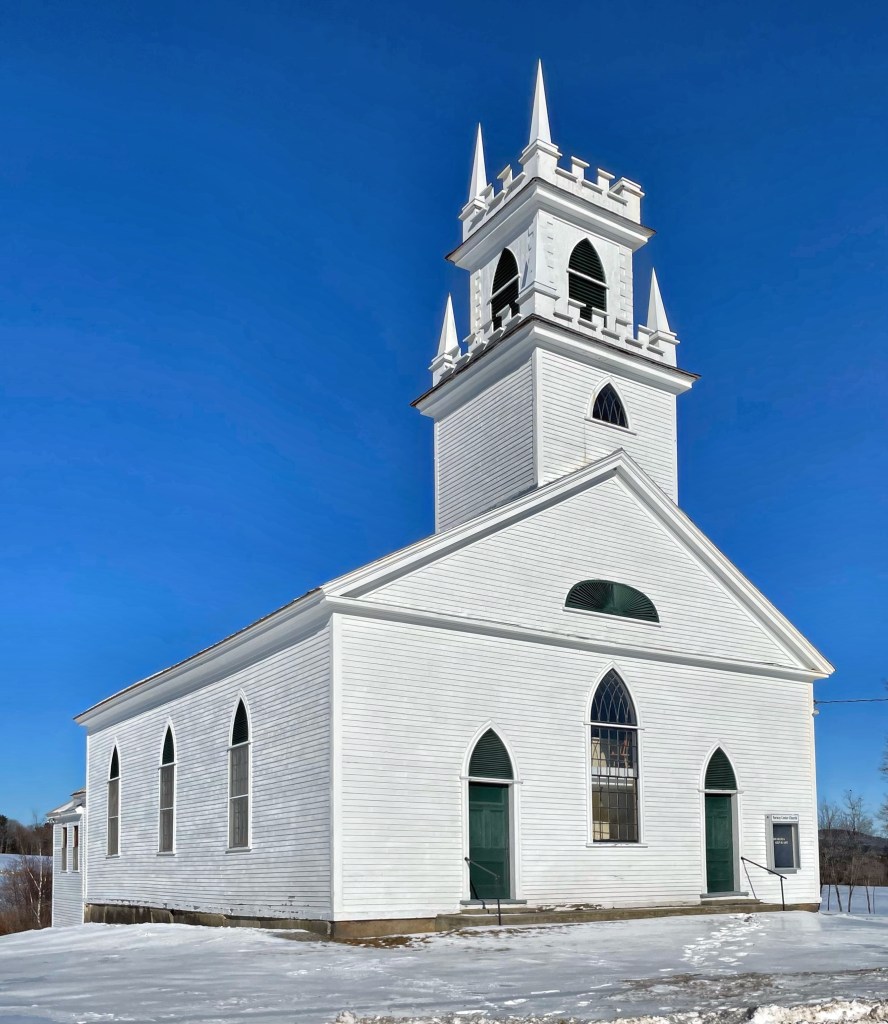
This beautiful, bucolic church in Norway Center was built in 1840 to replace an earlier meeting built in 1808-09 on the site. The present building is Gothic Revival in style with louvered panels making the windows appear lancet in shape and the amazing lancet window centered on the facade. The two-tiered tower is ornamented with crenellation and a wooden spire at each corner (besides one missing). The church features a louvered fan and strong pediment, which are nods to other prominent styles of the early-mid 19th century, Federal and Greek Revival respectively. This church quickly saw membership drop as Norway Village became the population center of town, with Norway Center becoming more agricultural and rural.
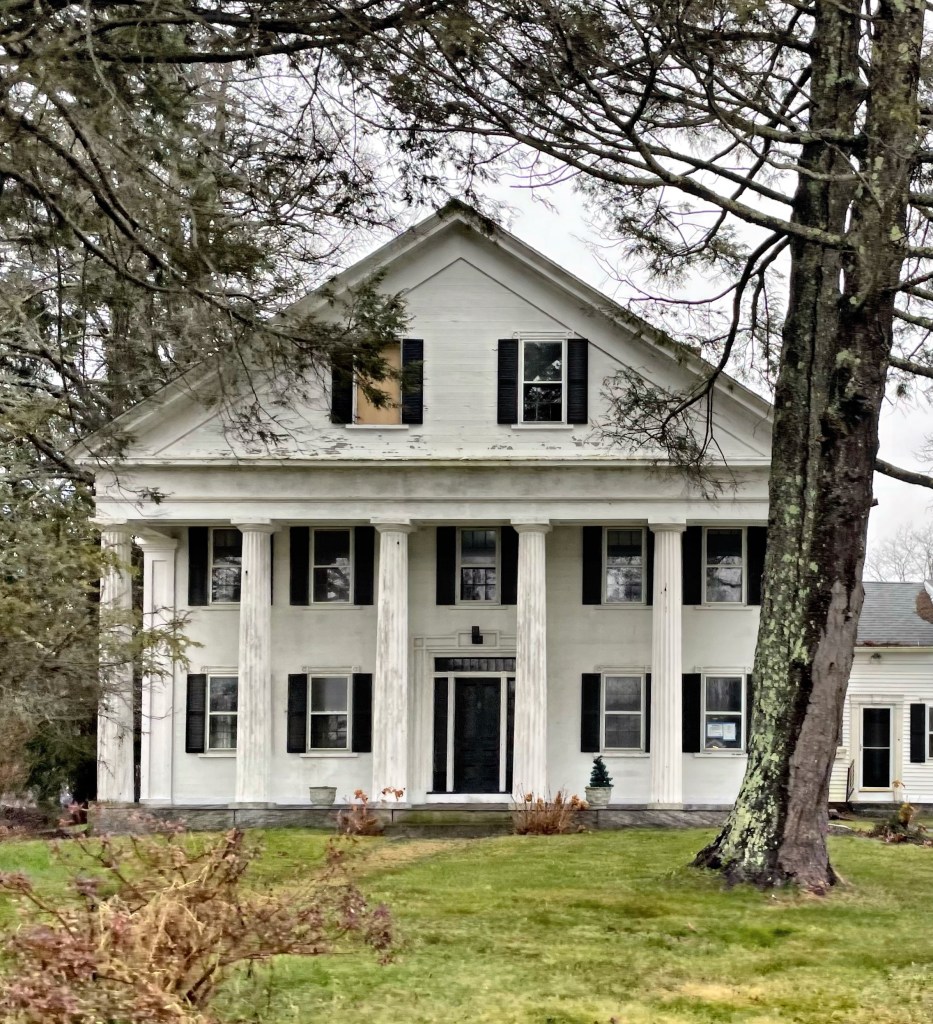
Located on Tolland Turnpike in Willington, east of the Town Common, this temple-front Greek Revival home stands in an excellent state of preservation. The home was built for General Orrin Holt (1792-1855) in about 1840 after his work as a member of the Connecticut State House of Representatives 1830–1832, and in the Connecticut Senate in 1835 and 1836. He was re-elected as a Democrat to the Twenty-fifth Congress, serving until 1839. After leaving Congress, he served as Inspector General of the Connecticut State Militia, until his death in 1855. He likely built this home after leaving Congress in 1839, in his hometown. There is something about a temple-front home like this, they are so stately!
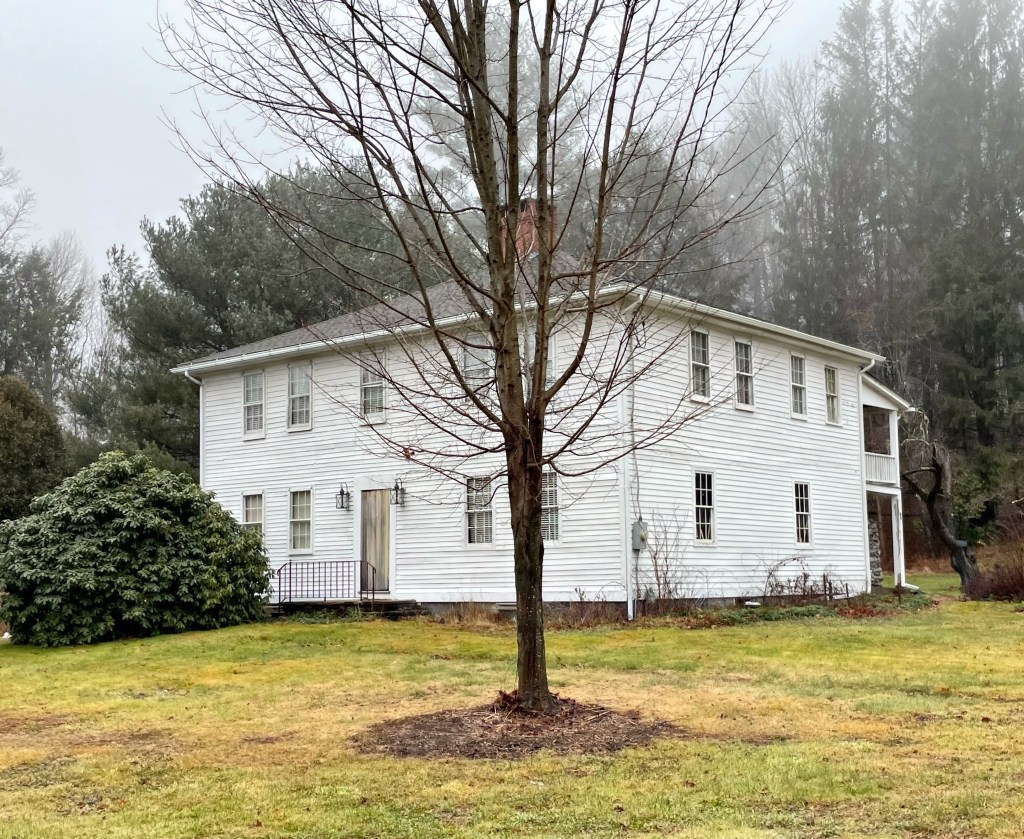
The Daniel Glazier Tavern is located at the west end of the Willington Green, an area showcasing great vernacular examples of Federal and Greek Revival architecture. The tavern was apparently built by Daniel Glazier as a stop along the route connecting Norwich, CT to Springfield, MA, where visitors could grab a bite to eat and/or stay the night to rest. Daniel’s son Isaac was the first tavern-keeper, followed by Daniel’s son-in-law Arial Eldridge until his death in 1849. The ballroom of the tavern had long been used in the winter months for town meetings, as he basement of the Town Meetinghouse, used for town meetings, lacked any form of heat. Since 2009, the property has been owned by the Willington Historical Society, who have restored the building.
Elijah Waters (1773-1846), a hardscrabble farmer in West Millbury inherited his father’s large farm and resided there for over thirty years before wanting something more his style. Unmarried and without children, Elijah (who was 72 at the time), had this impressive Greek Revival farmhouse constructed near his old family homestead. He was possibly looking to spend money saved up and without a wife or heirs to will it to. The massive temple-front Greek Revival mansion has a stunning doorway and six columns supporting a projecting pediment. Within a year after the home was built, Elijah died. The home was willed to his nephew, Jonathan Waters. The house is for sale for $384,000 which is a STEAL!
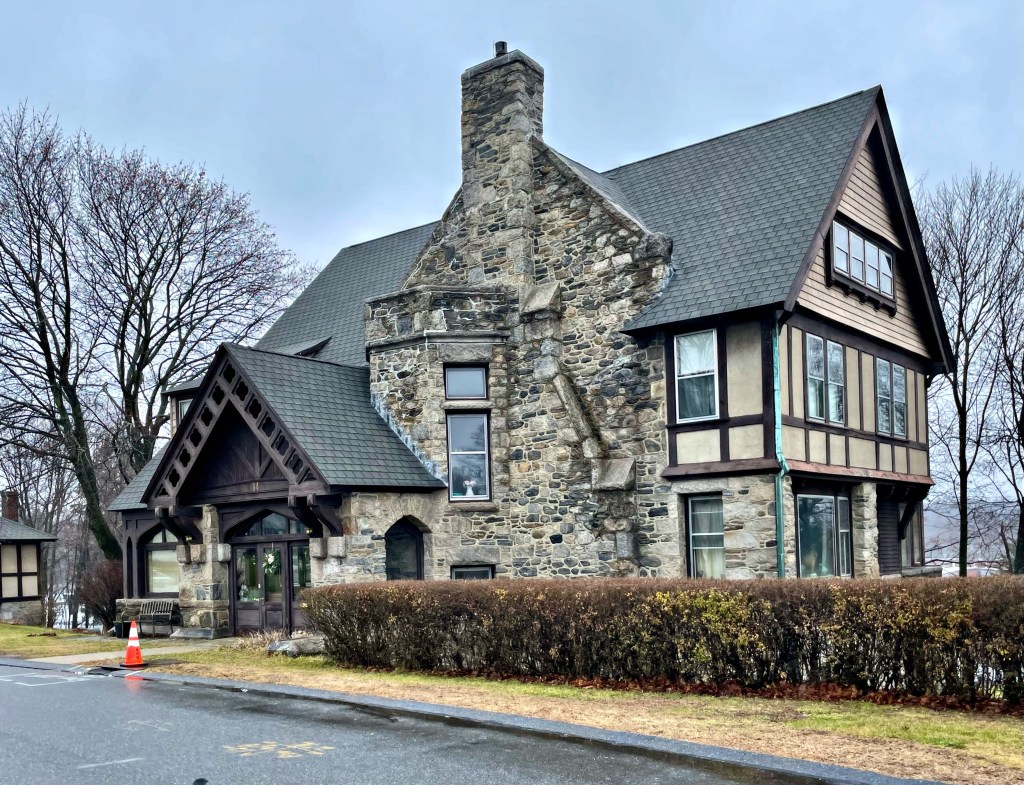
William “Willie” Winfred Windle (yes that is a real name) was born in Millbury at the height of the town’s industrial growth and prosperity. He ran the W.W. Windle Mill just west of downtown and with his wealth, was able to buy a house lot on one of the most fashionable residential streets in town. His home was built in the early 20th century and is a stunning example of Tudor Revival architecture. In 1911, Windle traveled to England to inspect mills there and was likely inspired by some of the residential architecture he viewed on the trip. The house elegantly blends stone walls with half-timbered wood, with a prominent entry. The timber and stone entrance porch which has decorative bargeboard and corbels, has been enclosed. The home remained in the Windle family at least into the 1940s, when it was occupied by William Winfred Windle’s son, Winfred Woodward Windle. By the 1970s, the home was occupied as the Millbury Society of District Nursing.
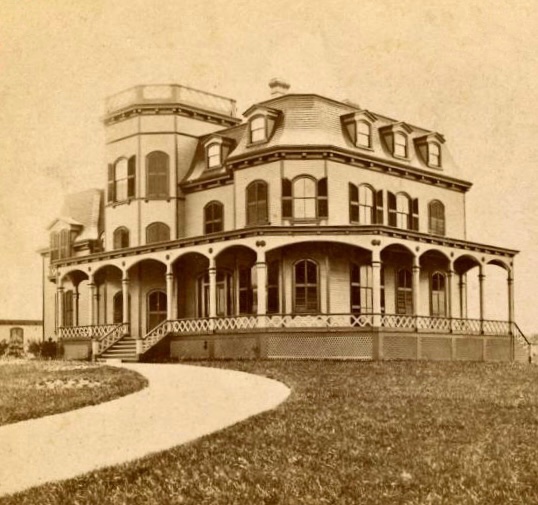
Not to be confused with The Villa, an extant mansard-roofed cottage in Newport, this beautiful example of the Second Empire style sadly is no longer around for us to gawk at. “Train Villa” was built as a summer cottage for George Francis Train (1829-1904), a nutty, attention-seeking businessman, who in 1870-1, traveled around the world in 80 days. The feat caused a sensation, but only after a writer named Jules Verne fictionalized it, naming the main character Phileas Fogg. Train was already one of the most famous men in America, but he was not happy that Verne co-opted his story. “Remember Jules Verne’sAround the World in 80 Days?” he told English reporters. “He stole my thunder. I’m Phileas Fogg.” Train undertook a total of three trips around the world, each time attempting to beat the record of 80 days, with his final trip clocked in at just sixty days. Ironically, Amazon Prime just released the story as a new series (literally airing days ago). Before his inaugural trip around the globe, Train had this summer cottage built in Newport, where he could relax after his globetrotting. After his death, the property was renamed “Beachholm” and owned by Woodbury Blairof Washington D.C..The home was one of the most eye-catching in town and was located in front of the Seaweed Cottage (featured previously), until a fire in the early 1970s led to its demolition.
Built in 1887 for John O’Brien, a direct descendant of Brian Boru, the High King Of Ireland, “Inchiquin” in Newport stands out for its bold stone exterior and proper siting. The mansion was named after Inchiquin, a barony (or state) in Ireland, likely where O’Brien’s ancestors were from. The cottage was designed by John Dixon Johnston, a well-known Newport architect, who designed the stone mansion in a sort of hodge-podge of styles, which actually work well together somehow! In 1901, Inchiquin was acquired by The Baroness Seilliere, the adopted daughter of John O’Brien. She was a daughter of Mrs. O’Brien by a former husband. After her first husband died she married the Baron de Seilliere, brother of the Princess de Sagan. Like some other massive, expensive mansions in Newport, this home was converted to condos.
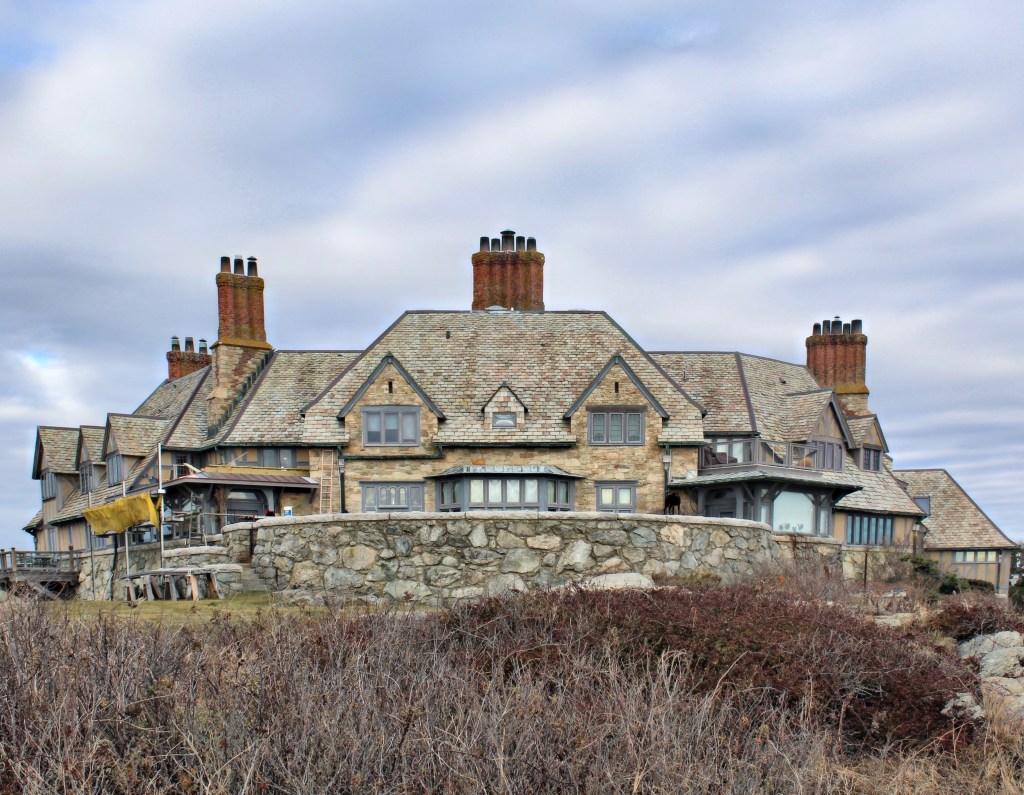
If anyone knows me, I absolutely LOVE Tudor and French Norman style houses, but they are much less common compared to the Colonial Revival style, which dominated residential architecture in New England for nearly a century. Located on Ledge Road, at the southeasternmost peninsula of Aquidneck Island in Newport, you’ll find this absolutely giant estate as you conclude walking Newport’s iconic Cliff Walk. “The Waves”, was built in 1927 by architect John Russell Pope (1874-1937) as his own residence. He built it over the ruins of the former Gov. Lippitt Mansion which was previously built on the site and demolished by Lippitt’s heirs. In designing The Waves, Pope wanted to focus on the natural, rocky site and build a structure that would blend in. The Tudor style mansion features stucco and stone siding, half-timbering, and a complex roof covered in slate, all in a U-shaped form. Years after completing his home in Newport, Pope would become even more well-known for designing major public buildings in Washington D.C., including the National Archives Building (1935), the West Building of the National Gallery of Art (1941), and the Jefferson Memorial (1943). After Pope’s death, the massive home became the first mansion in Newport to be converted to condos, a great preservation tool that maintains these massive mansions, and allows for them to be utilized today.
One of the more architecturally modest and refined Gilded Age summer cottages of Newport sits on one of the most picturesque pieces of land at the southeastern point of Aquidneck Island and is aptly named Land’s End. The cottage was built in 1864, Land’s End was designed by John Hubbard Sturgis for Boston banker, Samuel Gray Ward, his father’s business associate. The home features a refined Italianate style base with a roof comprised of a variation of the Second Empire mansard style called a “turtleback roof”. Land’s End is probably most famous as the residence of Edith Wharton (1862-1937) after she acquired the property in 1889. She worked with Boston designer Ogden Codman, Jr., to experiment with a style of subdued classical interiors and a remodel of the exterior, which was later featured in their book, “The Decoration of Houses”. Wharton was inspired to show what good taste is after the influx of Vanderbilts and other newly moneyed summer residents of Newport. The book focused on how to build and decorate houses with nobility, grace, and timelessness. It would, they hoped, lead its readers out of what Wharton called (pace the Vanderbilts) a “Thermopylae of bad taste” and into an aesthetic Promised Land. Wharton only lived at Land’s End for a decade, when the “stuffiness” of high-society there led her to move to the Berkshires in Massachusetts, where she worked with architect Ogden Codman to design her new home, The Mount. It the monstrous Lippitt Mansion, Breakwater was built at the time, just next door! did not help that Sadly, many of the interiors have been altered since Wharton’s time there, but with more recent interventions, but the book did help shift some of Newports later homes to a more refined, classical taste.
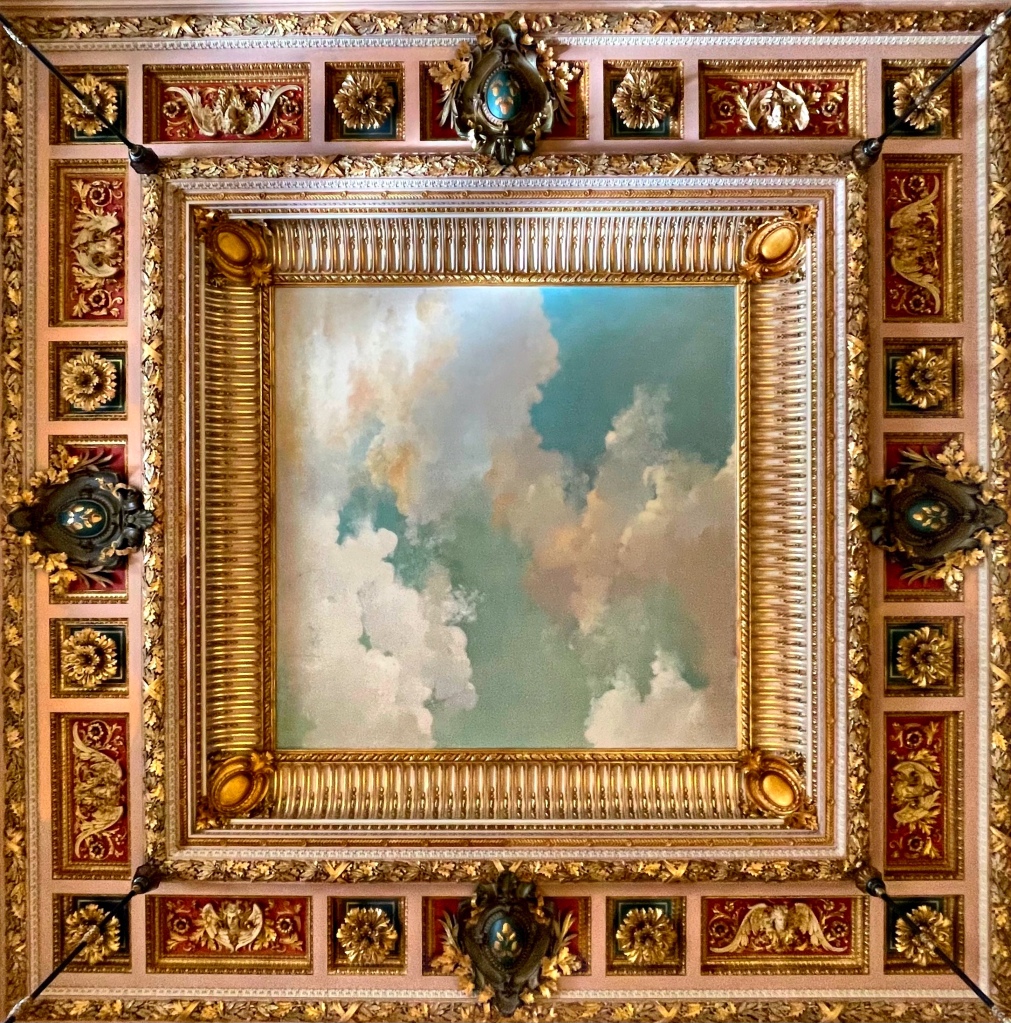
Merry Christmas from The Breakers! This 1895 Gilded Age mansion is the best to explore during December, when the halls are decked and stunning Christmas trees adorn the lavish rooms (learn more about the mansion in my last post) When you walk into The Breakers, you enter the Great Hall. Architect Richard Morris Hunt designed the Great Hall after the open-air courtyards in Italian villas, but enclosed due to the tough New England winters. The palatial space (measuring 50 foot square), even if crowded by tourists trying to get the perfect shot on their smartphones, feels spacious yet somehow welcoming given the art museum-like detailing. The walls are made of carved limestone from Caen on the coast of France and adorned with plaques of rare marbles. Elaborately carved pilasters decorated with acorns and oak leaves support a massive carved and gilt-cornice which surrounds a ceiling painted to depict a windswept sky, further expressing the open-air courtyard feeling envisioned by Hunt, the architect. Four bronze chandeliers dangle from the gilded ceiling, and flood the room with warm light, evoking warm summers in Italy.




 Buildings of New England