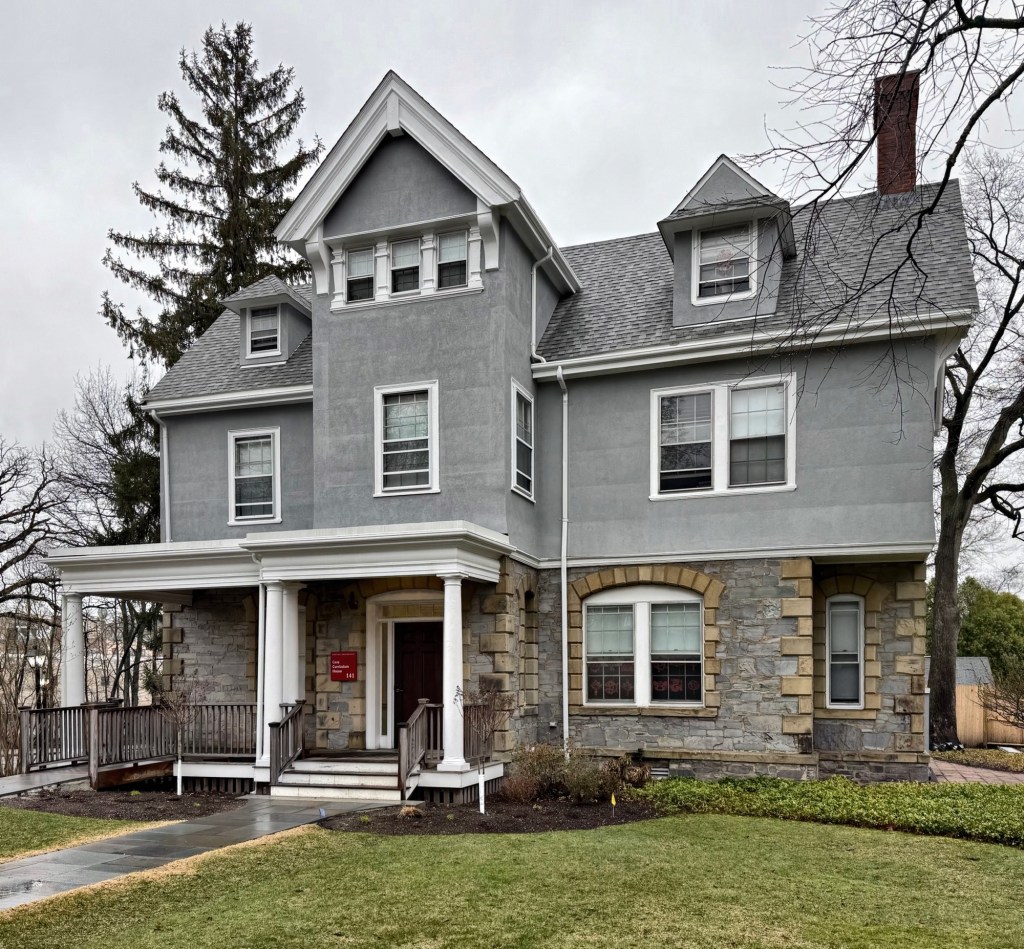
Lawrence-Parker House // 1864

Built in 1864 as one of the rental properties owned by Amos A. Lawrence as part of his exclusive Cottage Farm neighborhood in Brookline, this house has been extensively altered and even moved but retains significance as a surviving mid-19th century “cottage” in the neighborhood. The house was likely constructed as a one-story, stone cottage with a second floor contained within a mansard roof. In 1903, Mrs. Francis W. Lawrence hired the well-known architect and Brookline resident, Julius A. Schweinfurth, to make extensive alterations to the cottage, replacing the mansard roof with a new second floor with gable roof, along with a new porch. Schweinfurth’s design included wood shingle siding for the upper floors, which were replaced with stucco in 1970. The house was moved to its current site at the corner of Carlton and Mountfort streets in 1929 when the street was re-oriented to follow the old Boston & Albany Railroad tracks. When moved, the cottage was occupied by Philip Stanley Parker, a judge, and his wife, Eleanor. Today, the cottage is owned by Boston University and known as the Core House.

Old Pierce School // 1855

Located in the heart of Brookline Village, the old Pierce School sits tucked away behind the Brookline Town Hall and other municipal and institutional buildings. The school was built in 1855 at a cost of $15,000 and later expanded in 1904 from plans by Julius Adolphe Schweinfurth, a prominent local architect. Julius had two brothers who also were architects:  A. C. Schweinfurth, who worked out of California and Charles F. Schweinfurth, out of Ohio. The Pierce School was named after Reverend John Pierce, noted pastor of the Walnut Street church during the mid 19th century. He and his wife, Lucy Tappan Pierce, were active leaders in the abolition movement in Brookline. The school was expanded a number of times until the 1970s, when the present Pierce Elementary School was built, in an unsympathetic Modern design that does little to enhance the busy street. As expected, the 1970s school will soon be demolished and replaced by a new, $212 million school. The old Pierce School will be incorporated into the new development.

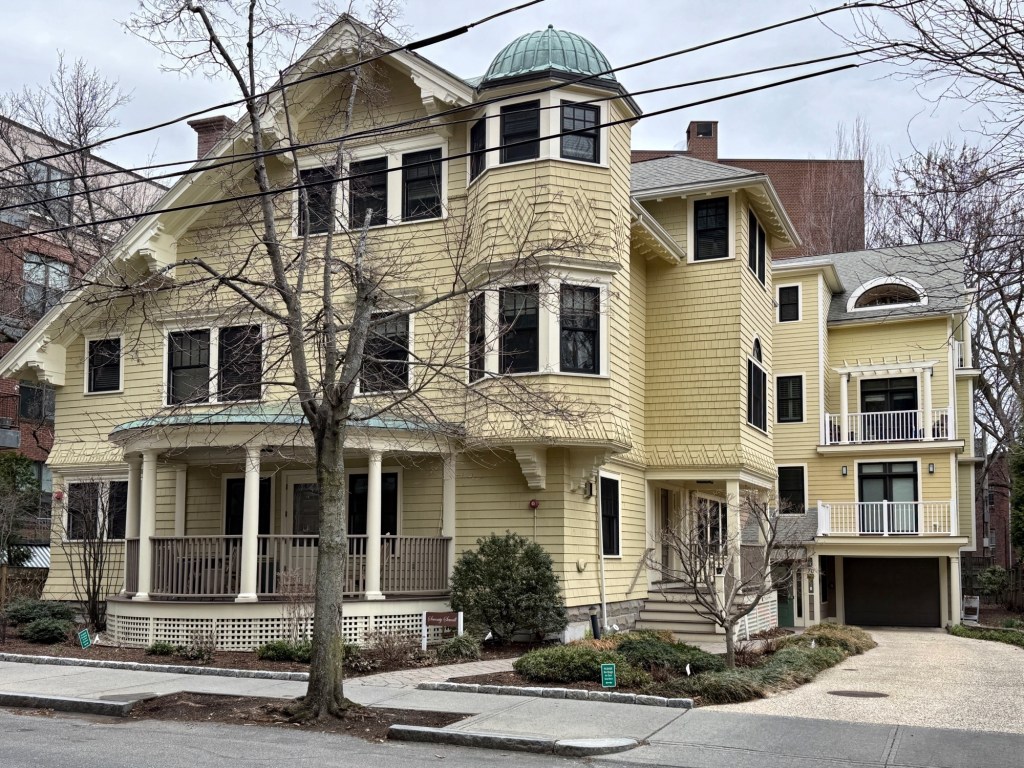
C. D. Hammer House // 1893

This lovely Queen Anne style residence near the Longwood section of Brookline was built in 1893 for C. D. Hammer, the General Agent for the Provident Life and Trust Company of Philadelphia. The stately suburban dwelling was designed by architect Julius A. Schweinfurth, a noted architect who designed many buildings in the region. While some of the stickwork and applied ornament has been covered by vinyl siding, much of the original detailing and some windows remain. The dropped pendants in the gables with flared bargeboard and highly ornamental corbels are a great touch and remain to this day. I bet all of the original details are still under that vinyl, just waiting to be shown again!

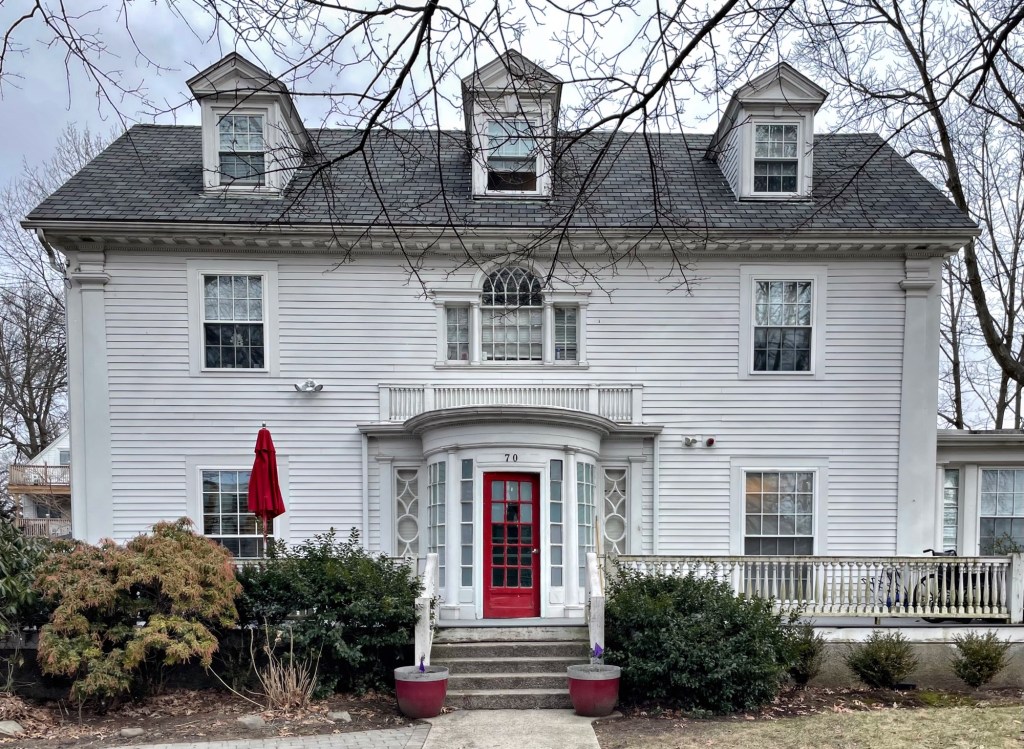
Pinderhughes House // c.1916

As much of the streets north of Franklin Park were developed in the early 20th century, a mix of middle-class apartment buildings and stately single-family homes began to sprout up. Boston contractor Hugh Nawn hired architect Julius Adolphe Schweinfurth to design this house, seemingly on spec, as an income-producing venture. Schweinfurth was employed by the architectural firm of Peabody and Stearns and worked as chief designer there until 1895, when he opened his own practice. His design for Mr. Nawn was this stately Colonial Revival style mansion, similar to Nawn’s own home just across the street, which overlooked Franklin Park. After WWII, Roxbury’s population saw an increase in Black residents, who began to be pushed out of the South End due to increased cost of living. This home was purchased by Dr. Charles A. Pinderhughes (1919-1998), Chief of Psychiatry at the Veterans Administration Medical Center in West Roxbury who also taught at Boston University, Tufts, and Harvard. He was engaged in the local chapter of the NAACP and advocated for African American residents when Urban Renewal began to destroy much of the surrounding neighborhood by the Mayor and Boston Redevelopment Authority. The Pinderhughes House is a well-preserved architectural landmark that also has ties to a more recent and overlooked history of the neighborhood. I hope this house stays like this forever!

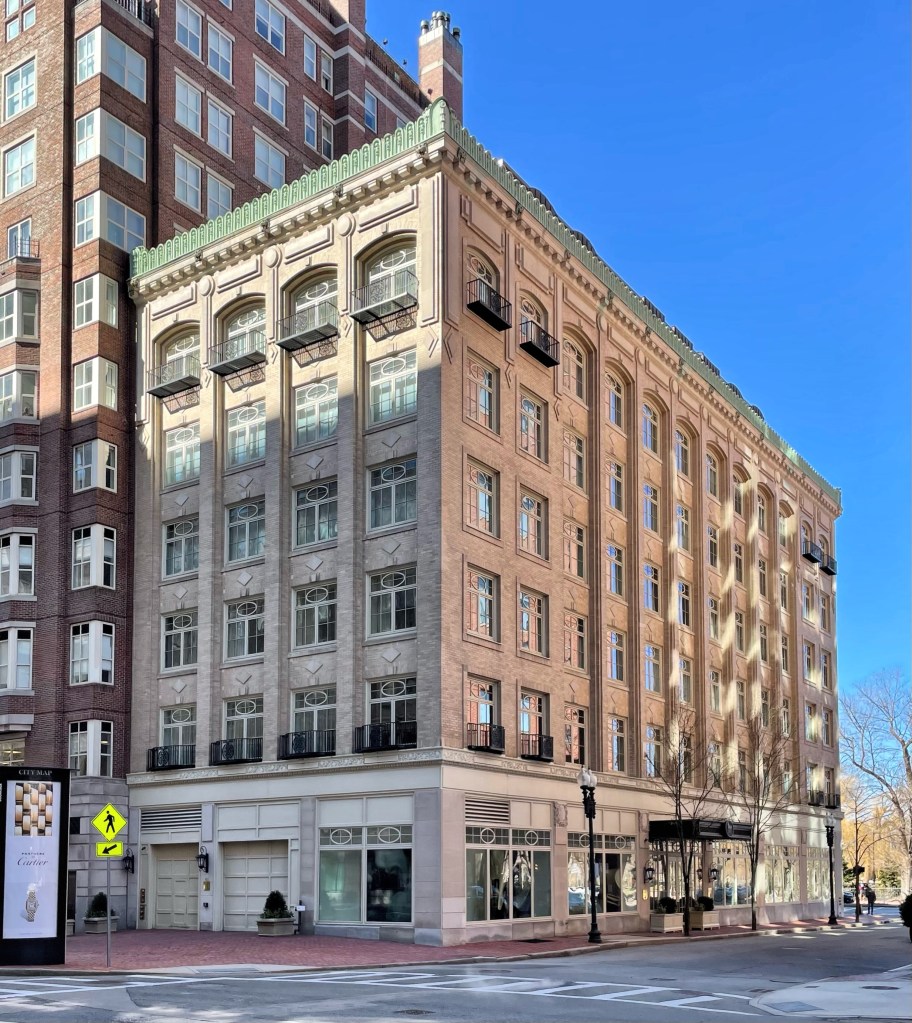
Garden Building // 1911

The only building that survived the wrecking ball of Urban Renewal on the stretch of Boston’s Boylston Street, south of the Public Garden was this six-story commercial building, known as the Garden Building. In 1911, architect Julius Adolphe Schweinfurth furnished plans for the new commercial building which was in the Beaux Arts style. The first floor was originally planned for three stores, with the upper five floors containing offices. A recessed penthouse floor served as studio space for artists and photographers with the large windows and skylights, the unobstructed views of the Public Garden didn’t hurt either! When the bulldozers of urban renewal came in the 1970s and 1980s to the area, this building surprisingly survived, and was reincorporated into the larger Heritage on the Garden condo development.

Williams-Sears House // 1905

Why cant we all have siblings this generous??

Located in Boston’s Back Bay neighborhood, this home was actually constructed as two attached homes for Ralph Blake Williams and his sister, Ruth (Williams) Sears, the wife of Dr. George Gray Sears. In 1905, Ralph B. Williams hired architect Julius A. Schweinfurth, who trained in the architectural firm of Peabody and Stearns, to design a double-townhouse, for him and his sister. After completion, Williams lived in the larger side (right three bays) with his widowed mother, and Ruth lived in the smaller home (left two bays) with her husband. After successive ownership, the buildings were and turned into a lodging house, soon after purchased together in 1955 and turned into a school, the Chandler School for Women. The homes remained separate until 1959, when the school demolished the interior party wall, effectively combining the two properties into one, this is likely when the Sears’ front door was filled in, leaving one front door in the center bay. In 1971, the New England College of Optometry purchased the building and occupies it to this day for classrooms and offices.