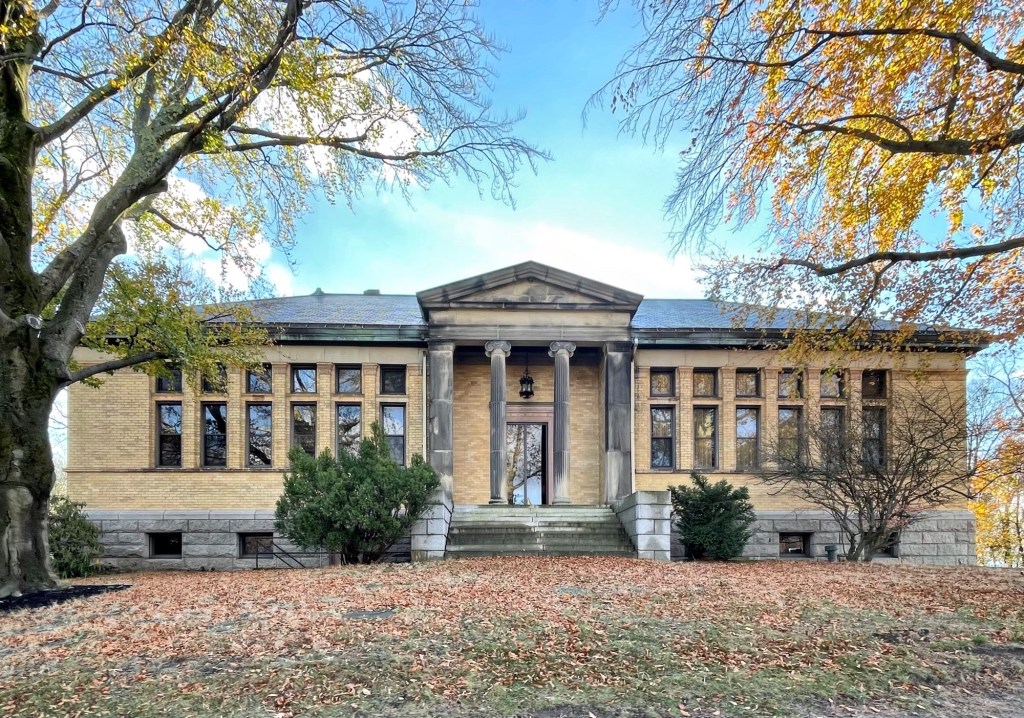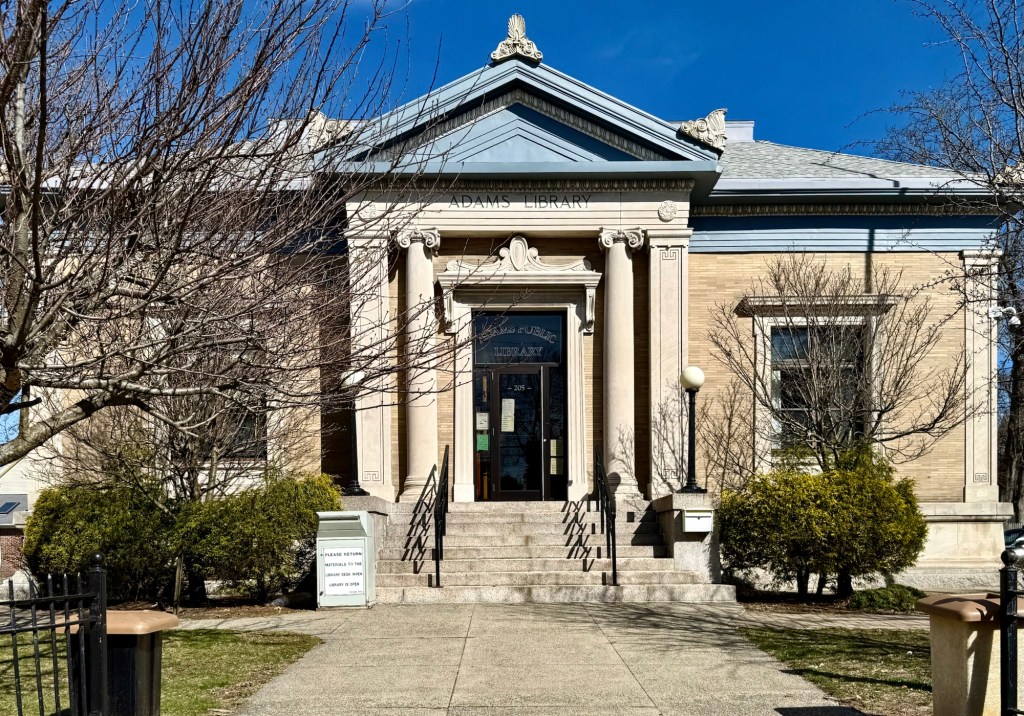
The Hills Library is a formal building standing at the summit of Institution Hill, so-named as the home of the Newton Theological Institution (and most recently as the Andover Newton Theological School). The library was constructed in 1895 from plans by architects Henry H. Kendall and Edward F. Stevens of the firm, Kendall & Stevens. Designed in 1894 in the Neo-Classical style, the library has a stately portico in the Ionic order with a pediment above. The building is constructed of yellow brick with stone and terracotta trimmings with banks of vertical windows. The library would be added onto at the rear, with the main entrance later closed for an accessible entrance in a rear addition. The building is now known as the Hanns Sachs Memorial Library for the current owners and stewards, the Boston Psychoanalytic Society & Institute (BPSI).
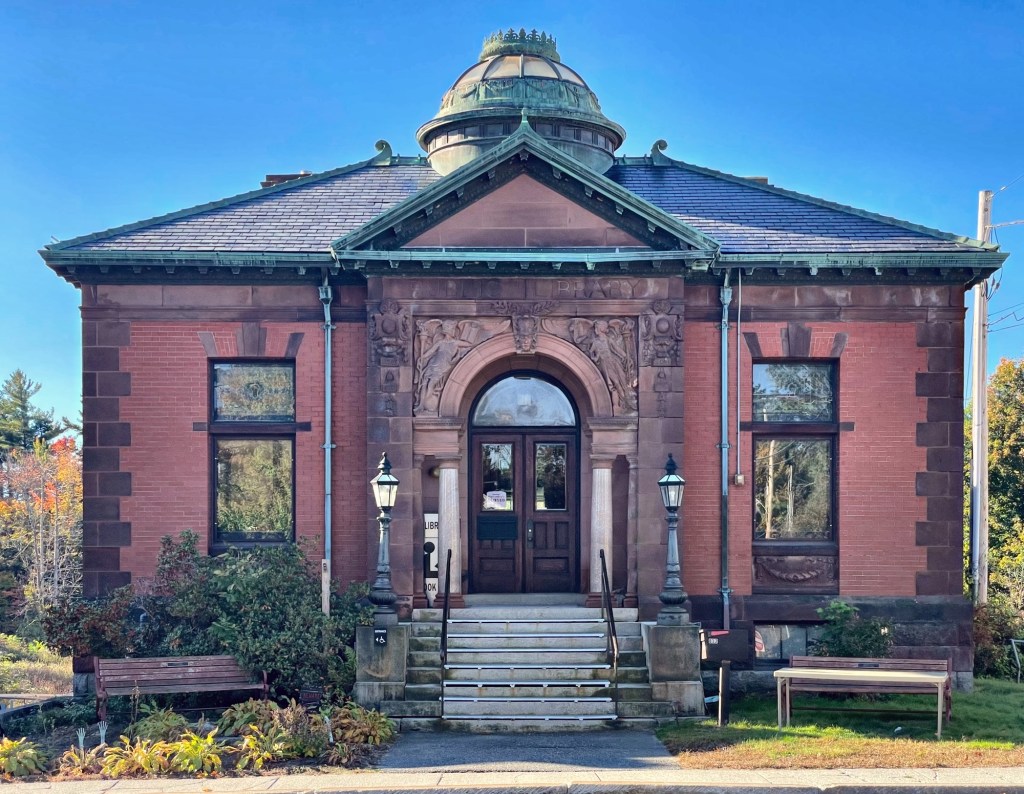
The Georgetown Peabody Library began on September 19, 1866, following a generous gift from George Peabody (1795-1869), a great man who is considered the father of modern philanthropy. George Peabody’s interest in the town was due to the fact that it was the birthplace of his mother, Judith (Dodge) Peabody, and for many years the home of his sister, Mrs. Judith Peabody Russell. Mr. Peabody decided to donate funds for the town’s first public library and also had 2400 books brought from London for its initial book collection. The wooden library building was designed by the Boston architectural firm of Bryant & Gilman and opened in 1869. After a few decades, the first library proved inadequate for the town’s needs and the present building was built with invested Peabody funds. In 1904, construction began on the new, present library building, a robust, brick structure in the Romanesque style with the firm of Cooper & Bailey furnishing the plans. The building has since been added onto as the town grew, but it retains its significance architecturally and historically for ties to Mr. George Peabody.
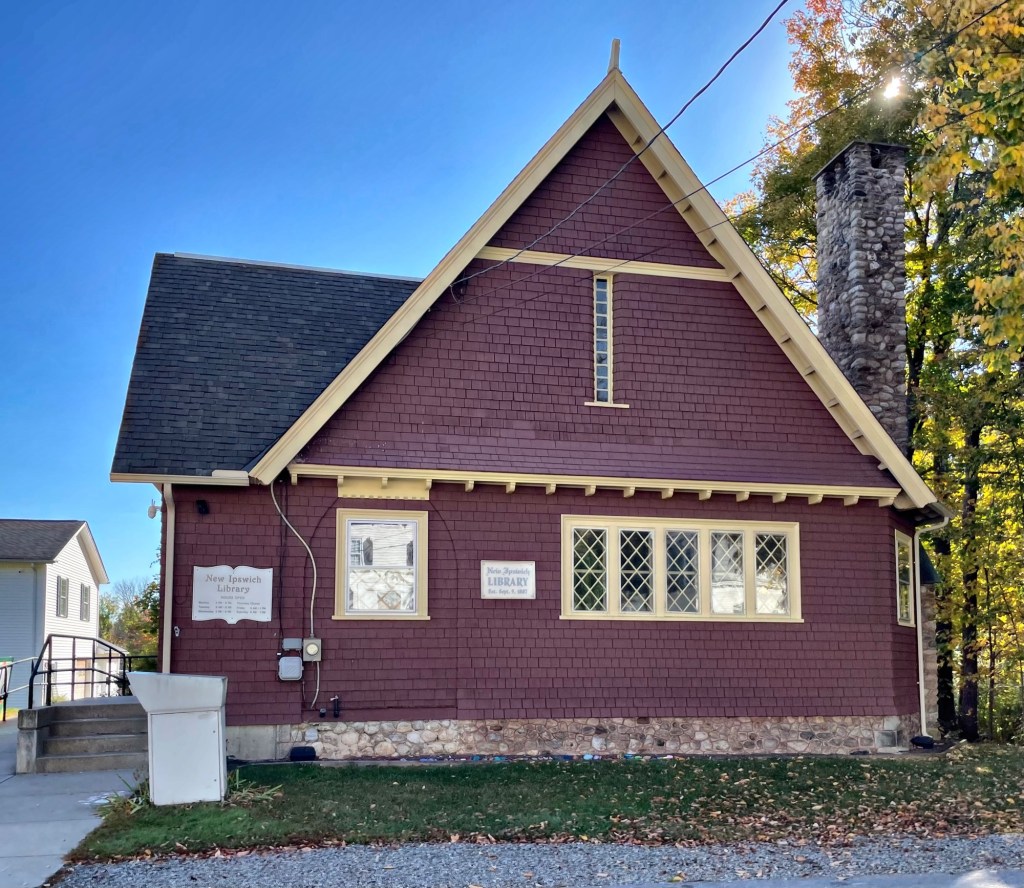
The New Ipswich Public Library is a one-story Shingle style building on Main Street in the charming village of New Ipswich, New Hampshire. The library building was likely designed by Ernest M. A. Machado, one of the best, and relatively unknown architects of the late 19th and early 20th century in Salem. The entrance which faces the side, is flanked by two diamond-pane windows, which can also be found on the primary facade. A special ten-light vertical window is recessed within a shingled depression in the gable, which adds some complexity to the design.
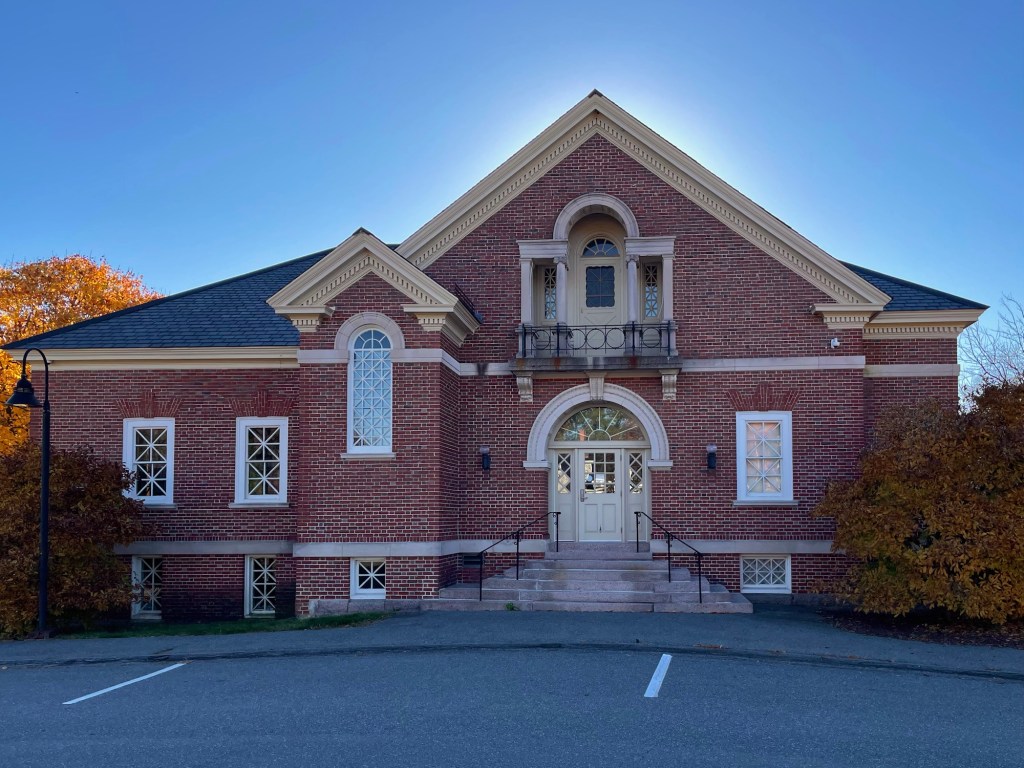
The Ashby Public Library in Ashby, Massachusetts, was built in 1902, completely funded by a donation from Edwin Chapman (1841-1915) who lived across the street from the new library. Mr. Chapman was raised in Ashby and became a wealthy Boston-area merchant in the meat trade by the late 19th century. Before this library was built, the town’s library collection was housed in the Wyman Tavern. The building was designed by architect Henry M. Francis in the Neoclassical style with Romanesque detail in brick and brownstone to make the building fireproof. The library was added onto in the rear in 2006 by The Galante Architecture Studio, which is recessed and mostly visible from the rear parking area. The addition is Modern in style to distinguish itself from the main library building.
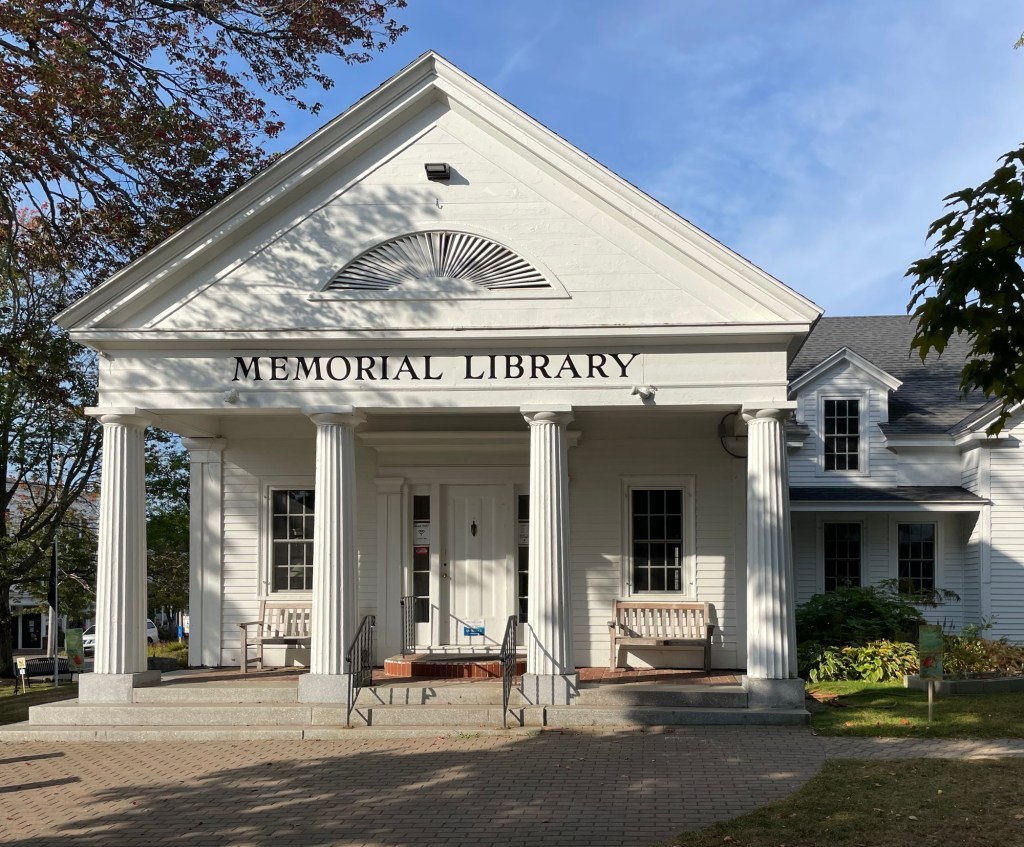
In 1906, the citizens of Boothbay Harbor voted to establish a free public library for all to enjoy. In 1923, the need for more library space, along with a desire for a World War I Memorial, led to the approval of a bond for the purchase of a 1842 Greek Revival style house on Oak Street. The building was remodelled for use as a library by the Boston architect William Stanley Parker, and was enlarged in 1966 to a design by Parker’s son, Stanley Jr. The temple-front, Neo-Classical entry was added at this time and harkens back to the original classical style Greek Revival home, while clearly showing a grander scale seen in the 20th century.
One of the best parts about New England is the diversity of the architecture and history of local public libraries. The Morrill Memorial Library in Norwood, Massachusetts, was erected by George H. Morrill in memory of his daughter Sarah Bond Morrill, who apparently died in 1895 of Typhoid Fever at the age of 22. George Morrill made his fortune as one of the largest producers of printing inks in America. The business was founded by Samuel Morrill, father of George H. Morrill in 1845 in Andover, but in 1856, he moved the works to South Dedham (present-day Norwood). The company grew rapidly and factories were built in Norwood and expanded to meet increasing operations. Mr. Morrill built a massive estate in Norwood (no longer extant) and also houses for his family members nearby to create a small enclave for the family. One of the lots on Walpole Street was utilized for a memorial library in honor of his late daughter. Architect Joseph Neal, who originally worked for Shepley, Rutan & Coolidge in Boston, designed the Richardsonian Romanesque library constructed of rough-faced granite blocks with a red terracotta tile roof above. The main entrance was deeply recessed within a great Assyrian arch typical of an arch-type that was a hallmark of the public and ecclesiastical buildings of Boston architect Henry Hobson Richardson during the 1870’s and 1880’s, but has since been enclosed by a vestibule, somewhat diminishing the original entry. The library was originally cruciform in plan but one-story additions constructed in the 1960s, on either side of the original facade have altered its original volume, but at least they are of a similar material. The library is one of the more unique in the Boston area and a testament to a father’s love to their children.
The Bugbee Memorial Library sits on Main Street in Danielson, the main village in the town of Killingly, Connecticut. The library was built in 1901 and financed by a bequest from Edwin Holmes Bugbee, who made his fortune at local mills. When Bugbee died in 1900, his estate left his entire collection of books along with funds for a new library for Danielson. Boston architect Walter Jefferson Paine designed the library building in the Classical Revival style with buff brick and stone construction. The names of Homer, Virgil, Plato and Horace, along with Shakespeare, Milton and Dante, are boldly emblazoned across the facade denoting the building as a house of learning. The library was outgrown, and a new library was built nearby in 1994. The old Bugbee Memorial Library has since been occupied by the Killingly Historical Society.
Located on a slight rise above Main Street and across from the sprawling Hiram Village Cemetery, this one-story library with walls of textured concrete blocks was dedicated in August of 1915 and has been a center for cultural activities in the town of Hiram, Maine, since that time. The Soldier’s Memorial Library was built with funds provided largely by Virginia Barker Jordan, a granddaughter of local businessman Benjamin Barker. Also instrumental in organizing Hiram’s first free public library was Llewellyn A. Wadsworth, local poet and cousin of Henry Wadsworth Longfellow. Beyond the unique use of concrete block construction for a library, other interesting exterior architectural features include the wide-flaring eaves with exposed rafters and the bands of windows on the first story walls, which hint of the Arts and Crafts/Bungalow styles. The library building was designed by Boston architects Robert Wambolt and Amos A. Lawrence.
The New England Masonic Charitable Institute building is located in Center Effingham, New Hampshire, and is among the rural town’s most impressive structures. The structure was built in 1858 by the Charter Oak Lodge No. 58 of Free and Accepted Masons as a school to educate orphans of Masonic members, but they also admitted local students. It is the only known school building purposely constructed by Masons in the United States. Classes were conducted from 1861 to roughly 1882 with students boarding with local families. The impressive Italianate style building is dominated by a six-story bell tower supporting an octagonal cupola, and exhibits many architectural details including the corner quoins, paired eave brackets, and dentilled cornice. Charter Oak Lodge No. 58 sold the building to the Town of Effingham in 1891 for one dollar but retained rights to the second floor temple room in perpetuity. The walls and ceilings of the Lodge’s temple space are covered with trompe l’oeil murals attributed to Massachusetts painter Philip A. Butler. Images of classic sculptures, architectural details and Masonic symbols, including the All-Seeing Eye, are incorporated into the paintings. Heavily water-damaged in the late 1980s, they have since been restored. The building remains occupied by the Effingham Public Library, what a library building for a town of just 1,700 residents!
In his will, lifelong Chaplin, Connecticut resident William Ross (1833-1908) bequeathed his hometown funds to erect its first purpose-built public library. As planning began, his widow, Emily Jones Ross donated even more to fund a building fitting of her late husband. The Queen Anne/Romanesque Revival style library is built of pressed brick with granite trim and features a prominent rounded corner bay of cedar shingles. The masonry work was done by George E. Snow but I could not locate the architect. The town outgrew the library and moved it into a new building nearby, selling the William Ross Public Library to a private owner, who appears to be renovating it now.