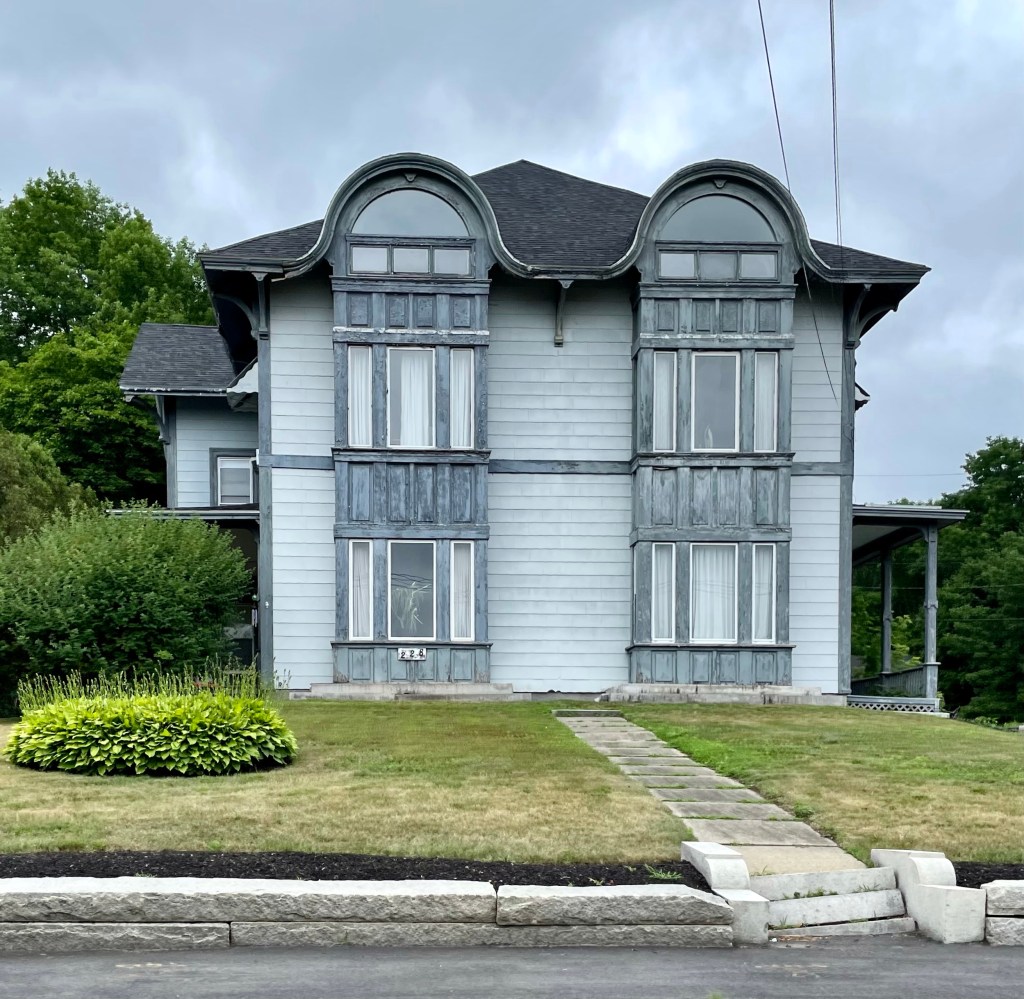
This stunning Queen Anne home in Gardiner, Maine, overlooks the Kennebec River from its high position on a hill. The home was built for Hartley Jewett, who ran a busy lumber mill in town, which sold long lumber, laths, and shingles, some of which ended up on his own home. Maine was huge in the lumber industry, and it’s vast forests were often cut and sent down to cities like New York and Boston on rail to supply their own building booms.
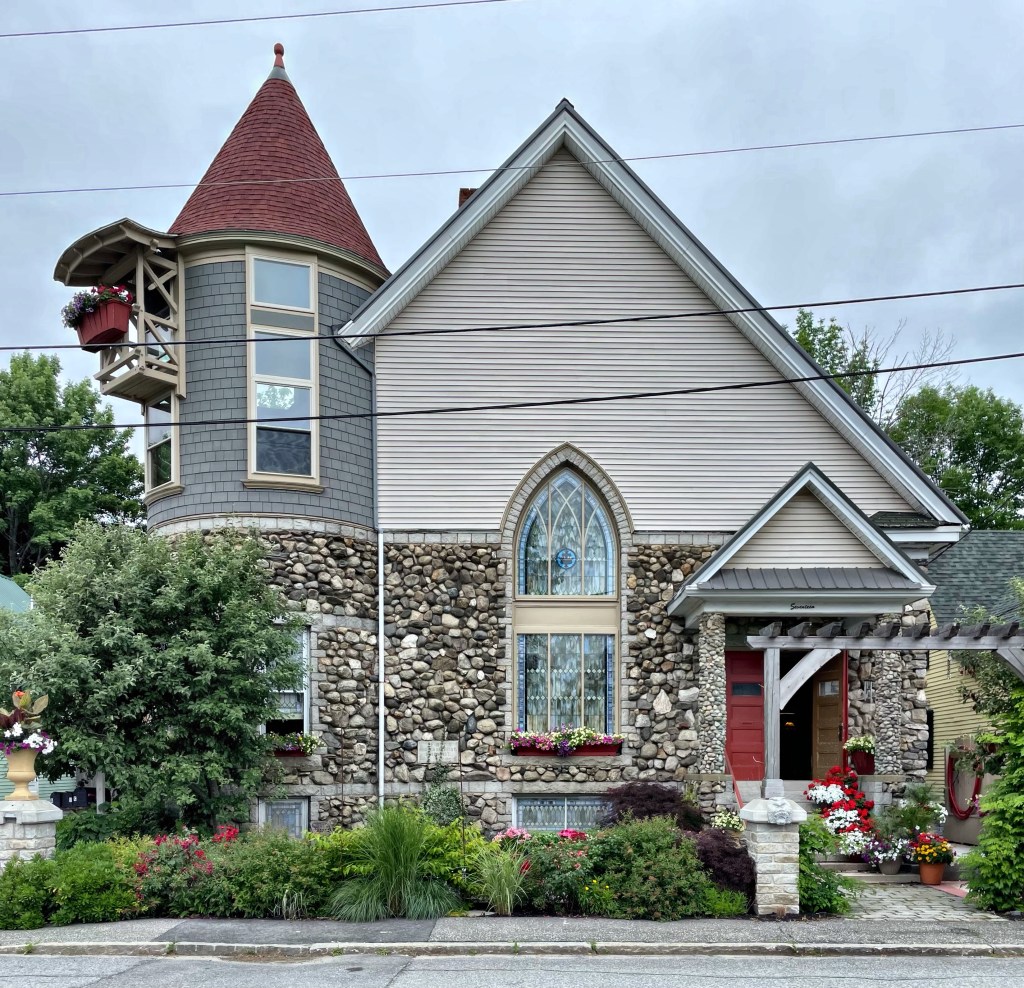
The first purpose-built Church of Christ, Scientist church in Maine is this turn-of-the-century edifice constructed in 1905 in Gardiner. Organized in 1897, this Christian Science Society of Gardiner met for several years in members’ homes and public places nearby until Palmer Noyes and his wife Caroline funded the new building. Caroline and Palmer helped establish the first such church in Chicago, after the couple witnessing a ‘healing’ and then heard Mrs. Mary Baker Eddy lecture in 1882. This church in Gardiner was seemingly designed by Caroline, who was likely inspired by architectural influences on the churches in town, from Gothic style lancet windows, to the shingle style facades. The building was eventually converted to a development center for the disabled, and is now known as “The Stone Turret”, a bed & breakfast, with amazing stained glass windows!
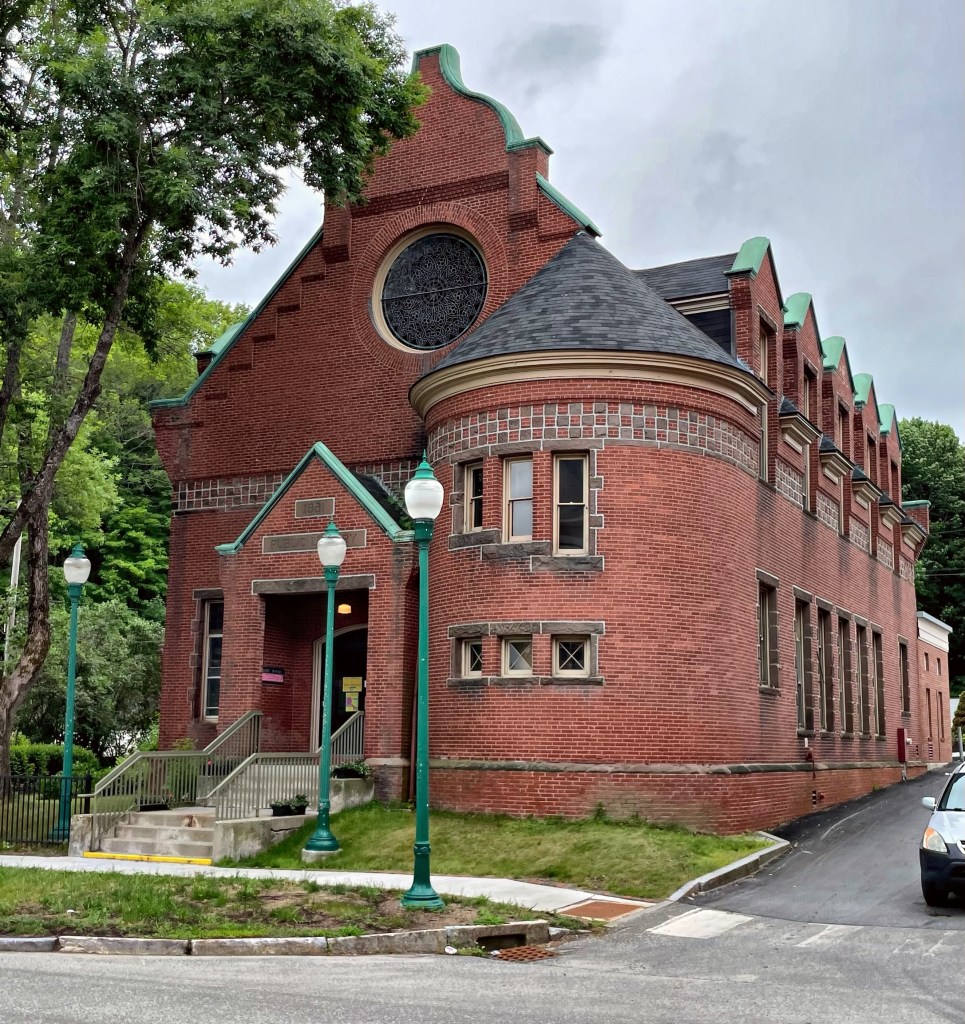
Possibly my favorite building type, the local town library buildings of New England, always amaze me with their small scale, yet architectural variety and intrigue. The library in Gardiner, Maine is no exception! This library building was constructed in 1881 from plans by Henry Richards, who was actually born in town in 1848. Henry graduated from Harvard in 1869, and soon after, took a post-graduate course in architecture at MIT. After completing schooling, he was a draftsman with Ware and Van Brunt. Soon after, he was a draftsman with Peabody and Stearns from 1872 to 1876, and then practiced architecture briefly on his own in Boston. During this time he married Laura Elizabeth Howe, daughter of Samuel Gridley and Julia Ward Howe. They moved to Gardiner, Maine and settled in a Federal house (featured previously), to learn more about Laura Richards and their house, check out the last post. Henry lived to be 100 years old! The library building is Queen Anne and Romanesque in style with a round corner tower with conical roof, brownstone and brick construction, and a stained glass ocular window with ogee parapet at the gable end roof. The small local library was added onto numerous times to hold a growing collection which includes works from Laura E. Richards, and Edwin Arlington Robinson, both Pulitzer Prize winning authors who lived in town.
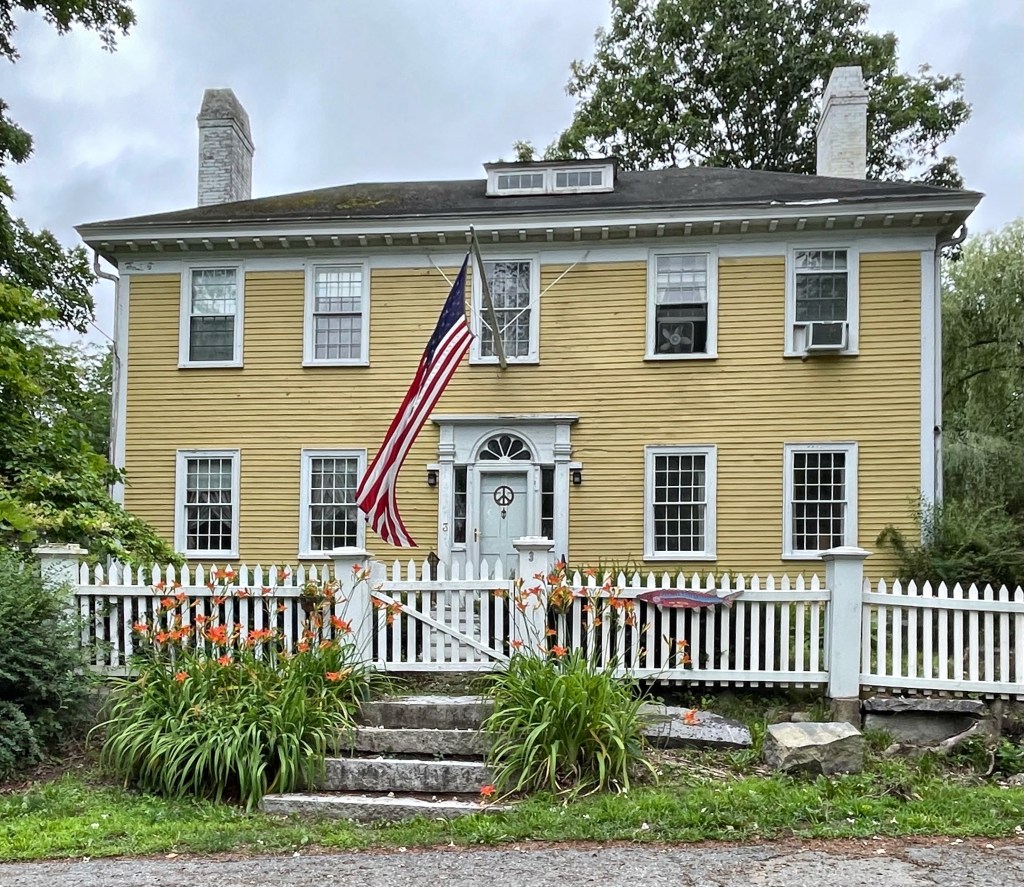
This stunning Federal style house in Gardiner, Maine, was built about 1810 by Ebenezer Byram, who had purchased the land from Robert Hallowell Gardiner, a descendant of Dr. Sylvester Gardiner, the “founder” of the town. Dr. Gardiner was a resourceful Boston druggist, who was one of the principal owners of the Kennebec Purchase, known as the Plymouth Company, who purchased land on the west side of the Kennebec River in Maine. Dr. Sylvester Gardiner had been attracted to the Gardiner area for a number of reasons, primarily because of the depth of the water of the river to the point of Gardiner as the head of navigation for ships here. This house overlooking that river was purchased in 1878, by Henry and Laura E. Richards. Laura Richards (1850-1943) was the daughter of Samuel Gridley Howe, an abolitionist and the founder of the Perkins Institution and Massachusetts School for the Blind. Her mother, Julia Ward Howe wrote the words to The Battle Hymn of the Republic, a tune that I am sure most of you have heard of, but never knew the name. Henry and Laura moved to Gardiner in 1876 after suffering financial reverses in Boston, where Henry worked at his family’s paper mill, and it was about that time that Laura Richards began her writing career. At this house in Gardiner, Laura wrote more than 90 books including biographies (including one on her mother), poetry, and several children’s books. Even more impressive, Laura was awarded one of the first four ever Pulitzer Prize in 1917 for her biography on her mother, years before women were even afforded the right to vote!
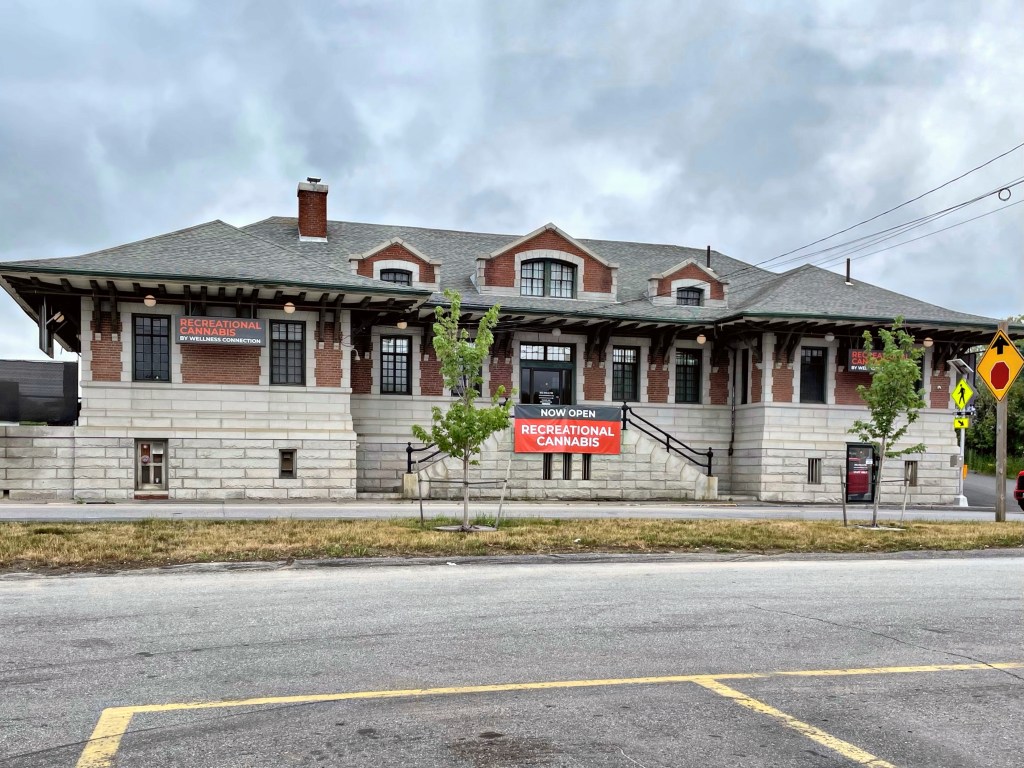
The first train arrived in Gardiner, Maine in 1851. Rail here introduced a new mode of transportation for passengers and freight, which previously relied on horse or ship up the Kennebec River. When the old station was deemed too small and outdated, the Maine Central Railroad Company decided to hire Portland architect, George Burnham to complete plans for a more fitting station. This building is a mix of styles, the two I would categorize it as are Romanesque Revival and Spanish Revival. The building incorporates a number of influences of the two along with a deep overhanging roof supported by large brackets, heavy rusticated granite blocks at the base, and quoining around the windows and corners. The station was in operation until about 1960 when rail service here halted. Since that time, the building has been adaptively reused as a retail store, today as a recreational cannabis dispensary. So you can get high and look at cool architecture!
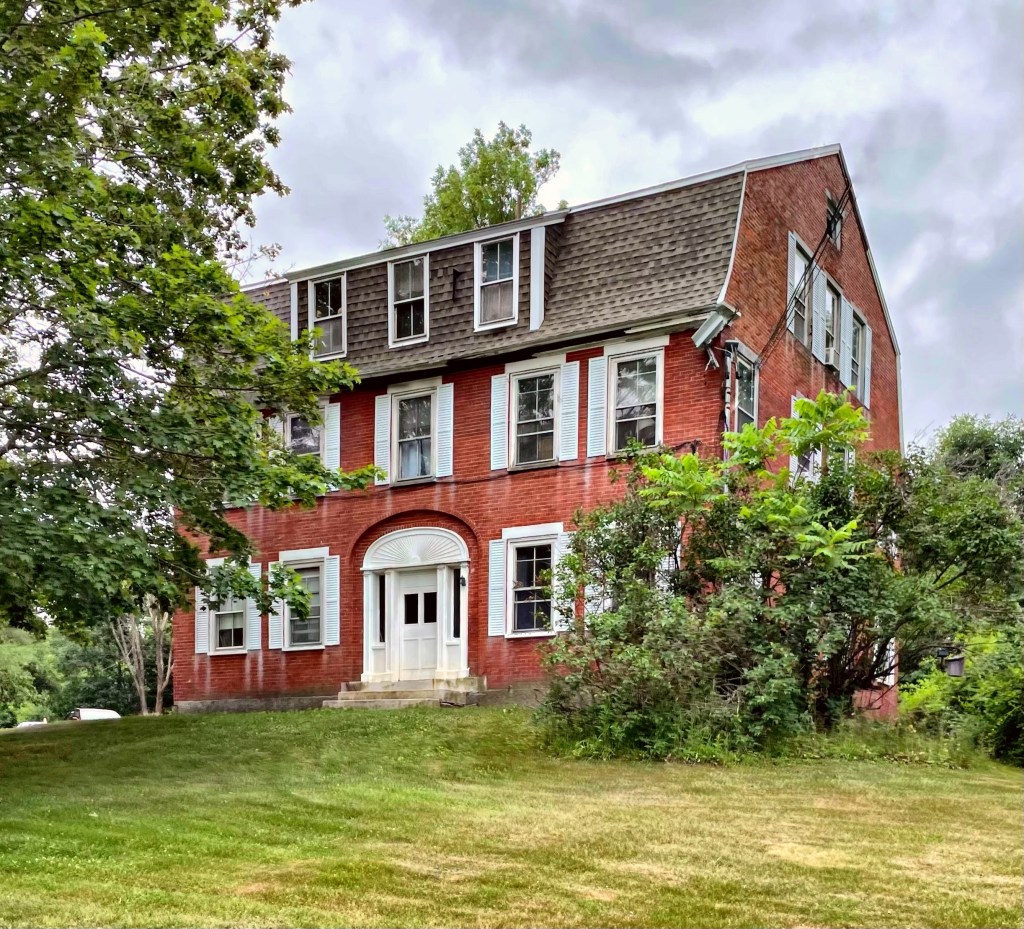
This large brick Federal house was built on the outskirts of Gardiner, Maine, in 1834. Ebenezer Moore, the builder, worked as a carpenter and house-wright in town and showcased his skill on his own brick mansion, selling it to a C.E. Bradstreet. By the late 1840s, the town of Gardiner decided that it would need a new almshouse, city-provided housing for the poor, so they purchased the Bradstreet house and 14-acres of land. In the 1848 town report documents noted, “The establishment is a brick one, of two stories, containing thirty-six fine rooms, including seven fitted for the insane in the most admirable manner, together with a spacious hall. The building is every way a most excellent one for the purpose, and is a monument of the humanity and generosity of the city.” The almshouse served as a working farm where the poor could harvest their own crops and contribute in a small, closed society. The almshouse burned in 1909, and was immediately rebuilt using the outside brick walls. In the Colonial Revival manner, a gambrel roof replaced the former gable roof, which added a third story to the almshouse. The building was eventually sold, as new housing models for low-income residents took off. The former almshouse was converted to an apartment building in 1970, a use that appears to continue to this day.
The Octagon form of architecture was conceived in 1848 in the prolific mind of Orson Squire Fowler, phrenologist and author of books on sex, family relations, and many other subjects. His book A Home for All, or, the Gravel Wall and Octagon Mode of Building struck the fancy of a certain few, and Octagon homes were built across the country, for just about a decade until they fell out of favor almost overnight. This home in West Gardiner, Maine, was built by Jesse Tucker in 1856 on land his father had cleared, replacing a more standard structure. The new octagon house was being constructed as a gift to Jesse’s soon-to-be wife, but tragically fell from the roof of the barn when building, and died. The home was completed, and it was seemingly acquired by Jesse’s twin brother David. The home remained in the Tucker family until the 1950s.
The this 1830 home in Farmingdale ranks as one of the first Greek Revival temple style residences in Maine. Situated on a rise overlooking the Kennebec River, the house reflects a dignity befitting the commercial success of its original owner, Peter Grant. Peter Grant was born in 1770 in Berwick, Maine. He was a fourth generation descendent of an earlier Peter Grant, born in Scotland in 1631, and one of 3,000 Scots taken prisoner by Cromwell’s army at the Battle of Dunbar. In 1650, he was sent as a convict laborer to the iron works in Lynn, Massachusetts, for a term of seven years. A number of the Grant family settled in Berwick, Maine, and from there, Peter, builder of this house, and his father, Capt. Samuel Grant, moved to Gardiner. Peter Grant soon involved himself successfully in land speculation and shipping in the area. In 1796 he and a group of associates, purchased a large tract of land along the west shore of the Kennebec River, which later became Farmingdale. Grant became sole owner of better than 200-acres of this land in 1800 and built a substantial house soon after. The original house was destroyed by fire and was replaced by Grant with the present house in 1830 six years before his death in 1836.
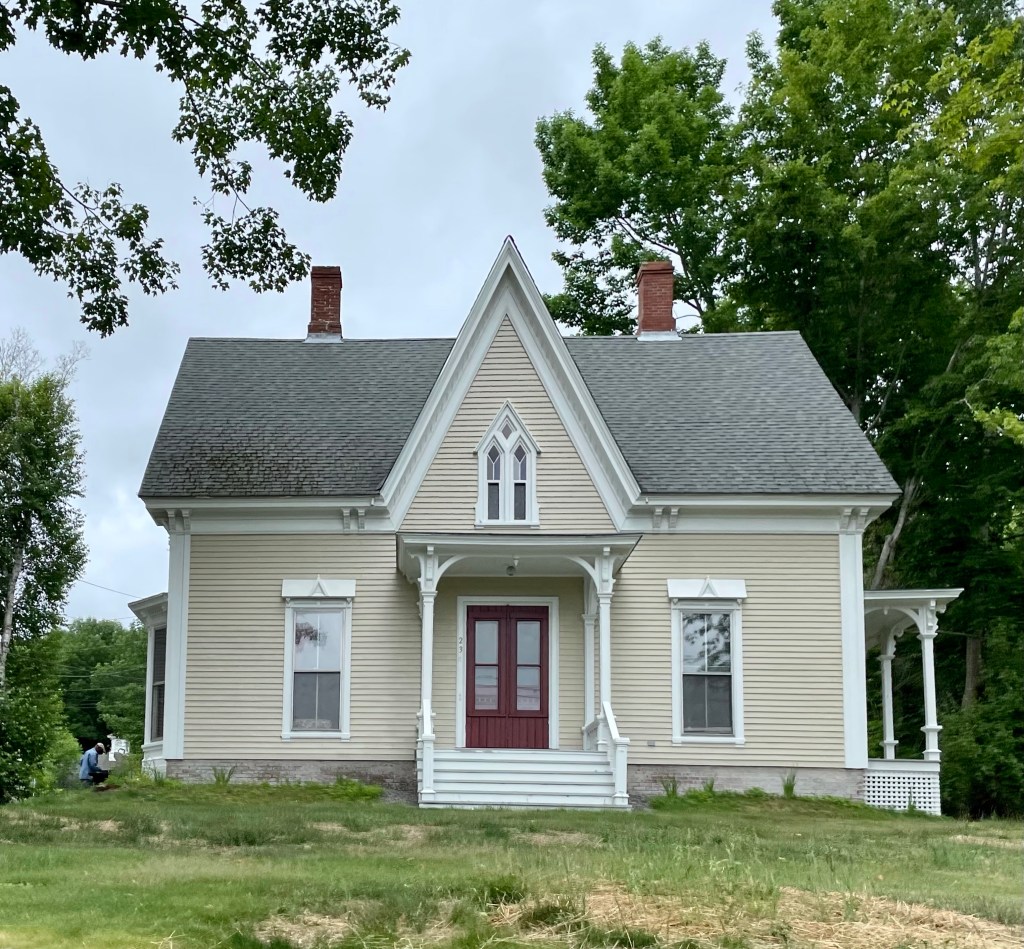
Constructed c. 1850, this Gothic Revival house in Farmingdale, Maine, has many identifying features common in the style: a symmetrical facade, steeply pitched gable, and lancet windows in the front gable. Besides its architectural significance, the home is also historically significant as the home of Dr. Gertrude Heath. Gertrude Emma Heath (1859-1935) was born in Gardiner, Maine in January 1859. When Gertrude was just three years old, after the American Civil War began, her father died in battle at Fredericksburg, leaving his widow Sarah to run the family affairs. She excelled in school and received her early education in the public schools of Gardiner, afterward attending Hahnemann Medical College at Chicago, Illinois, taking special courses. She graduated from this institution in 1883 with the degree of Doctor of Medicine, and began medical practice in Chicago in 1884, moving back home within that year. Soon after returning to Maine, she accepted a position at the Maine State Hospital, at Augusta, where she specialized in eye and ear conditions. It is amazing learning stories about such strong women, when at the time, women medical practitioners were almost unheard of and women were decades away from earning the right to vote.
One of the most unique homes in the state of Maine has to be this stunner in the small town of Farmingdale. Perched high on a hill overlooking the Kennebec River, the mansion was built in 1855 for Folliett Lally, a wealthy Civil Engineer. In 1842, Lally was hired by the U.S. Government to map out the border between present day Maine and New Brunswick, Canada. The issue arose after the Treaty of 1783 ending the American Revolution had described the northeastern boundary of the new United States, but with unclear boundary descriptions. After the Aroostook War in 1838-9, a cold war between the U.S. and Britain (who controlled New Brunswick), the long-standing controversy was ended with the Webster-Ashburton Treaty (1842). The new boundary was proposed by the King of the Netherlands, a mediator, who granted the U.S. more of the disputed area. We have Folliett Lally to thank for mapping and charting out the present northestern boundary of the United States. Now back to the house. The home was designed by Charles Alexander, a Portland-based architect. The home was sold, likely after Lally’s death, to two men, who converted the it to a double house, with entrances on both side elevations. A brick wall was run through the center of the home separating the house in half. The building was since divided up more and apparently has eight units.
Just a few doors down from the Nathaniel Stone House (last post) in Farmingdale, Maine, this large Italianate style home similarly commands the prominent siting overlooking the Kennebec River. The house was built in 1867 for Robert Thompson (1806-1888), a Scotsman, who took over a pottery company in nearby Gardiner. Robert and his wife Phebe had two children, Lucy and David, the latter died within his first year of life. After the couple passed, they willed their home to daughter Lucy, who married a druggist, James Jackson. The Colonial Revival style doorway was added sometime after their passing in the early 20th century.
The Captain Nathaniel Stone House in Farmingdale, Maine was constructed in 1872 on a small plot of land overlooking the Kennebec River. The charming home was constructed by Nathaniel Stone (1797-1884), a retired ship chandler,(a dealer in supplies or equipment for ships) who moved back to his hometown after making his fortune in Boston. He lived here with his wife, Martha, and his adopted son, Uriah, in this fashionable Second Empire style. Nathaniel died in 1884, outliving his wife by two years. The property was willed to his adopted son Uriah, who quickly sold the home on account of him seeing ghosts inside, he refused to live there because of it. The home was acquired by William Ring, a businessman who owned real estate in nearby Gardiner, Maine. Between 1886 and 1912 he and his family resided at the former Stone House, but by the turn of the Twentieth-century he grew increasingly in debt, and on several occasions he borrowed against his property to meet his obligations. Before the home went up for auction in 1912, a massive fire broke out in the home, destroying all the interior woodwork, and William perished inside. Although significantly damaged, it was largely rebuilt to its original appearance by its eventual buyer and has been an architectural landmark on the Kennebec River ever since. Now that I think of it, maybe Uriah Stone could see the future and saw William Ring as a ghost!
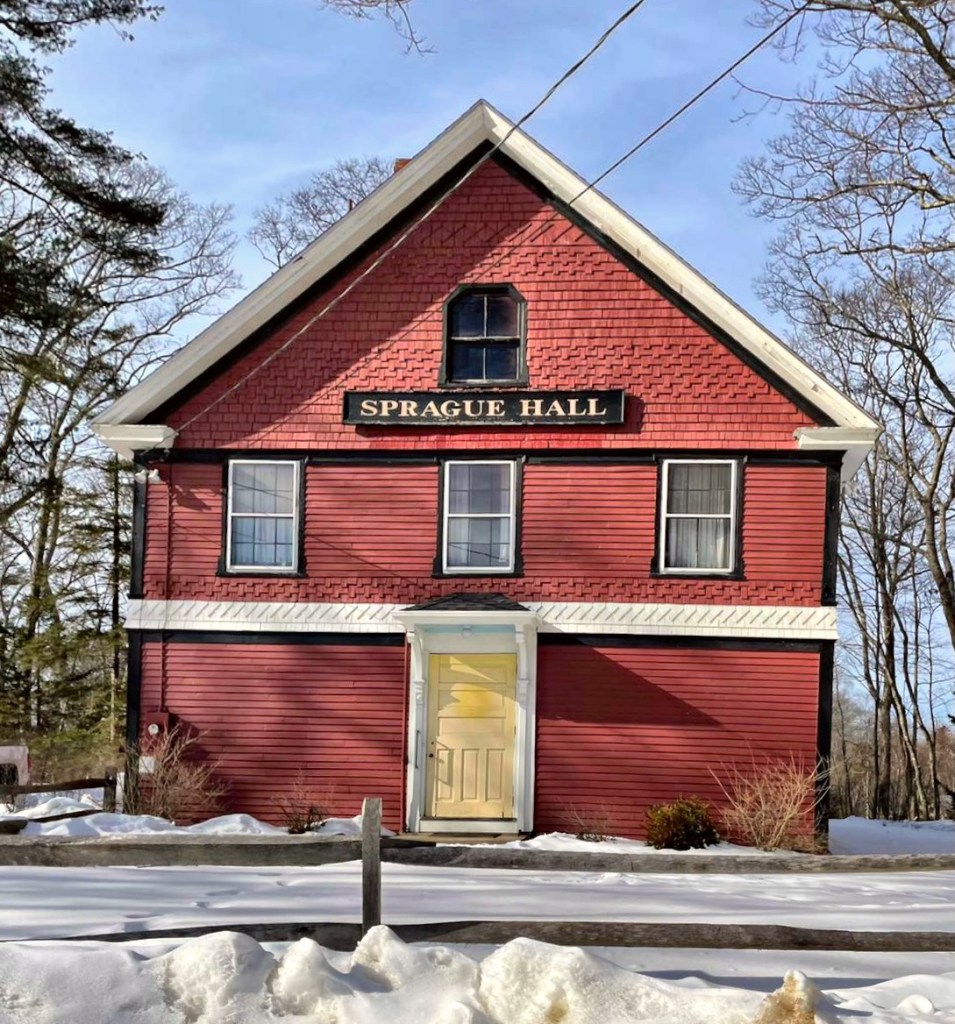
Built in 1889, this interesting structure is located away from the rocky coastline of Cape Elizabeth, a lasting remnant of the agricultural history of the town. The building was constructed as the Cape Elizabeth Grange Hall. The National Grange of the Order of Patrons of Husbandry, is a social organization in the United States that encourages families to band together to promote the economic and political well-being of the community and agriculture. The Grange organization, as it is often known as, had grange halls all over the country, where farming community members would gather to discuss issues and challenges that needed addressing. The building echos late 19th century architectural styles, blending multiple to create an elegant composition, wrapped in wood clapboard and shingle siding. In 1916, the hall was purchased by P. W. Sprague from the Cape Elizabeth Grangers to insure its use and upkeep – and it is still the home of the Patrons of Husbandry, Cape Elizabeth Grange #242.
The Cape Cottage Casino and Theater was one of several amusement parks developed in the late 1890s by Portland’s electric railways in order to increase business on their trolley lines. Residents of Portland would be able to take a surface trolley to the outskirts of the city in record time, and soak up the sun at luxurious summer communities. The Cape Cottage Casino and Theater was designed by iconic Maine architect John Calvin Stevens, completed in 1899. The casino represents the best in Neo-Classical design, with a full-height, projecting classical pediment supported by bold ionic columns. A wide entablature is accentuated with dentils and modillions; and at the entry, the main front door has a fanlight and is flanked by two small windows, creating a Palladian motif. In 1922, due to the demise in the trolley ridership, partly caused by the rise in personal automobile, the casino was sold off and the Cape Cottage Park Company then hired E.C. Jordan & Company, civil engineers, to subdivide the land and retained John Calvin Stevens and his son as consulting architects. Roughly 50 house lots were platted, resulted that were arranged around the former casino, which was extensively downsized and remodeled as a private residence. While the side wings were removed, the building does retain much of its architectural integrity, while its sheer size has been severely diminished.
Cape Elizabeth is full of amazing late-19th and early-20th century summer cottages, but one of the best examples of early International-style architecture can also be found here! This house was designed by Marcel Breuer, one of the most famous architects working in the International Style in the mid- 20th century. The house plays on the traditionally New England vocabulary, but Breuer, a proponent of the Bauhaus Movement, turned it on its head. The house appears to emerge from its ‘ancient’ fieldstone foundation towards the street and levitates over the hilly landscape, supported by light columns. The house originally was painted a shade of white, common in the International style, but a later owner preferred the natural wood finish. The home is one of the most significant examples of the style in New England, and an uncommon example in Maine.