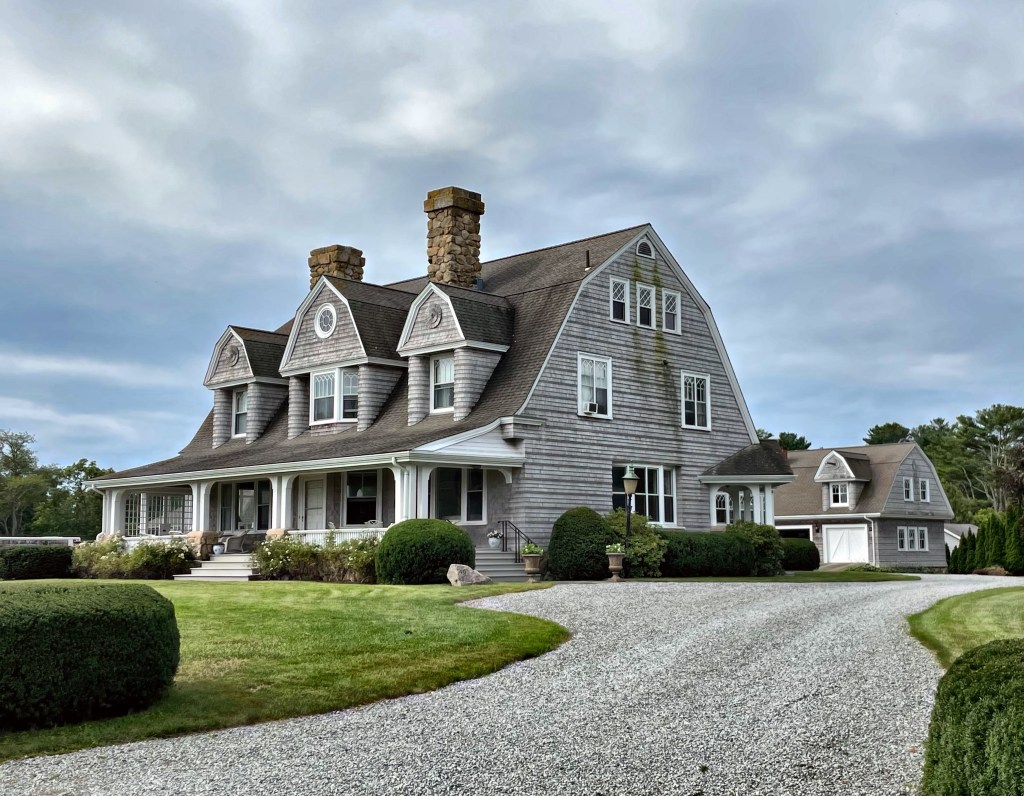
President Grover Cleveland Summer Home // c.1886

My favorite home in Marion, Massachusetts is this summer cottage on Water Street, overlooking Sippican Harbor. The home is said to have been built from a c.1840s house and enlarged by Reed as a summer home in the fashionable Shingle style. H. R. Reed, an agent for the Revere Sugar Refinery in Boston was well-connected in town and hosted President Grover Cleveland with Rev. Percy Browne ( a summer resident) at his cottage during the summer months. Evidently, Reed added the rubblestone elements, modified the porch, added a tower on the south elevation, the massive dormers at the roof, and is responsible for the exquisite Colonial Revival-style interior, from architect James Templeton Kelley. The home is arguably best known as the summer White House of Grover Cleveland, the only U.S. president to marry in the White House and the only two-time president to serve non consecutively – from 1885-89 and from 1893-97. The Cleveland’ Family summered in Marion between their time in the White House. In 1891, the President hoped to purchase the home, but could not settle upon a reasonable price, so he bought Grey Gables, a summer cottage in nearby Buzzards Bay (no longer extant).

Benjamin Waters Houses // c.1895

Benjamin E. Waters (1863-1962) was a local businessman and real estate developer in Marion by the end of the 19th century. He acquired a large property not far from the beach, in the middle of a high-class residential enclave and developed the property, running a small dirt path through the middle, known today as Pie Alley. He built three large Shingle style homes and appears to have rented them out to wealthy residents. The homes are all situated very well on their lots among large lawns framed by stone walls, just a short walk from the beach.

Robert Lippitt House // 1854

“Less is more” is a phrase adopted in 1947 by architect Ludwig Mies van der Rohe to describe his minimalist, Miesian glass box buildings. While he was referring to Modern architecture, the same phrase can be used in 19th century design, where massing, form, and materials are showcased in all their glory with little frills or additions. The Robert Lippitt House in Providence was constructed by 1854 for Robert Lincoln Lippitt (1823-1858), who worked with his brother Henry Lippitt in owning and managing textile mills. Henry would later build his own mansion nextdoor to his late brother’s house (see past post). Sadly, Robert died four years after this home was built, at the young age of 34. His widow, Louisa Gorden Hallet remained in the home and remarried within a year of her late husband’s death, to Charles Lippitt, possibly a cousin to Robert. Messy. The home was designed by architect Thomas A. Tefft, a promising and respected young architect who also died young, at the age of 33.

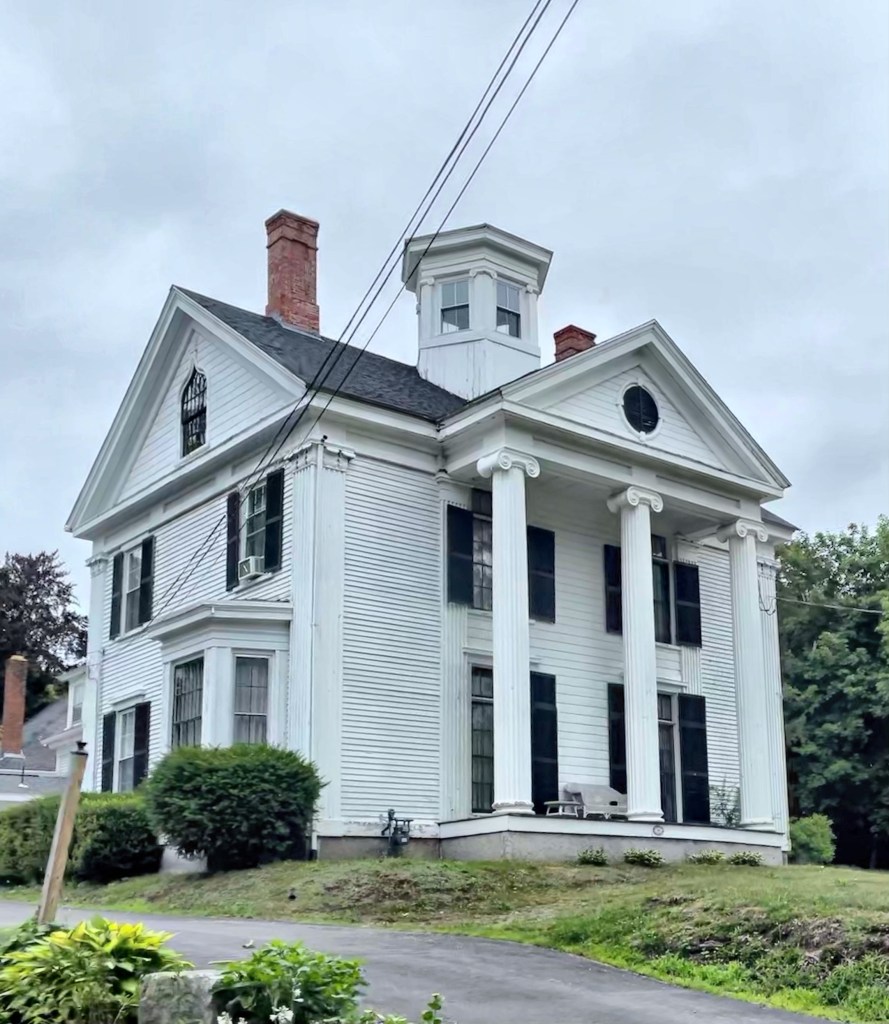
Mitchell-Patten House // c.1840

One of the most stunning examples of Greek Revival architecture in Gardiner, Maine, is the Mitchell-Patten House. The home was constructed in the mid-1840s for John S. Mitchell (1804-1891) head of the firm of Mitchell, Wilson and Co., who were traders on the Kennebec river, in lumber and other goods. The home was likely built not long after John’s wife, Philenia Sewall Mitchell died during childbirth in 1837 to the couple’s son, who died at just two years old himself. After the death of his wife and only son, John met Mary and they married, moving into this home. Together, they had four children. Together, they had three sons, but like with his first marriage, tragedy wasn’t far behind. Their first son was stillborn, their son William died at age 27, and their third son, Egbert died in his first year. The family home was willed to the couple’s only living child, Susan, after her marriage to husband Freeman Patten. Freeman was a successful businessman in town and worked as a bank director, and later served as President of the Board of Trade and as Mayor of Gardiner 1899-1900.

Governor Henry Lippitt Mansion // 1865

North (secondary) facade

New England is lucky to have so many diverse house museums where architecture and history nerds like me can tour old houses and envision what it was like to live in that era. The Governor Henry Lippitt mansion in Providence stands out as one of the most significant Victorian-era homes in Rhode Island, and contains one of the best-preserved Victorian interiors in America. The mansion was likely designed by local architect Russell Warren, and modified by Henry Lippitt (1818-1891), heir to one of Rhode Island’s leading textile manufacturing families, for his wife Mary Ann Balch (1823-1889) and their six children who survived to adulthood. While Henry was a prominent businessman, his wife Mary may have been even busier. Mary owned and managed rental properties in Providence, including this mansion, giving her husband Henry life tenancy. She oversaw day-to-day running of the mansion, supervising the servants while teaching her daughter Jeanie, who became deaf at age four due to complications from scarlet fever, to read lips and continue to develop her speech. The Lippitt Mansion is an early, and high-style example of an Italianate Villa/ Renaissance Revival design, which moved away from the more prescribed forms of architecture towards the more eclectic, Victorian-era mode. The home features two main facades, with the smaller, west (main) facade featuring a central pavilion with ornate foliate frieze and Corinthian columns, and the north (side) facade – my favorite – with a more commanding presence with a bold porte-cochere. The home remained in the Lippitt family for 114 years, and was later acquired by Preserve Rhode Island, who opened it to the public as a museum in 1993.

Harkness Estate – Eolia Mansion // 1908

Eolia, the Harkness Estate, sits on the shoreline of Waterford, Connecticut and is significant as one of the most complete grand-scale, seaside estates in Connecticut. Similar to Seaside Sanatorium (featured previously), the Harkness Estate is another Connecticut State Park in the coastal town, but is quite opposite as the buildings and grounds are in much better condition and get use! The property was developed as a formal seasonal retreat and working farm in the early 1900s for William Taylor and Jessie Stillman, until it was purchased by Jessie’s sister Mary and her husband Edward Harkness soon after. Edward S. Harkness (1874-1940) spent most of his life managing, with his older brother Charles, a tremendous fortune built up by their father Stephen Harkness, who had had the foresight in 1870 to become John D. Rockefeller’s business partner by investing in the Standard Oil Company. Edward Harkness married Mary Stillman, daughter of wealthy New York attorney Thomas E. Stillman, in 1904. Mary’s maternal grandfather was Thomas S. Greenman, a shipbuilder in Mystic, Connecticut, who co-founded George Greenman & Co shipyard (now part of the Mystic Seaport Museum). As the centerpiece of this summer estate, the premier NY architectural firm of Lord & Hewlett, designed this stunning Renaissance Revival mansion which holds a whopping 42-rooms. Mary hired female landscape architect Beatrix Farrand to design the absolutely stunning gardens on the grounds. In 1918, Edward Harkness was ranked the 6th-richest person in the United States, and the couple decided to give away much of their wealth, including selling off some of their property in Waterford for Camp Harkness for children with polio. Mary and Edward were very private people who avoided public attention and acclaim, unlike many of the rich of today. Mary Harkness’s final gift, was written in her will, that her beloved estate Eolia, would be gifted to the State of Connecticut.

Stay tuned for some more buildings on this stunning estate!

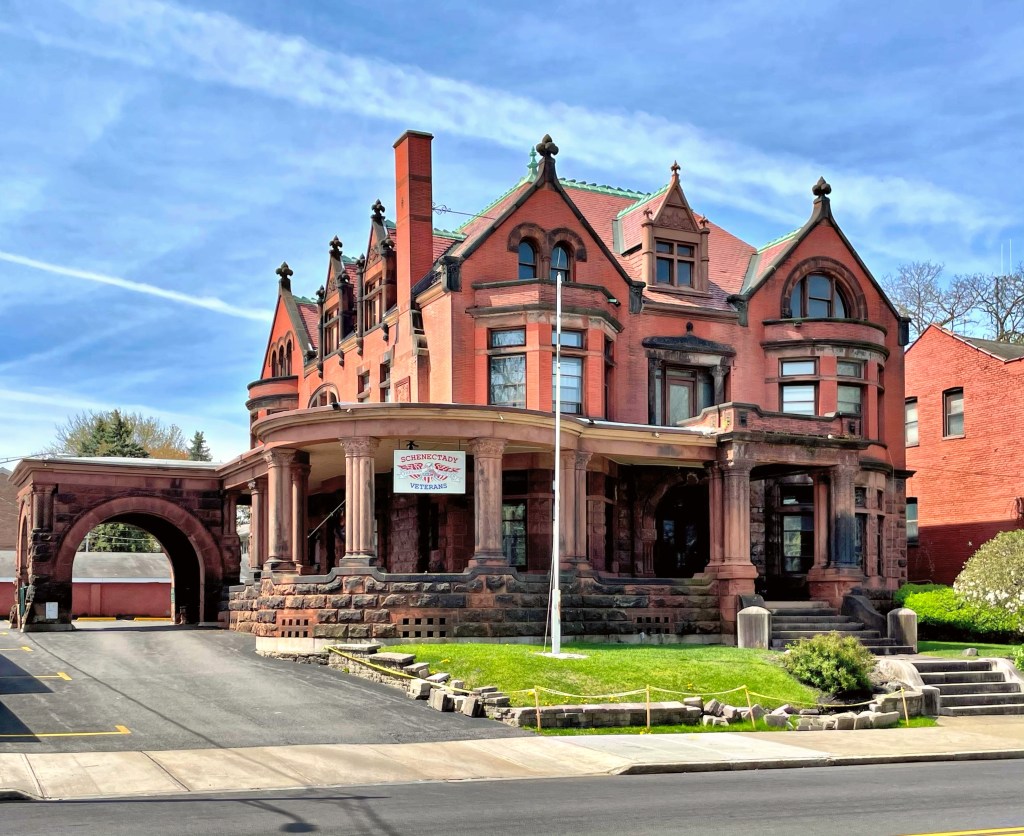
Henry S. DeForest Mansion // c.1890

Henry Schermerhorn DeForest (1847-1917) was born in Schenectady, New York and became a leading citizen of the bustling upstate city. He attended school in his hometown before leaving to study at Eastman Business College in Poughkeepsie. He returned to Schenectady and married Lucie Van Epps, soon after gaining employment by her brother at his broom manufacturing company as a clerk and bookkeeper. He began using his earnings to buy and develop property in the city, eventually making him the city’s largest landlord. He was also a building contractor, with his company constructing more than 1,000 homes in the Schenectady area. He served as Mayor, in a role that he successfully advocated for General Electric to locate in Schenectady when it was formed from the mergers of several other companies, including Edison Machine Works, which had moved to Schenectady in 1886, creating a huge boom in development and growth for the city. After this, he has this large stone mansion constructed to showcase his wealth and success as a developer and Mayor. After his death in 1917, the home remained in the family for some time until it was acquired by the Schenectady Veterans Association not long after WWII, who maintain the building to this day.

George C. Wright House // 1861

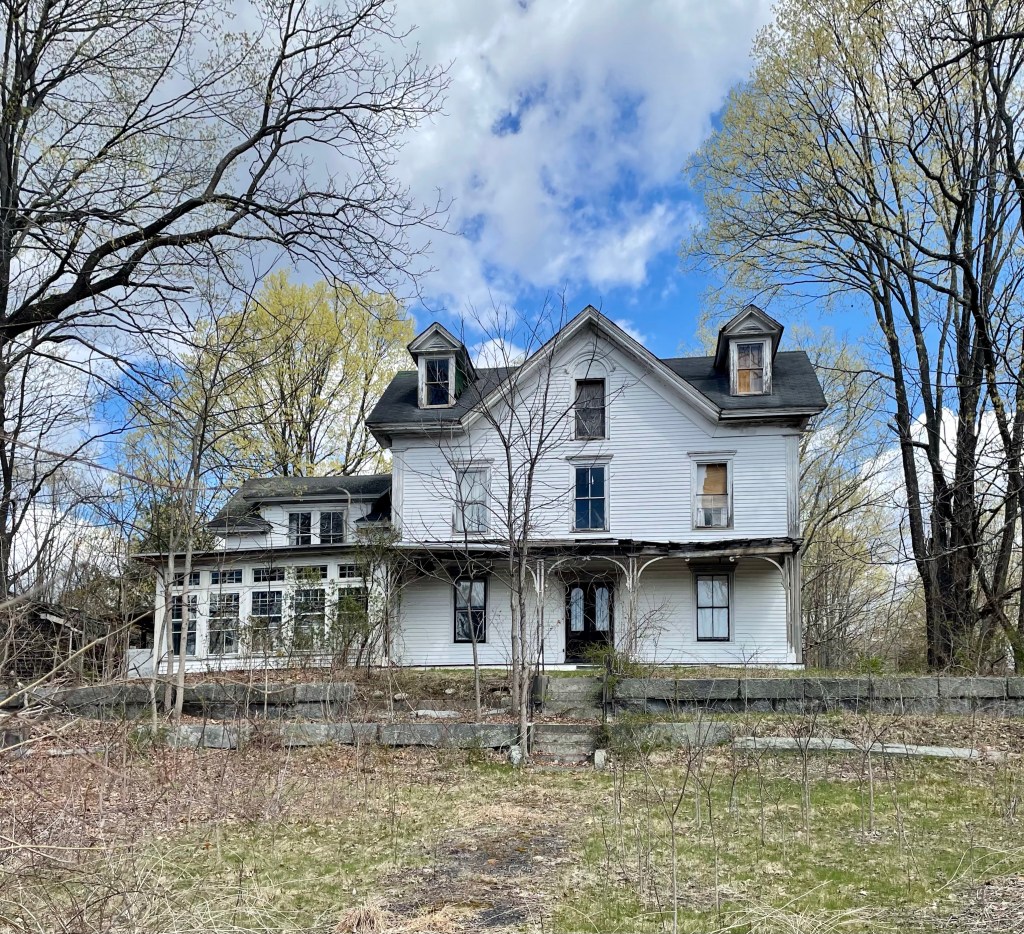
Perched high on a hill in Acton, Massachusetts, this once grand Italianate mansion has been slowly deteriorating without a caretaker. The home was built in 1861 for George C. Wright (1823-1910), a wealthy coffee and spice merchant at Dwinell, Hayward, and Co., a powerhouse in the coffee industry in Boston. In 1855, he was overworked in Boston and fell ill for two years, which worried his wife, who convinced him to relinquish some of his work and move back to Acton, which he did. Soon after he built this house, not too far from the village train depot which would give him easy access to Boston. In papers, he stated, “I felt that good air and a plenty of sunshine would do more for my health than anything else. For this reason, we built upon a hill and arranged the rooms of the house so as to get the sun to its fullest degree.” Wright later served as a State Representative, and remained active in local politics in the suburban town. His home was connected to a large barn (since demolished) and featured a large belvedere (removed after a hurricane) to provide sweeping views from his house on the hill. In recent years, an absentee owner did not appear to maintain the home and it has deteriorated, but good news! The house sold the week that I took these photos, so hopefully it will be restored to its former glory soon!

“Seven Oaks” // 1873

When strolling around Bristol, Rhode Island, you are overloaded with gorgeous early 19th century house styles, primarily in the Federal and Greek Revival styles. Among these, one house (or should I say mansion) stands out as a flamboyant Victorian Gothic showpiece at the southern end of the downtown area. Built in 1873 for Augustus O. Bourn (1834-1925), the founder of the National Rubber Company (and from 1883 to 1885 governor of Rhode Island), “Seven Oaks” could go toe-to-toe with any house in the state. Bourn’s architect was James Renwick of New York, one of the most celebrated architects of his time. Before designing Seven Oaks, Renwick’s resume included: Smithsonian Institution Building, Washington, D.C.; St. Patrick’s Cathedral, New York City; and the Renwick Gallery, Washington, D.C.. Seven Oaks is a large, hip-and-cross-gable-roof Victorian Gothic mansion constructed of stone, with multiple towers and a slate roof capped with iron cresting.

Frederick W. Lewis Mansion // 1876

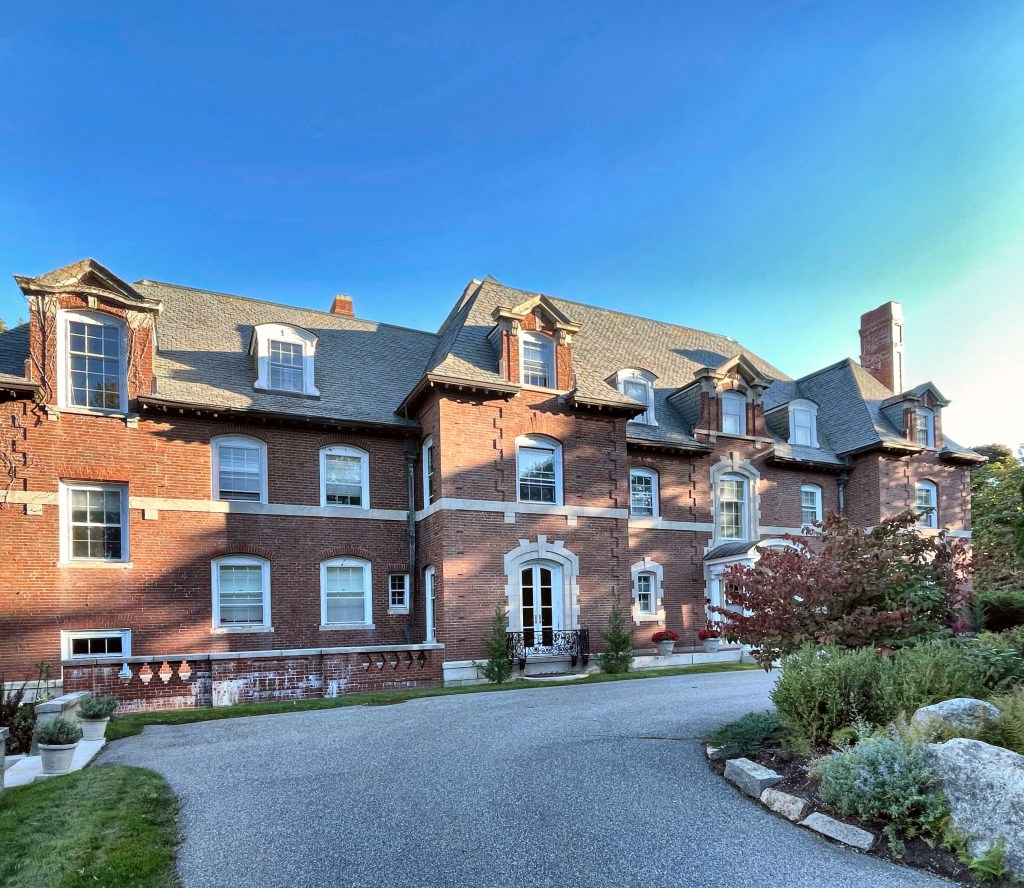
The Frederick W. Lewis Mansion in Newport, New Hampshire is a unique, late-Second Empire home constructed of brick. The home was built in 1876 for Frederick W. Lewis, a merchant who climbed the ranks as a young man, eventually purchasing the store he worked at as a 14-year-old. In 1862, he became cashier of the Sugar River Bank, and held the position until 1865, when the bank was re-organized as a national bank, taking the name of “The First National Bank of Newport.” He then leveraged his position to get into local politics, and took an active role in the development of the town, even incentivizing the railroad to build a stop in town. From this wealth and position, he built this large home. After his death, the home went to his son. By the 1940s, a group of over 30 residents of town purchased the home as a Veteran’s Home. By the end of the 20th century, the home was occupied by the Newport Earth Institute, a school created by esoteric historian and researcher Reverend Vincent Bridges, who died in 2014. The property appears to be vacant now and the home is in much need of some TLC.