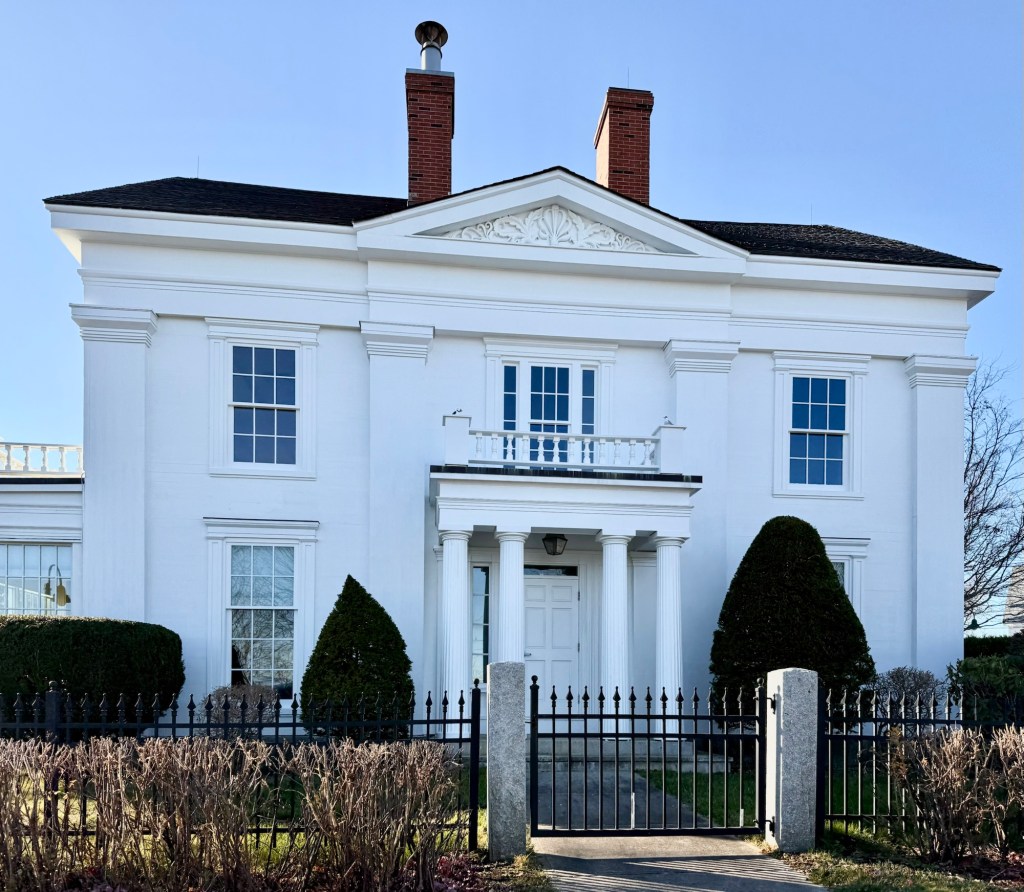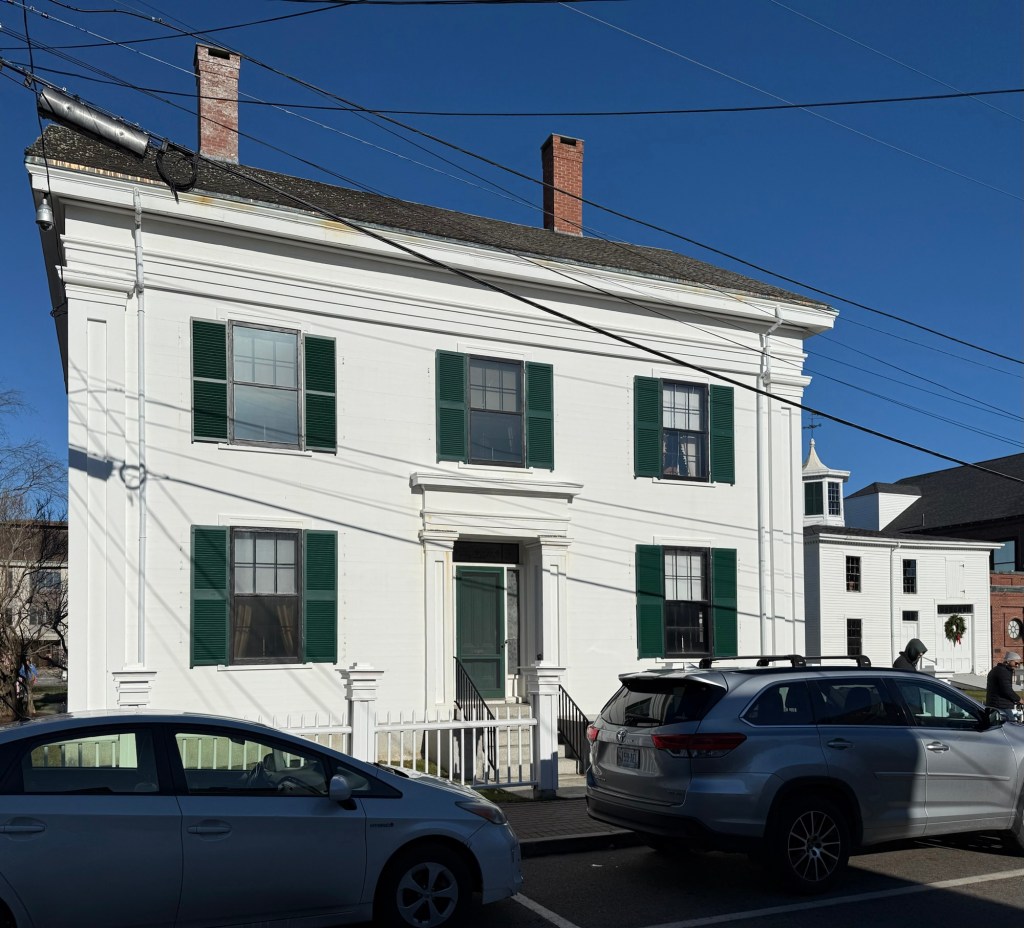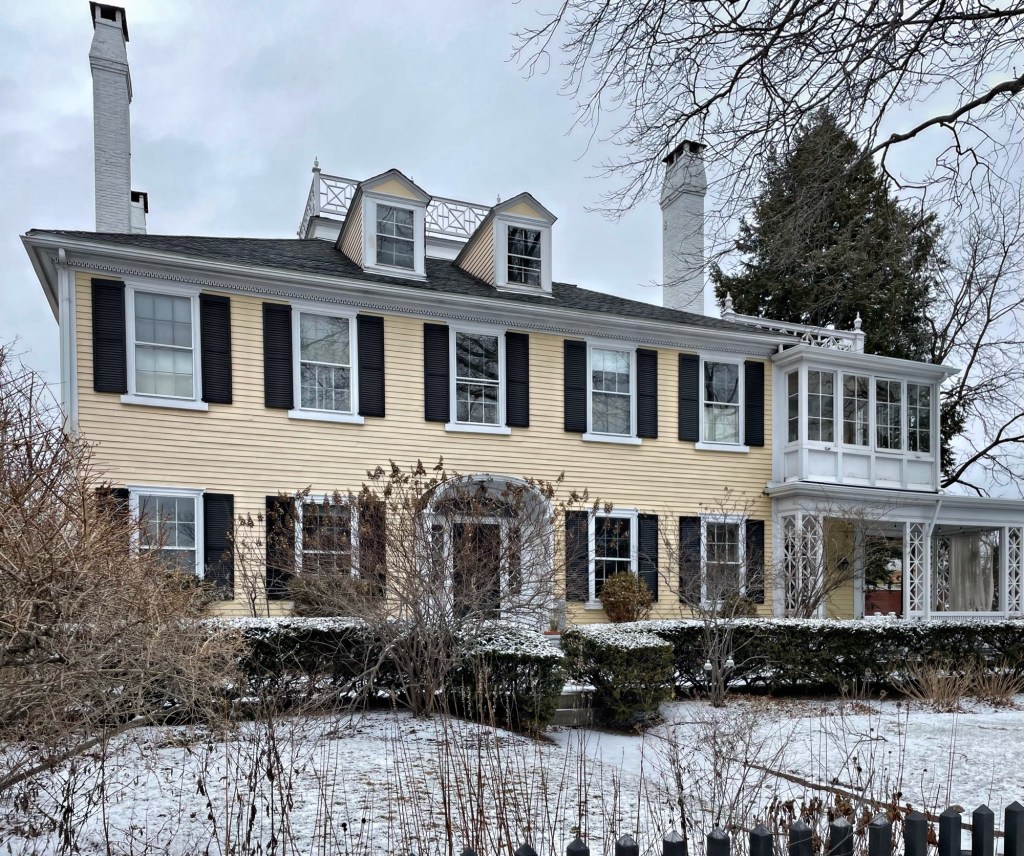
Rose Farm – Ebenezer Knight Dexter House // 1800

When Ebenezer Dexter built this country retreat in 1800, it stood at the eastern edge of settlement in Providence, Rhode Island. Several of the city’s wealthy residents maintained country seats on the then rural outskirts of the city, but Rose Farm is the only remaining gentleman’s farmhouse from the period in this part of the city, surviving over two centuries of development pressure and economic recessions. The house stands out amongst a neighborhood of mid-to-late 19th century residences, for its refined form and simple symmetry. Rose Farm is a wood-frame dwelling with brick end walls and exceptionally tall chimneys at the hipped roof, which once had two levels of a decorative balustrade. Ebenezer Knight Dexter (1773-1824), was a businessman and philanthropist, who left the bulk of this farmland to establish a home for the poor, Dexter Asylum, on land to the north. John Stimson bought the farmhouse and surrounding land in 1837 and the property directly surrounding the farmhouse was later subdivided with large residential lots, with the neighbrohood filling-in by the late 19th century.
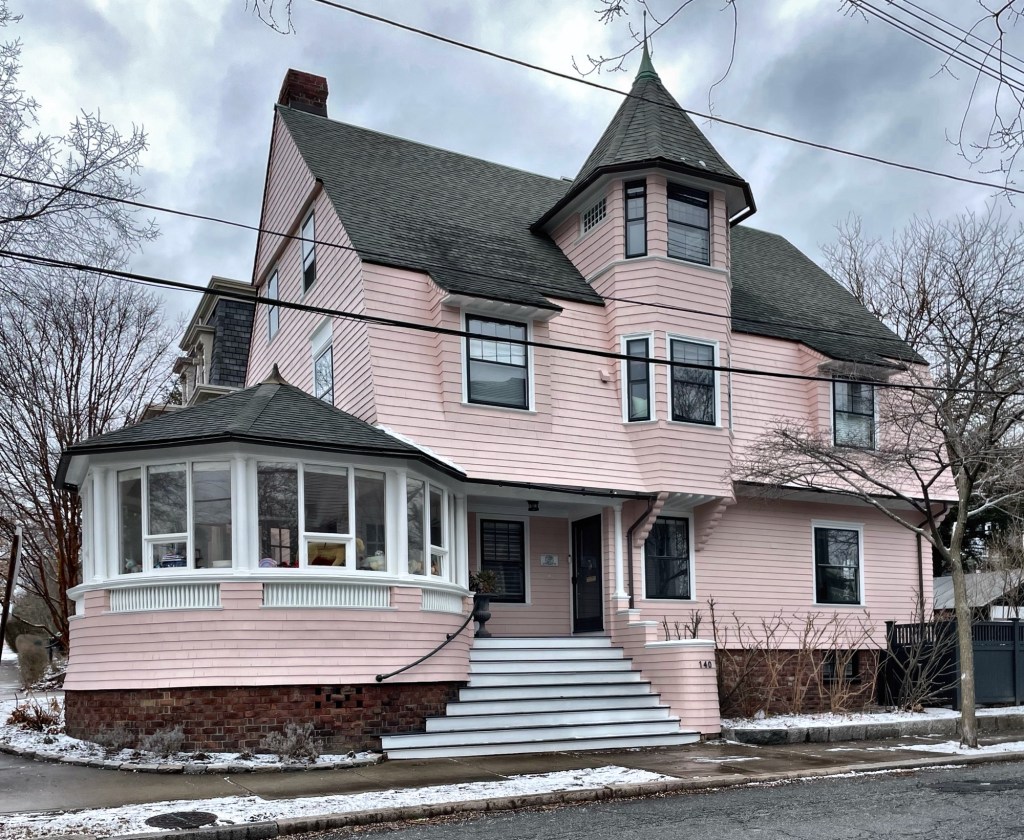
Crandall-Peirce House // 1890

Talk about a statement! This pink, Shingle style house is located at 140 Brown Street in the fashionable College Hill section of Providence, Rhode Island. Built in 1890 for William and Katherine Crandall, the Shingle style residence stands out for its cantilevered two-story tower and corner rounded porch at the corner, and of course the continuous shingled facades. William T. Crandall was the president of the Union for Christian Work, a religious charitable institution which provided aid to needy children in Providence. Augustus R. and Ida W. Peirce would board in the home for decades, and were likely family, inheriting the property upon Katherine’s death in 1932. The architect could not be located.

Cushing Apartments // 1902

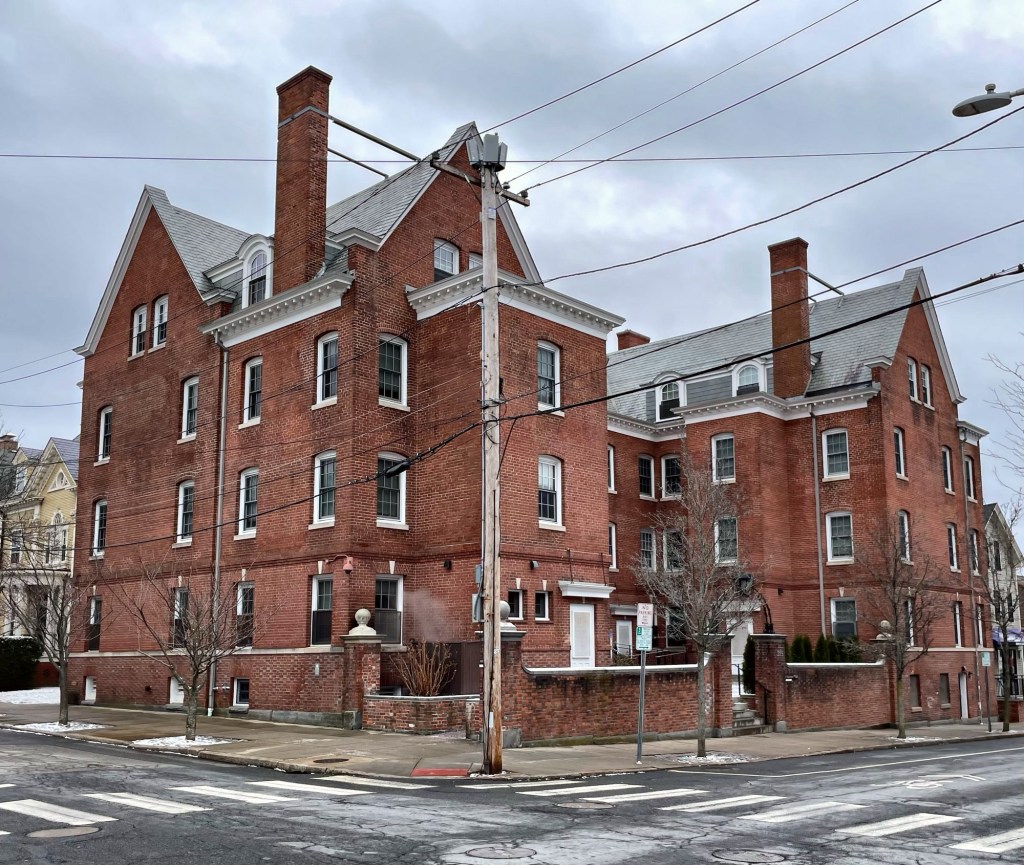
Apartment buildings get a bad rap, largely because of the cheaply built monstrosities built after WWII through today; but apartment buildings can be dignified and fit within their surrounding context, it just takes good design. These are the Cushing Apartments at Thayer and Bowen streets in Providence’s College Hill neighborhood. The building was constructed in 1902 for owner, Stephen Cushing Harris, from plans by young architect Frederick Ellis Jackson (1879-1950), who would have been in his mid-20s when he designed it! While not an academic example of the Tudor or Colonial Revival styles, the building blends both in a unique U-shaped form. The building is supposedly wood-frame and was eventually purchased by Brown University in 1963. The college renovated the building in 2012 to serve as an upperclassman dormitory with LBB Architects and Gilbane Construction overseeing the project. The building adds a subtle density to the block without being overbearing with the courtyard design.

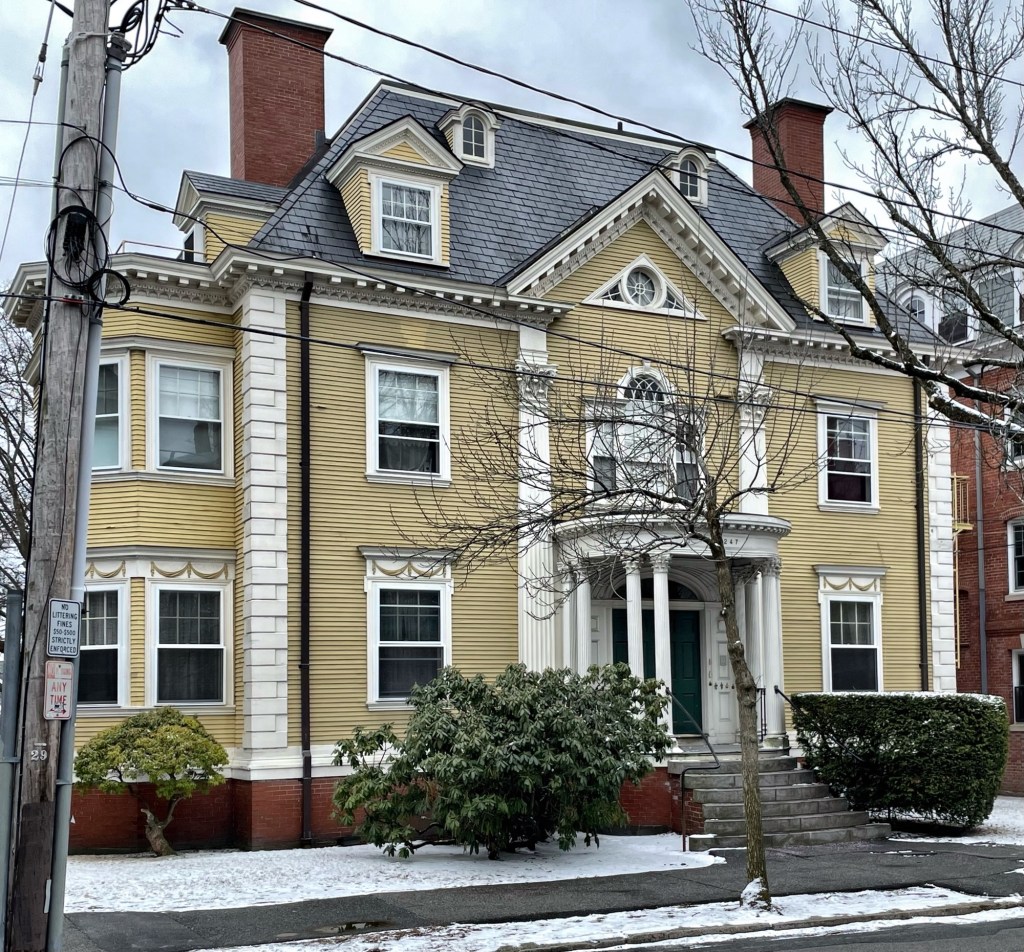
Francis and Sarah Cranston House // c.1895

The Francis and Sarah Cranston House is located on Bowen Street in the College Hill section of Providence, Rhode Island. Built circa 1895 for Francis Augusta Cranston (1837-1909) and his wife, Sarah (Hill) Cranston, the house is one of the best residential examples of Colonial Revival architecture in the city. Francis was the son of Barzillai Cranston, a descendant of Gov. Samuel Cranston, who held office from 1698 to 1727, being elected to office 30 times; serving as governor longer than any other individual in the history of Rhode Island. Francis worked as cashier of the Old National Bank of Providence for over fifty years and built this residence to settle into retirement. The residence is unique for its high-sloping hipped roof with two layers of dormers, corner quoins, Palladian window, and Ionic portico. I could not locate the architect, but if anyone knows, I’d love to give them their deserved credit!

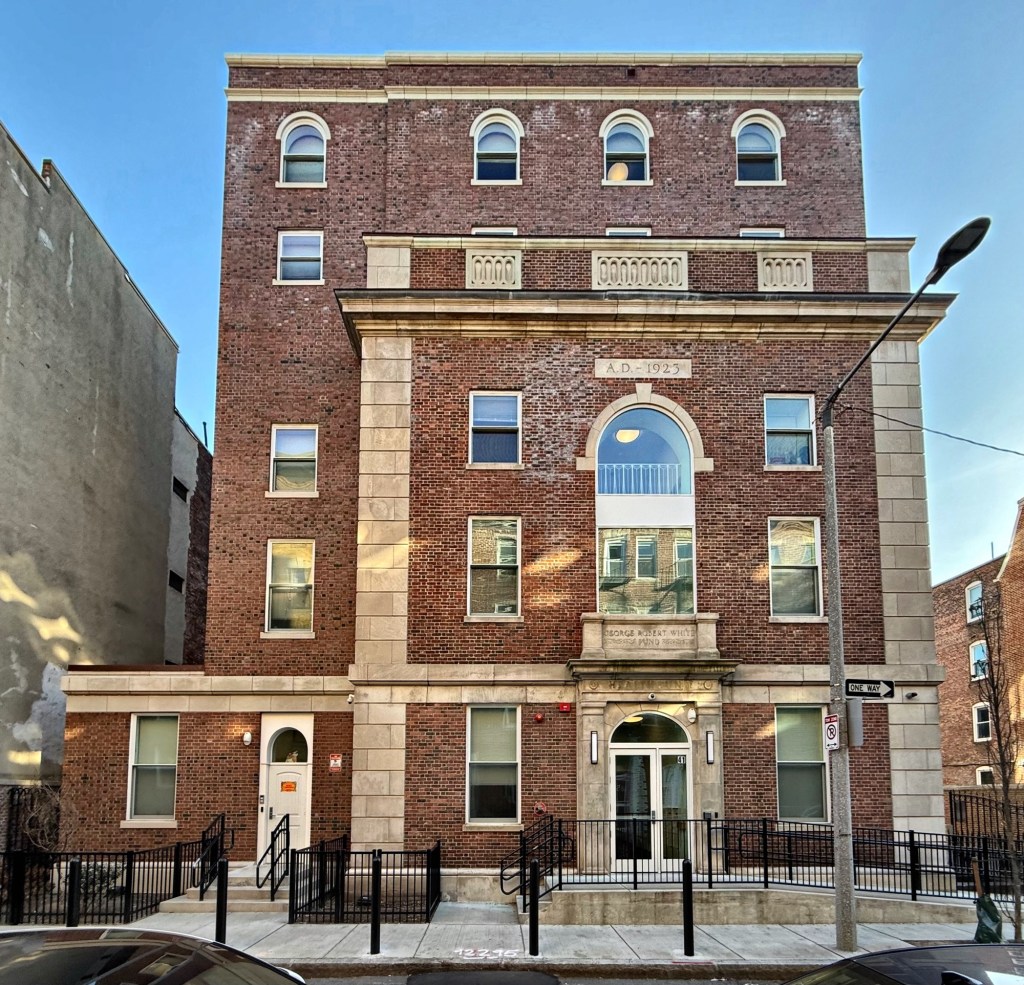
George Robert White Health Unit No. 2 // 1923

Originally known as the George Robert White Health Unit Number 2, this Colonial Revival style building is located on North Margin Street in the North End of Boston, and is significant as an early health center providing health and education services for some of Boston’s most underserved residents. The building was constructed in 1923 as one of the neighborhood-based health centers built in Boston in the 1920s and early 1930s from funding by the George Robert White charitable trust. George Robert White (1847-1922), a longtime resident of Boston, worked in the office of the Potter Drug and Chemical Company as a boy, eventually becoming president and an owner of the corporation. He was an investor in real estate and reportedly was known for many years as the largest individual taxpayer in Boston. Upon his death, his will specified that his bequest to the city, about $5 million in 1922 (approximately $93 Million valued today), would be held in a permanent charitable fund “to be used for creating public utility and beauty and for the use and enjoyment of the inhabitants of Boston.” The North End Health Unit was the second built (the first was in the West End), and designed in the Colonial Revival style from plans by Coolidge and Shattuck, later known as Coolidge, Shepley, Bulfinch & Abbott. Since the 1970s, the building was occupied by the Knights of Columbus, a fraternal organization, until 2020, when the building was renovated and converted into housing with 23 units for elderly residents.

William Slattery Tenements // c.1893

It is not always the architect-designed, high-style buildings that give a place character. The North End is a neighborhood almost entirely built of working-class tenement housing, but its density, immigrant history, and vernacular, make it one of the most visited and unique in the city. Michael Slattery, an Irish-born teamster, and his son, William, a grocer, developed this handsome block of tenement housing on North Margin Street in the North End neighborhood of Boston. The row of apartments stands out for its elevated design elements, including the projecting metal oriels with decorative wreath and swag motifs, arched openings, and brick corbeling at the cornice. The apartments here were rented by the Slattery family until the mid-1920s when the buildings were sold to Italian-Americans who continued to rent the buildings to lower-income residents. There is something about the North End’s vernacular that is so charming.

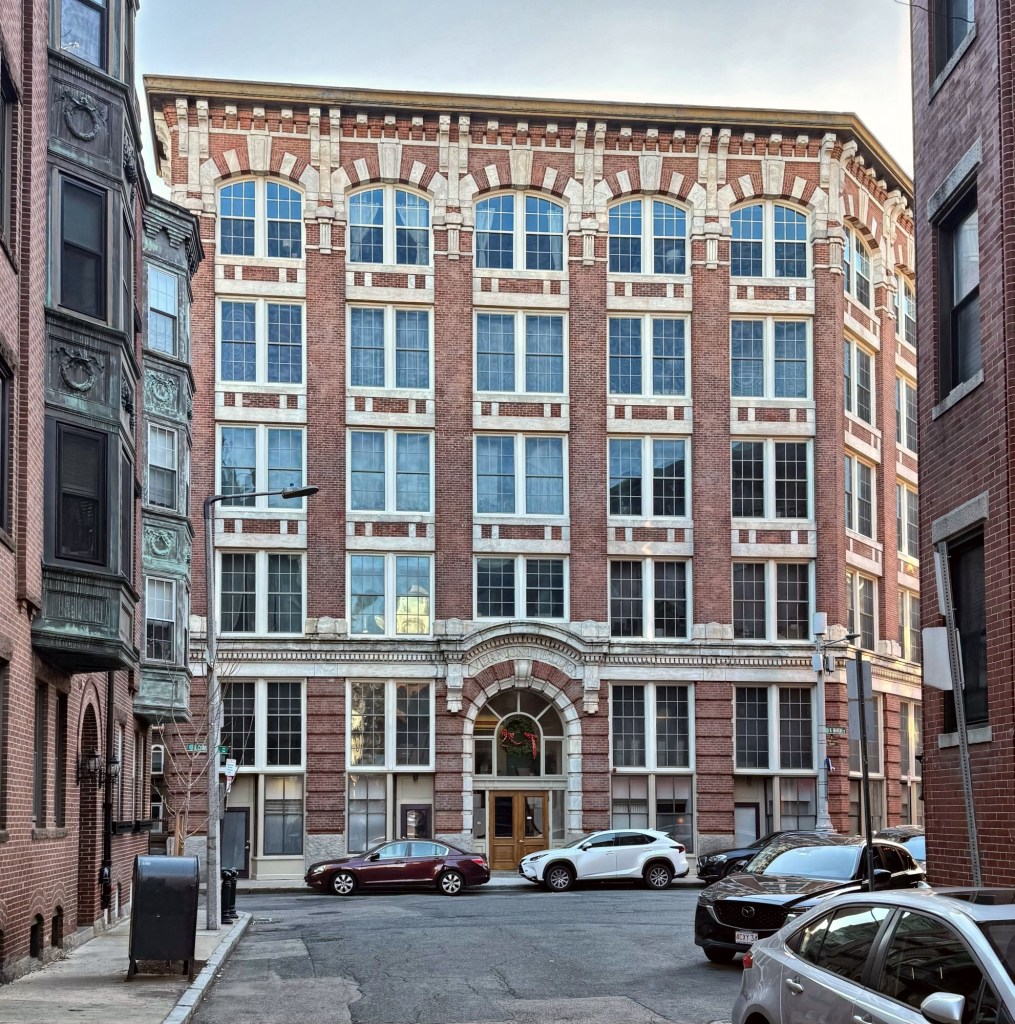
Vermont Marble Building // 1904

Located across the street from Regina Pizza in Boston’s North End, the Vermont Building stands as one of the most ornate and decorated buildings in the neighborhood. Designed by Boston architects Arthur H. Bowditch and Edward B. Stratton and constructed in 1904, the Vermont Building is a six-story brick commercial building with marble detailing. The building was erected as a personal investment by Redfield Proctor, U. S. Senator from Vermont and partner in his family’s marble company based in Proctor, VT, with the building used for light manufacturing, a warehouse, and storefronts. The building has since been converted to housing as lofts.

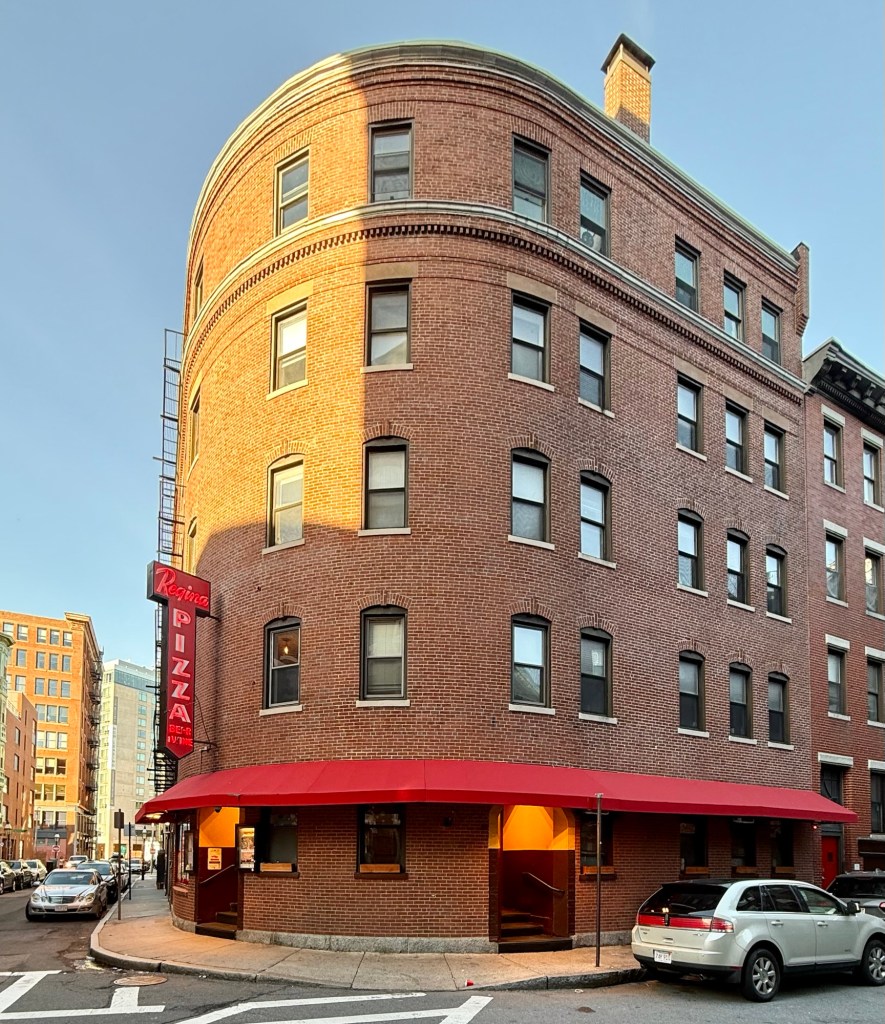
Boston Cooperative Building Company Tenements – Regina Pizzeria // 1886

What is your favorite pizzeria in the Boston area? For many, it is likely to be Regina Pizzeria, but specifically this location in Boston’s North End. The building was originally constructed in 1886 for the Boston Cooperative Building Company, a charitable organization which built and rented tenement housing for low-income residents in the city. Many recently arrived immigrants would have lived in the building and paid a nominal rent, giving them the opportunity to work and grow their savings to move into better, more permanent housing. The Association was incorporated in 1871 and its original stockholders represented the financial elite of Boston. As a result of their financial backing, the association was able to hire the white-shoe architectural firm of Cabot & Chandler to design this tenement block in 1886. While not ornate, the building fits within the late 19th century vernacular of brick tenements of the North End. The building is now best known as the home to Regina Pizza, which was founded in 1926 by Luigi D’Auria, who was born in Campania, Italy, who purchased the building around that time. Regina Pizza (translated to “Queen Pizza” in Italian), was sold to the Polcari family in 1956, who have operated the restaurant since. The pizzeria with its prominent blade sign is one of the best landmarks in the North End.

Israel Snow House // c.1850

The Israel Snow House stands at 9 Water Street in the South End of Rockland, Maine, and it is one of the region’s finest examples of late Greek Revival architecture. The residence was built for Captain Israel Snow (1801-1875), a mariner and captain of several vessels, including the schooner Maria (1829), the brig Snow (1835-36), the brig Lucy Ann (1842), and the Barque Star (1848). In 1850, he and his wife Lucy moved from Thomaston to Rockland, and he would build this stately mansion where they raised seven children. Some records put the construction of this house at 1861, but that seems very late for such an example of this style. In 1863, he founded Snow’s Point Shipyard on Mechanic Street in the South End. Rockland was the fourth largest seaport in the United States in terms of production and commerce at the time, and Snow’s shipyard was a large part of that production. This residence is now offices to the U.S. Fish and Wildlife Service’s Maine Coastal Islands National Wildlife Refuge Complex.

Farnsworth Homestead // 1850

The Farnsworth Homestead is located on Elm Street in Downtown Rockland, Maine, and is an excellent example of a mid-19th century residence in the Greek Revival style. The home was built in 1850 for Rockland businessman William Alden Farnsworth, who gained his income from lime-rock quarries and the Rockland Water Company. Mr. Farnsworth was a leading businessman who helped establish Rockland as the number four port in the United States, largely exporting lime for masonry construction all down the east coast. After William died in 1873, the property was inherited by his heirs, the last of which, Lucy Farnsworth, lived here until her own death in 1935. The 96-year-old Lucy Farnsworth died in the home and in her will, bequeathed the family property and ample funds to establish the Farnsworth Art Museum, and included preservation of the family homestead as a mid-19th century house museum, which it remains to this day. The Greek Revival style house with its flushboard siding and bold pilasters, was recently restored by the museum, along with the carriage house which stands to its east.