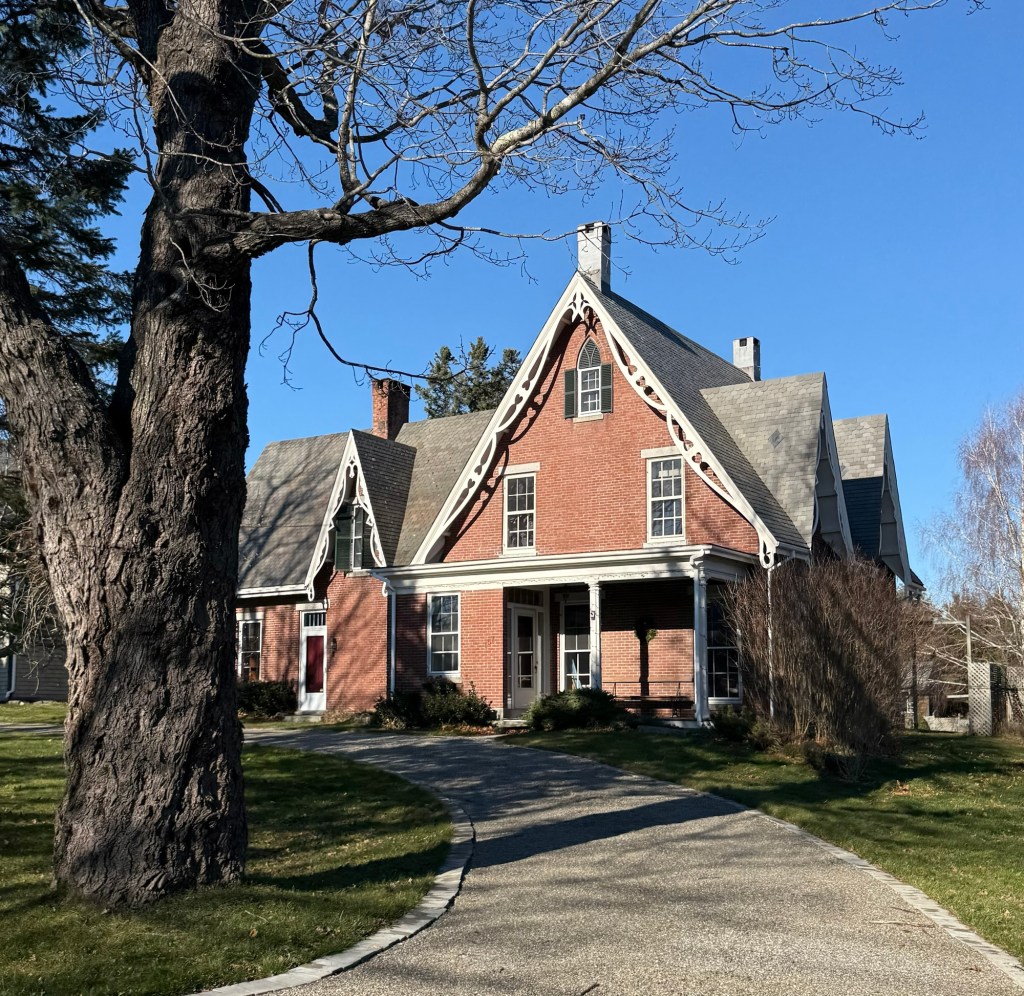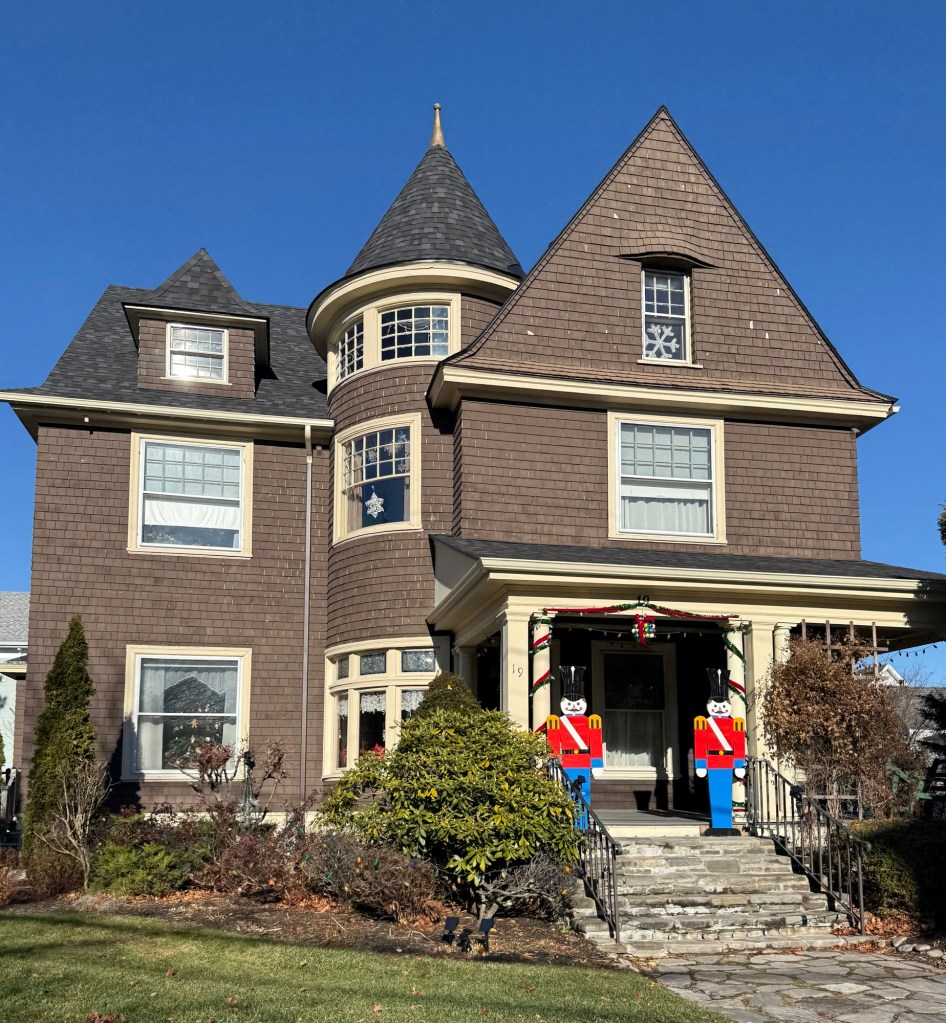
William Bates Summer Cottage // 1885

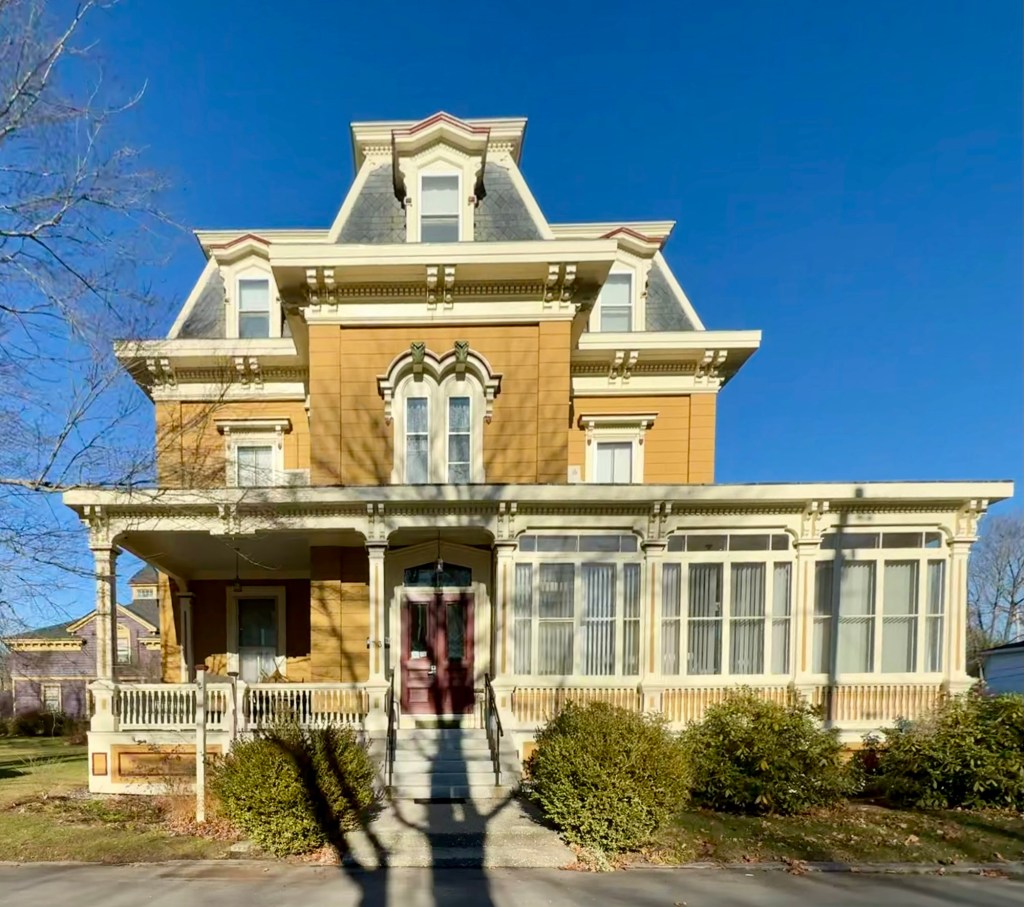
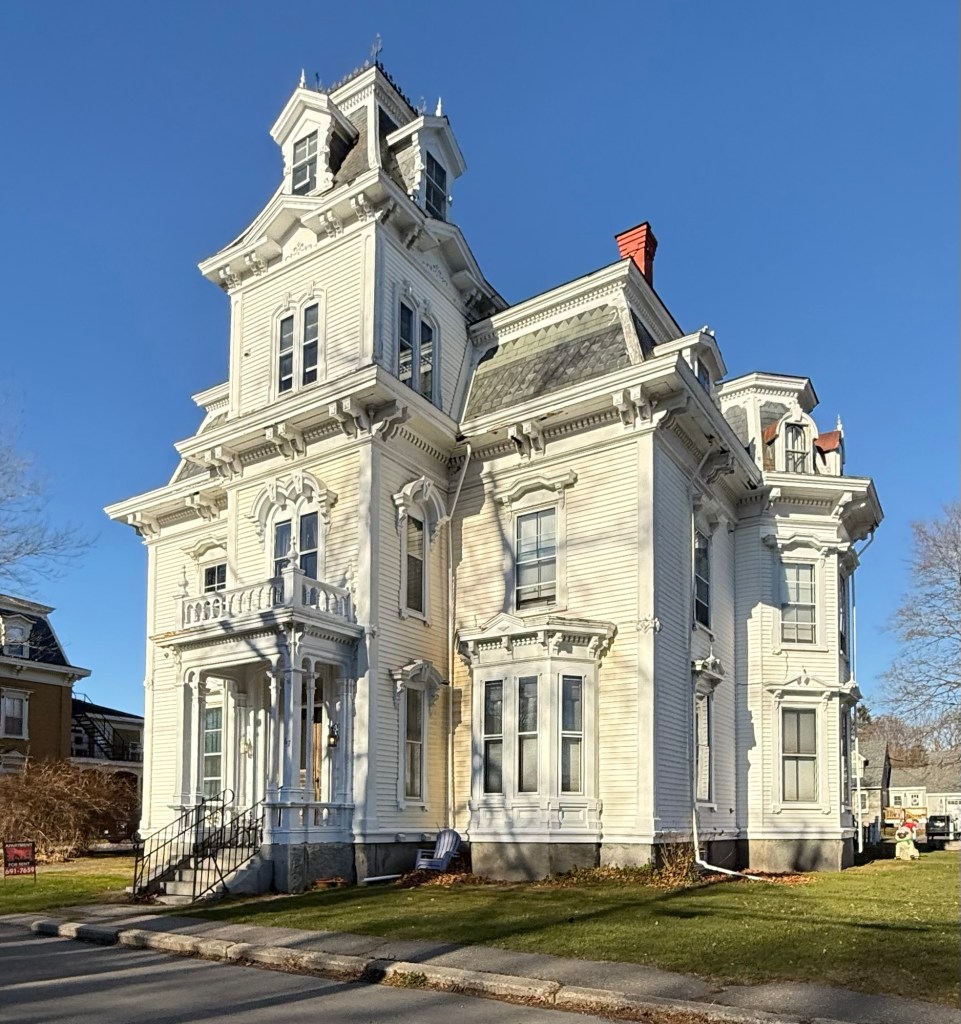
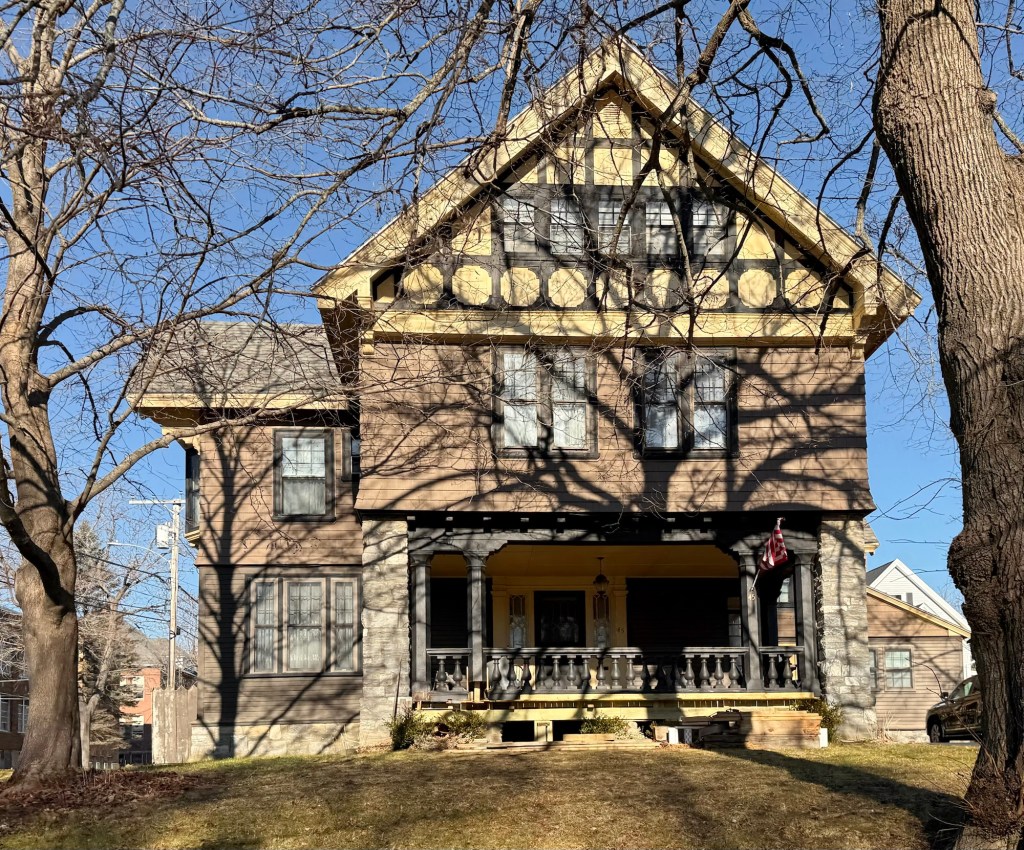
While Salem is best-known for its First Period and Federal style buildings, the Salem Willows neighborhood features some of the finest Victorian summer cottages in the Boston area. This cottage was built in 1885 by William Marston Bates (1820-1912), a Salem-based dentist, as his summer retreat when not in the office. The Stick style cottage has a steep gable roof with jerkinhead clip at the facade and a wrap-around porch with decorative jigsawn bracketed details. The house is a well-preserved example of the style, examples of which are becoming less-and-less frequent in recent years.

Salem Willows Park // 1859

The Salem Willows neighborhood of Salem, Massachusetts sits at the extreme tip of Salem Neck, which juts out into the Atlantic Ocean. The area here was sparsely used until the 19th century, when a smallpox hospital was built here in 1800, mainly used for sailors to recover and be treated. Soon after, a man by the name of Hezekiah Williams planted rows of Willow trees for the enjoyment of patients, which would give the area (and later park) its name. The hospital burned in 1846. Part of the land on the Neck became a park, and a former farm known as the Derby Farm, was purchased and redeveloped with new streets and house lots laid out for summer cottages in the early 1870s. The neighborhood became known as Juniper Point. The Salem Willows Park was enhanced in the late 19th and early 20th centuries with bathing facilities, pavilions, and amusement and commercial buildings. The park is today well-maintained by the City of Salem and is an important protected site that documents the city’s history of the 19th and 20th centuries. I was also pleased to find the 1965 Memorial Shell Band Stand with accordion metal roof designed by the architectural firm of Robert Charles, Associates.

Wadsworth Hall // 1800

Wadsworth Hall is a significant and hidden estate house located in rural Hiram, Maine. The house was built in 1800 for Peleg Wadsworth (1748-1829), an officer during the American Revolutionary War and a Congressman from Massachusetts representing the District of Maine. He was also grandfather of noted American poet Henry Wadsworth Longfellow. General Wadsworth’s primary residence, now known as the Wadsworth-Longfellow House in Portland, Maine, was built in 1785–86. Following the war, Wadsworth was granted 7,800 acres of land by the state in 1790 for his war service, the land was located here in Hiram. General Wadsworth would build this large Federal period home. After, he gave his Portland home to his daughter Zilpah and her husband Stephen Longfellow, parents of the poet Henry W. Longfellow. Wadsworth, in his role as a leading citizen in Hiram, opened his house for meetings and town functions, and even used the large hall for militia drills during bad weather.

Hiram Lodge 39, Knights of Pythias // 1895

Another of the extant, significant vernacular buildings in the small town of Hiram, Maine, is this large frame building on Main Street. Hiram Lodge #39, Knights of Pythias, was organized in 1883 and a building was constructed on this site around that time. The first meeting hall was destroyed by fire in 1895, and soon-after replaced by this large lodge building, which is possibly the largest wooden building in town!  On the destruction of that first “hall” by fire in 1895, the Lodge hired Alva Ward to build what is probably the largest wooden building extant in Hiram. The Knights of Pythias Hall is important as a remnant of Hiram’s earlier commercial prosperity, with general store on the first floor, a large hall on the second floor (where dances, theatrical performances, and public suppers were held), and the lodge hall on the third floor.

Mount Cutler Grange Hall // 1875

The two-and-a-half story Mount Cutler Grange Hall in Hiram, Maine, is a plain but important vernacular structure near the western end of the town’s Main Street. Originally organized in 1875 by local farmers, the local grange was able to dedicate its present building in late December of that year. Attributed to local builder James Lot Hill, the clapboard-covered frame building has a three-bay facade and retains its original windows. Once the site of grange store, the well-preserved structure still displays a fine late-nineteenth century sign above its first story. Little changed over the years, the Mount Cutler Grange Hall remains an important part of Hiram’s social fabric, but appears vacant or largely unused. Hopefully some life can be brought back to this significant building (and other abandoned Grange Halls in New England).

Hiram Public Library // 1915

Located on a slight rise above Main Street and across from the sprawling Hiram Village Cemetery, this one-story library with walls of textured concrete blocks was dedicated in August of 1915 and has been a center for cultural activities in the town of Hiram, Maine, since that time. The Soldier’s Memorial Library was built with funds provided largely by Virginia Barker Jordan, a granddaughter of local businessman Benjamin Barker. Also instrumental in organizing Hiram’s first free public library was Llewellyn A. Wadsworth, local poet and cousin of Henry Wadsworth Longfellow. Beyond the unique use of concrete block construction for a library, other interesting exterior architectural features include the wide-flaring eaves with exposed rafters and the bands of windows on the first story walls, which hint of the Arts and Crafts/Bungalow styles. The library building was designed by Boston architects Robert Wambolt and Amos A. Lawrence.

Hiram Village Store // c. 1850

Hiram is a small, rural town in Oxford County, Maine, and has a handful of notable old buildings. The town was incorporated in 1814 and was occupied by white settlers as early as 1774. The land here has long been heavily wooded and the town’s name was inspired by the biblical King Hiram of Tyre whose kingdom was set among “timber of cedar and timber of fir.” The town’s two villages, Hiram Village and South Hiram, grew along the Saco River, and are typical rural villages built around industry and modest frame dwellings. This commercial building is one of the larger structures in Hiram Village and it dates to the mid 19th century. The structure was owned by Thomas B. Seavey, who purchased a store built on the site as early as 1816, from a Simeon Chadbourne. The store was enlarged and became a major hub of the sleepy town in the 19th and 20th centuries, but like many such structures, struggled due to changing of shopping habits and rural decline. The building, with its vernacular and Greek Revival lintels, appears vacant today.

Ms. Perkins’ Millinery Shop // c.1890

This charming one-story shop sits on the Porter-side of Kezar Falls village, a district that spans the Ossipee River between Porter and Parsonsfield, Maine. This shop was built at the end of the 19th century as a millinery shop (womens’ hat store) for Ms. Florence Perkins (1862-1950), who appears to have been unmarried all of her life. Retaining almost all of its original decorative detail, the building has a symmetrically arranged facade with two-sided projecting bays; the upper sash in the facade windows, including that in the entrance door, has a border of small rectangular colored glass panels. The storefront is a rare survivor of this period, with not many other examples in the area.

Riverside Methodist Church, Porter // 1883

The focal point of the riverside village of Kezar Falls in Porter, Maine, is this large frame church building with prominent siting and grand proportions. This is the Riverside Methodist Church, built in 1883 in the Stick/Eastlake style by Portland architect Charles H. Kimball. The first Methodist services held in the town of Porter were in 1833, when a church was formed in the small town. Soon after 1839, a gable-roofed meetinghouse with tall lancet windows was erected near where the present church stands. The original church still stands, but in a much-altered form and was used as a local fire station. The church remains owned by local Methodists and is well-preserved.

Old Porter Meetinghouse // 1818

Welcome to Porter, Maine! The town is located on the Maine/New Hampshire border and was first called Portersfield Plantation. Porter was incorporated in 1807 and named after its first proprietor, Dr. Aaron Porter (1752-1837). The Porter Meetinghouse was built beginning in 1818 and it is said that it was not completely finished until 1824. The original congregation was a Freewill Baptist organization led by Reverend Jeremiah Bullock, and were known locally as “Bullockites“. The structure housed the Baptists and town meetings as needed. The plain vernacular, meetinghouse is typical of many early meetinghouses of the period in rural New England. The inside retains its original character with its space as a single large chamber with a gallery above on three sides. The walls are plaster, much of it original, with trowel marks visible. The main floor is populated with original box pews and a replica pulpit. The structure is a rare survivor!

Lord Mansion // 1822

Isaac Lord (1772-1838) was born in Maine, but would spend much of his time transforming the small town of Effingham, New Hampshire. Isaac married the love of his life, Susanna Leavitt in Exeter in 1793 and the couple moved to Effingham, living and working in a tavern he built. Isaac prospered as an innkeeper, merchant, farmer, and entrepreneur, becoming Effingham’s wealthiest citizen, making the village he owned buildings to be called Lord’s Hill in his name. From 1818 to 1822, Isaac and Susanna lived in Portland, but he was ridiculed for “having money but no culture”. Growing tired of the city, he decided to return to Effingham. Mrs. Lord found the village too quiet and longed for the social life to be had in Portland, Maine. To convince his wife to remain with him, Isaac promised her a mansion that rivaled the homes in wealthy seaports like Portland and Portsmouth and began working on his mansion in Effingham in 1822. After years, the massive estate was completed, but Susanna remained in Portland. A heartbroken Isaac moved into the large mansion and continued business until his death in 1838. The Isaac Lord House consists of a three-story main block with a grand cupola on its roof and a three story ell to its rear. Stables and a carriage house are also on the lot today. I would do anything to see the inside of this beauty!

Effingham Academy // 1819

The small town of Effingham, New Hampshire, is the home to the state’s first Normal School. This building was originally constructed in 1819 as a vernacular, Federal period academy for the youth in the rural town of Effingham on land formerly owned by wealthy resident Isaac Lord. A normal school for the training of teachers was established on the school building’s second floor in 1830 with James W. Bradbury, a Bowdoin College graduate, to head it. Bradbury, later a United States Senator, took the position only on condition that it should be for the instruction and training of teachers, a novel idea at the time. The school, like many small academy buildings of the period, eventually closed. The building is now managed by the Effingham Historical Society.

Old Effingham Meetinghouse // c.1800

The location of the Effingham meetinghouse in New Hampshire was a controversial question in the 1790’s, with the villages of Lord’s Hill and Drake’s Corner both vying for the town’s most important public building. After several votes and repeals of votes, the Town’s voters in 1798, chose a committee of hopefully disinterested men from other towns and instructed them to settle on the location. The committee recommended Lord’s Hill, and in June, the Town voted to accept that location. The contract for the meetinghouse was awarded to Isaac Lord, a local landowner and operator of a tavern and store, who promptly erected the building the same year. In its original form, the building had the traditional meetinghouse plan, with its main entry in the long southeast side and a belfry at the northeast end. In 1845, the meetinghouse, by then the property of the Congregational Church, was thoroughly remodeled in the Greek Revival style, what we see preserved today.

Lord’s Tavern // c.1792

Isaac Lord (1772-1838), the namesake of Lord’s Hill, came to Effingham, New Hampshire by 1791. An enterprising man, he was the most important figure in the village’s early history and in its architectural development. By 1792, Lord opened Effingham’s first store on the Hill, and soon thereafter began building a house that also served as the local tavern, this Federal style structure. As Lord prospered as a merchant and innkeeper, he enlarged the Tavern with a large ell connecting the main block to the 3-story barn. The fine Federal tavern was embellished with a vestibule and a triple window. The high quality of the Tavern foretold the character and scale of Isaac Lord’s later buildings nearby. The Tavern stayed in the extended family until 1903. Throughout the 20th century, the property was used as an inn and restaurant, including a stint as a dance hall. By the 21st century, though, deferred maintenance and successive attempts to fix the building ended in mortgage sales, foreclosure, and most recently, a tax deed, the the Town of Effingham recently acquired the property with the aim to restore the significant building. It was sold to a private owner in May 2024 and awaits its future. The Lord’s Tavern was listed in the New Hampshire Preservation Alliance’s ‘Seven to Save’, to advocate for its preservation and funding.

Drake Store // c.1816

The Drake Store is a vernacular, early 19th century commercial building located in the center of Effingham, New Hampshire. According to local sources, the building was erected around 1816 by Weare Drake, an original settler of the town at age 78, and his 23-year-old grandson, Thomas Parsons Drake. The store sold provisions and was home to a post office, when Thomas Drake served as the town’s postmaster. Within a few years, the store fell into disuse and the building was fitted up as an academy known as the Carroll Literary Institute. Due to insufficient enrollment, in the 1850’s, it was again occupied as a store by Alexander Mellen Drake (hence the sign) and changed hands several times before being purchased by Grange No. 313 in 1913, operating as a grange hall for local farmers. The building was given by the Grange to the Town in 1994 and purchased from the Town for $1 by the Preservation Society in 2002. The Preservation Society has been restoring the building through capital campaigns and grants and the old store shines once again!