Captain John Felt House // 1757

The Captain John Felt House on Federal Street in Salem, Massachusetts, is a surviving Georgian residence with ties to the American Revolution. In May 1757, John Felt purchased a lot on present-day Federal Street from Benjamin Lynde for 52 pounds, and began building his family home here. John Felt, a Salem native, worked as a “shoreman,” but was primarily an owner of vessels involved in the coasting trade, also owning a large warehouse to store the goods from the West Indies brought in by his ships. Felt’s title of “Captain” came from his involvement in the Essex county militia. Captain Felt was a key figure in Leslie’s Retreat, also called the Salem Gunpowder Raid, which took place on February 26, 1775, in Salem. British Colonel Alexander Leslie led a raid to seize suspected cannons from a makeshift Colonial armory in Salem. Instead of finding artillery, Leslie encountered an inflamed citizenry and militia members ready to stop his search. These colonists flooded Salem’s streets, preventing Leslie’s passage and forcing him to negotiate. Ultimately, the Salemites convinced the British Regulars to stand down and return to Boston. No shots were fired, and no one was seriously injured—but tensions were high and a skirmish was evident until Captain Felt stated, “If you do fire, you will all be dead men.” Had a soldier or a colonist gone rogue and fired their weapon, the American Revolution might have begun in Salem, and not Concord just weeks later. After the Revolution, Captain Felt sold his house and moved to present-day Danvers. After centuries of successive ownership by merchants, today, the Felt House is used (at least in part) as professional law offices.

Blaisdell-Carter House // 1890

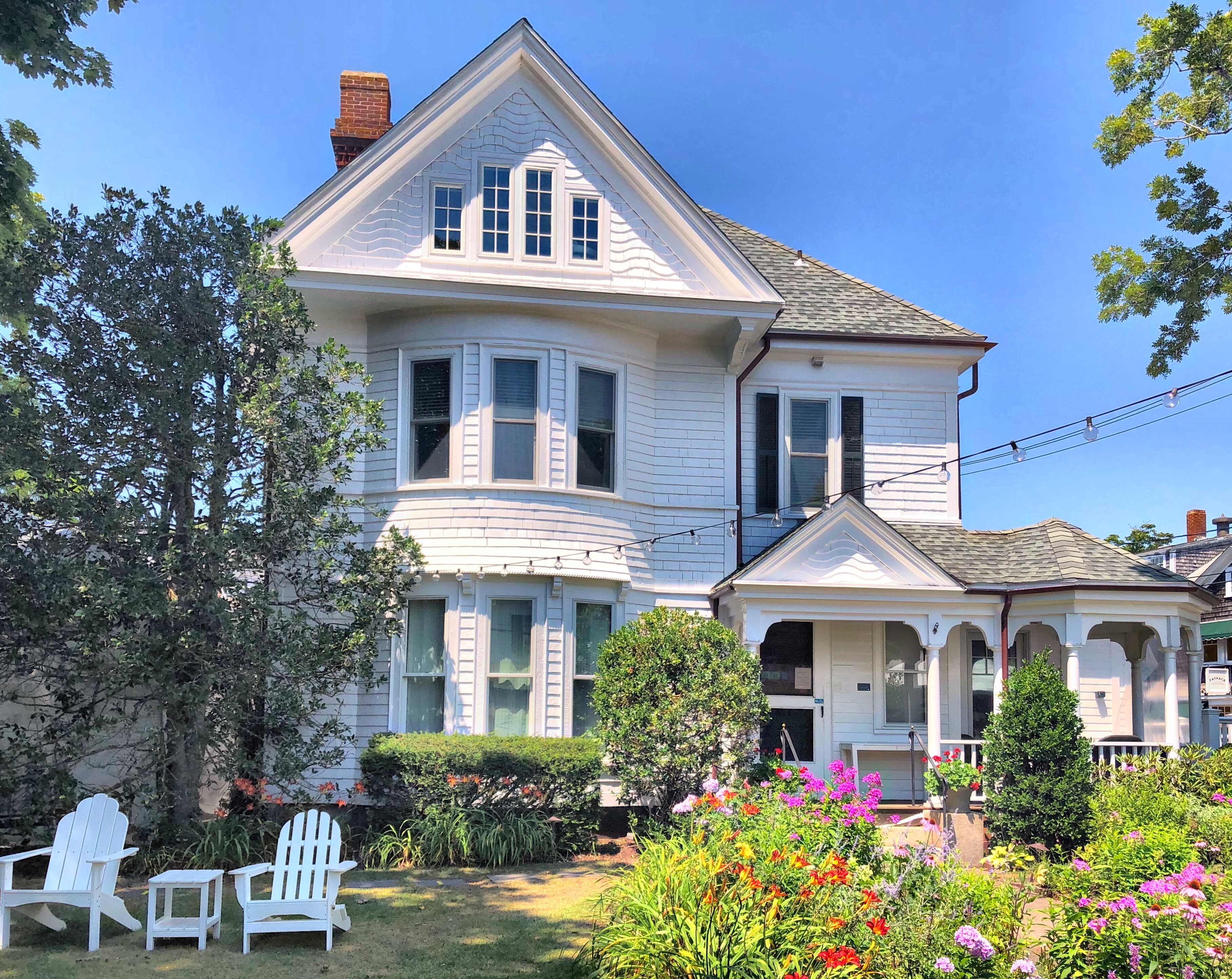
The Blaisdell-Carter House is a great example of a Queen Anne style home in Chicopee, Massachusetts. The house was built in 1890 for Harriet P. Blaisdell following the death of her husband, Samuel Blaisdell, a cotton broker, in 1888. Mrs. Blaisdell hired David B. Griggs, a builder in Chicopee under the firm D. B. Griggs & Sons, to design and build the residence, which sat across the street from Griggs’ own home. Harriet would pass away just three years after her home was built, and the property would eventually be sold to Nathan P. Ames Carter (1864-1959). The residence sits on a large lot and exhibits varied siding, asymmetrical plan with porches, additions, and steep gable roofs, and the use of irregular windows of varied sizing and locations. While the second floor porch has been enclosed, the house retains much of its original fabric and has not been covered by vinyl or aluminum siding, a rarity in Chicopee.

Barnes-Kellogg House // 1809

The main village in Cornwall, Connecticut, looks like a postcard. Mature trees and beautiful, historic homes line the bucolic streets with sweeping views of the Litchfield Hills in the distance; it is what many envision when they think of “New England charm”. This stately Federal style mansion is sited deep on its lot beyond a field and dates to the first decades of the 19th century, it is the village’s grandest early home. The house was built for Amos Barnes, but supposedly remained unfinished when he died suddenly. Barnes’ widow sold the property to the local Foreign Mission School as a dormitory for students. The school’s (in my opinion, problematic) mission was to educate students of non-Christian cultures, including Native Americans, East Asian, and Hawaiian pupils, for them to become missionaries, preachers, translators, teachers, and health workers in their native communities in the Christian faith. These types of programs furthered the erasure of other cultures and promoted Christianity in all corners of the world, but I digress. In 1826, this home was acquired by Frederick Kellogg, the long-time town clerk and Judge of Probate, who owned the property
until his death in 1891.

General John Sedgwick House // 1860

The Major General John Sedgwick House is located in Cornwall Hollow, Connecticut, and stands out as one of the finest residences in this part of the state in a rural setting. The house was built by 1860 for General John Sedgwick (1813-1864), who was born in a house standing on this site, which had been built by his grandfather, a veteran of the Revolutionary War. In 1859, the Sedgwick family homestead burned to the ground. Sedgwick, then already well established in his military career, took leave to oversee construction of its replacement. This house was built, apparently on the foundation of the old house, in 1859–60. The work was done by Cyrus Marsh, a local builder, in the Italianate style with decorative brackets, window mouldings, hoods, and a large columned entry portico. Major General Sedgwick was active in many campaigns, and during the American Civil War, he was killed by a sharpshooter at the 1864 Battle of Spotsylvania Court House, he was the Union Army’s highest-ranking casualty of the war and never got to reside in his Cornwall home.

Hidden Valley Castle // 1921

Photo from listing.

A castle can be found in the small town of Cornwall, Connecticut! Set amongst 275 acres of woodland and streams, with several outbuildings on the property, this whimsical castle looks like it was dropped here from Cornwall, England, but it actually dates to the 1920s. Hidden Valley Castle, had its beginnings when socialite Charlotte Bronson Hunnewell Martin envisioned building a unique country retreat for herself and her husband, Dr. Walton Martin, in the Litchfield Hills of Connecticut as a summer retreat. Just before this, Charlotte had bought a group of 20 brownstones in Manhattan on 48th and 49th Streets, between Second and Third Avenues, and converted them into charming townhouses around a central Italian-inspired garden. Called Turtle Bay Gardens, the houses were highly acclaimed and almost immediately attracted prominent and celebrated residents. The Cornwall Castle was designed by architect, Edward Clarence Dean, who also redesigned the Turtle Bay Gardens for the couple. Dr. Martin imported many of the materials as well as the 100 workmen required to build the castle, a project that lasted five years. Charlotte would also have a cottage built on the estate and hired young Italian artist, Vincenzo Rondinone, to be her resident artist on the estate to create unique vases, bowls, and pots to be used at the house and to be given as gifts to visitors and friends. The property was restored in recent years and put up for sale, with the cottage sold as a separate dwelling.

Brattle-Thurston House // c.1749

This early Colonial house with unique, rusticated wood coursing carved, treated, and painted to resemble ashlar stone, can be found on Prospect Hill Street in Newport, Rhode Island. This is the Brattle-Thurston House, a circa 1749 Georgian residence of an appropriate gray color, yet when I stopped by in early 2024, had peeling paint. The house was originally part of the Latham Thurston estate, and was later rented or purchased by Robert Brattle (Brattell), who lived here with his wife, children, and an enslaved person according to the 1790 census. The home would later be owned by William Thurston, a hatter and dyer, who likely inherited the residence from his ancestor. Beyond the unique rusticated wood siding, the design features splayed lintels, the main entrance on the side elevation and a later entrance facing the street with segmental pediment above.

Birdsey Hall // c.1804

Built circa 1804 in the form of an English country estate house, Birdsey Hall stands as the finest property in the town of Goshen, Connecticut. The residence was built for Birdsey Norton (1763-1812), a wealthy cheese merchant who was said to have been inspired to build a country estate after travelling the American south on business. The high-style Federal/Adamesque mansion features expansive grounds bounded by brick walls and Victorian gardens. The property was later owned by Fred Favorite and Robert Devoe, friends of Liberace, who operated an antique store. Birdsey Hall remains one of the finest Federal estates in Connecticut.

Myron Norton House // 1840

The Myron Norton House, built in 1840, is located in the central village in Goshen, Connecticut. Built of stone, the house is unique as the only example of a stone house in the village, and the only Greek Revival house that departs from the usual gable-roofed form, having a square plan and hipped roof with monitor. The home was built for Myron Norton (1788-1853) and his wife, Caroline (Marsh) Norton, who outlived her husband by 23 years, living here until her death in 1876. Myron Norton made his fortune patenting and selling pineapple cheese molds, where he pressed the curds from local cows in wooden pineapple-shaped molds to give them the desired shape. It is the house that cheese built!

Thompson-Sperry House // 1803

In 1803, General David Thompson (1766-1827) and his wife, Sybil (Norton) Thompson, moved into this recently completed Federal style residence on North Street, the main road through Goshen Village, Connecticut. David Thompson was a merchant and partner in the firm Wadhams & Thompson, occupying a store nearby the Congregational Church. Business partners David Thompson and David Wadhams built near-identical houses across the street from each other, though the Wadhams house has since been gut renovated and lost much of its original fabric. The Thompson House stands out for its Palladian second-story window, glazed with interlacing arcs. The property was owned at the end of the 19th century by Albert Sperry, a Civil War veteran.

Brocklebank-Nelson-Beecher House // c.1661

The Brocklebank-Nelson-Beecher House is a First Period structure in Georgetown, Massachusetts, believed to have been built in the 1660s. The land on which the house stands was granted in 1661 to Samuel Brocklebank (1628-1676) , a surveyor who, with his widowed mother and brother, left England and were among the first settlers of Rowley in 1639. It was built by Lieut. Samuel Brocklebank who also owned a farm of 72 acres on the site. Lieut. Brocklebank was appointed captain in a militia and was killed with his entire company in Sudbury in 1676 during a raid by Native people during the period of the King Philip’s War. Samuel’s wife remarried and moved to Newbury, and his son, Samuel Jr., resided in the family home which remained in the Brocklebank family until 1754. The house became a tavern by owner Solomon Nelson, who purchased the property in 1765 and made substantial additions and renovations to the house in its current Georgian style. In 1858 the house was bought by Rev Charles Beecher, brother of Harriet Beecher Stowe and Henry Ward Beecher. An ardent abolitionist, he was the pastor of the town’s Old South Congregational Church. Today, the Brocklebank-Nelson-Beecher House is owned by the Georgetown Historical Society, who maintain and showcase the town’s rich history from this important early residence.