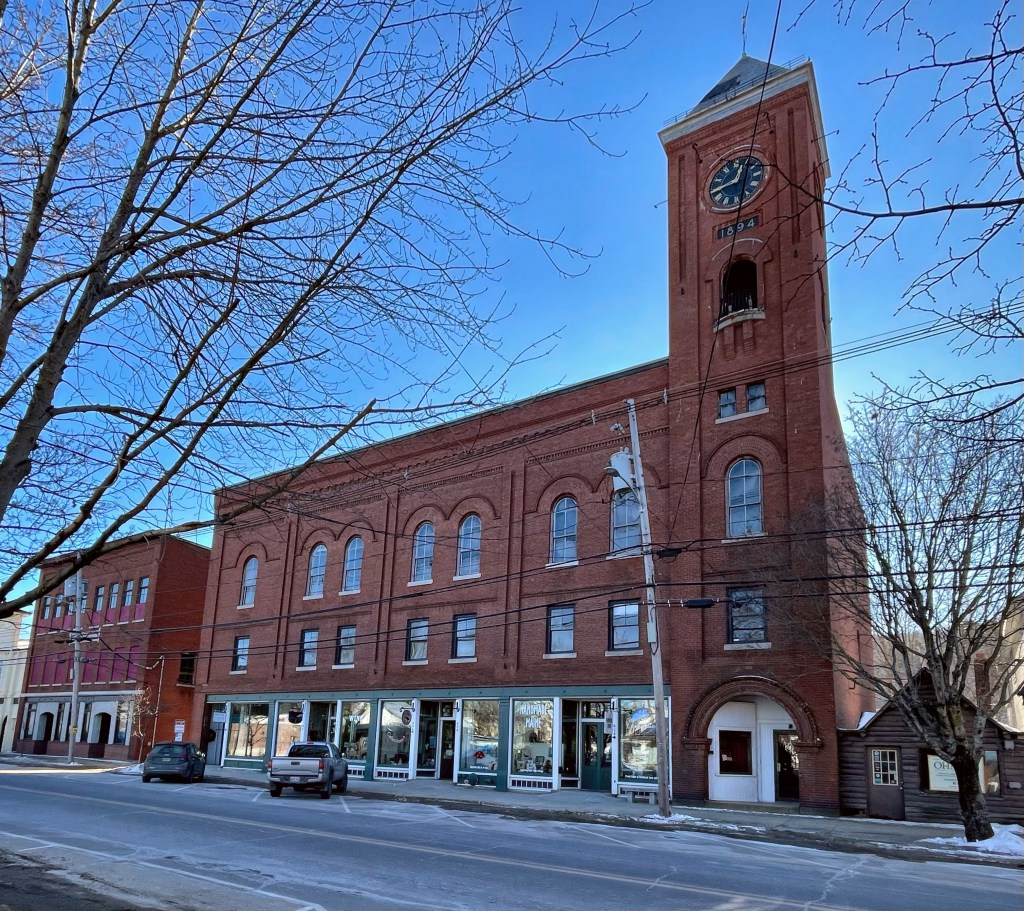
Norway Opera House // 1894

The most substantial building on Norway’s Main Street is this hefty brick commercial block with its prominent corner clock tower. The structure was designed by Maine architect Edwin E. Lewis and built in 1894 as the Opera House with stores along the ground floor. The building was constructed immediately after a large fire destroyed much of the downtown village area of Norway, and was built in such a way to show the strength and resolve of the town, leading the way for a larger re-building effort by the local business community. The Romanesque Revival building features lovely arched windows and brick detailing. The building has seen better days, but a local group has been working tirelessly to restore this beauty to her former glory! The group is presently soliciting donations to restore the roof and rear wall, to keep the building standing for future generations.

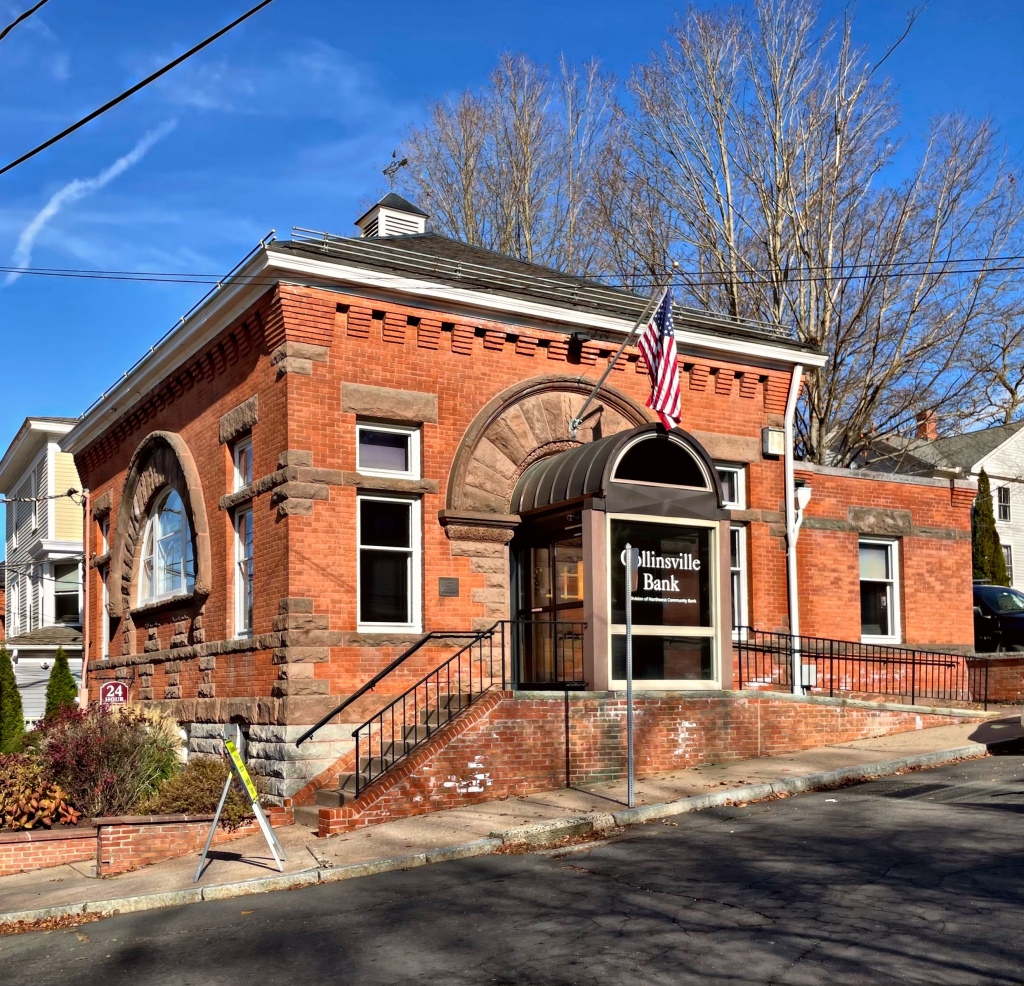
Collinsville Savings Bank // 1892

Historically, banks would construct architecturally grand buildings with ornate interiors to showcase their wealth and stability. The aim for these institutions would be to express longevity and security for those looking for a place to store their wealth. The Collinsville Savings Bank grew out of the Collinsville Company and was incorporated to provide a bank for the ever-growing community in the village, from executives to recent immigrants. The bank was incorporated in 1853, and later relocated into the company’s office building. By the end of the 19th century, company offices expanded into other spaces in the building, and the bank was forced to build this new Romanesque Revival style building on Main Street. The rusticated blocks in the brick facades add a lot of depth and detail to the building, and those ARCHES!

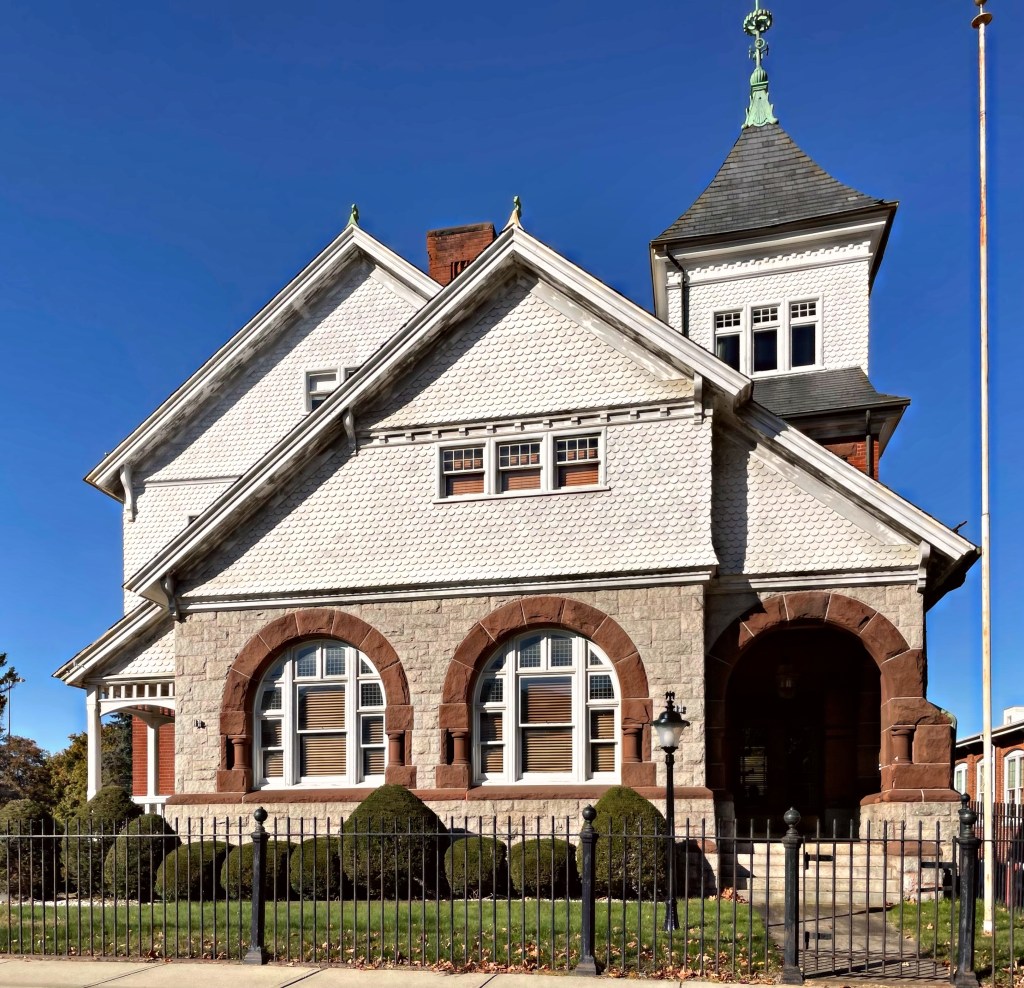
Lancaster Industrial School for Girls Chapel // c.1840

The Lancaster Industrial School for Girls was a self-sustained campus of housing, dining, farming, and functional buildings giving the State of Massachusetts little need to worry about its day-to-day function or funding. In 1838, the First Universalist Society in South Lancaster (then known as New Boston), built a house of worship for members living there. When the southern part of Lancaster reincorporated as the separate town of Clinton, members of the church relocated a short distance to the new manufacturing-oriented community for prosperity. This church was closed, but was purchased by the Industrial School for Girls, who moved the building 1.5 miles to their campus, for use as a chapel. The building was added onto and altered a couple times, but has sat deteriorating since the school closed.

Thompson Hall – University of New Hampshire // 1892

The centerpiece of the University of New Hampshire (UNH) campus in Durham, is Thompson Hall, a stunning example of Romanesque Revival architecture. Thompson Hall was the first building to be built on the new campus of the New Hampshire College of Agricultural and Mechanical Arts, which had been founded in 1866 as a land grant college and was previously located near Dartmouth in Hanover. Benjamin Thompson, a Durham farmer, died 1890, leaving an estate worth $400,000, with 253 acres (102 ha) of land, to the state for use as an agricultural school. The state accepted his gift, and construction of Thompson Hall began in 1891, with a landscape plan for the campus developed by the great Charles Eliot. The bold Romanesque building was designed by Concord, NH architects Dow & Randlett, who were among the most prestigious architectural firms in the state at the end of the 19th century. The building remains as a significant piece of UNH’s ever-growing campus.

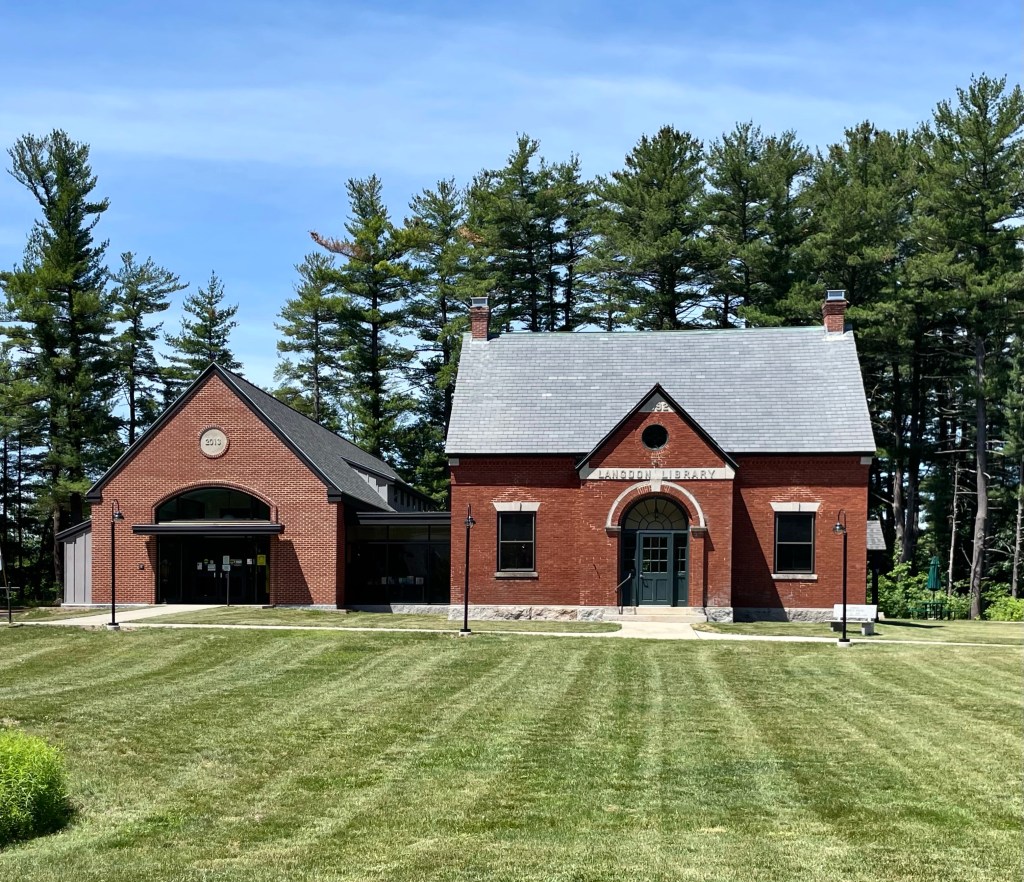
Langdon Library // 1892

Langdon Library in Newington, NH, was established through the generosity of Woodbury Langdon of New York City, a summer resident of Fox Point in town. In 1892 Langdon offered to donate 2,000 books to the Town of Newington, if suitable provisions could be made for their care and circulation. The Town voted to erect a library at town meeting in 1892 and accepted the offer. Portsmouth architect William Allyn Ashe furnished designs for the building which reads as a pleasing, symmetrical Romanesque Revival building. The structure was outgrown and needed repairs in 2013, and hired the firm of Lavallee Brensinger Architects to oversee the redesign, which restored the 1892 building. The resulting project tripled the usable square footage of the library, and the new wing allows the library to remain quaint and the main focus.

Hotel Royal // 1886

This large apartment house at the corner of Beacon and Exeter Streets in the Back Bay neighborhood of Boston commands its site with a six-story rounded corner oriel. Built in 1885-6 for George H. Brooks, a developer, the apartment house exhibits a Romanesque Revival design with the use of a monumental arch at the entrance, decorative brownstone and terra cotta, and the large full-height rounded bays. The apartment hotel was designed by architect Samuel D. Kelley, who designed many apartment houses and tenements in the Boston area. Sadly, the conical roof atop the corner oriel was removed sometime in the 20th century, somewhat minimizing its architectural integrity. The apartment hotel is now home to 30 condominium units.

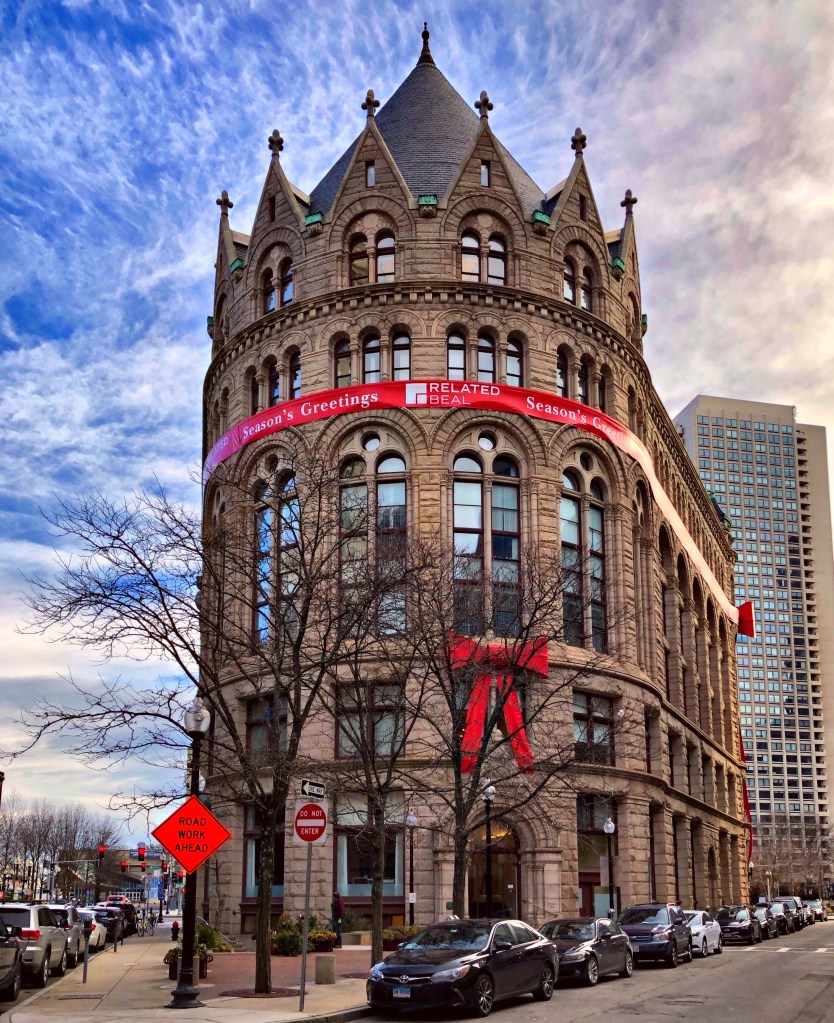
Flour and Grain Exchange Building // 1892

One of my favorite buildings in Boston (and always dressed up with a big red ribbon for the holidays) is the Flour and Grain Exchange Building in Downtown Boston. The third Boston Chamber of Commerce was incorporated in 1884 to promote just and equitable principles of trade, solve disputes between members and acquire and disseminate information related to mercantile interests. There was, however, a feeling among the members that the organization could not attain its full stature until it had a building of its own, one that would be both an ornament to the city and a credit to itself. In 1889, a triangular site was donated to the organization by members, who then hired prominent Boston architectural firm, Shepley, Rutan and Coolidge, the successor to Henry Hobson Richardson‘s practice. It appears the firm was inspired by H.H. Richardson’s F. L. Ames Wholesale Store which was built nearby just years before. The steel-frame building is constructed of rough hewn Milford granite pierced with engaged columns and arched openings, both common in Richardsonian Romanesque buildings. The prominent corner at Milk and India Streets features a rounded corner tower with conical roof, surrounded by a crown of dormers. The building was restored by owners Beal Properties in the late 1980s who own it to this day.

North Easton Savings Bank and Post Office // 1904

Located across the street from the Oakes Ames Memorial Hall and the Ames Free Library, the North Easton Savings Bank and Post Office building perfectly compliments the Romanesque Revival motif seen in the village. The building was constructed in 1904 in a Richardsonian Romanesque design with rough-faced granite ashlar walls with brownstone trim. The three-bay front façade contains centered entrances recessed behind a wide brownstone arch in the signature Richardsonian manner. The building was designed by Shepley, Rutan and Coolidge, a Boston-based architectural firm which grew out of Henry Hobson Richardson’s office, where they completed many of Richardson’s unfinished works after his death.

Boylston Building // 1887

2019 image courtesy of Brandon Bartoszek.

Built by the Boylston Market Association, replacing the former Boylston Market (1810-1887) in Downtown Boston, the Boylston Building is a great example of late 19th-century commercial design in Boston. The Association hired German-born architect Carl Fehmer (who also designed the amazing Beaconsfield Terrace housing in Brookline) to design a structure that would stand up to the architectural landmarks along Boylston and Washington Streets nearby. Fehmer’s design exhibits many features of the emerging Commercial style (also known as Chicago school style) of architecture which promoted new technologies of steel-frame construction in commercial buildings with masonry cladding, while clearly showcasing the Romanesque round arch windows. In the mid-20th century, this area of Downtown Boston became known as the ‘Combat Zone‘, Boston’s Red Light District, flooded with prostitution, drugs, and adult video stores. The Boylston Building was occupied by an adult video store and dive pizza shop. The building and area surrounding are different today, but you can always find some characters nearby!

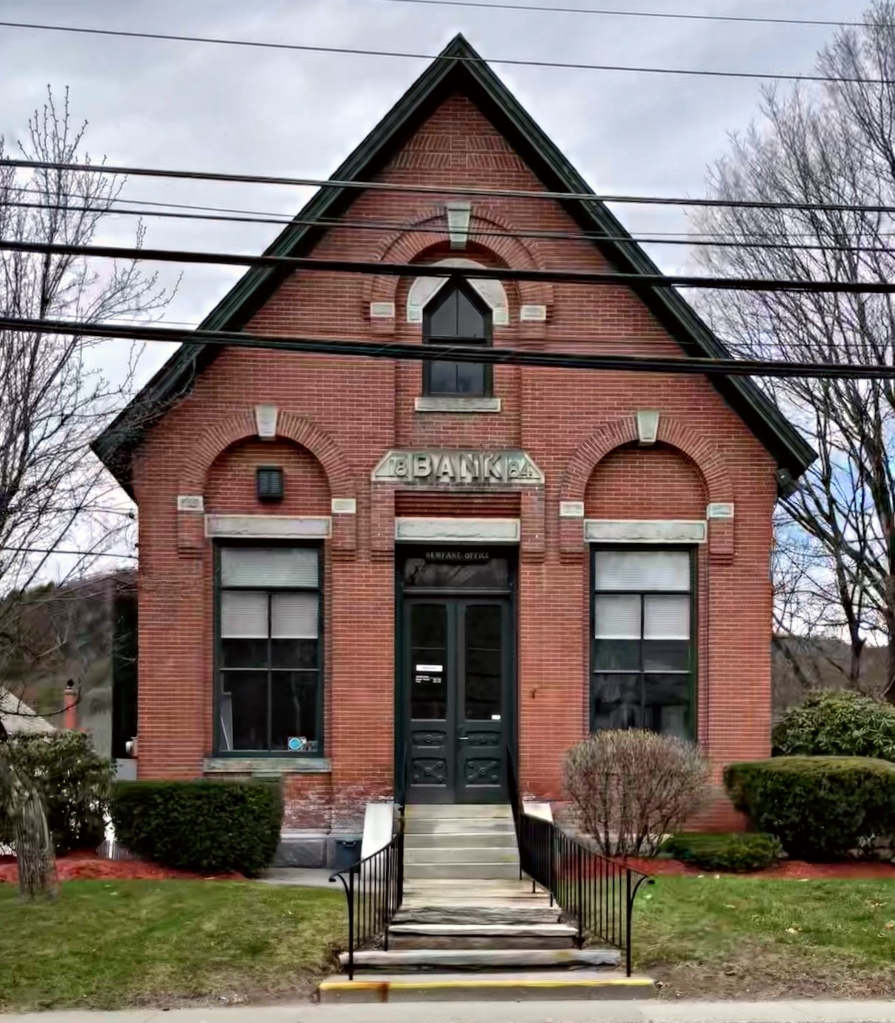
Hoosac Savings Bank // 1893

Located in Downtown North Adams, this beautiful Romanesque Revival commercial block is one of the better designed buildings in the region. Designed by architect H. Neill Wilson of Pittsfield, the Romanesque headquarters with fine terra cotta decorations cost $60,000 to build. When built in 1893, the stone over the storefronts were carved to display the bank’s name. The two venerable institutions merged into the North Adams Hoosac Savings Bank in 1962. In 2013, the bank merged with MountainOne Bank.