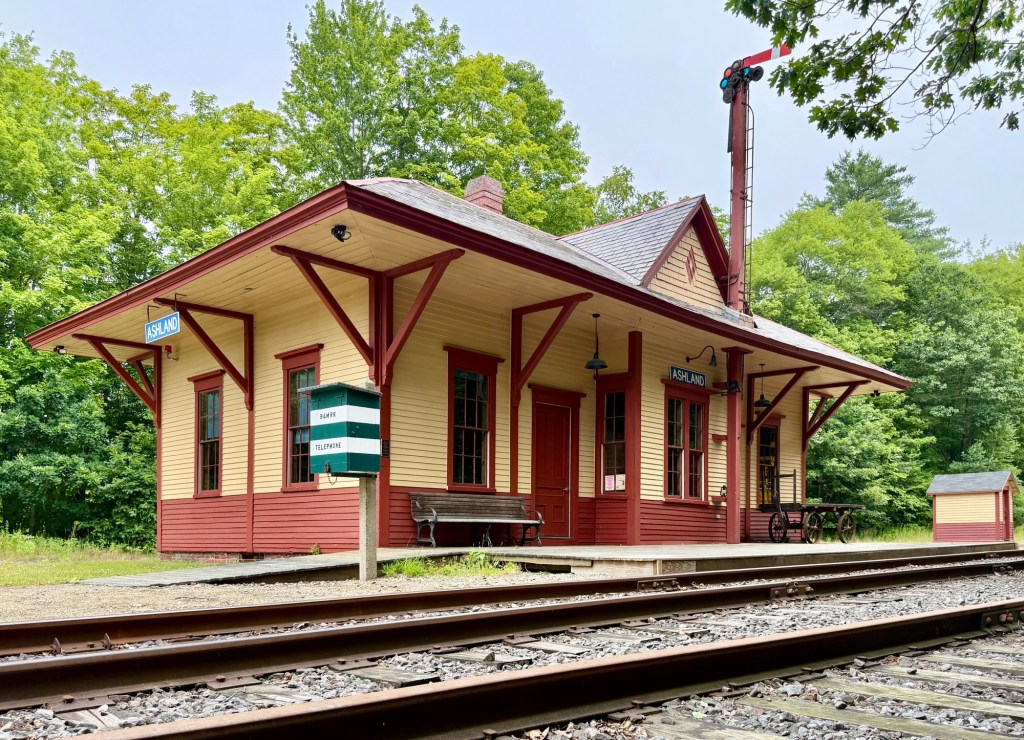
The railroad arrived to Ashland, New Hampshire (then a part of Holderness) in 1849, which connected the industrial village to Concord for both freight and passenger service. The first Ashland Station opened as a combined passenger and freight station of the Boston, Concord & Montreal Railroad, which was chartered by the State of New Hampshire in 1844. Construction of its initial 93-mile track through largely agricultural, rural, and mountainous territory began in 1846 and concluded in 1853, when the railroad reached its terminus in Wells River, Vermont. Over time, the railroad expanded and acquired branch railroads, connecting it to routes all over the northeast. As manufacturing flourished in Ashland, the town grew, which necessitated the demand for a larger passenger station for the railroad. Additionally, in 1869, the original freight and passenger station (built c.1850), was remodeled to handle increased freight. This passenger station was built in 1869 and resembles many other rural New England railroad stations of its period with its rectangular form and low hipped roof with extended eaves supported by brackets to shelter those waiting for the next train to arrive. In 1895, the Concord & Montreal came under the control of the Boston & Maine Railroad and it continued to serve many travelers as the gateway to the town and the popular Squam Lakes Region in summers. Regular passenger service at the Station ended in 1959, and the Boston & Maine Railroad sold the Station to Joseph Curley. In 1980, his widow Vera Curley generously donated the station and site to the Ashland Historical Society, who oversaw a restoration of the building. Today, the building serves as a local history museum and serves as a stop along the Winnipesaukee Scenic Railroad on its popular Fall Foliage Tours.