Brookline Town Hall // 1965

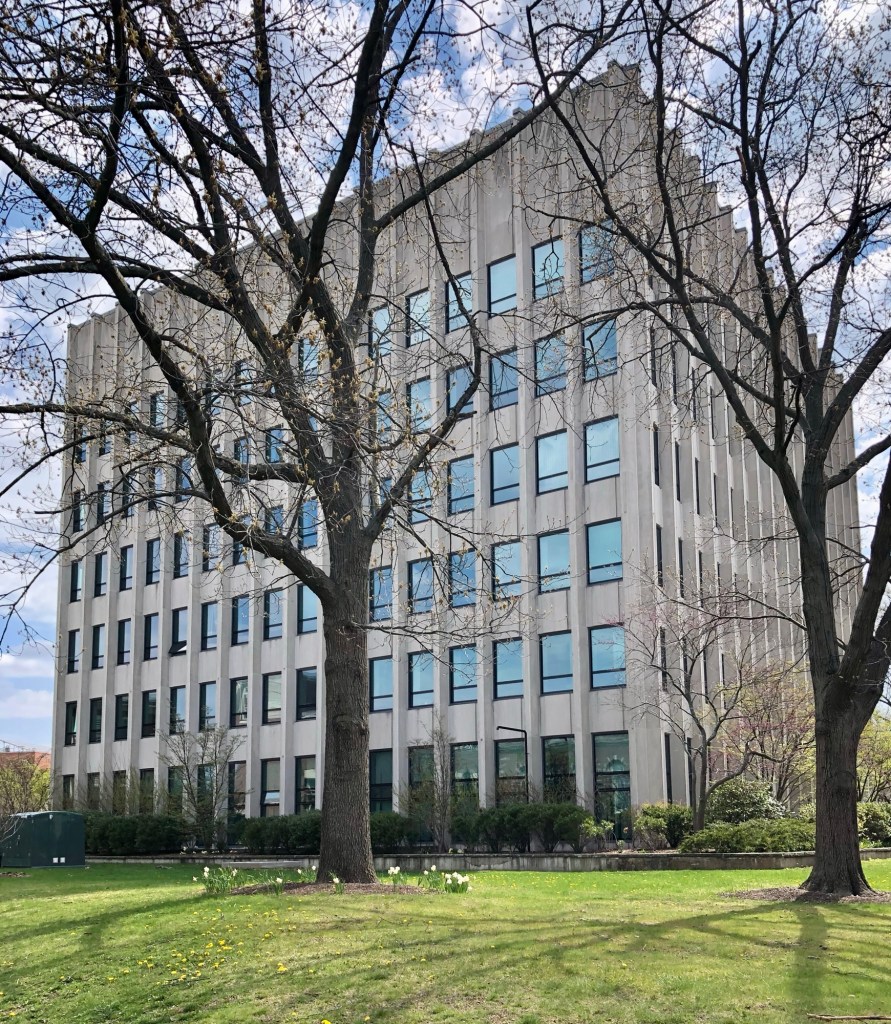
The modernist Brookline Town Hall building stands in stark contrast to the many historic buildings in Brookline Village, and even more-so from the town’s third Town Hall, a Victorian Gothic design by architect Samuel J. F. Thayer. Completed in 1965 as a six-story municipal “skyscraper”, the structure was designed by Anderson, Beckwith, and Haible, architects who specialized in sleek, clean, Modernist designs, primarily in office parks and college campuses. The unadorned box is broken up only by the rows of identical windows and slightly projecting fins, which break up the bays in their own monotony. Like many such municipal and office buildings of the time, the structure is set back from the street and surrounded by landscaping, with surface parking behind. While the building was lauded when it opened in 1965, tastes shifted and like in many communities, a majority of the public (and likely the employees who work here) would have preferred its predecessor.

Chamberlain Cottage // 1940

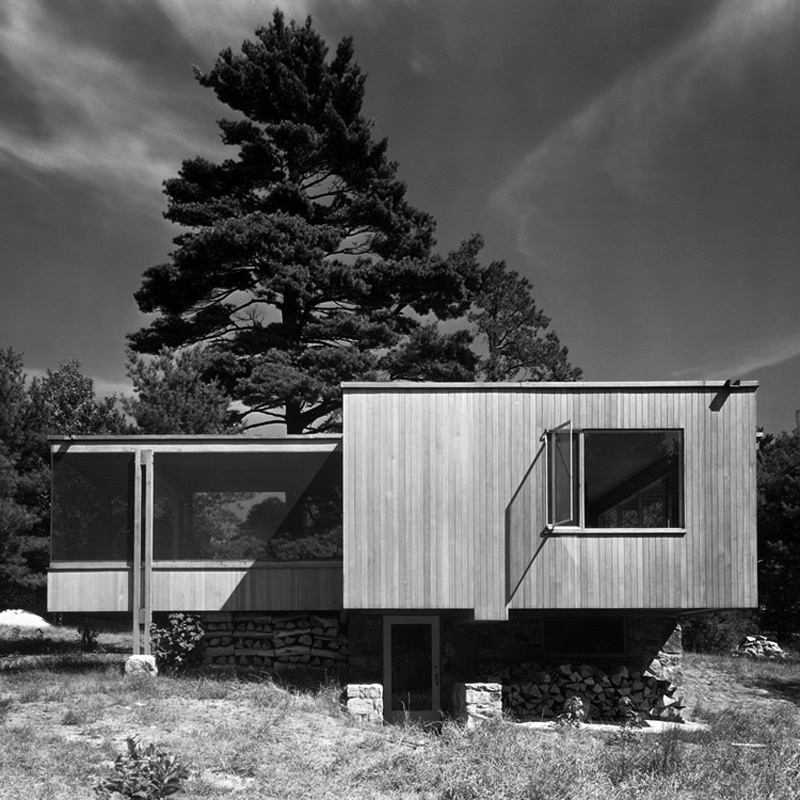
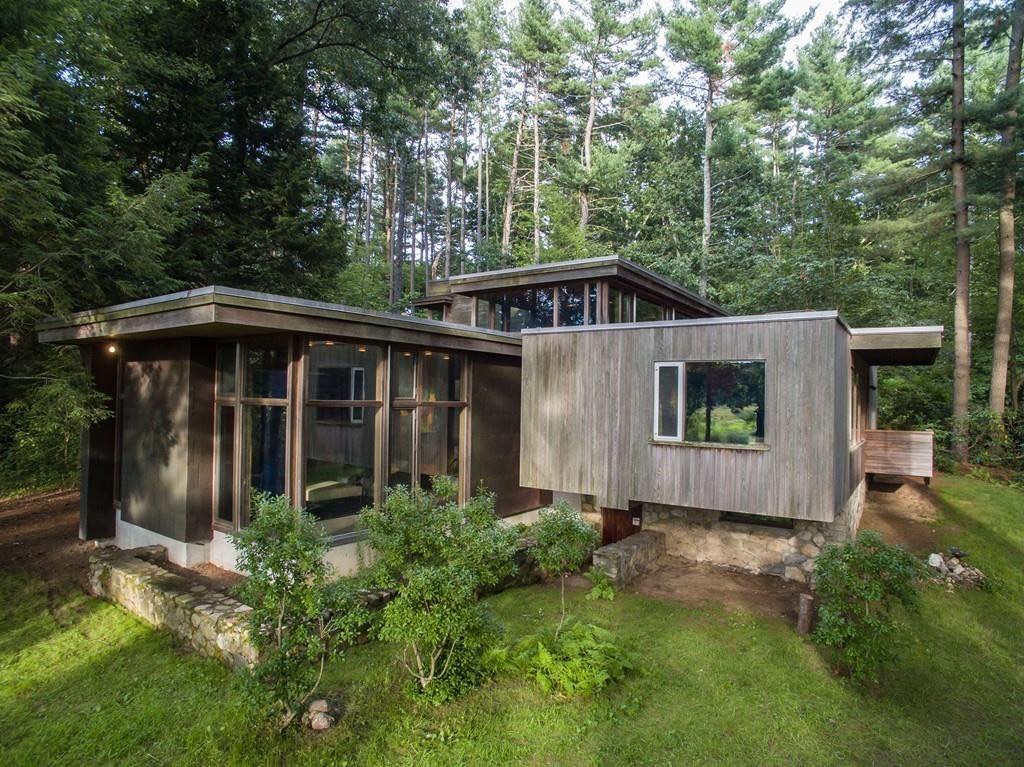
Nestled into the forests of Wayland, Massachusetts, one of the most significant examples of early Modernist architecture, the Chamberlain Cottage, represents the European Bauhaus style adapted to the American landscape and New England vernacular. Designed in 1940 and completed in 1941, the house was commissioned by Harvard Economics professor, Henry Chamberlain and his wife, Margareth, as a weekend retreat from Cambridge. Professor Chamberlain commissioned Marcel Breuer and his mentor, Walter Gropius, then Dean of the Harvard Graduate School of Design, to design a home with a specific request for a screened porch similar to Gropius’ residence in nearby Lincoln. For the Chamberlain Cottage, the design responds to the uneven terrain and the potential for river flooding by two distinct parts: a grounded stone base and a cantilevered wooden volume above. The lower stone level functioned as a foundation while providing storage for a canoe and housing a fireplace that extends vertically through the structure; with the upper wooden volume containing living spaces. Despite its compact size for weekend visits, the upper level is well planned and includes a living space, kitchen, a single bedroom, and the porch. Due to its small scale and siting, the one-bedroom cottage was not easily adaptable for modern living. After falling into disrepair in the 1980s and ’90s, the home was purchased by architects Sidney R. Bowen and Angela Watson, who expanded the structure over the course of a decade to its current size of 3,742 square feet. It has been occupied and lovingly maintained by later owners. It remains a private residence.

Former Howard Johnson’s Motor Lodge, Kingston // 1956

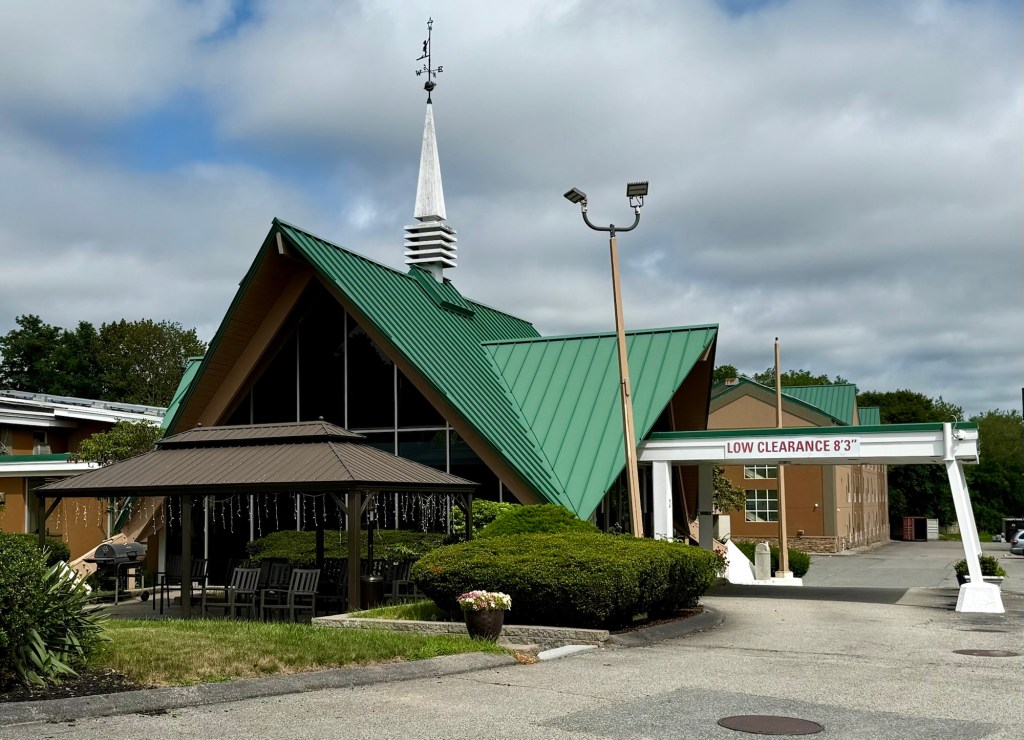
Howard Johnson’s (Hojo’s) traces its beginnings to the late 1920s when the Boston native Howard D. Johnson (1887-1972) opened a series of ice cream stands at various locations along the South Shore of Massachusetts. By 1940, there were more than 125 restaurants from Maine to Florida and by the late 1950s there were approximately 500 along the east coast. In 1954 the company expanded to motor lodges (motels), eventually opening over 500 across the United States. The growth of the motel tied closely with 1950s legislation that authorized Interstate highways connecting cities via automobile, increasing traffic all across the country. Howard Johnson’s adopted a policy of acquiring real estate directly off highway exit ramps and often the parcels were large enough to include a restaurant and motor lodge. Specifically, many Howard Johnson’s Motor Lodges featured prominent signage and bright orange roof, to help motorists identify the motel while speeding down the interstate. The Kingston location here opened in 1956 along Rt. 3, connecting Boston and points north, to Cape Cod. While it’s iconic name and orange roof do not remain, the unique Googie-esque form of the lobby with very 50s weathervane remain as an important vestige of 1950s America. 

Bow Market // 2018

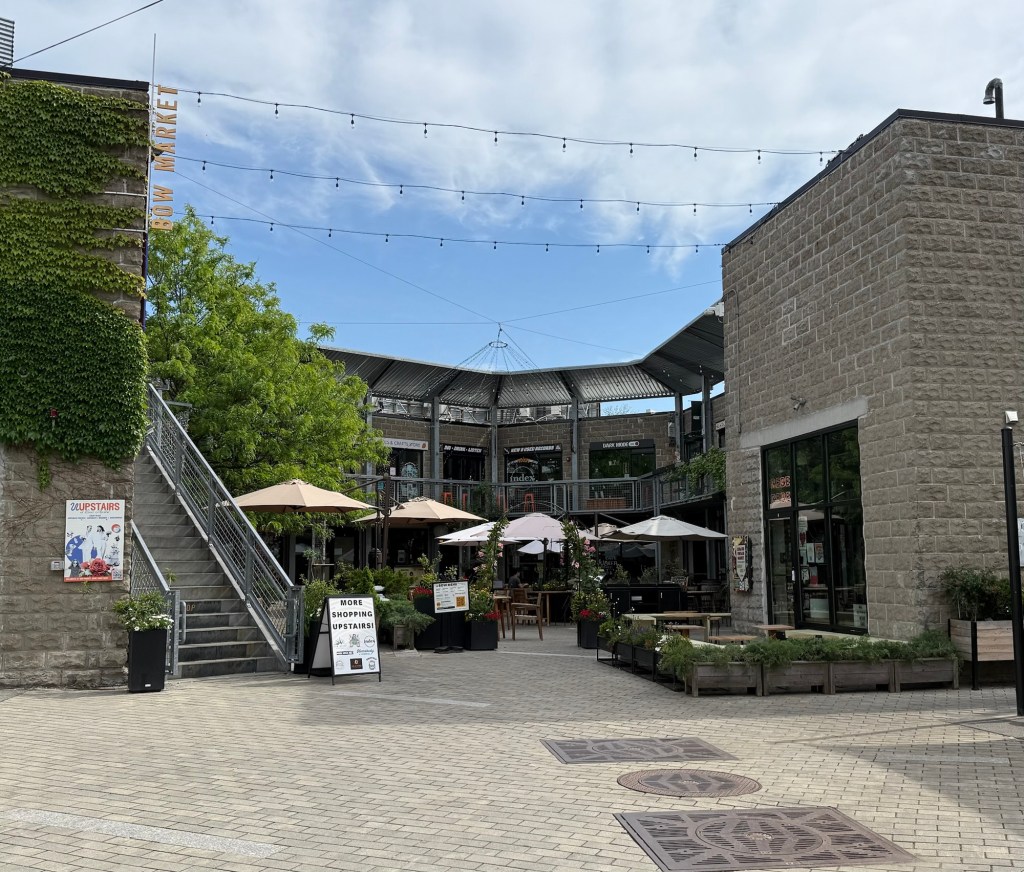
One of the best and most successful examples of adaptive reuse in the Boston area has to be Bow Market in Somerville’s Union Square commercial district. Tucked away behind buildings on the busy streets, a former concrete block storage facility was reimagined as a vibrant, European style marketplace of local vendors and businesses. The project was envisioned by business partners Matthew Boyes-Watson and Zach Baum, who worked with Matthew’s father, architect Mark Boyes-Watson, to renovate the storage building to create storefronts. The team worked with landscape architects, Merritt Chase, to make the public courtyard more enticing, which each micro-commercial space opening onto the landscaped communal courtyard. Design elements include seat walls constructed from recycled granite from the renovation of the Longfellow Bridge and reclaimed wooden beams from a ship building facility in Hingham. If you haven’t been to Bow Market yet, you must. This project is exactly what good urban planning and design is all about!

Frederick and Erna Gibbs House // 1936

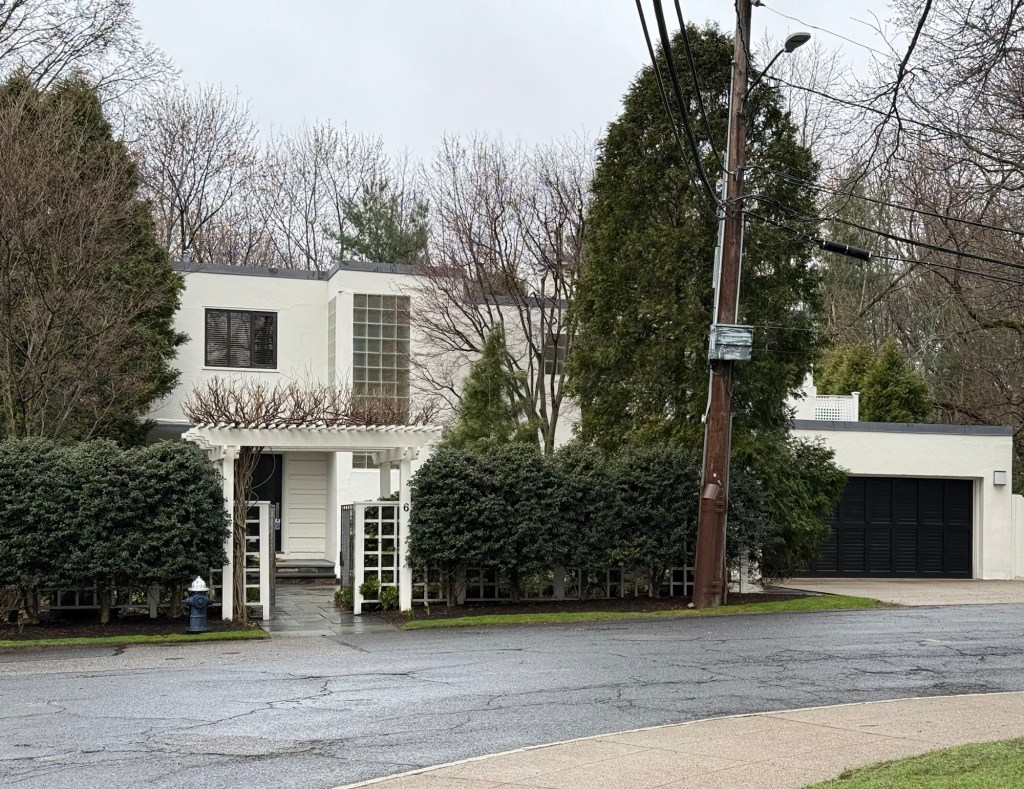
Built at a time when Colonial Revival and Tudor Revival styles dominated the suburban landscape of the Boston area and elsewhere, the Frederick and Erna Gibbs House on Chilton Street in the Cottage Farm neighborhood of Brookline, Massachusetts stands out. Built in 1936 for Frederic and Erna Gibbs, the house is said to be the first International style single-family home built in the Boston area, predating the famous Gropius House in Lincoln by a couple years. Erna Leonhardt-Gibbs (1904–1987), a German-born pioneer in the development of electroencephalography (EEG) technology, in 1930, married Frederic A. Gibbs, a neurologist, and would soon-after vacation in Germany, seeing the Modern revolution of architecture there in the interwar period. Upon returning the States, the couple hired architect Samuel Glaser, to design their dream home in the Bauhaus style. Set amongst a street of 1930s Tudor houses, the Gibbs residence stands out for its stark white stucco walls, boxy form, with elongated and block windows. While set behind a tall fence and hedge, the house is a landmark example of the style and appears much as it did when built 90 years ago.

Abercrombie Fine Arts Wing // 1974

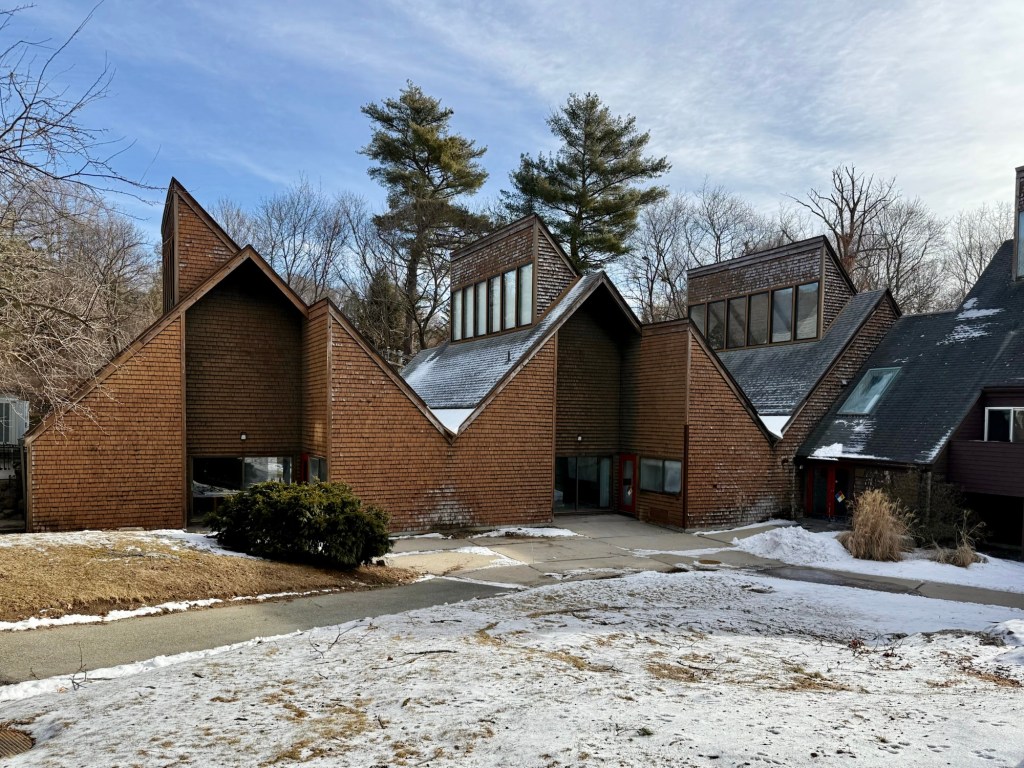
Completed in 1974 for the now defunct Pine Manor College in Brookline, Massachusetts, this interesting Contemporary/Shed style building is modern, yet employs materials and a general form that fits into its surrounding context. When Pine Manor College received a grant by the Abercrombie Foundation, planning began immediately to design and build the Abercrombie Fine Arts Wing of the school. The building was designed by Paul J. Carroll & Associates, and features a bold roofline with clerestory windows, used to provide ample natural light for the classroom and art studio spaces inside. The building remains a part of the newly established Messina College, a Boston College campus enrolling first-generation high-financial need students, giving all an opportunity for education, no matter their circumstances.

Lyman Park Offices // 1959

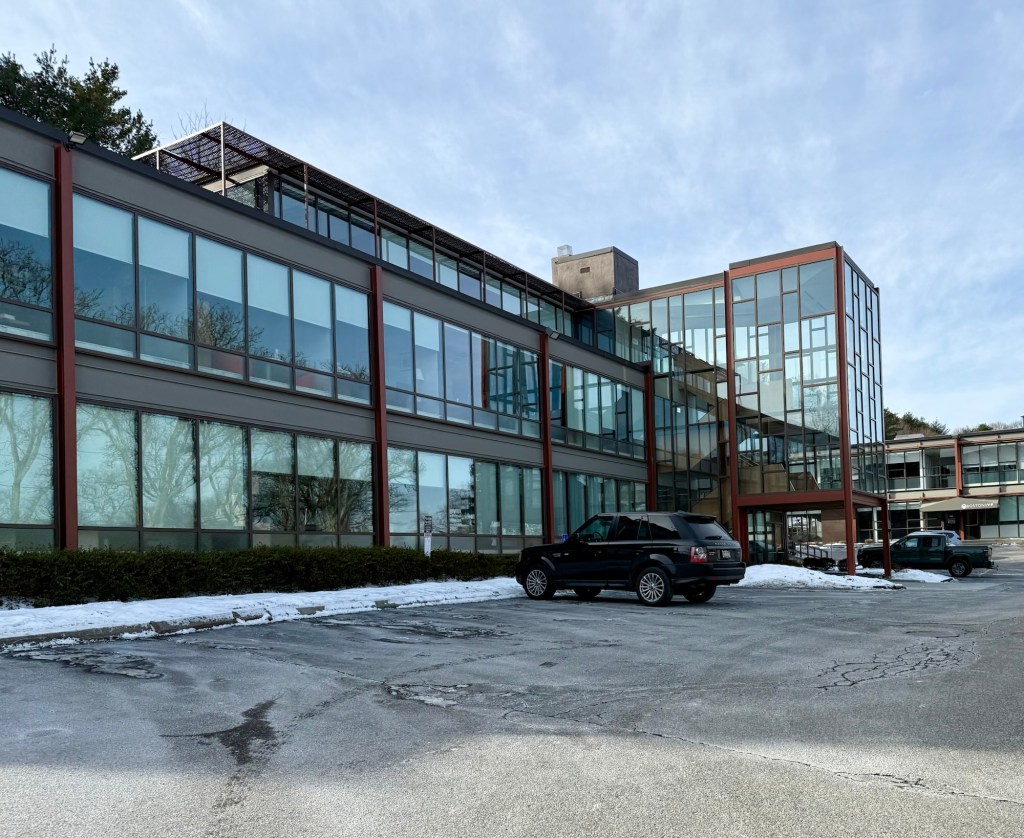
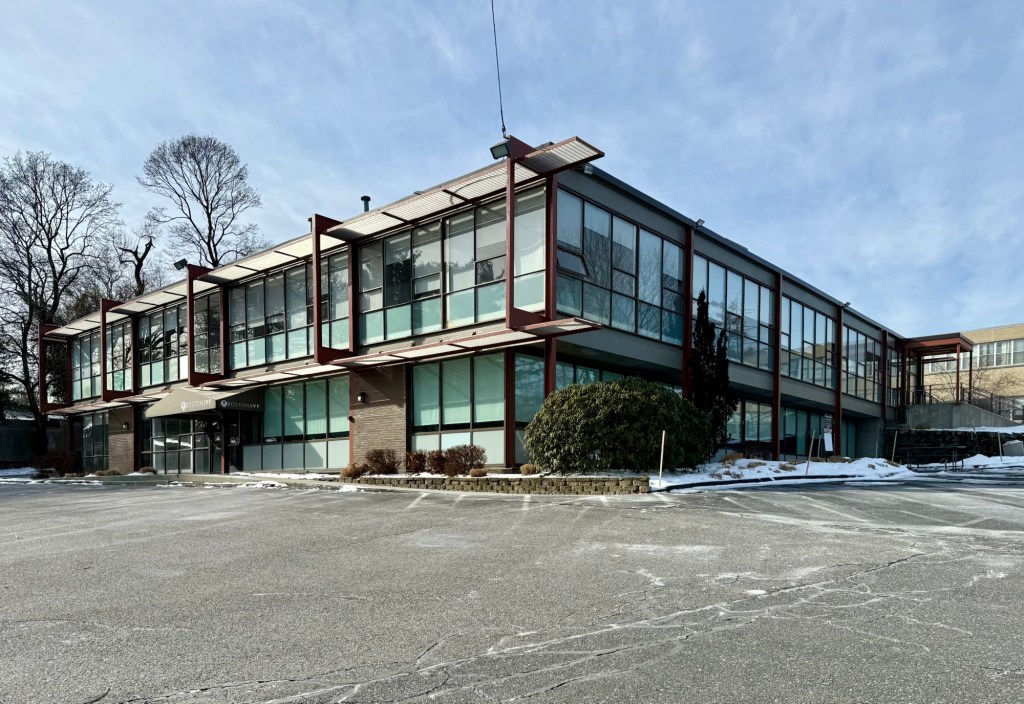
Mid-Century Modern commercial architecture is often maligned for its car-centric and unadorned designs, but the Lyman Park Offices on Boylston Street in Brookline, Massachusetts, are some of the finest office buildings constructed in Brookline in the 20th century. The two office buildings were built on the site of the Theodore Lyman estate and were built at a time Brookline saw rapid commercialization along the Boylston Street corridor. Designed by the firm of Salsberg & LeBlanc, the Lyman Park Offices are landmark examples of the International style in the commercial form in Brookline. Built of steel and glass, the buildings exhibit spandrels above each floor level, enhancing the strong horizontal emphasis of the design.

Alumnae Memorial Library – Elms College // 1973

Located just north of and in stark contrast to the ornate Neo-Gothic 1932 Administration Building of Elms College, the school’s main library building showcases how much architecture styles changed in just 40 years. The college’s library was long in the main Administration building, but was outgrown in the latter half of the 20th century. The two-story steel and cast-concrete library building was built in 1973 with exterior details in red brick and concrete, a nod to the historic materials of the older campus buildings. Unapologetically Modern, and somewhat Brutalist, the building has complex geometry of sunken voids and solid sections, broken up by a horizontal band of windows with concrete fins to mitigate sunlight. The building was designed by Boston architects, Carroll & Greenfield, and recently celebrated its 50th anniversary.

Federal Reserve Bank of Boston // 1972

Established by Congress in 1913, the Federal Reserve System is the nation’s quasi-public central bank. Its primary functions are to set monetary policy, supervise and regulate banking institutions, maintain a stable financial system, and provide financial services to the U.S. government, the public, and domestic and international financial institutions. Organized in 1914, the Federal Reserve Bank of Boston is one of 12 district banks across the country and serves the six New England states. Construction for the Boston Reserve’s Renaissance revival bank was begun in 1920 and finished in 1922, but was outgrown in the second half of the 20th century. The original building would be landmarked and is now known as the Langham, a luxury hotel. Planning began on a newer office and a site was acquired on waterfront land cleared from Urban Renewal in the late 1960s. The current building was constructed between 1972 and
1974, and occupied by the bank in 1977. Designed by the firm Hugh Stubbins & Associates, the complex occupies a full city block, with the 32-story tower and a 4-story section serving as the bulk of the mass. A 600-ton major steel structure called a “truss” marks the beginning of the tower’s offices above the breezeway. The exterior is natural anodized aluminum, which acts as a curtain wall and weatherproof facing. The aluminum spandrels or “eye-brows” shade the building interior from the sun in the summertime and allow more sunlight in the winter months. Love it or hate it, this building is extremely significant architecturally for its Modern design and materiality, and for its engineering. It has become a visual landmark and anchor into Boston’s dense Downtown.

Lincoln Street Garage // 1956

Few buildings in Boston showcase the evolution of its neighborhood (or bring out the architectural critics) quite as well as the Lincoln Street Garage in the Leather District of Boston. This Post-WWII mixed use building was originally constructed in 1956, on the former site of the United States Hotel (1839), one of the first major hotels in the nation, which was razed in 1930. The original building was designed by architect Archie Riskin, and stood three stories high with parking on half of the second floor and on the 3rd floor and roof. A fifth floor of office space was designed and constructed by 1959 also by Riskin. Due to its site at the edge of a historic commercial/industrial district and adjacent to the Central Artery, a raised highway that snaked its way through Downtown Boston, the building was minimally visible and faded away to obscurity until the late 1990s when the highway was buried under the city as part of the “Big Dig”. The open scar and subsequent re-greening of much of the former highway spaces necessitated the owners to re-work the building, due to its newfound gateway presence into the neighborhood. Brian Healey Architects renovated the building, adding an additional floor of offices and reworked facades. The result is a Post-war mixed-use hodgepodge of a building that expresses its use visually on each floor in a no-nonsense way, making it a unique urban building. Additionally the building has long been rented to small businesses, almost all Asian-owned with direct ties to the Chinatown and Leather District neighborhoods. Recent plans have been approved for a new office tower on the site and supported by preservation groups stating that “the existing garage is historically significant or beneficial to the neighborhood”, but to me, the further erasure of quirky buildings for more out-of-context developments is not the way to go.