Otis Company Mill #1 // 1845

This five-story granite mill building was one of the major catalysts for the 19th century population surge in Ware, Massachusetts. As New England’s fledgling textile industry of the era played a vanguard role in transforming the U.S. into an industrial nation, the significance of this type of mill can hardly be understated. The Otis Mill #1 in Ware is one of the last remaining granite textile mills of this early period in central/western Massachusetts. The mill was built in 1845 for the Otis Company, which initially manufactured woven cotton fabric, but later branched out into stockings, woolen shirts and drawers underwear. The company was Ware’s largest employer for about 100 years! The company prospered thru WWI employing over 2,500 people. During the 1920’s the business began a decline due to the southern state’s mills and lack of modernization. In the mid 30’s the Otis Co sold its property to the citizens of Ware, which they formed Ware Industries, Inc to continue the major employer in the town. Due to this Ware came to be known nation-wide as “The Town That Can’t Be Licked.” The mill is now home to local small businesses as a sort of incubator, providing jobs to local residents!

Dorset Playhouse // 1929

During the spring of 1927, Mr. and Mrs. Edward Goodman, devotees of the performing arts, were able to interest a number of Dorset residents in producing a play. In April 1927, a three-act play entitled ’39 East’ was presented in the Dorset Town Hall for the benefit of the PTA and was received with great enthusiasm. From this, a movement took off. Many summer residents and artists in town formed a group, the Dorset Players, who would continue performances for the town. They realized that the space in Town Hall was not suitable nor permanent enough for the goals of the group. May Goodman purchased land at the edge of the village and the group held two years of performances in nearby towns to gather funding to erect a playhouse. Ernest West, a member, offered two barns on his property in town and it, plus one more barn, were incorporated into the new playhouse. The auditorium was built so that the weathered sides of the barn boards were on the inside and hand hewn timbers 12 by 12 inches were used to achieve a rustic effect which draws many favorable comments from those visiting the Playhouse. It remains a cultural center of the town and greater region to this day.

Old Peru Schoolhouse // 1864

In 1816, the turnpike to Manchester, Vermont was completed and ran through the small town of Peru. As a result, inns and taverns were built, and the young village of Peru began to grow, with farming and lumber businesses being the most common employment in town. A village school was built here and in the town’s other school districts. By the end of the 19th century, the lure of moving to the Western U.S. and cities for industrial work caused some population decline in Peru, and a larger, consolidated school was built in the town village. This schoolhouse on the hill was constructed in 1864, replacing the former one-room schoolhouse on the lot. The school consolidated again in the mid-20th century when further population decline necessitated a school district encompassing Peru and nearby towns. This building was later converted to town offices, a use that remains to this day.

The good news is that the town’s population is seeing a resurgence, led by both tourism and the Bromley Mountain Ski Resort as an anchor.

Landgrove Old Schoolhouse – Town Offices // c.1900

Before driving down the winding dirt roads of Landgrove, Vermont, I had never even heard of the town, let alone what I would find. It is always a treat to explore a rural Vermont town, not knowing what lies beyond each hill and bend in the road. Landgrove was chartered in 1780 and is one of the least-populated towns in New England at just 177. The town’s founding occured in the spring of 1767, when Captain William Utley (1724-1790) and his 16-year-old son Asa, traveled from Connecticut to what is now Springfield VT, across a newly created road to the frontier town of Chester. Upon arriving, they spent the rest of the year cutting a road from Chester to the West River. He thought that he arrived in the Town of Bromley, one of the New Hampshire Land Grants. After building his cabin, settling here with his family, he realized he was in unincorporated land between other grants. He petitioned for a new town and it was accepted after the Revolution. The town grew slowly with farms sprouting up along the countryside, never expanding beyond 355 people. This old schoolhouse was constructed, likely around the turn of the 20th century at the geographic center of town after the town consolidated their school districts. When the town’s population shrunk further, Landgrove’s school district merged with nearby Londonderry and Weston. This former school was converted to town offices.

Church of the Holy Transfiguration // 1891

Highlighted by the establishment of the Catskill Mountain House in the 1820s, and furthered by the construction of subsequent resorts and boarding houses, the Catskill Mountains enjoyed a lively seasonal tourist industry that continued largely unabated throughout most of the nineteenth century. Mead’s Mountain House was representative of the smaller, less ostentatious boarding houses that sprang up in the region to serve a more middle-class clientele of tourists. This church, the Church of the Holy Transfiguration was originally constructed in 1891 in association with Mead’s Mountain House as a modest place of worship for guests of the Mead family’s boarding house and those of the nearby Overlook Mountain House. The chapel was constructed in 1891 and modestly built, constructed with a wood balloon frame above a fieldstone foundation with detailing reminiscent of the rustic aesthetic, popular in the Adirondacks to the north. In the 1960s, Father Francis, the much-beloved “hippie priest”, here welcomed hippies who had congregated in town during those years that culminated in the famous art and music festival. Fr. Francis began the practice of this lesser known branch of Catholicism, which acknowledges the Pope as an earthly spiritual leader but, unlike classical Roman Catholicism, does not consider the Pope to be supreme or infallible. The small chapel remains as a quirky and important piece of local history.

Overlook Mountain House Ruins // 1923-

One of the most intriguing and historical hikes around is at Overlook Mountain in Woodstock, there is just something so mesmerising and enchanting about abandoned places. Overlook Mountain has long been a significant location in New York. In the boom years of New York City after the Civil War, more than 90 quarries in the Town of Woodstock (many around Mount Overlook) produced bluestone for sidewalks in Manhattan. By the end of the 19th century, the mountain and surrounding area became a tourist location for New Yorkers escaping the woes of city living, looking to breathe in the fresh mountain air up the Hudson. The current ruins Overlook Mountain House was actually the third hotel on the site. The first Overlook Mountain House was built in 1871 and accommodated 300 guests, before it was destroyed by fire in 1875. It was rebuilt in 1878 by the Kiersted Brothers of Saugerties. Overlook was used irregularly between 1887 and 1917, when Morris Newgold of Manhattan purchased the hotel. In 1921, it was the site of a secret organizational meeting of what was to become the Communist Labor Party of America. The second incarnation of the Overlook Mountain House was destroyed by fire in 1923. And Morris Newgold sought to rebuild with fireproof construction.

His architect used concrete to rebuild the hotel, which likely would have been covered with stucco. They also broke ground for a chapel, stables, and a standalone lodge for private housing for his family. Newgold’s shaky finances paired with the Great Depression made for slow progress, and portions of the resort were still “under construction” as late as 1939 (and the main hotel never being finished from what I could find). Morris Newgold died in 1940 and the property was either sold by his son or acquired via eminent domain by the New York State Conservation Department and made part of the Catskill Forest Preserve. You can now explore the old ruins of the Overlook Mountain House between views of the Catskill Mountains.

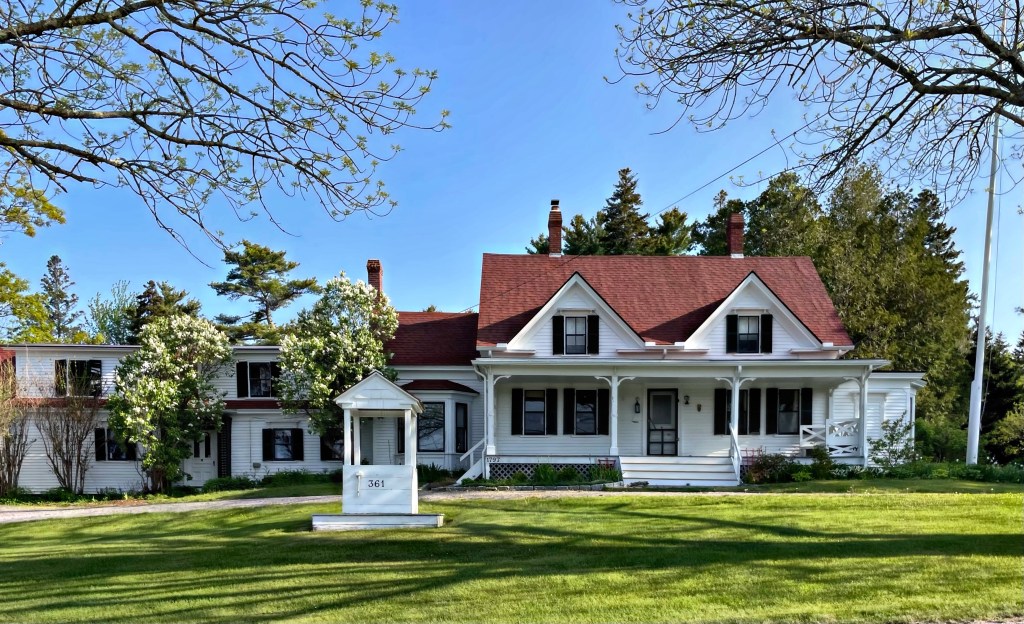
1928 House

Trippy Tower House // 2002

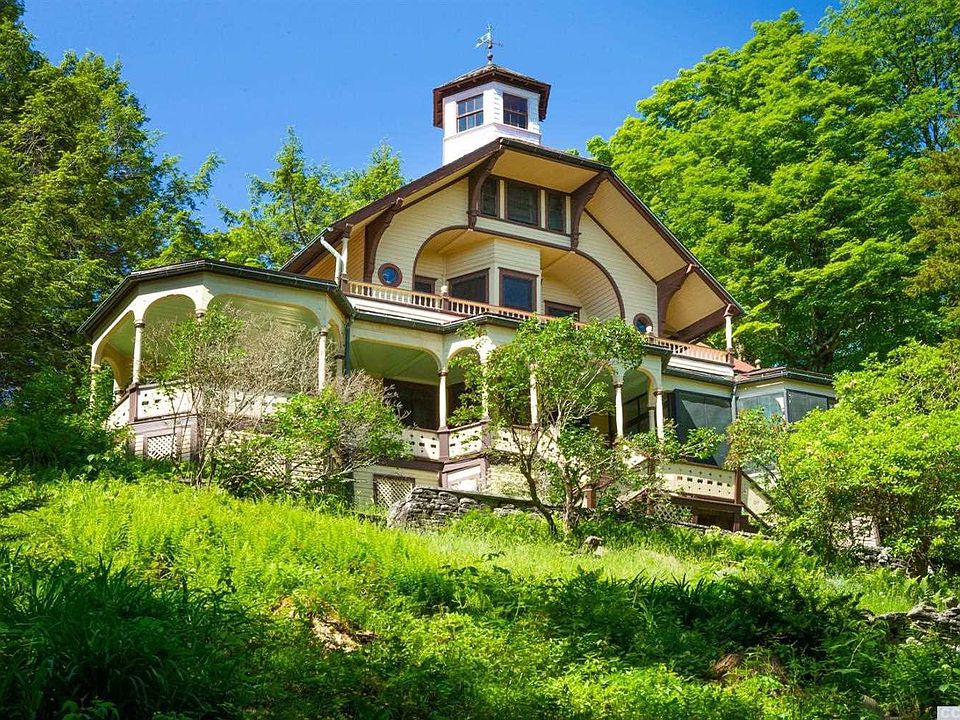
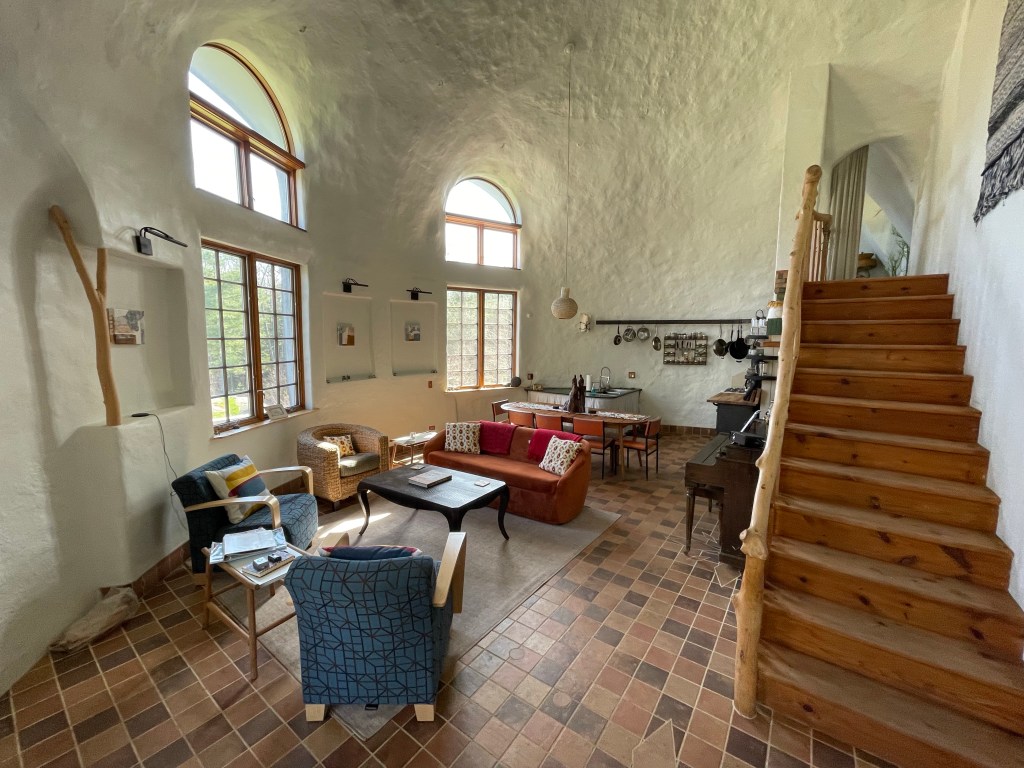
One of the most unique buildings I have ever stumbled across is located in the mountain town of Woodstock, NY. Often referred to as the Trippy Tower House, the house was built over the course of 15 years by artist John Kahn, who designed sets for the Muppets and “Fraggle Rock”. The Tower House is crafted from repurposed materials such as slate, copper, aircraft grade aluminum and redwood with the property being considered his largest “sculpture” and his life’s work. The 3,518 square foot home has three bedrooms and four bathrooms across its five floors The cylindrical house was completed in 2002 and sold five years later when Kahn moved to Easter Island. Kahn sold the house to Rhoney Gissen Stanley, who was former secretary to the Grateful Dead and wife of Owsley Stanley, the Dead’s sound man and the alleged first mass producer of LSD. It was listed for sale again in 2017 for $1.2 Million.

Tannery Brook House – Old Forge House // c.1780

One of the oldest extant buildings in Woodstock Village is the old Tannery Brook House. The building (or a part of it) was originally an old grist mill developed by Isaac Davis and it was later turned into a saw mill. Around the end of the Civil War, the structure was home to the village blacksmith operated by John Wigram Davis, then it was enlarged as a barn for wagons and carriages. Later, owner Peter Longendyke operated a boarding house from the building. Around 1904, the New York Art Students League is believed to have had their first summer art class in the upstairs rooms of the building. In 1935, owner Lamonte Simpkins remodeled it as “The Art Shop”. Upstairs Mr. Simpkins sold clothes, shoes and drygoods, while downstairs The Art Shop and Tannery Brook Garden Flourished. The building was rebranded as the Old Forge House, as a nod to its historic use. It remains a vernacular, and important piece of Woodstock’s rich history from sleepy industrial village to vibrant artist community.

Krack House // 1870

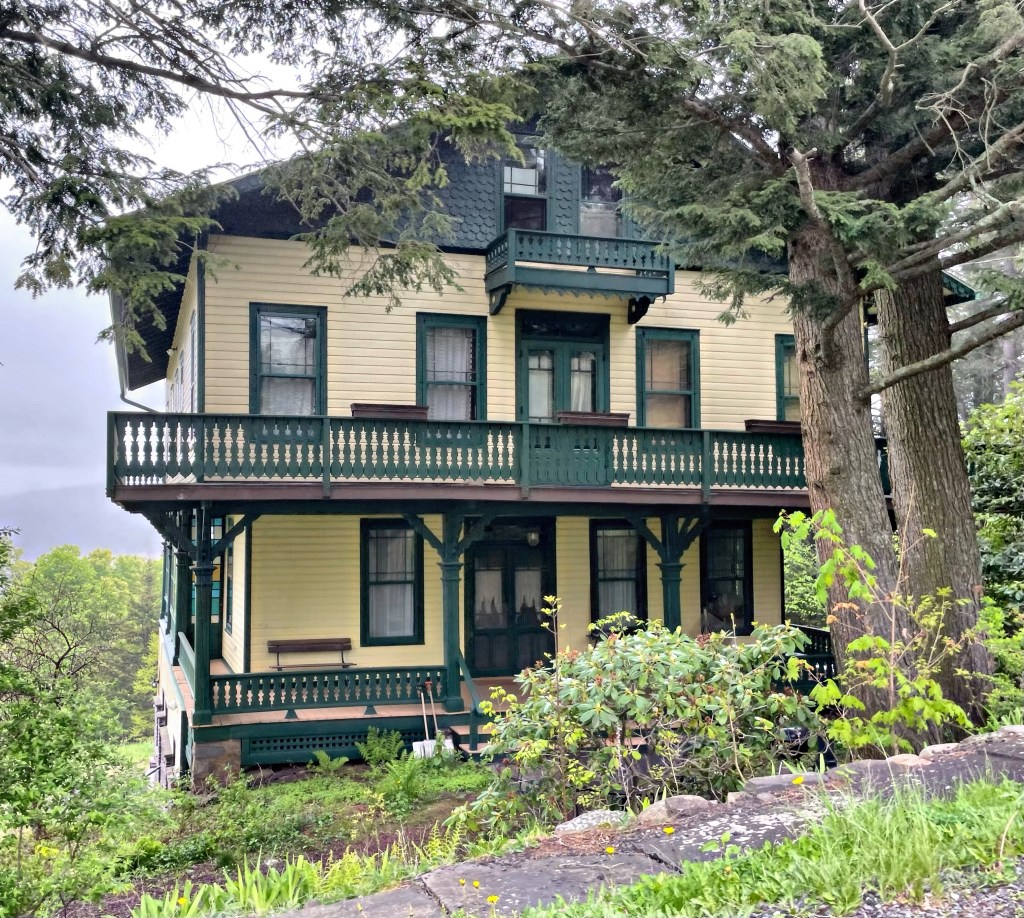
One of the largest buildings in the charming village of Woodstock, NY, is the former Krack House… I know what you are thinking, and no it was not due to illegal activity! The Krack House was developed in 1870 by Charles H. Krack (1824-1893), as a response to the success of other summer hotels built nearby as the area saw a boom in tourism. Charles Krack was born in Germany and after serving in the military there, he arrived to America in the mid-1800s. Here, he served as an overseer of a Georgia plantation, and moved to New York City after the Civil War, operating a hotel in Manhattan. He later became the owner of a floating bathhouse on New York City’s East River anchored near Grand Street, and made great money, investing it up the Hudson in Woodstock. In Ulster County, he got involved in politics. The Krack House was a summer lodging facility with food service and all the best amenities in the village. After Charles’ death in 1893, the property was eventually purchased by Stanley Brinckerhoff Longyear, who rebranded the hotel in his name, The Longyear. The building appears to now contain apartments above commercial spaces.

Pagoda Building // c.1850-1917

For the last on this series of Lost Boston buildings, I present this little-known landmark which was once neighbors to the Old State House. The Pagoda Building as it was named, was located on the corner of Washington and State Streets and was one of the tallest buildings on the street upon completion. The seven-story building of Quincy granite exhibited round arched windows and an interpretation of a belvedere at the roof which served as a penthouse. The building’s upper six stories were residential, including the spectacular Oriental penthouse at the top, with retail space at the ground floor. The architect was a recent immigrant from Britain named George Snell, who clearly made a name for himself, later entering a partnership with James R. Gregerson. The Pagoda Building, which was originally an early “skyscraper” in Boston was quickly surpassed in height and floor plate size and was deemed inadequate for such a prominent location. It was demolished by 1917.

Cragin-Frye-Savage Mill // 1858

There’s not much that is more picturesque and stereotypical New Hampshire than old, wooden mill buildings. When I was looking for a town to explore in NH, I got stuck on a photograph of the old Cragin-Frye Mill in Wilton, and off I went! Daniel Cragin (1836-1921) was born in Merrimack, NH of Scottish descent. In 1856, age 21, he rented a room in a woolen goods mill, and he built knife trays and wooden toys which he turned into a business. He started his business with ten dollars, and turned a profit from the beginning, so much so that by 1858, he accumulated enough money to purchase a nearby existing building for his own operation. The mill was water-powered and grew quickly. The Daniel Cragin Mill began production of sugar boxes and dry measure boxes. The mill closed briefly after Cragin retired in the early 20th century. In 1909, Whitney Morse Frye and his father, Dr. Edmund Bailey Frye, bought the mill from Cragin. Frye continued the Cragin line of wooden trays, boxes, and pails in addition to his normal processing of grains. Whitney Frye died in 1961, and his employee, Harland Savage Sr. purchased the old mill, continuing operations. After his retirement in 1981, his son Harley and his wife Pam Porter Savage took over operations and they have operated the mill to the present day as Frye’s Measure Mill. The mill is one of a few remaining operating water-powered measure mills in the United States!

Colony-Abbott Worsted Mill // 1882

The site along the southern bank of the Souhegan River in East Wilton, NH has been the location of successive mills since 1814. These wooden mills were wiped out by fire, and the land was vacant until 1882, when members of the mill-owning Colony family of Keene, NH bought the site for a new cotton mill. That year they built a three-story brick mill building atop a raised basement level. Colony Bros., the company, began their manufacturing in early 1883. They produced woolen flannel and other woolen goods and employed 70 workers in the factory. The building was powered by steam and water from the adjacent Souhegan River. In 1894, the Colony Bros. mill passed into the hands of Philip Amidon, who formed the Wilton Woolen Company, who produced everything from traditional woolen goods to the finest cashmere. In 1932, the struggling mill was purchased by the Abbotts, owners of two local mills and others in Massachusetts. Abbott Worsted produced a very fine finished cloth, with much of their product going to New York City where it was made into fine men’s suits. The building was later purchased in 1971 by Leonard Peterson, to house his growing company, Label Art. The company has for many years been a nationwide distributor of pressure sensitive labels. Their occupancy likely saved the buildings from the wrecking ball, like so many others did at the time!

Oh, and how cute is the 1885 office for the mill?! The date is found in the brickwork!

Proctorsville Firehouse // 1883

Industrial villages like Proctorsville in Cavendish, Vermont, have always been susceptible to fire and complete destruction. As a result, many such villages erected firehouses or barns where apparatus (and sometimes horses) would be kept in case of emergency. The Proctorsville Volunteer Fire Department was formed in 1883, and this structure was built to house the fire apparatus and possibly a small apartment or living quarters above. Today, the building appears to be home to the Fire Society.

Scott Farm – Pig Barn // 1911

Cows, horses and pigs once dominated the 571-acre landscape of Scott Farm in Dummerston, VT. We have seen where the farmer, cows, and horses lived, so now it’s time to see where the pigs “pigged” out. This barn building was constructed around the time of the horse barn when the farm was owned by Frederick Holbrook II of Boston. The one-and-a-half-story pig barn, like the others, was built into the landscape which would allow for the animals to easily get into the structures. This building was used as the “Cider House” in the 1999 movie Cider House Rules.

Scott Farm – Cow Barn // 1862

Historic barns really are the most charming buildings, and luckily, Vermont is home to soooo many great examples. The Cow Barn at Scott Farm in Dummerston, VT was built in 1862 and constructed into the slope of the land. The barn has a brick and stone foundation, barn board siding, and a roof sheathed with small dark slate. It is built into the slope of the land and has a single-story shed roof addition (c.1915) off the west facade to give the building a saltbox form, and a single story gable roof milk house addition off the east facade. The rear facade has a more rustic appearance and has a large entrance to the space inside which is occupied by The Stone Trust, with the mission to preserve and advance the art and craft of dry stone walling. The organization holds classes and trainings where people can learn how to build a traditional or modern stone wall and more! The barn (and the rest of the buildings on the Scott Farm property) is owned by the Landmark Trust USA.