First Methodist Church, Burlington // 1869

This beautifully designed Romanesque Revival church consists of a large rectangular block with a steeply pitched gable roof and a square tower surmounted by a spire. The church is constructed of Willard’s Ledge stone (a locally quarried purplish limestone) with trimmings of Isle La Motte grey sandstone from quarries north of Burlington. This church is the only Romanesque Revival style church in the city and just one of four pre-1880 churches in Burlington. Architect Alexander R. Esty (1826-1881) designed the building and was a noted New England architect working during the late nineteenth century. He was trained in Boston and opened his own office in 1850 in Framingham, Massachusetts. The congregation remains active and welcoming.

Burlington Trust Co. Building // 1891

This narrow, four-story commercial block is located near the Burlington City Hall, and fronts the park it sits on. Constructed in 1891 from local redstone in a unique Romanesque Revival style, the building stands out as one of the most unique in the commercial downtown area. The building was built for the Burlington Trust Company from plans by Clellan W. Fisher, an architect who soon after joined a firm with Stephen C. Earle in Worcester, MA. The design features an unusual checkerboard pattern of inlaid red and white ashlar paired with a stone cornice which similates dentils and brackets. The building is now home to a Burton snowboard retail store, a company started in Vermont in 1977, now the leading snowboard company in the country.

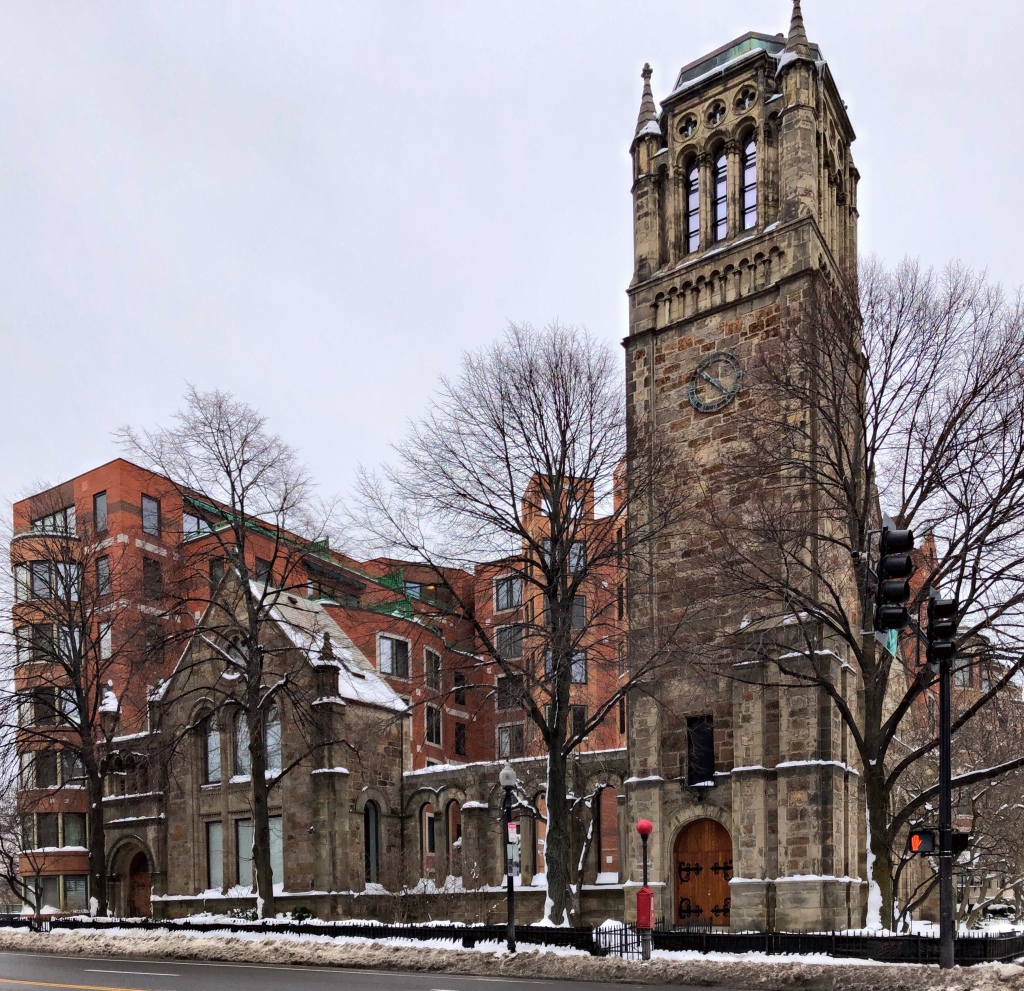
Mount Vernon Congregational Church // 1892 & 1984

The Mount Vernon Congregation Church was founded in 1842 and originally was located in Ashburton Place on Beacon Hill (which I featured previously). As its members moved to the Back Bay, the congregation decided to build a new church in the western portion of the neighborhood. They hired architect C. Howard Walker to design the new church building, with stained glass windows by John LaFarge and Louis Comfort Tiffany added as memorials to several members of the congregation over subsequent years. As originally designed, the church had a 45-foot high steeple on top of its 85-foot square tower, but over the years it became structurally unsound, and it was removed just before the Hurricane of 1938, which toppled many steeples all over the region. In 1970, the church merged with the Old South Church in the Back Bay. In 1977, developers proposed to remodel the church building into retail and office space. The proposal was approved by the Boston Redevelopment Authority in January of 1978. Before work could commence, a fire destroyed much of the church building leaving a shell of Roxbury Puddingstone walls and the tower, the developer pulled its funding and the building’s future was uncertain. One year later, architect Graham Gund purchased the building. Gund was familiar with adaptive reuse projects, like his restoration of the Middlesex County Courthouse in Cambridge for his own office in Cambridge in the 1970s. Gund redesigned the building into 43 condominium units called Church Court. What are your thoughts on the architecture?

Dexter Richards and Sons Woolen Mill // 1905

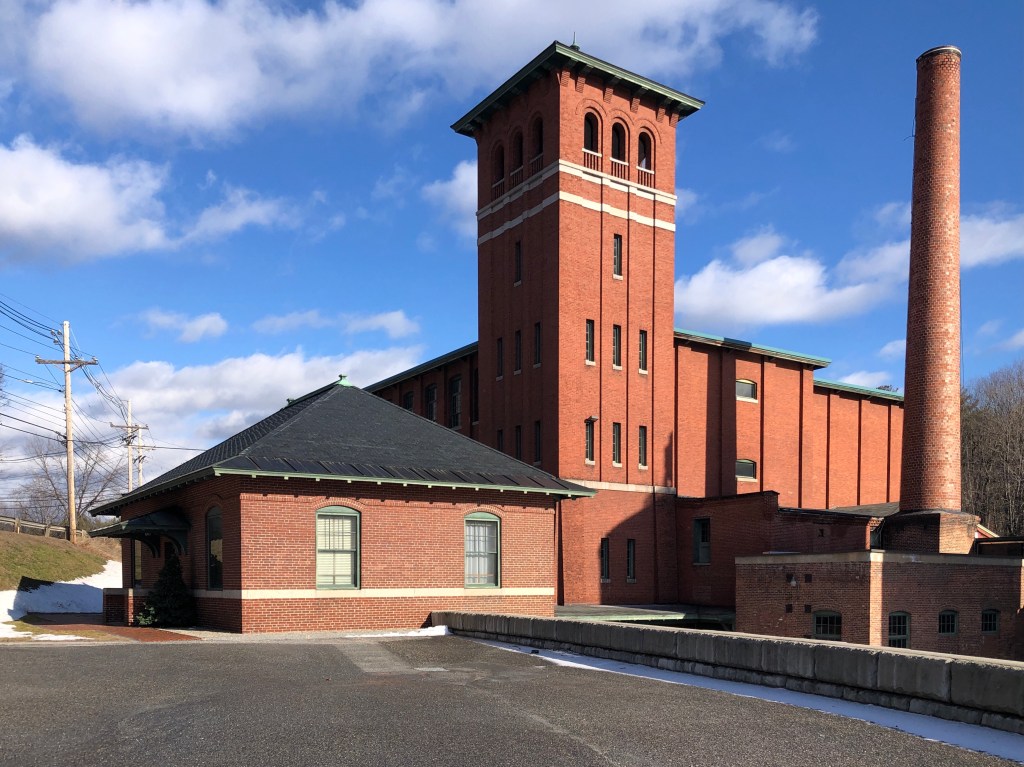
The Dexter Richards and Sons Woolen Mill is the last surviving textile mill in Newport, New Hampshire. It was one of the city’s largest and most successful industries and employers. Built in 1905 on the banks of the Sugar River – which supported industrial activity as early as 1768 – the mill reflects the evolution of water-powered mills throughout the city and the region for more than a century. Designed by Peterborough native Edward A. Buss, Richards Woolen Mill is a typical three-story brick mill building from the early 20th century with granite, brick and metal architectural flourishes; it stands out for its five-story Romanesque tower with three tall arched windows on each side. At the base of the tower, above the entrance, are two slate roundels with the dates “1848” and “1905,” marking when both a previous mill on the site and the existing mill were built. In addition to running the mill, the Richards family was instrumental in establishing the Newport Electric Company (1892) and brought both Western Union Telegraph service (1866) and the Concord & Claremont Railroad (1871) to Newport. Richards and Sons, Inc. dissolved in 1926. The property was purchased by Harry W. Brown and Associates and was renamed the Gordon Woolen Mill. That business made wool linings for Army clothing during World War II. The mill was later owned by William Ruger Jr. an heir to the Ruger Firearms Company. Within the last couple years, the mill was purchased for redevelopment into housing, which has not yet materialized.

Newport Opera House // 1886

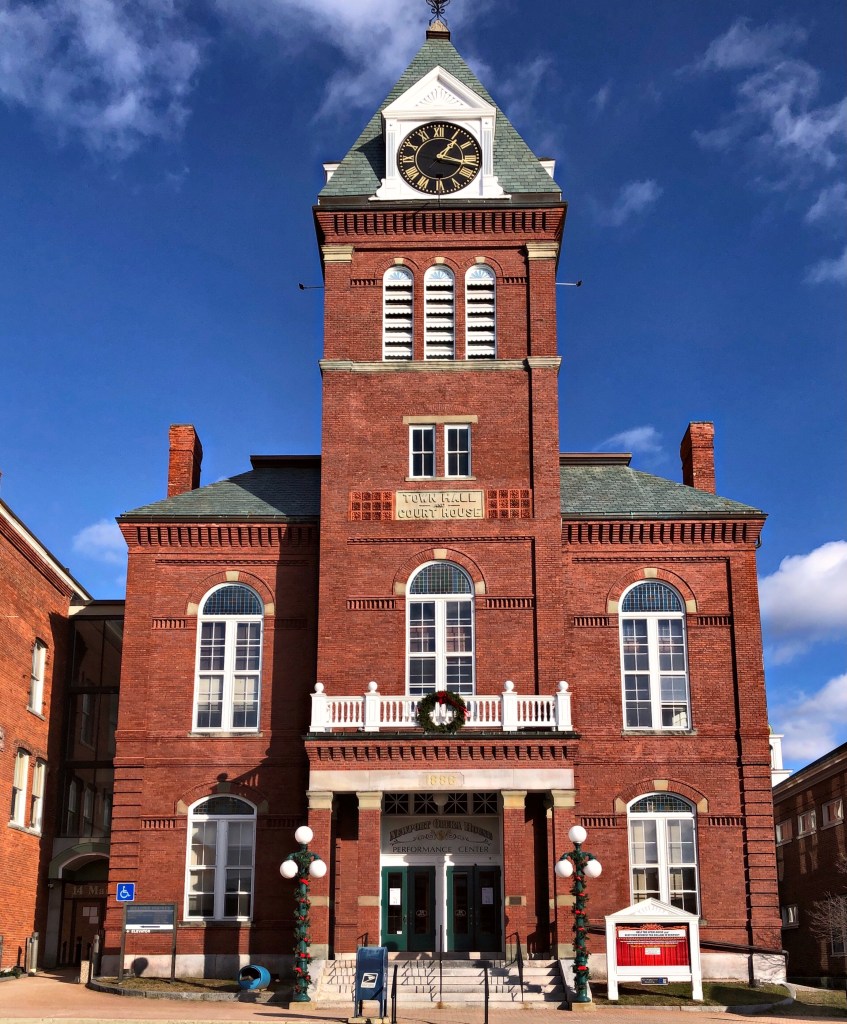
The architectural focal-point on Main Street in Newport, NH is the Newport Opera House, with its solid massing and prominent central tower. The town was growing after the American Civil War and its position as County Seat solidified that growth. A new large civic building was erected in 1872 which housed a new courthouse and town hall. A fire destroyed much of the buildings on Main Street in 1885, and destroyed the courthouse and town hall building. As a response to the loss of the building, a fire-proof structure was erected from designs by Hiram Beckwith, a regionally prominent architect from Claremont. The structure featured space for the county, town, and even an opera house! The jewel of the new building was the Opera House located on the second floor that housed a stage considered the largest north of Boston. The Newport Opera House soon became the center of entertainment in Sullivan County and patrons came from far away to enjoy the large variety of programs presented. The large hall played host to dances, boxing matches, weddings, political rallies, plays, school graduations and more! After a period of severe decline, a group of artists and residents of town worked together to restore the building and use the space as a performance center. It remains one of the finest buildings in this part of the state.

DeWolf Block // 1893

Located next door to the Lewis Block (last post) on Main Street in Newport, NH, the DeWolf Block showcases late Victorian design before the more generic 20th century main street architecture took hold. The DeWolf Block was built in 1893 by Samuel DeWolf Lewis, who also erected the Lewis Block, both named after himself. As was traditional with many business blocks, fraternal organizations occupied the upper floor of the building, and retail uses were located on the ground floor. In the case of the DeWolf Block, it was the Knights of Pythias. By the 1950’s the DeWolf Block was home to J. S. Hirsch Department Store, operated by Joshua & Sally Hirsch, until it was purchased by the Hubert family in the 1970’s. The Huberts operated a clothing store
there until the building was purchased by Sullivan County and has since housed the county offices. The DeWolf Block is a modest Romanesque Revival style building with large, round arched windows at the third story.

St. Paul’s Church, Stockbridge // 1884

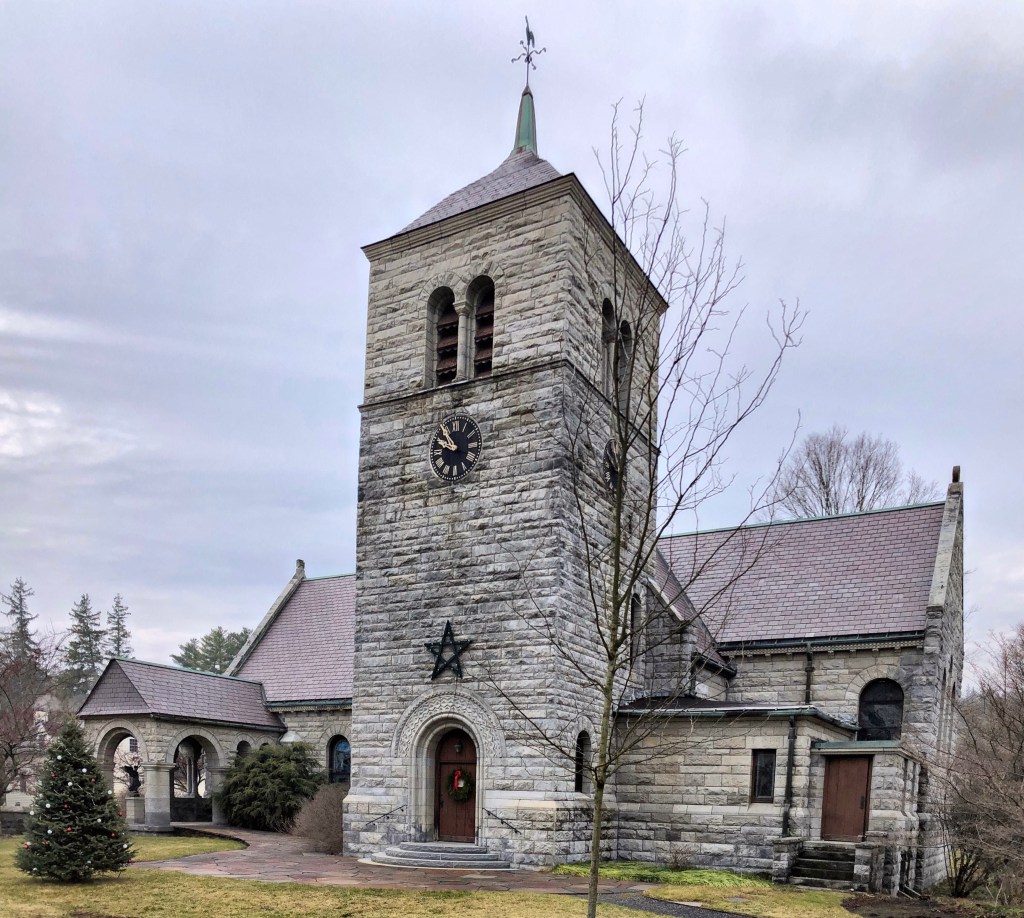
Located on the idyllic Main Street in Stockbridge, MA in the Berkshires, this stone church marks the emergence of the once sleepy town into a summer retreat for wealthy citizens, escaping the cities in the late 19th century. This building is Charles Follen McKim’s first church design, a building reflecting his early training in the office of H. H. Richardson with the use of Romanesque detailing, though with a hint of Norman design. St. Paul’s Church is constructed of gray Berkshire granite with stained glass windows by John La Farge. The church replaced an older wooden church building designed by Richard Upjohn in the Gothic Revival style. The church was almost entirely funded by Charles Butler, a New York lawyer who wanted to honor his late wife Susan Ridley Sedgwick Butler, a descendant of Theodore Sedgwick, whose home I featured not long ago.

Pequot Library // 1894

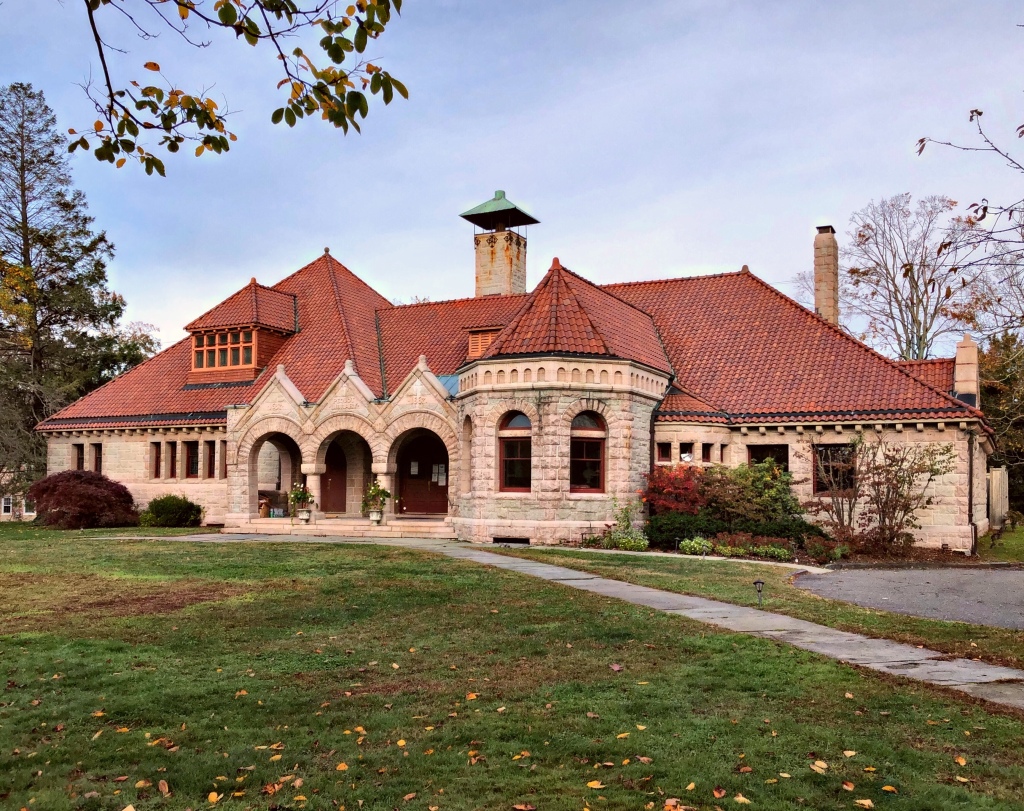
The Pequot Library in Southport, Connecticut was founded in 1889 by Virginia Marquand Monroe and her husband Elbert B. Monroe. The library, designed by noted New York City architect Robert H. Robertson, opened to the public in March 1894. The building is Romanesque Revival in style in a granite sandstone construction. There is an expansive roof area topped with red tile and hipped dormers; an arcaded entrance porch with three arched openings serves as the focal point of the front facade. It was Mrs. Monroe’s intention that Pequot be as “free as air to all”, which it remains as to this day.

First Church Congregational of Fairfield // 1892

The First Church Congregational in Fairfield, Connecticut is the sixth church to occupy this site! The first structure was built in 1640, and the current building was constructed in 1892. The third version of the church was burned by the British in 1779, while the fourth “meeting house” took nearly 42 years to finish and was partially funded by the sales of properties which formerly belonged to Tory sympathizers. The Romanesque Revival church was designed by architect J. Cleaveland Cady, who is best known for his design of the south entrance of the American Museum of Natural History on the Upper West Side of Manhattan.

First Church of Christ, Suffield // 1869

Located adjacent to the Town Common, the First Church of Christ in Suffield showcases the grandiose architecture seen in many churches after the Civil War in New England. This brick edifice is the fifth in the history of the church which dates back to around 1680. The church was designed by local architect John C. Mead, who designed many churches in the region. The church is a blending of Italianate and Romanesque Revival styles and originally featured a tall spire and secondary tower. In 1938, the New England Hurricane destroyed the tall spire (a similar event occurred to many New England Churches, including Old North in Boston). Even without the steeple, the church remains as a great architectural treasure in town.