“Good Cheer Estate” // c.1820

Originally built as a Federal period farmhouse, this gorgeous estate is the epitome of what happened to Ridgefield… city money! By the end of the 19th century, wealthy New Yorkers were flocking to small towns every summer for clean air, rest, and relaxation. Ridgefield, Connecticut became an obvious option for its close proximity to New York and bucolic setting of farmlands bounded by old stone and rolling hills. As a result, wealthy summer residents purchased older estates and either demolished or renovated the homes there. Aaron Lockwood Northrop was raised in Ridgefield and was educated in its private schools before moving to New York as a young man, being awarded an apprenticeship as a dentist. Dr. Northrop went on to establish a prominent dental practice and would serve as President of the American Dental Association. As a wealthy adult, he acquired a circa 1820 house on this lot and renovated it, doubling its size and giving the residence its current Victorian flair. The summer house was affectionately named “Good Cheer”. Aaron died unexpectedly in 1908 while overseas in Paris, France. His widow, Caroline, resided at Good Cheer until her own death in 1927.

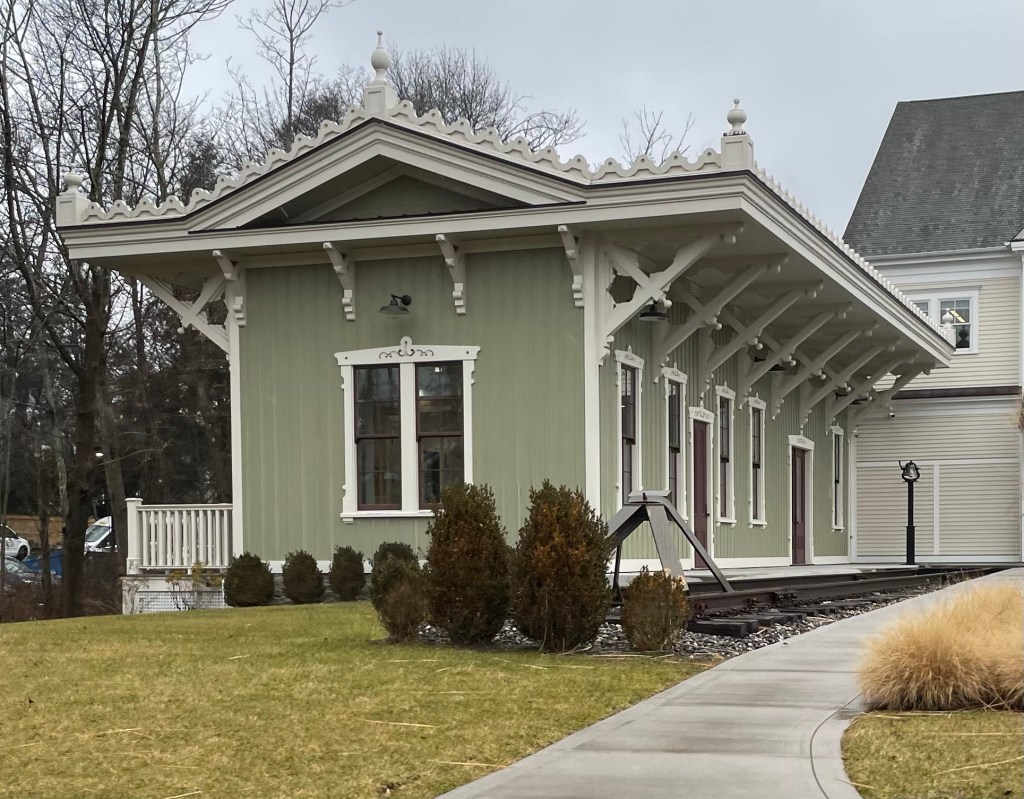
Ridgefield Train Depot // 1870

In 1870, the Ridgefield Branch branch line of the Danbury and Norwalk Railroad and later the New York, New Haven and Hartford Railroad was built connecting the sleepy village of Ridgefield to Branchville train station via the main line. The line was an early risk, built to offer service to the wealthy New Yorkers who began arriving to spend their summers in Ridgefield. Many of these “summer people” had their own private railroad cars, with chauffeurs meeting them as they arrived, driving horse and buggies to bring them and their luggage to their estates located throughout the town. As travel shifted to personal automobile, ridership dropped in the early 20th century, and the branch was replaced by bus service in 1925. Freight service was scarce, and lasted longer, to 1964. The depot was sold to the Ridgefield Supply Company, who used the 1870 building as storage for decades until it was disassembled, moved and rebuilt by the Ridgefield Supply Company in 2015, as part of their expansion. The historic station today provides an important link to Ridgefield’s past.

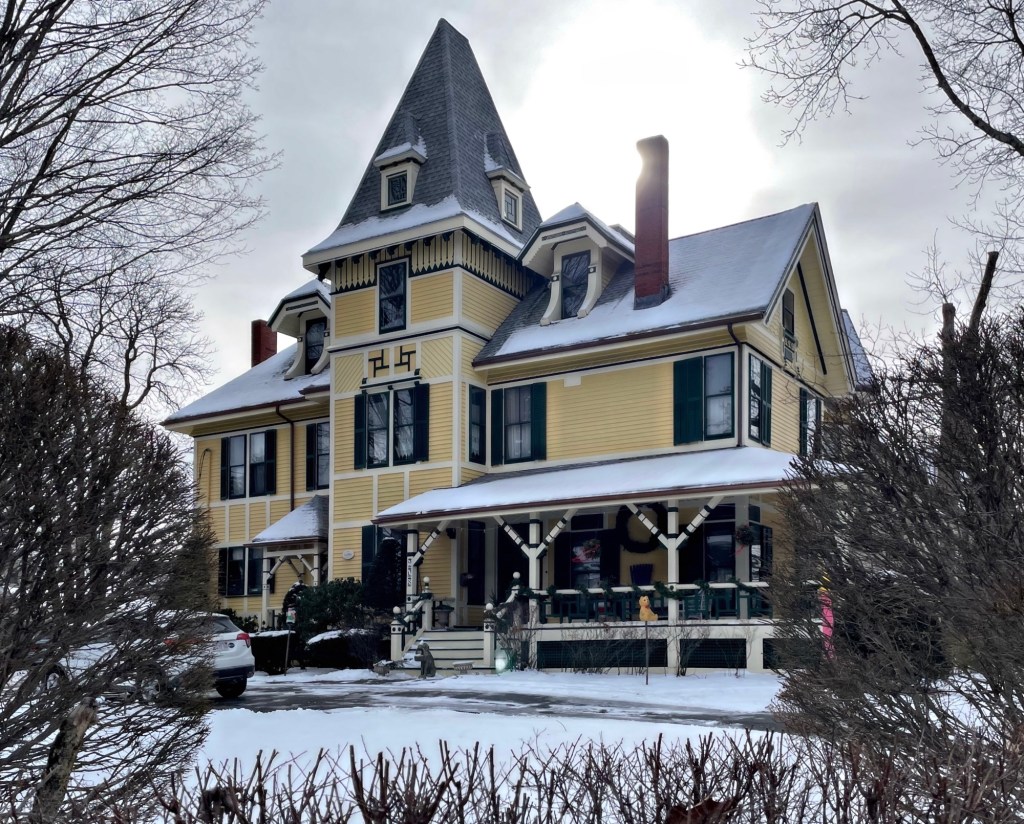
Leatherbee House // c.1870

Andrew F. Leatherbee (1842-1920), a wealthy lumber dealer in Boston, built this large Stick style victorian house in Newton Center around 1870, likely using his own lumber products! The large frame house is prominently sited on a corner lot on Beacon Street, a short walk to Crystal Lake, a natural pond in the center of town. I could not find information as to who the architect was, but it was likely a notable local firm. As Andrew got older, he downsized and relocated to a smaller apartment in Cambridge. Upon his death in 1920, the property was sold by his heirs to Mae Van Dusen. The house is a high-style example of the Stick style of architecture, with large half-timbers, heavy porch bracing, and a central tower with pyramidal roof. Swoon!!!

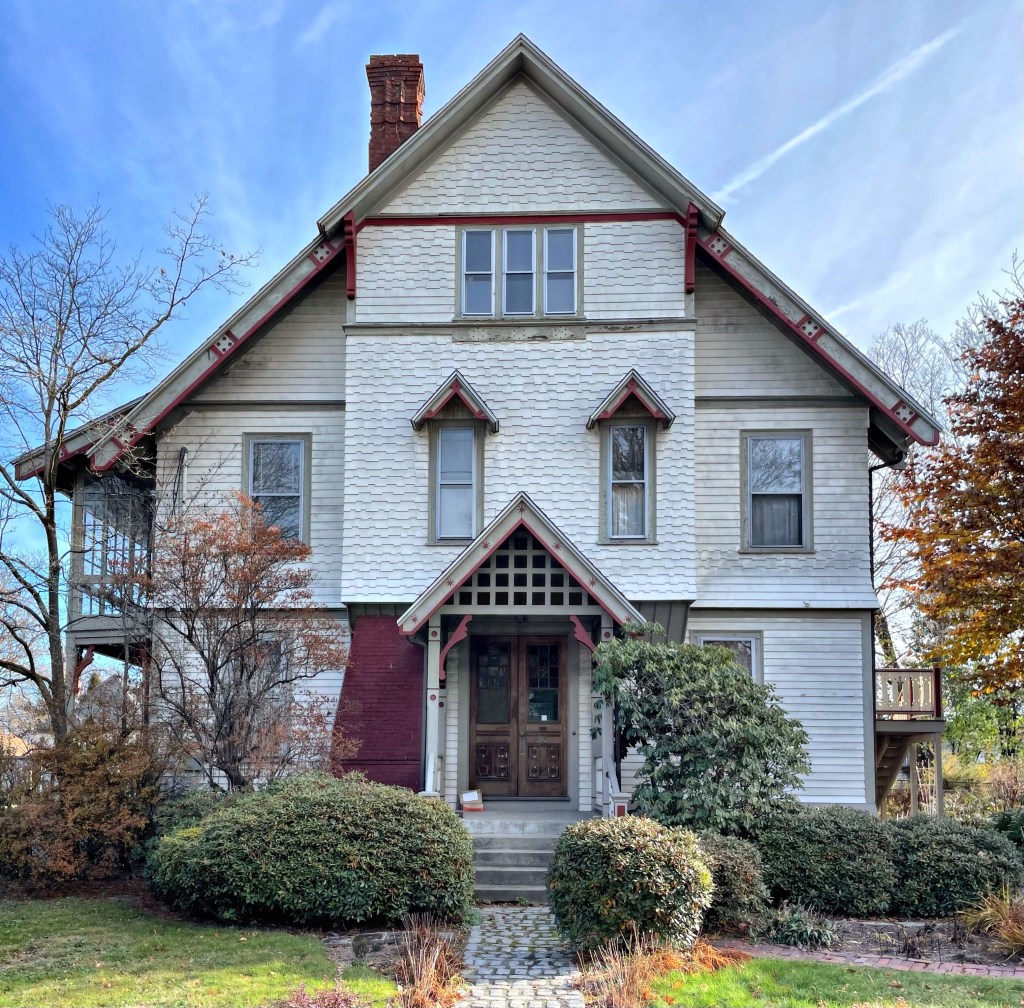
Wales House // 1883

Built in 1883 for a member of the Thomas Wales family, this house in Clam Point, Dorchester, possesses a compact essentially rectangular clapboard and wood shingle-clad form. The architect, John A. Fox, designed the main façade elegantly with an open Stick style porch projecting from the center of the first floor which is enclosed by a steeply-pitched roof. The pitch of the porch roof is echoed in the small and shallow gable-like lintels which are really unique to the area. The treatment makes the facade read somewhat like a face.

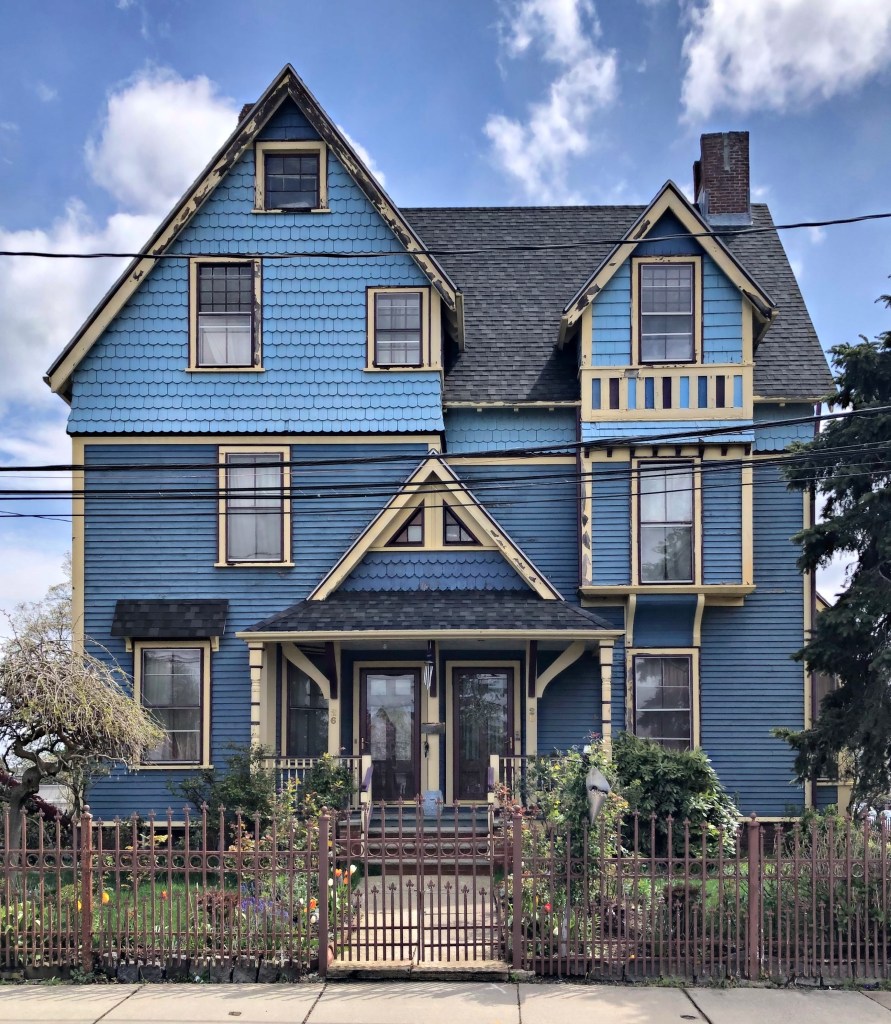
Hersey-Noyes Double House // 1879

Nothing beats a good Victorian-era house! This example in the Clam Point neighborhood of Dorchester does not disappoint. The Stick-style double-house was built for miss Mary E. Noyes and Ms. Hersey replacing an older house on the lot. The women hired architect John A. Fox to design the house which possesses one of the most complex forms and roof configurations in the neighborhood. Clad with clapboards at the first and second stories, its six intersecting gables are sheathed with scalloped shingles. At the main entrance on the façade is an open porch with square posts and railings with turned balusters. The side façade is even more complex with two side gables and a two-tier porch enlivened by Chinese Chippendale and spool work railings. The Herseys, along with Mary E. Noyes, co-owned the house until 1884; thereafter it was owned by Mary E. Noyes until around World War I. The stick style home really pops with that blue color, what do you think?

Charles Gilman House // 1871

Southport, the coastal village in Fairfield, Connecticut is an old house lover’s dream! Case-in-point, the Charles Gilman House. Charles Gilman, a Bridgeport lawyer, constructed this house on the ridge parallel to Main Street in Southport between 1871-1874. The building is a fine example of the Stick style of architecture, in which the decoration on facades and gable ends reflects the building’s internal structure. Gilman used the services of two New York architects, J. Cleaveland Cady and William H. Beers, to design the house and the later (1900) library addition, respectively. In the 20th century, the house was owned by Richard Joyce Smith, an attorney who was hired to guide the New Haven Railroad through a long and tricky bankruptcy reorganization ending it it being acquired by the Penn Central in 1975.

George Carpenter House // 1885

While many lots in Brookline village in the final decades of the 19th century were being redeveloped as duplexes, three-deckers, and apartment houses, some property owners still wanted single-family living. In 1885, George Carpenter had this home in the village built from plans by well-known architect Obed F. Smith, who designed many Victorian-era homes in Boston’s Back Bay and around the region. George Carpenter worked in Downtown Boston as an agent for the Massachusetts Mutual Life Insurance Company. The house features some Stick style elements seen in the porch spindles and carved brackets.

Franklin Street Fire Station // 1886

When your town grows organically without zoning, fire prevention becomes even more important to the preservation and protection of the town. Before paid firemen worked for the town, volunteers would either be stationed or rush to the aid of those in trouble via these neighborhood stations. The Franklin Street Firehouse in Marblehead, Massachusetts, was constructed in 1886 by local contractors Ramsdell Brothers replacing the former on the same site with plans drawn by Nathan P. Sanborn. The station was built to house a horse-drawn handtub and the horses were stabled nearby. The wood-frame structure blends Second Empire and Stick style detailing elegantly and is one of my favorite old buildings in Marblehead.

Charles Copeland House // c.1875

Spot Pond, now encompassed by the Middlesex Fells Reservation, became a site of country retreats for Boston businessmen in the mid-late 19th century. One of the property owners was Charles Copeland, a confectioner and ice cream dealer, had ice houses on Spot Pond where he harvested ice for production into ice cream in Boston area shops. Copeland’s main house was located near the ice houses at the eastern shores of the pond, but this home was also owned by him in the 1870s. This residence was possibly rented out by Copeland or occupied by one of his many children. It remains a great example of the Stick and Shingle styles of architecture. The residence is maintained as part of the Massachusetts Department of Conservation and Recreation’s property in the Fells Reservation park.

St. John the Evangelist Church // 1885

One of the most bucolic and beautiful buildings I have ever seen is this church in the Catskills, just outside of Elka Park, NY. Wow I wish New England could claim this one! The St. John the Evangelist Chapel was developed as part of a smaller enclave of summer cottages for rusticators from the Philadelphia-area, which was largely established by Mr. Alexander Hemsley (1834-1904) a chemist from Philadelphia who would later die from anaccidental chemical explosion at his factory. In 1883, Hemsley sold cottage lots to friends and family to erect summer houses in the Catskills and in 1884, decided to develop a lot for an Episcopal summer chapel. In that same year, Hemsley hired his future son-in-law, William Halsey Wood, to design the chapel. The Stick-style Victorian chapel blends the rustic use of natural materials found on the property with an elegant siting and attention to detail, not typically found in rural chapels. The native stone and stylized half-timbering really stood out to me. The church is used still in the summer with regular services on Sundays in July and August.