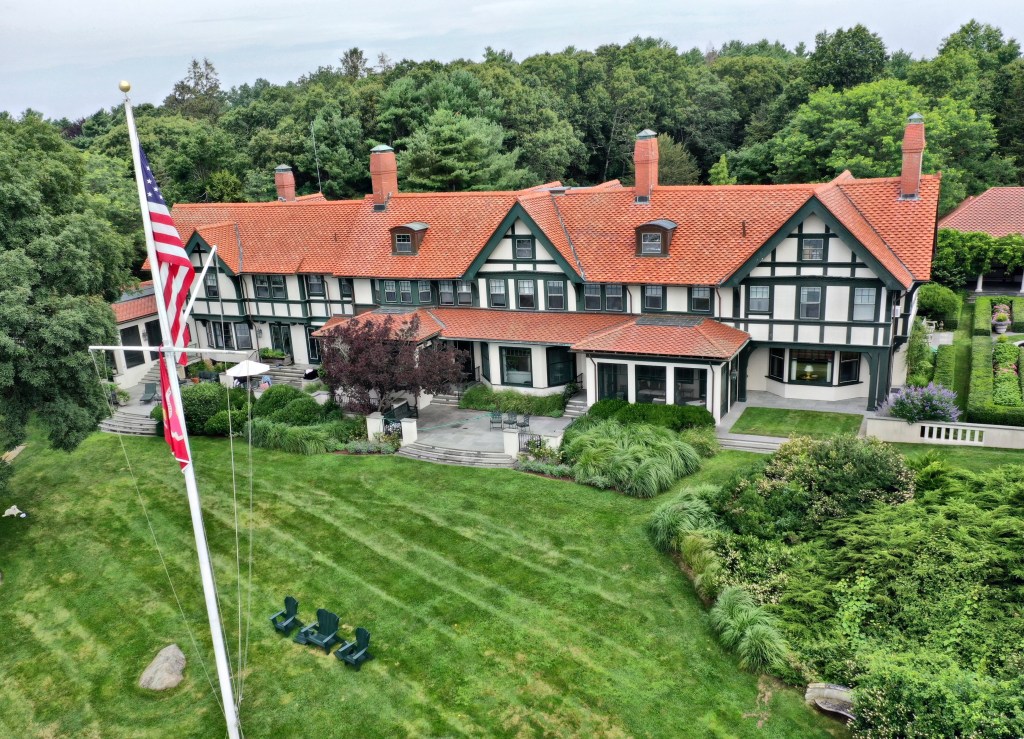
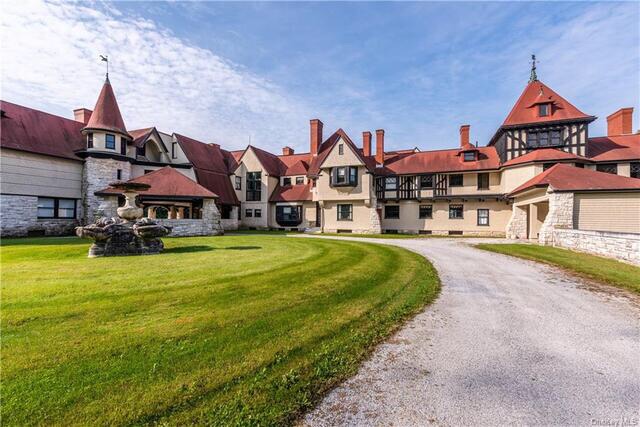
One of the most grand Summer estates on the coast in Marion, MA, is “Fair Oaks”, a 1903 Tudor Revival mansion across the Sippican Harbor from the village. Horace B. Shepard was the president of the Shepard and Morse Lumber Company, which was headquartered in Downtown Boston. The company was a wholesale dealer in all kinds of lumber including: white pine, spruce, hemlock, North Carolina pine, yellow pine, poplar, and various oaks. Given Shepard’s line of work he not surprisingly called his summer estate “Fair Oaks”, and his house’s building materials were undoubtedly supplied by his company. He appears to have hired Charles Allerton Coolidge, who lived nearby in his own summer cottage (featured previously) to design the Tudor mansion. The “cottage” is almost 13,000 sq.ft. and has 11 bedrooms, 9.5 bathrooms. Wow!
The last stop we will see at the stunning Seaside Sanatorium campus in Waterford, Connecticut is the former Superintendent’s Residence. Built in 1936, the home is elegantly sited at the waterfront, which would have provided amazing views for the man in charge of running Seaside, the Tuberculosis hospital for children here. Like the Maher Building, Nurse’s Residence, and Duplex Residence previously featured, this building was designed in the Tudor Revival style and is also credited as a work of architect Cass Gilbert. The Superintendent’s Residence is interesting as it has two completely different facades. The campus-facing facade features an L-shape with a garage wing and projecting entry pavilion in stone. Above, a diamond-pane window would allow natural light into what may be the stairhall. At the waterfront, a large open porch (since boarded up) and large windows at the first floor, would provide natural light and air into the building, along with amazing views of Long Island Sound. Additionally, a catslide roof extends from the rightmost bay and covers a recessed porch with basketweave brickwork above. I would for sure live here, could you?
Another of the handful of original structures extant on the Seaside Sanatorium campus in Waterford, Connecticut, is this gorgeous Tudor Revival style duplex constructed for medical staff housing. Like the Main Building and Nurse’s Residence, this duplex is credited as a design by the great Cass Gilbert. While the building was constructed after Gilbert’s death in 1934, the plans were likely all drawn up at the time the Maher (main) building was in 1933. The duplex residences feature a symmetrical facade with two main entranceways, located in slightly projecting pavilions, and are set within basket-arched openings, detailed with alternating brick and granite voussoirs. There are three-part windows above the doors which project from the wall plane and have cross-braced faux balustrades of wood below. Identical sun porches are recessed at either end of the house. The small associated garage to the immediate northeast has a simple design, but one that reflects the style of the houses. Like the other buildings on the campus, this structure is vacant and is slowly rotting away. So sad to see.
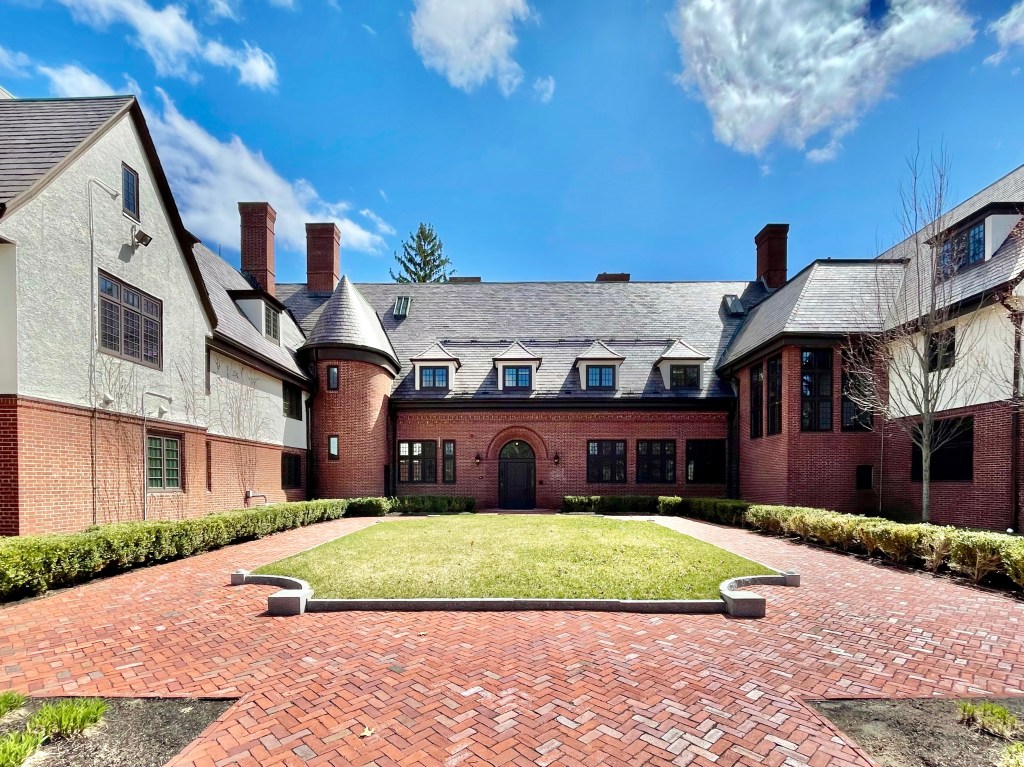
Next to the Maher Building at Seaside Sanatorium, the Nurse’s Residence building (1935) sits in the same sad state but retains a lot of its architectural character and charm. The Nurse’s Residence was built for… you guessed it, housing for the nurses who worked at the Seaside Sanatorium and treated the young children with Tuberculosis. Like the main building, this structure was designed by famed architect Cass Gilbert in the Tudor Revival style. In designing the buildings, Gilbert met the requirements of the sanatorium to have a self-contained hospital for the children and a large separate dormitory for the nursing staff, but adapted an essentially domestic architectural style to de-institutionalize their appearance through the use of applied, decorative detail and an extraordinary wealth of materials. The Nurse’s Residence is constructed of brick and is capped with a polychrome slate roof which is lined by 15 dormers on each slope, alternating in size. The end gables, which are similar to those of the main building and in surprisingly decent condition given the circumstances, are covered with decorative tile and add a punch of architectural intrigue. Oh too see these buildings restored one day…
One of the most entrancing and clearly haunted places in Connecticut is the Seaside Sanatorium on the coast of Waterford, CT. It’s founding dates back to the early 1900s, when tuberculosis killed 252 of every 100,000 people living in the state, making it the leading killer in the state early in the century. When Connecticut Tuberculosis Commission members, including Chairman Dr. Stephen J. Maher, a New Haven physician, began hearing of success in Europe with exposure not only to ocean air, but to strong sunlight, they began pushing for a new location in Connecticut to treat children with tuberculosis. The first Seaside was established in Niantic in 1918, which was outgrown, and a newer, modern facility on the coast was needed. The State found a site on the coast of Waterford and hired world-renowned architect Cass Gilbert to design the complex in the Tudor Revival style, a departure from the Colonial or Classic Revival styles favored at the time for such projects. When the facility opened, children would spend as much time as possible exposed to the sun’s rays as part of their treatment here. They played sports, took lessons, ate, read, and played music outside year-round, either on the beach, the lawns, or the three levels of south-facing porches. By the early to mid-1950s, tuberculosis became curable with antibiotics that required limited bed rest and could be given in a regular hospital setting. After its use as a TB facility ceased, the state re-opened Seaside as a hospital for people with mental illness, which too closed in the 1990s. The massive campus has sat vacant since, rotting away as a State Park. Apparently the State has been looking for a developer to revitalize the campus as a hotel or other use, but sadly, nothing has materialized.
Born into the heart of Boston Brahmin society (Boston’s elite class), Robert Gould Shaw II (1872-1930) had a life of great opportunity, but full of tragedy. Robert was born in Boston and was a first cousin of Robert Gould Shaw, the famed military officer who accepted command of the first all-Black regiment (the 54th Massachusetts) in the Northeast. Robert II had a life of leisure, and enjoyed his position in society by drinking and enjoying elite sporting events. He became a wealthy landowner around Boston, and international polo player of the Myopia Hunt Club in the North Shore. He gained a reputation for alcohol abuse and promiscuity and divorced his first wife after just four years, she would later move to England and marry Waldorf Astor, and become the first woman seated as a Member of Parliament. The couple’s only son Robert Gould Shaw III followed his mother to England, but was eventually imprisoned there for six months for “homosexual offenses”. His alcoholism and his mother’s death, may have led to his suicide in 1970. Robert Gould II in Boston, remarried and purchased land in Oak Hill, Newton to build a country estate. He hired James Lovell Little Jr. to design the Tudor style property with a mansion, and various outbuildings including a carriage house and stable. As the Gilded Age gave way to the Progressive Era and eventually the Great Depression, the Shaw fortune collapsed. Shaw died in New York in 1930. The estate was later purchased as the new home to Mt. Ida College, now a regional campus of UMass.
As another piece of this interesting family’s history… Louis Agassiz Shaw II, one of Robert’s four children in his second marriage, had all the opportunities of his father, as he attended Harvard, had a sizable bank account, but was a recluse and had some mental issues and paranoia. Like his elder half-brother Robert Gould Shaw III, and father, Louis struggled with depression and alcoholism and in 1964, he strangled his 64-year-old maid, who he said was plotting to murder him in his sleep. He confessed but plead not guilty; he was committed to Danvers State Hospital and later McLean, where he lived for 23 years until his death. After which, much of his art collection, which he intended to donate to the Fogg Museum at Harvard, was discovered to be fakes.
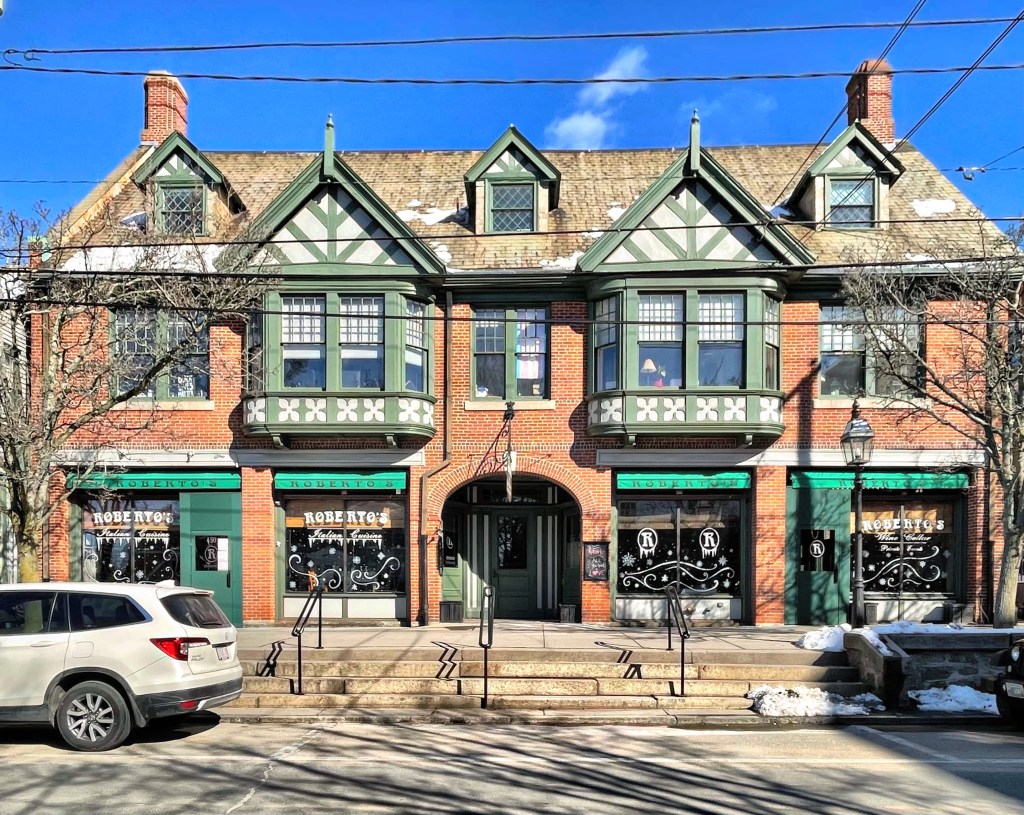
In 1899, the Bristol Young Men’s Christian Association (YMCA) selected architect Wallis E. Howe to design this five-bay, gable-roof, Tudor Revival building as its headquarters. Architect Howe created a rich effect with red brick and white mortar in combination with Tudor half-timbers in green, and buff-colored stucco. The building is a rare example of the Tudor style in Bristol, but is one of the most successful in the state (in my opinion), due to its strong presence and massing working with the use of materials and colors. The large central archway led upstairs to a library and gymnasium for use by YMCA members, while the ground floor featured four small businesses. In 1967, a new entrance and lobby, was constructed, linking the original YMCA to the since abandoned Bristol Customs House and Post Office.
Before the Kennedy compound on Cape Cod where the political Kennedy Family summered, there was this house in Hull, now known as the ‘Honey Fitz’ summer house; named after John F. Kennedy’s maternal grandfather, John F. Fitzgerald, who owned the property. Fitz, the former mayor of Boston, would holiday at this home in the summer months with his wife Mary and six children Frederick, John Jr, Eunice, Thomas, Mary and Rose, who would go on to marry Joseph Kennedy and raise the political dynasty; The Kennedys. After Rose’s marriage to Joe Kennedy, she would return to the home with her children in the summer months, including the future president John Fitzgerald Kennedy. Rose Kennedy’s family often rented a smaller cottage on the peninsula for their family, but would always visit the big house for family dinners. Joseph Kennedy, who soon ended up being extremely wealthy, later bought a summer house in Hyannis, and the rest is history. This early Tudor mansion, with its stately proportions, stands out amongst the shingled cottages in Hull, fitting for the Kennedy dynasty.
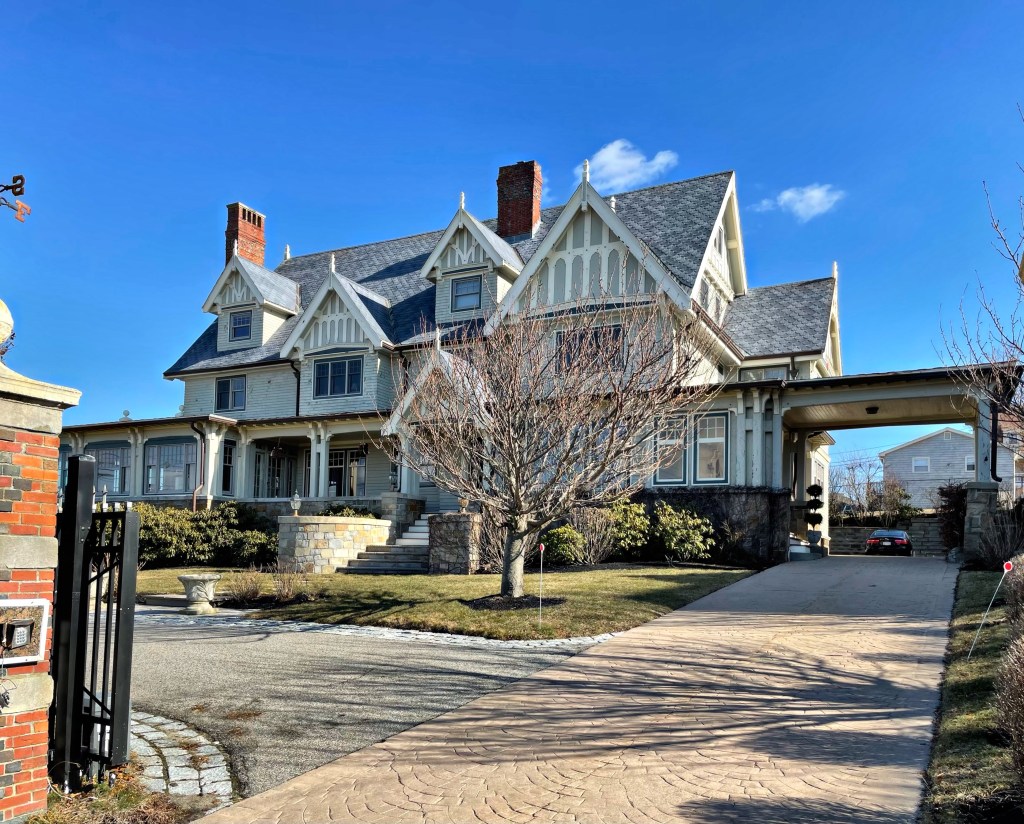
At 55,000 square feet and 106 rooms, the Elm Court mansion retains the title of the largest American Shingle Style home in the United States. The structure was built for William Douglas Sloane and Emily Thorn Vanderbilt (granddaughter of Cornelius Vanderbilt) as their summer “cottage” in the Berkshires. The home straddles the towns of Stockbridge and Lenox and sits on a massive parcel of land, giving the owners space to breathe the clean countryside air. Emily’s brother, George, built The Biltmore in Asheville, North Carolina and her sister, Eliza (Lila), constructed Shelburne Farms in Shelburne, Vermont. The home was constructed in 1886 from plans by the great Peabody & Stearns architects. Shortly after the turn of the century, ca. 1901, the couple commissioned Peabody and Stearns again, to vastly enlarge their original house. The additions used both Shingle Style and Tudor Revival motifs, and the result is a structure highly reminiscent of an English country house. William Sloane died in 1915, and Emily Vanderbilt continued to use the summer cottage, and in 1921, she married a summertime neighbor, Henry White, a career diplomat. While Henry White died in 1927, Emily retained the house and kept the grounds running until her death in 1946. The property’s use evolved into an inn in the late 1940s. During the 1950s, it embraced the public for dinners, overnight accommodations and events. Eventually Elm Court’s doors closed, and for approximately 50 years the mansion succumbed to significant theft and vandalism. The property has been listed for sale numerous times in the past decades, after a renovation by the last owners in the Sloane family. It is now listed for $12,500,000!
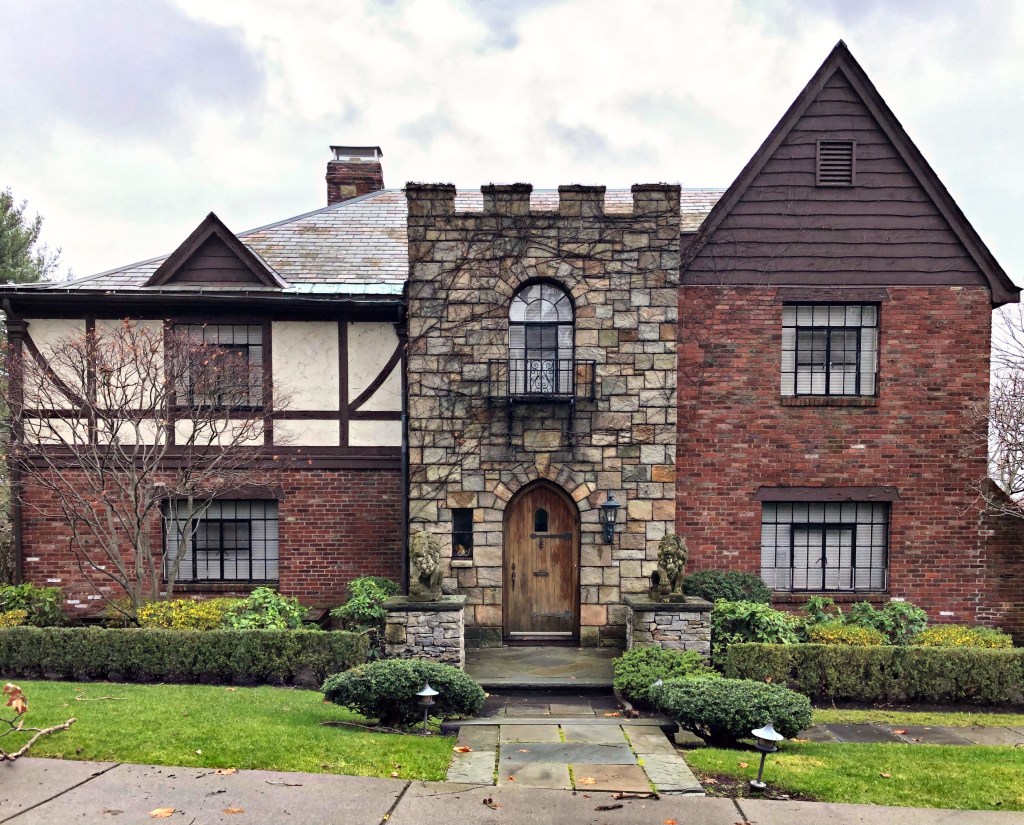
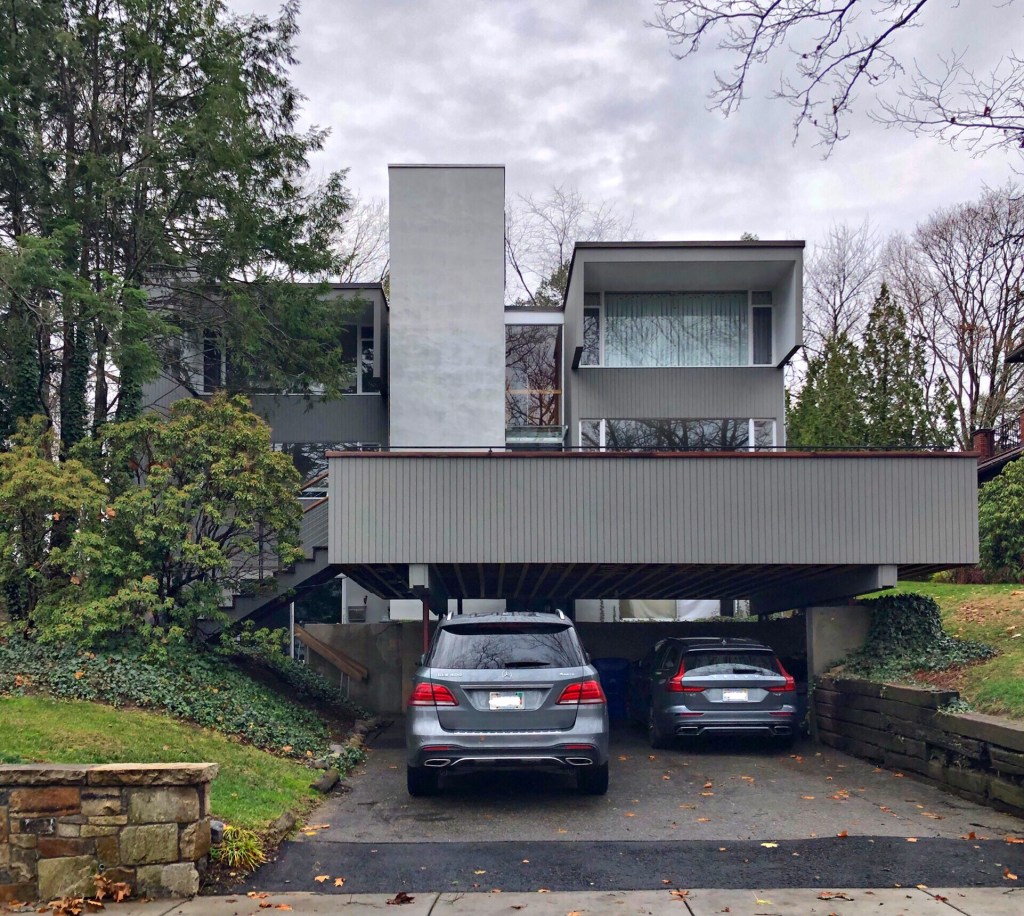
Located across the street from each other in Brookline, the Pastan Houses are an excellent example of how architectural tastes can change from one generation to another. The William Pastan House was constructed in 1936, and is Tudor Revival in style. The home has a projecting square entry tower with castellated roofline and interesting mixture of materials and textures. The first owner, William Pastan raised his family in the home, attending the synagogue a couple blocks away. By 1963, Pastan’s son, Harvey became a successful engineer and built a home near his parents for his own family, though in a very different aesthetic. The Modern home features boxy forms, prominent covered parking spaces, and expanses of glass.
Which house would you prefer, William’s (1936) or Harvey’s (1963)?


 Buildings of New England