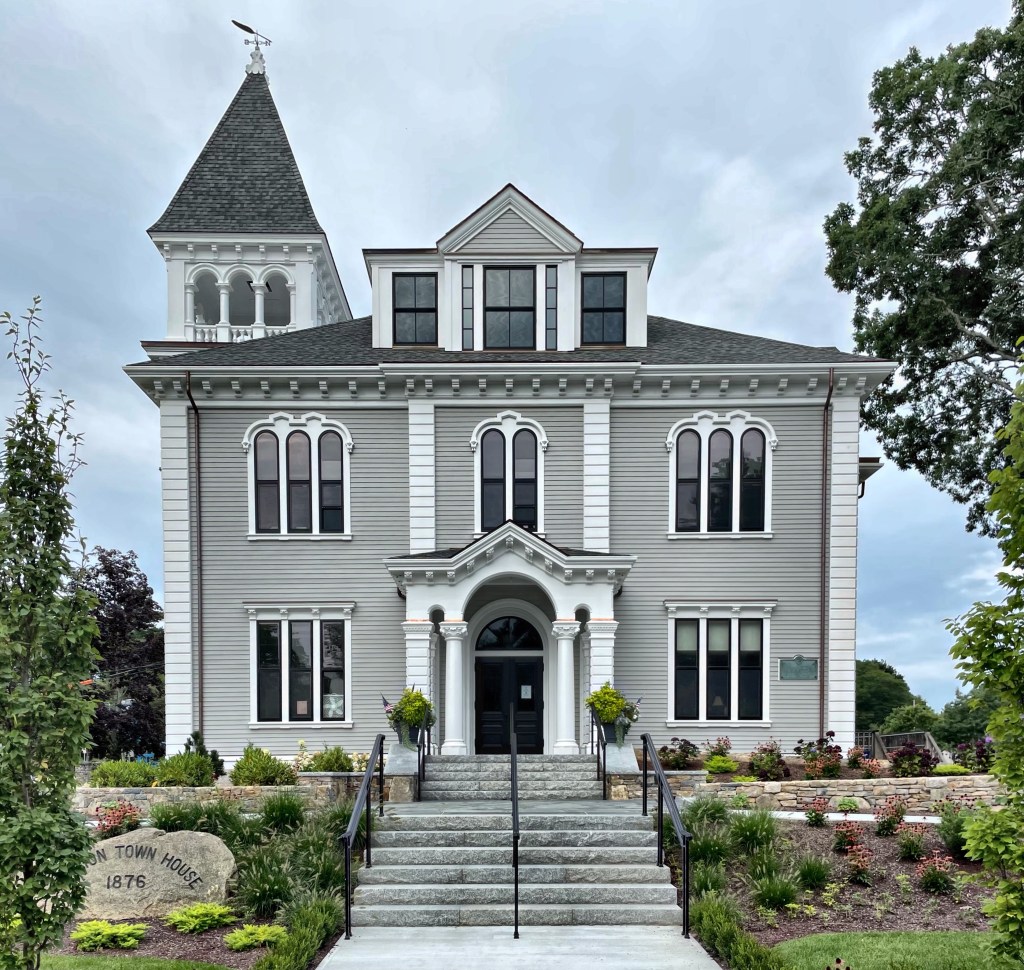
Marion Town Hall // 1876

Welcome to Marion, Massachusetts! Colonized in 1679 as “Sippican”, the town was once a district of adjacent Rochester, Massachusetts. The name, which also lends itself to the river which passes through the north of town and the harbor at the heart of town, was the Wampanoag name for the local tribe that once utilized these lands. Native settlements in present-day Marion dates as far back as 3000 B.C. as the local people were members of the Wampanoag tribe who, when the Pilgrims came, lived in a number of villages in Southeastern Massachusetts under the leadership of the great chief Massasoit. By the 19th century, the town was mostly known for its many local sea captains and sailors whose homes were in town. Today, the coastal town is known for its charming village and large waterfront homes, oh and amazing architecture!

This building was constructed in 1876 by Mrs. Elizabeth Taber (1791-1888), who, at the age of 85, founded Tabor Academy in town. She named it after Mount Tabor in Palestine rather than after herself. The school was built towards the end of the “Age of the Academies”, when in 1852, Massachusetts became the first state in the country to make education compulsory. While some major private institutions already existed, many more were founded in the mid-19th century. Tabor Academy served as a private school for boys and girls over 12 years of age, and was to remain free for local students. With the rise of public schools in the state, many academies began to struggle with admitting students, especially those that had parents willing to pay additional money for enrollment. The school struggled around the Great Depression and thus, traded buildings with the Town of Marion in the 1930s and this building became the Marion Town Hall, a use it retains to this day. The building itself is a stunning Italianate design constructed from plans by Boston architect William Gibbons Preston.

Stay tuned for more buildings and history on one of my favorite Massachusetts towns!
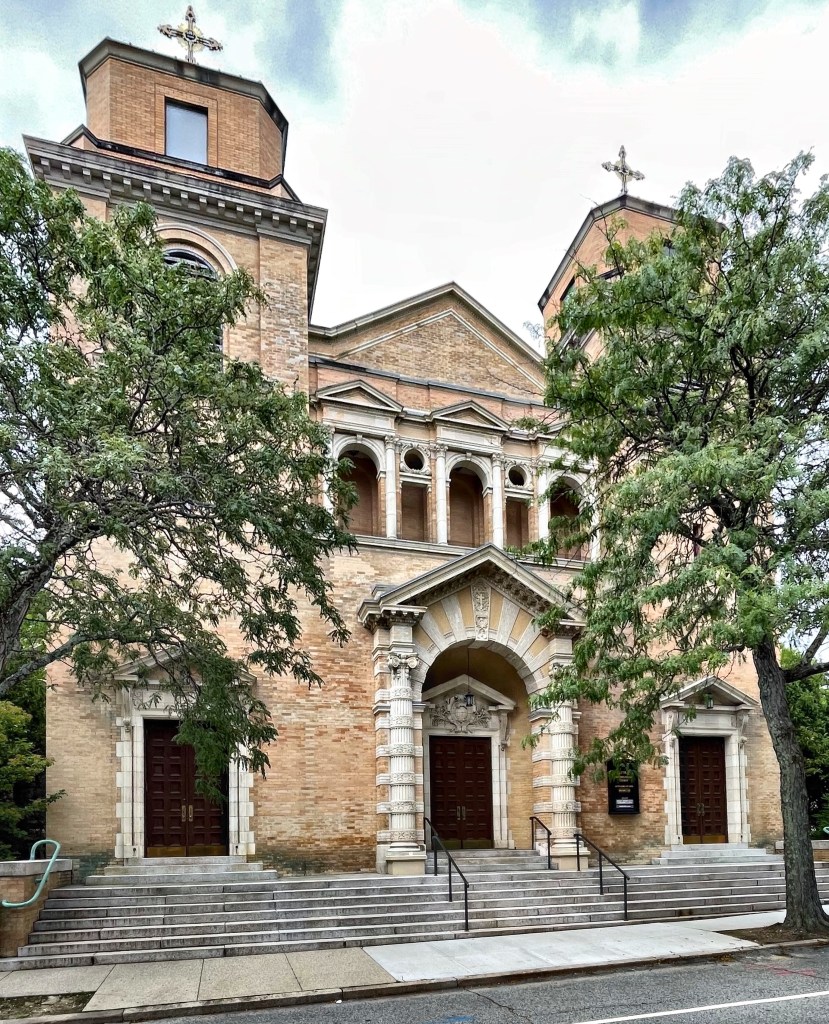
Central Congregational Church, Providence // 1893

One of the best examples of Renaissance Revival architecture in Rhode Island is the Central Congregational Church of Providence. Constructed between 1891-1893, this building was the new home to a growing congregation, which outgrew its original Thomas Tefft-designed building on Benefit Street (which has since been occupied by RISD). Famed architect Thomas Hastings of the firm Carrère and Hastings of New York City, was hired to furnish plans, and worked closely with Reverend Edward C. Moore to make sure the building was fitting of the site. The church is cross-gabled in form and is constructed of yellow brick with terracotta trimmings, evocative of Spanish and Italian Renaissance styles. The facade has a detailed central pavilion which is flanked by two towers. These towers were originally surmounted by elaborate belfries, but these were damaged by a hurricane in the mid 20th century and replaced by the present brick caps. The dome and vaulting is of tiles by Rafael Guastavino, it is the first dome that he constructed in the U.S., making this building even more significant.

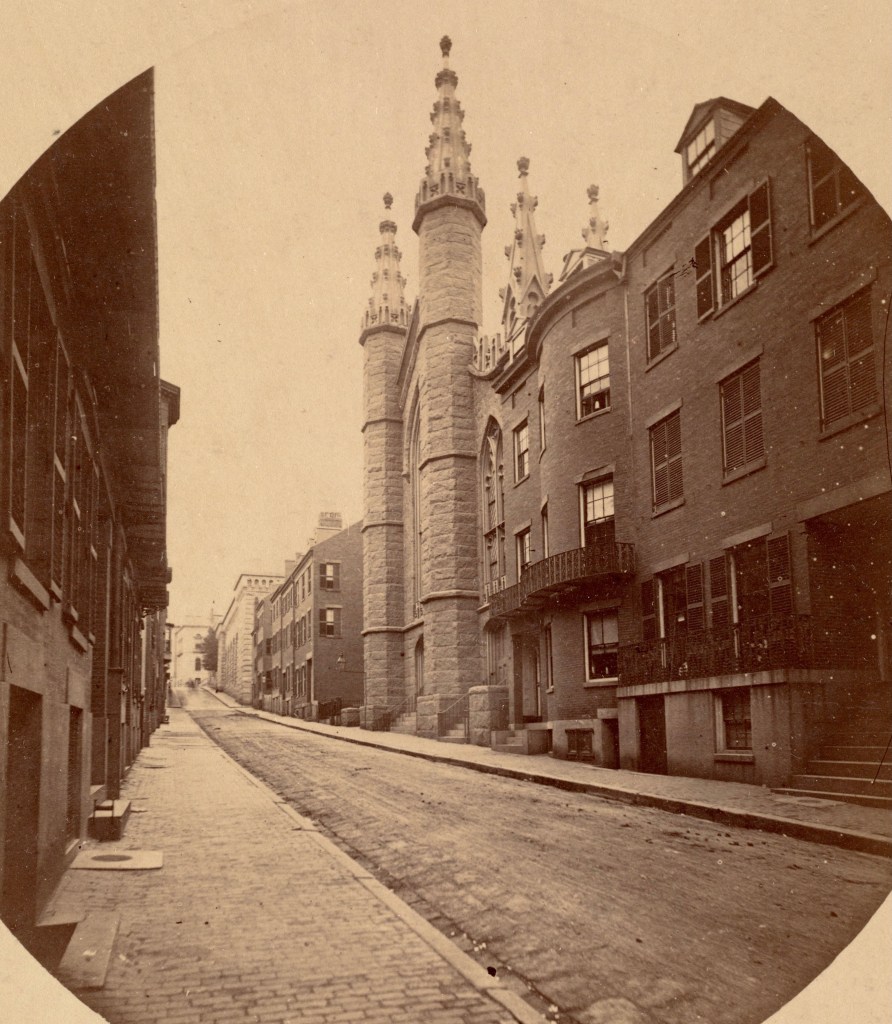
Grace Church // 1835-1966

Grace Church was built in 1835 for a growing congregation in Beacon Hill. The absolutely stunning Gothic style church was designed by William Washburn (1808–1890), an architect and city councilor in Boston. The church was constructed of granite and had massive stained glass windows and soaring towers with decorative embellishments. Inside, a massive central window flooded the interior with natural light, and illuminated paintings from Mario Bragaldi, a Milan artist. In 1865, the building was sold to the Methodist Episcopal Society. 1873, it merged with Hanover Street, and took the name First Methodist. The church was variously referred to as First, Grace, or Temple Street, sometimes all at once! This church was occupied until 1962, when it merged with Copley to form First-Copley, which appears to have then occupied the Old West Church. The building was soon after acquired by Boston University and demolished for the building on the site today, a true loss to one of Boston’s most beautiful buildings.

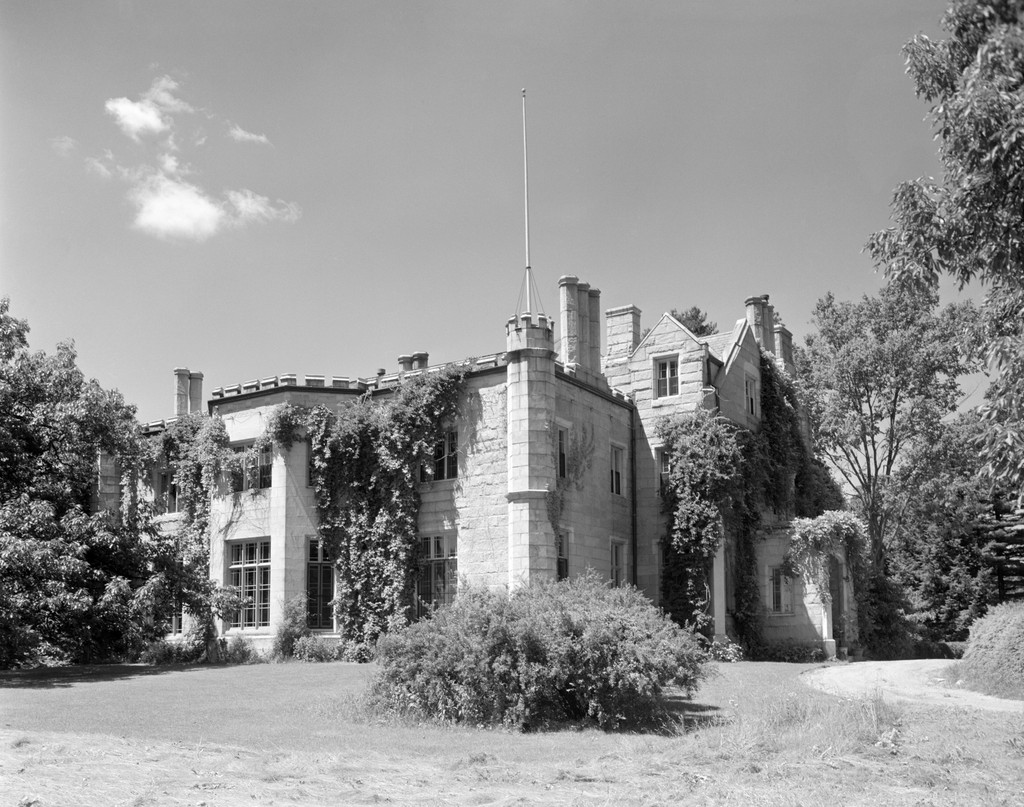
Oaklands // 1835

A massive amount of land on the eastern edge of the Kennebec River was acquired by Sylvester Gardiner in the 18th century, but confiscated by the state during the American Revolutionary War (because Gardiner was a Loyalist who fled). Years later, the land was recovered by Gardiner’s grandson and heir, Robert Hallowell Gardiner. Upon coming to age, Robert Hallowell Gardiner returned to Maine in 1803, after graduating from Harvard, ready to straighten out and manage the holdings willed to him by his late grandfather Dr. Sylvester Gardiner, the founder of Gardiner, Maine. He came with no inclinations or training in business, but his cousin Charles Vaughan in Hallowell helped in steer him on the right course. Starting at the age of 25, Robert Hallowell Gardiner embarked on the task of developing an entire city, Gardiner, but with profit and investment in mind over the next sixty-one years. His business enterprises included: six dams, saw and gristmills, shipyards, foundries, a brick mill, broom making industries, furniture manufacture, paper making and the ice-harvesting business. He married Emma Jane Tudor of Boston (who he likely met during his time at Harvard, in 1805. They soon after built a home for their family and welcomed friends and family to stay there on the massive property. The first Oaklands estate burned in 1834 and the present Gothic Revival mansion on the site was built in 1835-37. Designed by English-born architect Richard Upjohn, Oaklands typifies an English country manor house and features a rectangular hip roof, hooded window moldings, turrets and elaborate stonework. Oaklands is among the first and finest 19th-century rural villas in the State of Maine and is among the most significant in the country. The home remains on over 310-acres of sprawling land which looks out over the Kennebec River, and is owned by the Gardiner family to this day!

Hartley Jewett House // c.1895 //

This stunning Queen Anne home in Gardiner, Maine, overlooks the Kennebec River from its high position on a hill. The home was built for Hartley Jewett, who ran a busy lumber mill in town, which sold long lumber, laths, and shingles, some of which ended up on his own home. Maine was huge in the lumber industry, and it’s vast forests were often cut and sent down to cities like New York and Boston on rail to supply their own building booms.

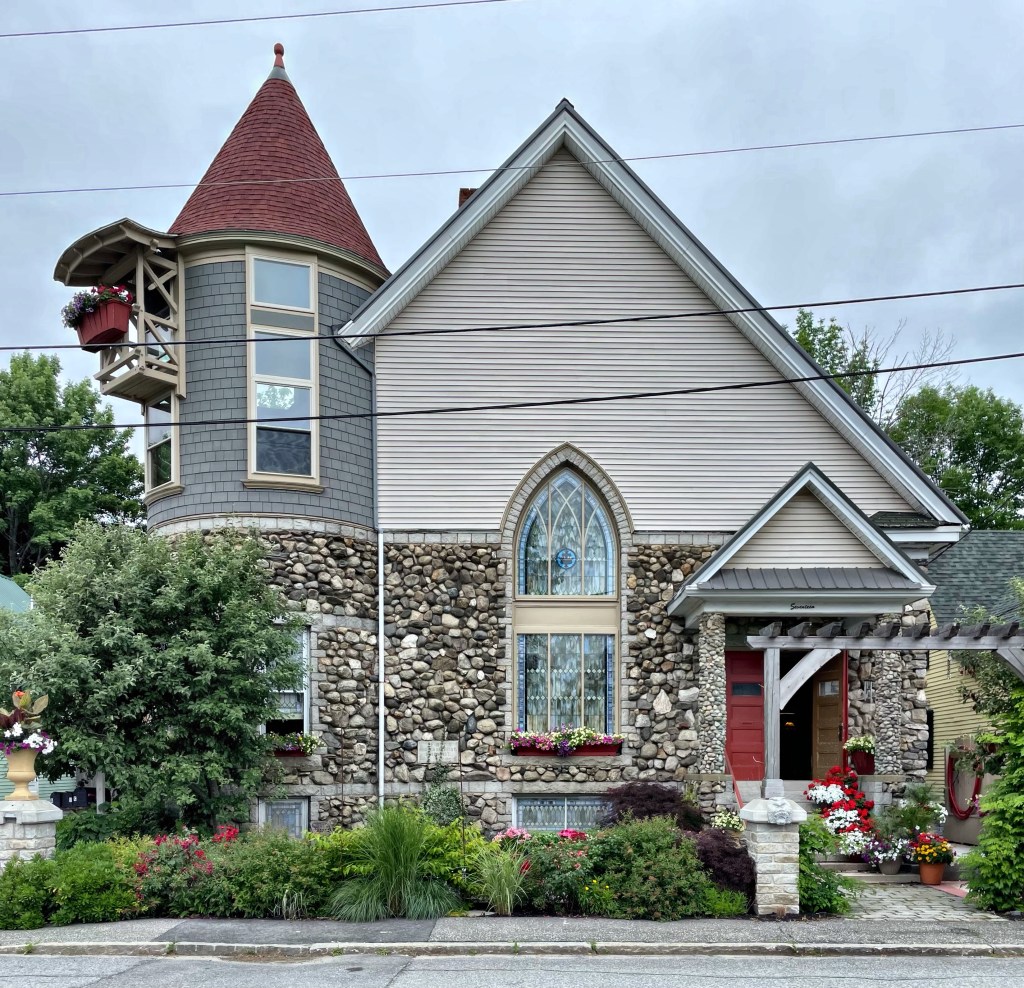
Christian Science Church, Gardiner // 1905

The first purpose-built Church of Christ, Scientist church in Maine is this turn-of-the-century edifice constructed in 1905 in Gardiner. Organized in 1897, this Christian Science Society of Gardiner met for several years in members’ homes and public places nearby until Palmer Noyes and his wife Caroline funded the new building. Caroline and Palmer helped establish the first such church in Chicago, after the couple witnessing a ‘healing’ and then heard Mrs. Mary Baker Eddy lecture in 1882. This church in Gardiner was seemingly designed by Caroline, who was likely inspired by architectural influences on the churches in town, from Gothic style lancet windows, to the shingle style facades. The building was eventually converted to a development center for the disabled, and is now known as “The Stone Turret”, a bed & breakfast, with amazing stained glass windows!

Governor Henry Lippitt Mansion // 1865

North (secondary) facade

New England is lucky to have so many diverse house museums where architecture and history nerds like me can tour old houses and envision what it was like to live in that era. The Governor Henry Lippitt mansion in Providence stands out as one of the most significant Victorian-era homes in Rhode Island, and contains one of the best-preserved Victorian interiors in America. The mansion was likely designed by local architect Russell Warren, and modified by Henry Lippitt (1818-1891), heir to one of Rhode Island’s leading textile manufacturing families, for his wife Mary Ann Balch (1823-1889) and their six children who survived to adulthood. While Henry was a prominent businessman, his wife Mary may have been even busier. Mary owned and managed rental properties in Providence, including this mansion, giving her husband Henry life tenancy. She oversaw day-to-day running of the mansion, supervising the servants while teaching her daughter Jeanie, who became deaf at age four due to complications from scarlet fever, to read lips and continue to develop her speech. The Lippitt Mansion is an early, and high-style example of an Italianate Villa/ Renaissance Revival design, which moved away from the more prescribed forms of architecture towards the more eclectic, Victorian-era mode. The home features two main facades, with the smaller, west (main) facade featuring a central pavilion with ornate foliate frieze and Corinthian columns, and the north (side) facade – my favorite – with a more commanding presence with a bold porte-cochere. The home remained in the Lippitt family for 114 years, and was later acquired by Preserve Rhode Island, who opened it to the public as a museum in 1993.

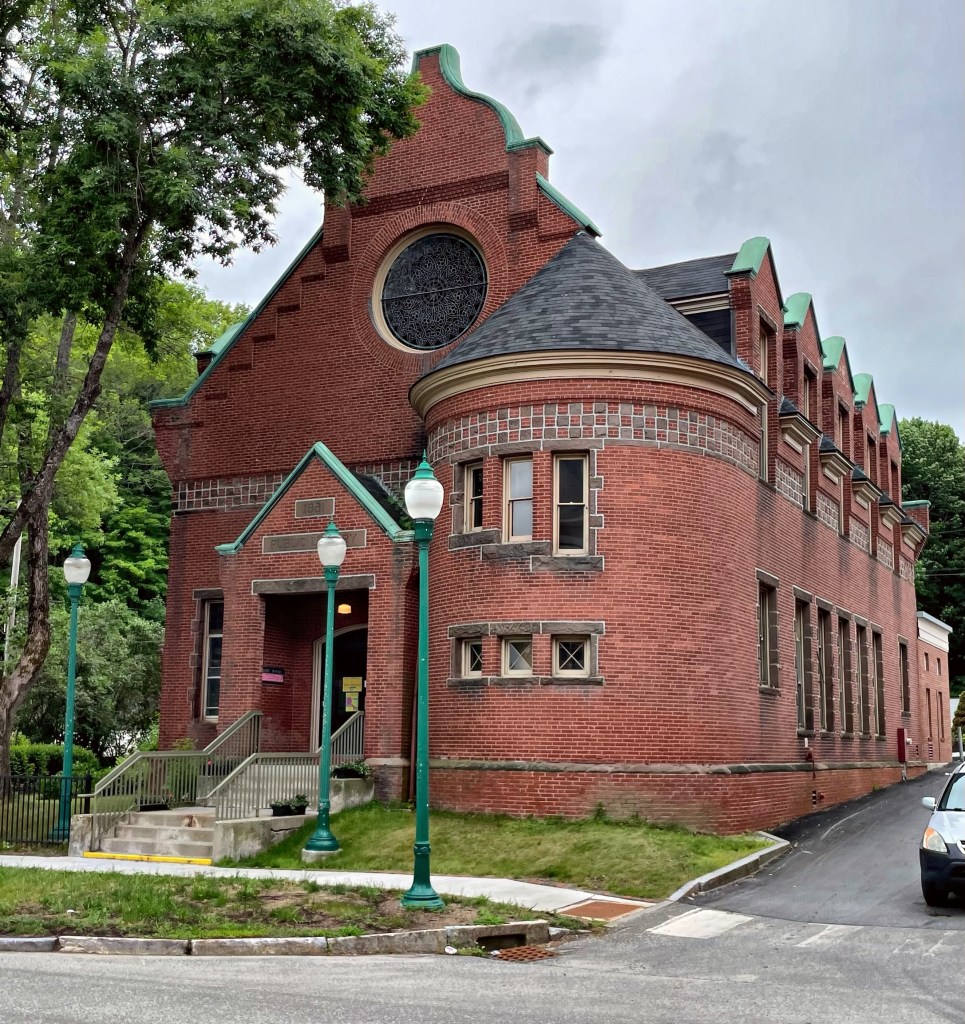
Gardiner Public Library // 1881

Possibly my favorite building type, the local town library buildings of New England, always amaze me with their small scale, yet architectural variety and intrigue. The library in Gardiner, Maine is no exception! This library building was constructed in 1881 from plans by Henry Richards, who was actually born in town in 1848. Henry graduated from Harvard in 1869, and soon after, took a post-graduate course in architecture at MIT. After completing schooling, he was a draftsman with Ware and Van Brunt. Soon after, he was a draftsman with Peabody and Stearns from 1872 to 1876, and then practiced architecture briefly on his own in Boston. During this time he married Laura Elizabeth Howe, daughter of Samuel Gridley and Julia Ward Howe. They moved to Gardiner, Maine and settled in a Federal house (featured previously), to learn more about Laura Richards and their house, check out the last post. Henry lived to be 100 years old! The library building is Queen Anne and Romanesque in style with a round corner tower with conical roof, brownstone and brick construction, and a stained glass ocular window with ogee parapet at the gable end roof. The small local library was added onto numerous times to hold a growing collection which includes works from Laura E. Richards, and Edwin Arlington Robinson, both Pulitzer Prize winning authors who lived in town.

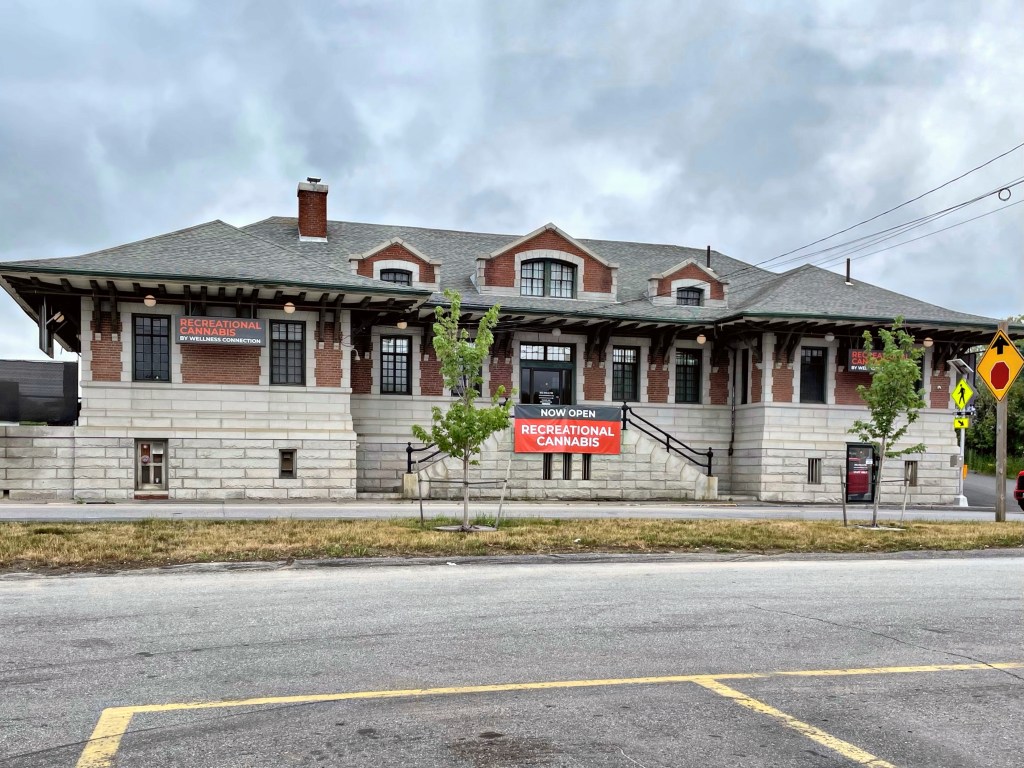
Gardiner Train Depot // 1911

The first train arrived in Gardiner, Maine in 1851. Rail here introduced a new mode of transportation for passengers and freight, which previously relied on horse or ship up the Kennebec River. When the old station was deemed too small and outdated, the Maine Central Railroad Company decided to hire Portland architect, George Burnham to complete plans for a more fitting station. This building is a mix of styles, the two I would categorize it as are Romanesque Revival and Spanish Revival. The building incorporates a number of influences of the two along with a deep overhanging roof supported by large brackets, heavy rusticated granite blocks at the base, and quoining around the windows and corners. The station was in operation until about 1960 when rail service here halted. Since that time, the building has been adaptively reused as a retail store, today as a recreational cannabis dispensary. So you can get high and look at cool architecture!

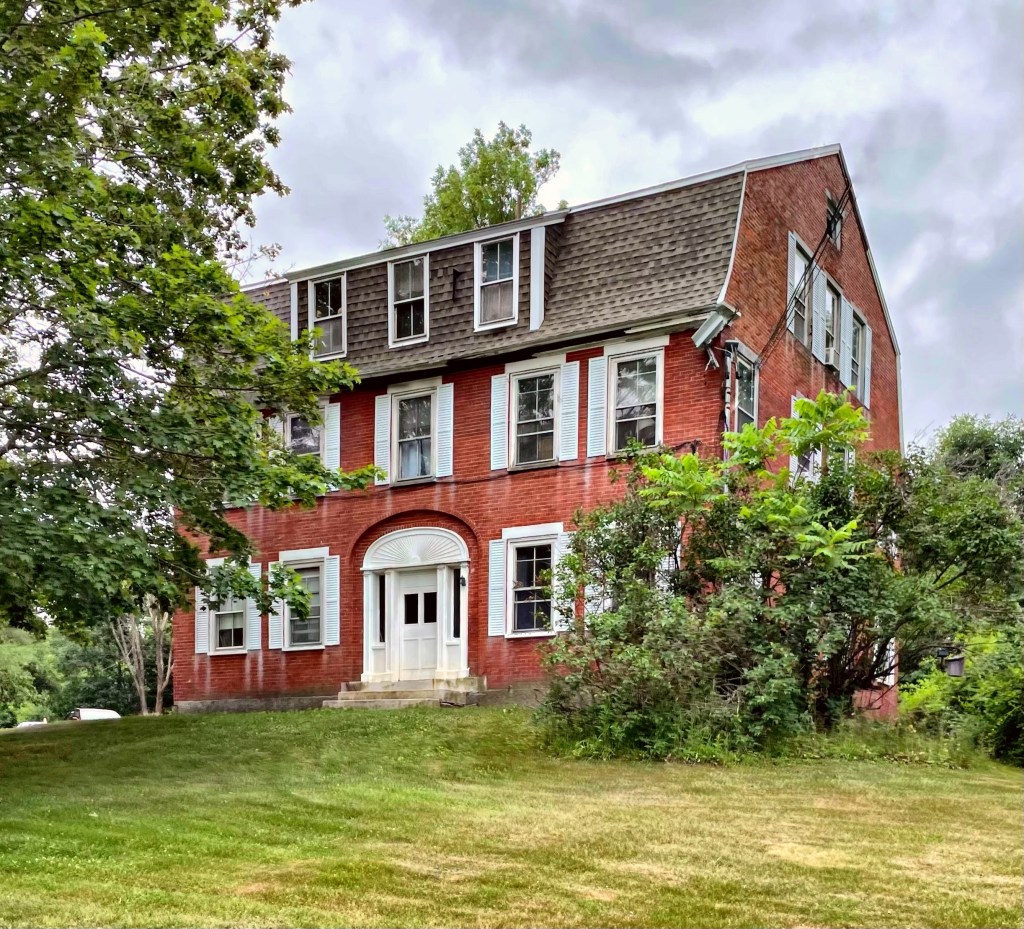
Gardiner Almshouse // 1834

This large brick Federal house was built on the outskirts of Gardiner, Maine, in 1834. Ebenezer Moore, the builder, worked as a carpenter and house-wright in town and showcased his skill on his own brick mansion, selling it to a C.E. Bradstreet. By the late 1840s, the town of Gardiner decided that it would need a new almshouse, city-provided housing for the poor, so they purchased the Bradstreet house and 14-acres of land. In the 1848 town report documents noted, “The establishment is a brick one, of two stories, containing thirty-six fine rooms, including seven fitted for the insane in the most admirable manner, together with a spacious hall. The building is every way a most excellent one for the purpose, and is a monument of the humanity and generosity of the city.” The almshouse served as a working farm where the poor could harvest their own crops and contribute in a small, closed society. The almshouse burned in 1909, and was immediately rebuilt using the outside brick walls. In the Colonial Revival manner, a gambrel roof replaced the former gable roof, which added a third story to the almshouse. The building was eventually sold, as new housing models for low-income residents took off. The former almshouse was converted to an apartment building in 1970, a use that appears to continue to this day.