Judge Philip Rubenstein House // c.1915

In the early 20th century, the suburban development of Longwood in Brookline saw another period of rapid development. Larger estates were subdivided and developed with all kinds of housing from single-family mansions to middle-class homes to large apartment buildings. One of the more modest-sized houses built in the first decades of the 20th century was this house, one of a collection of stuccoed homes on Colchester Street. The house was purchased by Judge Philip Rubenstein, the first member of the Jewish faith to serve on the Massachusetts bench and one of the first three judges of Boston’s juvenile court, the first in the country. The unique home is clad with stucco with a terracotta shingle roof and Colonial Revival style entry, showing an effective blending of the Arts and Crafts and Colonial styles.

Mansfield DAR Lodge // c.1830

Tucked away on a side street in Mansfield, I was pleasantly surprised to stumble upon this charming example of a Craftsman bungalow, a style and form not too common in New England. The style, synonymous with the western United States’ population growth in the early 20th century, never took off the same way here as Yankee homeowners and builders often stayed true to the Colonial Revival style (even today). This building is said to date from the early 1800s and was built as a Federal style cape. It was owned by a Margaret Lane in the late 19th century. By the 1930s, the house was significantly altered with a full-length porch supported by tapered shingled columns atop fieldstone bases and new dormers at the roof with flared eaves. The building has been home to a local chapter of the Daughters of the American Revolution (DAR). What a charmer!

“Highfield” // 1914

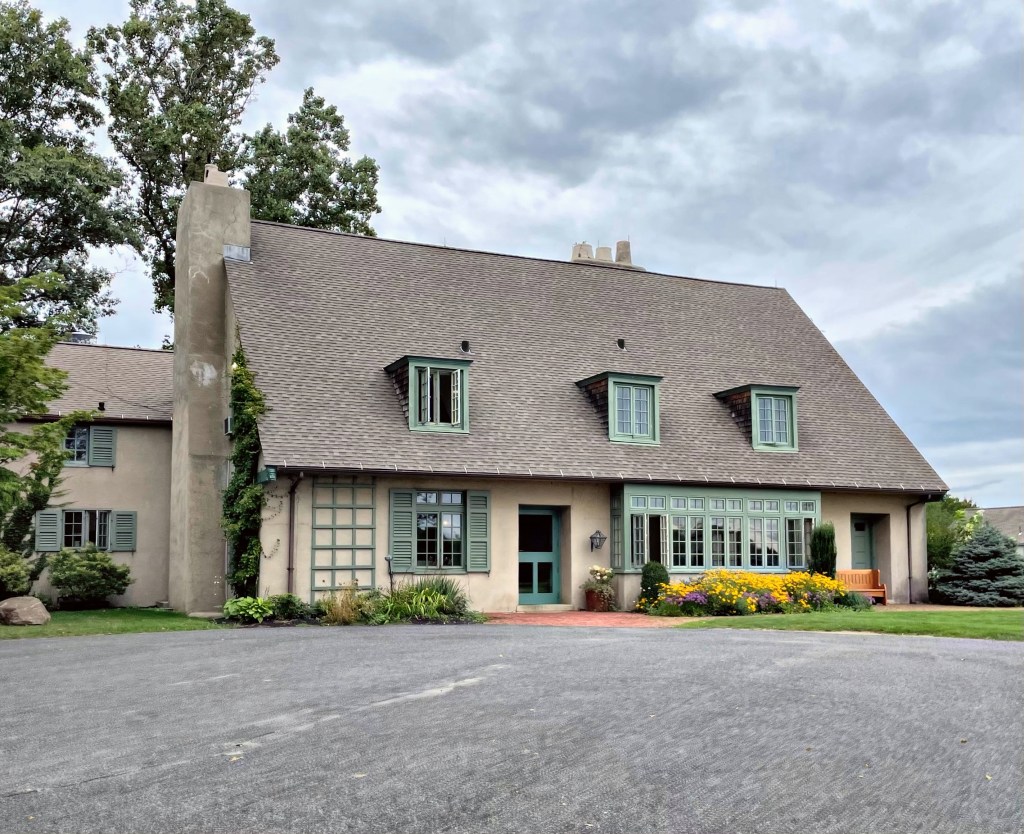
The Highfield house is a historic building located in Middlebury, Connecticut. The House, surrounded by over 600 acres of land, was the former summer estate of Columbia University law professor Joseph and his wife, Elizabeth Chamberlain. They commissioned Theodate Pope Riddle, one of the first licensed female architects in America to build this comfortable English Arts and Crafts style cottage on a hill above a lake. It is likely that after the Westover School was completed in town, the Chamberlains were excited to see how Theodate could design them a summer house in the similar Arts and Crafts style. The estate was completed in 1914 and stands two-stories with the second floor concealed within the steeply pitched gable roof. Like Westover, the building was stuccoed. In the 1950s, the estate was purchased by a group of individuals who dedicated the complex as a family and country club with golf, tennis courts, and pool. It is known as the Highfield Club today.

Elwin Cove // 1908

While Blue Hill has historically been a summer colony for wealthy city-dwellers to escape to experience the beauty of Maine, it has never gotten the coverage as Bar Harbor or the other Mount Desert Island towns. Many of Blue Hill’s summer cottages are more refined and hidden away amongst the trees, and that is how the town likes it, unpretentious. I was lucky enough to take a wrong-turn and stumbled upon this gem of a cottage between the Blue Hill village and East Blue Hill, I had to take a photo! Upon further research, the rambling cottage was built in 1908 for Ellen and Edward J. Brooks of New Jersey. The cottage was named Elwin Cove, possibly as a merge of their children’s names ELinor and WINfred.

East Blue Hill Library // 1920

Every village needs a library, and East Blue Hill is no different! Without easy access to the main Blue Hill library, a group of “willing workers” amassed a collection of books with the hopes to donate to a future village library organization. A campaign to build the present building began in 1914 with the acquisition of land adjacent to the village post office, with major fundraising undertaken in 1917. The building, completed in 1920, was designed by John W. Merrow, a New York City theatrical architect and is an uncommon example of a small, Arts and Crafts style library in the state of Maine.

Talitha Cumi Home // 1912

One thing I love about Boston is that nearly every old building has such a rich history that takes so much time to compile and write up (this account keeps me busy)! Located on Forest Hills Street in Jamaica Plain, this stucco building caught my attention when driving by, so much so, that I had to stop and go back. The building was constructed in 1912 as a home for unwed mothers called Talitha Cumi Home (a phrase from the Bible meaning “Arise, young woman”). The charitable organization outgrew their space in the South End and sought greener pastures and open space in Jamaica Plain. The group had been organized in 1836 by “earnest Christian women” who longed to open a “door of hope” to “those hopeless and helpless girls who found themselves facing the sadness and shame and wrong of unwed motherhood.” The Talitha Cumi Home allowed pregnant women to reside and birth their children before their pregnancy began to show. The site originally included an administration building and a hospital with both structures connected by a covered breezeway. The home closed in the 1950s and the former home for unwed mothers has since been converted to a middle school.

Oliver Johnson House // 1905

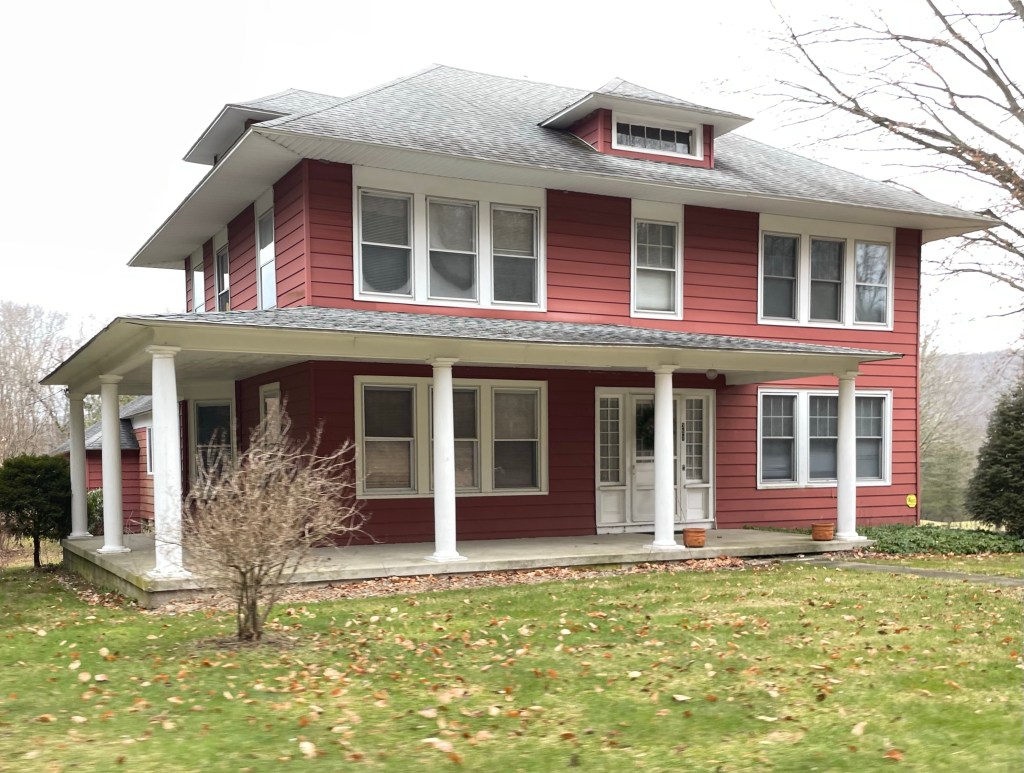
Prairie style architecture is not nearly as common in New England as it is in the Mid-western United States. The style was almost always seen in early 20th century residential designs and is characterized by horizontality, low slope roofs, overhanging eaves, and open interior floor plans. This New England vernacular version of the Prairie style employs some Arts and Crafts influence with Tuscan columned porch and wood frame construction, rather than the more bulky and bold use of brick and stone. This residence sits on a busy state route in the sleepy town of Franklin, Connecticut. This house appears to have been built for Oliver Johnson who was about seventy by the time the house was built. Do you know of any other Prairie Style houses in New England?

Wilkinson House // 1908

Waban Village in Newton, Massachusetts has dozens of amazing examples of early 20th century residential architecture, possibly the best collection in the Boston area! This Arts and Crafts style residence was built around 1908 for William and Delia Wilkinson the former of the two owned the William H. Wilkinson Company, which manufactured oiling devices and oil cups for steam engines. Delia, his wife, owned their family home under her name. The home is an excellent example of the Craftsman style, with stucco siding, thick rounded column supporting the inset porch, oh and that catslide roof!!

Bauckman House // 1915

The Arts & Crafts movement in architecture provided some of the most stunning and well-designed properties of the early 20th century but sadly, there are not too many examples here in New England. When I find some, I always get excited and pull over to snap a photo! This home on busy Beacon Street in Waban, Newton, was built in 1915 for Harry W. Bauckman a salesman in Boston. The designs are credited to architect James G. Hutchinson, who specialized in Arts & Crafts and Tudor style buildings in the area. The Bauckman House is Foursquare in form which basically segments the house into four, large rooms on each floor with a stairhall in the center. The home is clad with banded shingles which extend to the piers at the porch, a subtle nod to Shingle style architecture. SWOON! I was later informed by a follower that this was also the home of landscape historian and author Judith Tankard for some time.

James H. Gardner House // 1923

My favorite part about the Boston suburbs is the sheer number of well-preserved early 20th century residences. The collection of Colonial Revival, Tudor, and Arts and Crafts style houses found in Waban Village, Newton, are among my favorites. This two-story stucco-clad house enclosed by a slate gable roof with exposed rafter ends was built in 1923 from designs by architect Harry Morton Ramsay. Ramsay was hired to design dozens of middle-upper class houses in Newton during its period of rapid development in the early 20th century. The original owner was James H. Gardner, who lived here with his family and a maid for a couple decades.