St. Stephen’s Episcopal Church // 1914

When Ridgefield, Connecticut was settled in 1708 by Europeans, there was only one Episcopal Church in the state, and the general assembly allowed dissenters their own churches so long as they continued to pay taxes to support the Congregational Church. Ridgefield’s first Episcopal church, St. Stephen’s was built in 1740 on land granted by the Proprietors who founded the town and laid out lots along the towns new Main Street. In 1776, St. Stephen’s minister, Epenetus Townsend, a Tory (loyal to the British), was ordered to leave town with his wife and five children when the Revolution picked up steam. He was appointed chaplain to a British regiment and in 1779, the battalion was ordered to Nova Scotia. En route by vessel, a severe storm arose and all passengers were lost. The church was taken over by the commissary department of the American Army. During the Battle of Ridgefield, British troops set it on fire as a statement to the townspeople. The church was replaced two more times until 1914 when the present building was constructed. The Colonial Revival church is absolutely stunning and built from plans by (unknown to me) architect Walter Kerr Rainsford. The rubblestone church is one of the most pleasing designs I have seen in Connecticut!

First Congregational Church, Ridgefield // 1888

The First Congregational Church was first established in Ridgefield, Connecticut just four years after the establishment of the town. Civic leaders in October 1712 successfully petitioned the Connecticut General Assembly for permission to levy a tax for “the settling and maintaining of the ministry in the said Town of Ridgefield.” Rev. Thomas Hauley, the first minister, also served as town clerk and school teacher. The first meeting house, on the town green, opened for worship in 1726. Plans for a new meeting house were drawn up in 1771 to fit a growing population, but construction was not complete until 1800. The second church was built in a more traditional style with a steeple. With a shift in the towns demographic from rural homeowners to ritzy exurb to New York City, a more suitable church was required by the end of the 19th century. Josiah Cleaveland Cady, one of the many great New York architects at the time was hired to design a new church suitable for the wealthy New Yorkers who summered in town to consider a neighbor, and he did not disappoint! The building blends many styles from Queen Anne, to Victorian Gothic, to Romanesque Revival in a way that isn’t clunky as in some other versions.

St. Mary’s Catholic Church, Ridgefield // 1896

Located just a block of Main Street in Ridgefield, Connecticut, St. Mary’s Catholic Church stands out as a rare example of Victorian Gothic architecture in a village full of Colonial (and Revival) and mid-19th century buildings. The first known Catholic to arrive in town was James Brophy, who’s family settled in Ridgefield in 1848. While growth of a local Catholic church in Ridgefield was slowly being established, the character of the town was changing by the second half of the 19th century, with wealthy New Yorkers building homes for vacationing in the summers. From this, many Irish Catholic immigrants were hired to work on the new estates. The first permanent Catholic church in town was built in 1867 as a modest wood frame church. As the congregation grew, a new church edifice was needed, and after a capital campaign, funds were gathered to erect a new church. Connecticut architect Joseph A. Jackson (who specialized in ecclesiastical design), was hired to furnish plans for the new church. The building exhibits eclectic architectural styles. Gothic design is seen in the pointed or lancet windows, arches and cast iron finials. The Queen Anne style is reflected in the use of textured and varied building materials, such as brick, brownstone, and shingles. And St. Mary’s most unique feature, its unusual steeple with its four turreted abutments and conical roof worked in shingles, is representative of the Shingle style.

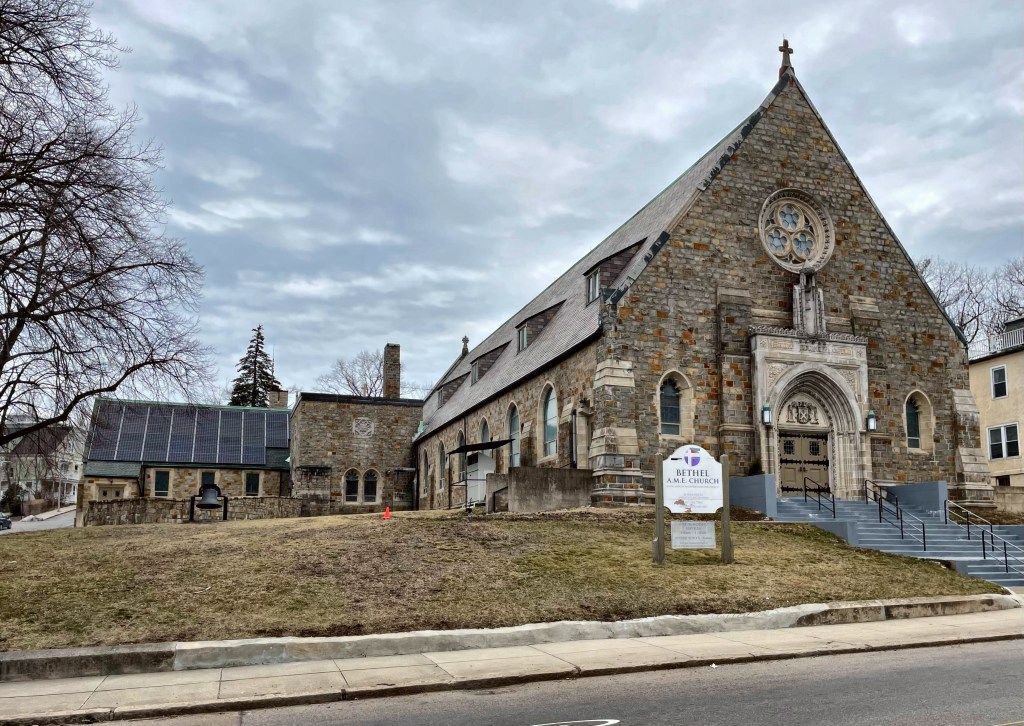
St. Andrew R.C. Church – Bethel AME Church // 1921

During the rich Arts and Crafts movement of Boston, dozens of churches and their associated buildings were constructed using principles of the movement, which sought to incorporate English design with hand-crafted detailing, moving away from the mass-produced features and architecture seen in the Victorian-era/Industrial Revolution. After WWI, the Forest Hills neighborhood of Boston saw a massive influx of residents and housing construction, leading to the desire for a new neighborhood church. The Roman Catholic Archdiocese commissioned Boston architects Timothy O’Connell and Richard Shaw, who specialized in ecclesiastical design to build the new church. Opened in 1921, the building is constructed of random ashlar walls with buttresses, lancet windows, and a large rose window, all nods to Gothic architectural precedent. Demographic changes and declining church attendance led the parish, for the first time in 1995, to accept aid from the archdiocese to meet expenses. Unable to justify keeping the church open, the Archdiocese sold the church to Reverend Ray Hammond and the Reverend Gloria White-Hammond, a husband-and-wife pastoral team, who started a local African Methodist Church (Bethel AME Church) in the neighborhood.

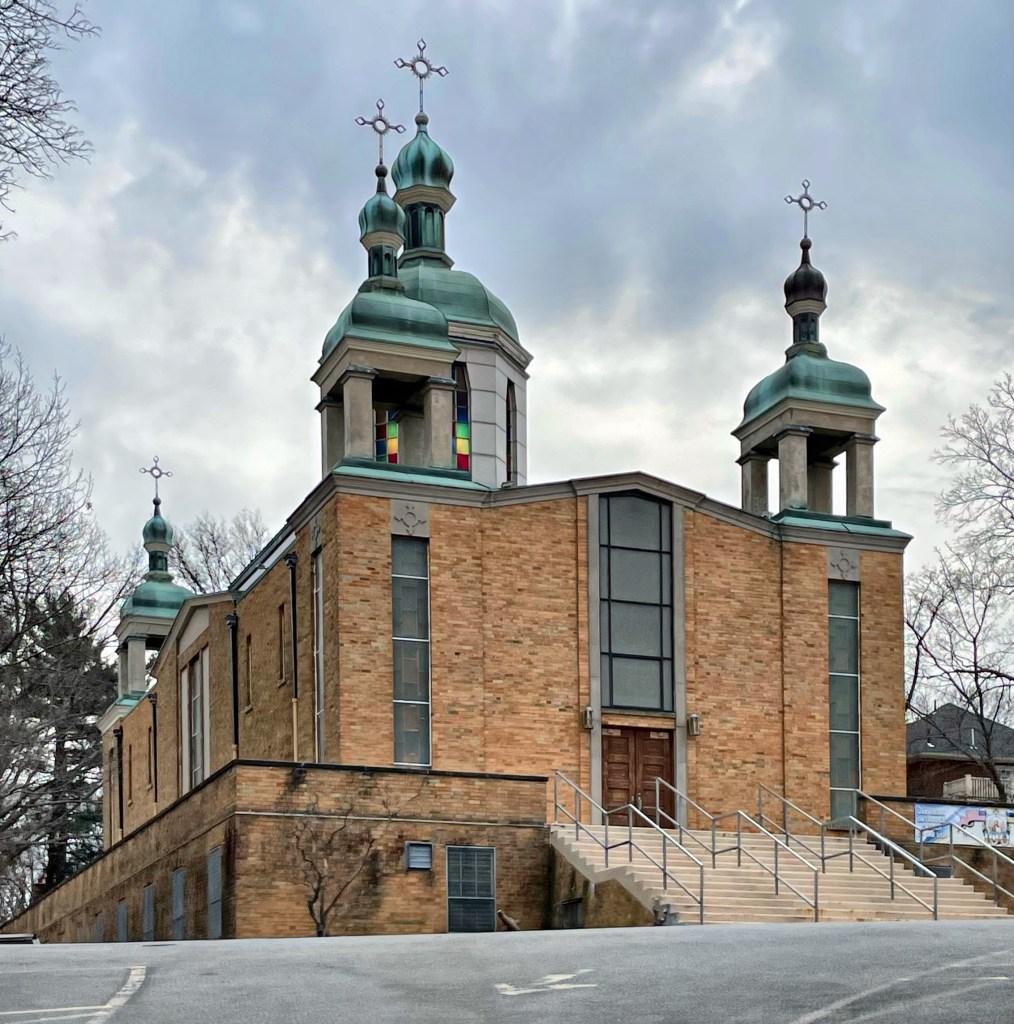
St. Andrew Ukrainian Orthodox Church // 1958

I typically do not connect my posts to current events, but I really wanted to take time to highlight the strength and fortitude of the Ukrainian people fighting to preserve their home and democracy around the globe. Closer to home, a growing Ukrainian community in Boston in 1956, decided to erect a new church in the Forest Hills section of Jamaica Plain. Land was acquired and a blessing ceremony was attended by members of the church, the architect, and Reverend John Theodorovich; the head of the Ukrainian Orthodox Church of America, who was born in Ukraine, and served at chaplain with the Army of the Ukraine National Republic in the war against Russia in 1919-20, before eventually moving to North America. The architect, John Kodak, was a Toronto-based architect of Ukrainian descent who ended up in Canada after fleeing from his home to escape communist rule from the USSR. This church is a Modernist interpretation of the iconic St. Andrew’s Church in Kiev, Ukraine, with its onion domes surmounted by crosses. The church, like many others, is holding prayers for Ukraine and is coordinating donations and aid to the Ukrainian people and related charities.

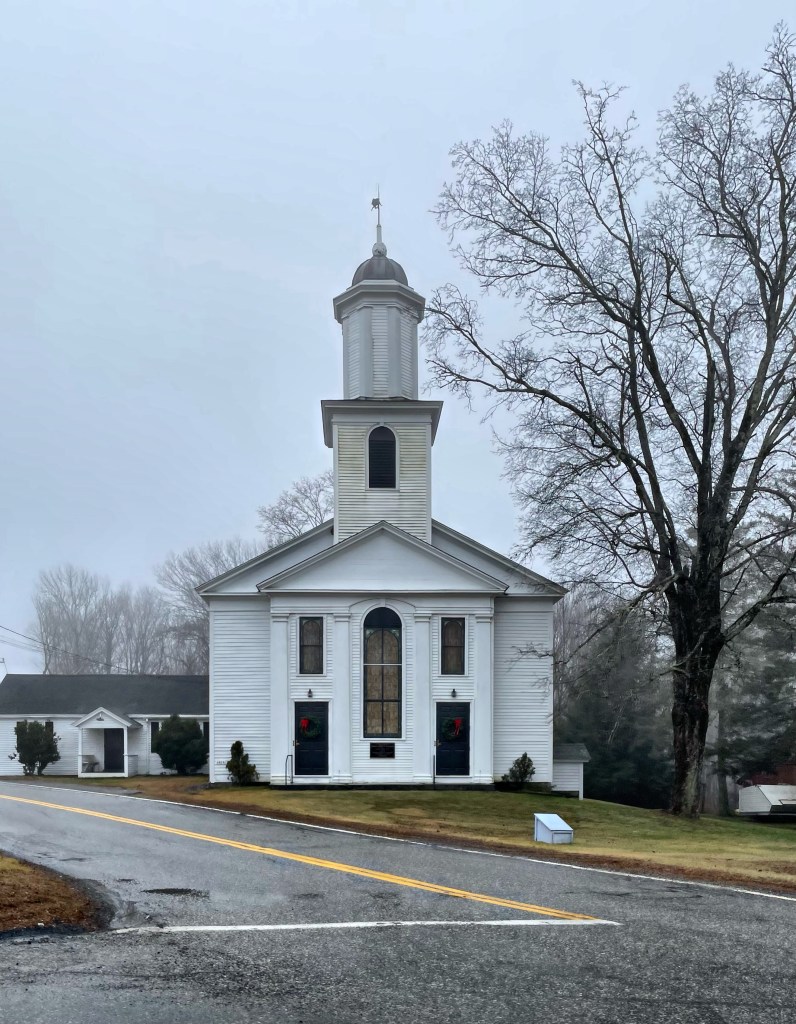
Waterford Congregational Church // 1928

Upon first glance, this transitional Federal and Greek Revival style church building in Waterford, Maine, appears to date to the early-mid 19th century, but things are not always as they appear! The Waterford Congregational Church we see today was actually built in 1928, after a fire that year destroyed the previous building, constructed in 1837. The congregation hired Maine architect John Calvin Stevens, who designed over 1,000 buildings in his career. The church was “masterfully recreated in almost every detail” from the 1837 building, down to the 1,200-pound bell cast from the historic Revere foundry bell.

North Waterford Congregational Church // 1860

The Town of Waterford, Maine was created as the result of a 1774 grant made by the General Court of Massachusetts to the descendants of a company of Massachusetts soldiers involved in a 1690 expedition against the French in Canada, leading to the Battle of Quebec. The land was surveyed in 1774; in spring of 1775, David McWain of Bolton, Massachusetts arrived with his dog at a lot he bought for $40. He cleared land and built a log cabin, returning to Bolton for two winters until he settled permanently at Waterford in spring of 1777. The town grew around agriculture and industry with sawmills built at streams to manufacture the region’s abundant timber into lumber. The town later became more of a resort area in the early 20th century, with urban-dwellers flocking to the area to take in the fresh air and natural scenery.

This church in North Waterford is located in a more rural part of the town, and was constructed in 1860 by a group of local residents from designs by Maine architect Thomas Holt. The Italianate influence is evident from the round-arched windows set in a recessed arch and a bracketed cornice. The steeple looks to be more contemporary and slightly turns, giving it a really interesting presence.

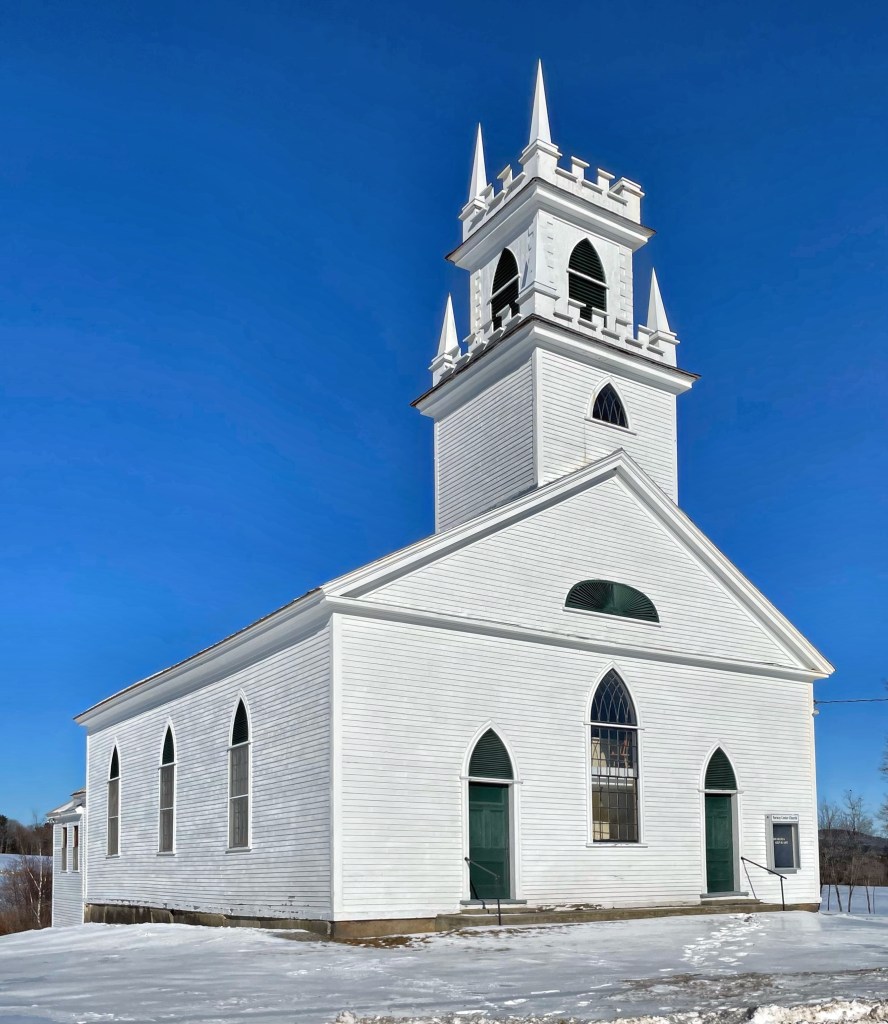
First Congregational Church, Norway // 1840

This beautiful, bucolic church in Norway Center was built in 1840 to replace an earlier meeting built in 1808-09 on the site. The present building is Gothic Revival in style with louvered panels making the windows appear lancet in shape and the amazing lancet window centered on the facade. The two-tiered tower is ornamented with crenellation and a wooden spire at each corner (besides one missing). The church features a louvered fan and strong pediment, which are nods to other prominent styles of the early-mid 19th century, Federal and Greek Revival respectively. This church quickly saw membership drop as Norway Village became the population center of town, with Norway Center becoming more agricultural and rural.

Old Baptist Meetinghouse, Willington // 1829

The Baptist Meetinghouse in Willington was built in 1829 by a local carpenter Albert Sharp, in a transitional Federal/Greek Revival style, common for the period. Its clapboarded facade has a projecting pavilion with two entrances flanking a two-story round-arched window. Four pilasters are surmounted by a wide entablature and the flushboarded pediment of the pavilion. Round-arched windows are repeated on the side elevations and the belfry, which is topped by an octagonal drum and a small dome. The Willington Baptist Church was organized in 1828, started by Rev. Hubbell Loomis, the fourth pastor of the Congregational Church across the common. Rev. Loomis was prominent both as a minister and an educator, and founder of Shurtleff College of Illinois. During his pastorate at the Willington Congregational Church, Mr. Loomis had strong tendencies toward Baptist sentiments. From this, membership of the congregational church split, some leaving for a new Baptist belief and others remained at the congregational church. The two congregations were split until 1911, when they again worshiped under the same roof, as the Federated Church of Willington, meeting in this building.

Old Willington Congregational Church // 1876

The Congregational or Town Church of Willington, Connecticut, has existed since the town’s incorporation in 1728, but originally met in a member’s small home on the Town Green. The Victorian Gothic style church we see today was built in 1876, after members gathered funds to construct the building. Land, materials, and labor were donated to offset costs for the small congregation. The church flourished until a split in the beliefs led to the formation of the Baptist Church of Willington. Eventually, the Congregational Church merged with the Willington Baptist Church in 1911 to form The Federated Church of Willington. The congregation then moved to the Baptist meeting house across the Green. In 1924, the Old Congregational meeting house, which was erected in 1877, was sold for $1 to the Town of Willington with certain restrictions, the most important of which was that, if it should cease to be used for public meetings under the control of the selectmen, possession would revert to the Congregational Ecclesiastical Society. From 1926-1974, the church was used as town hall (when the smaller building next door was outgrown. The church’s bell was removed during World War II to allow plane-spotters to use the tower. Instead of being placed back in the tower, it was mounted on a pedestal outside the building, where it remains today. The Willington Town Offices moved to a former industrial building a short distance away, but retain and maintain the building.