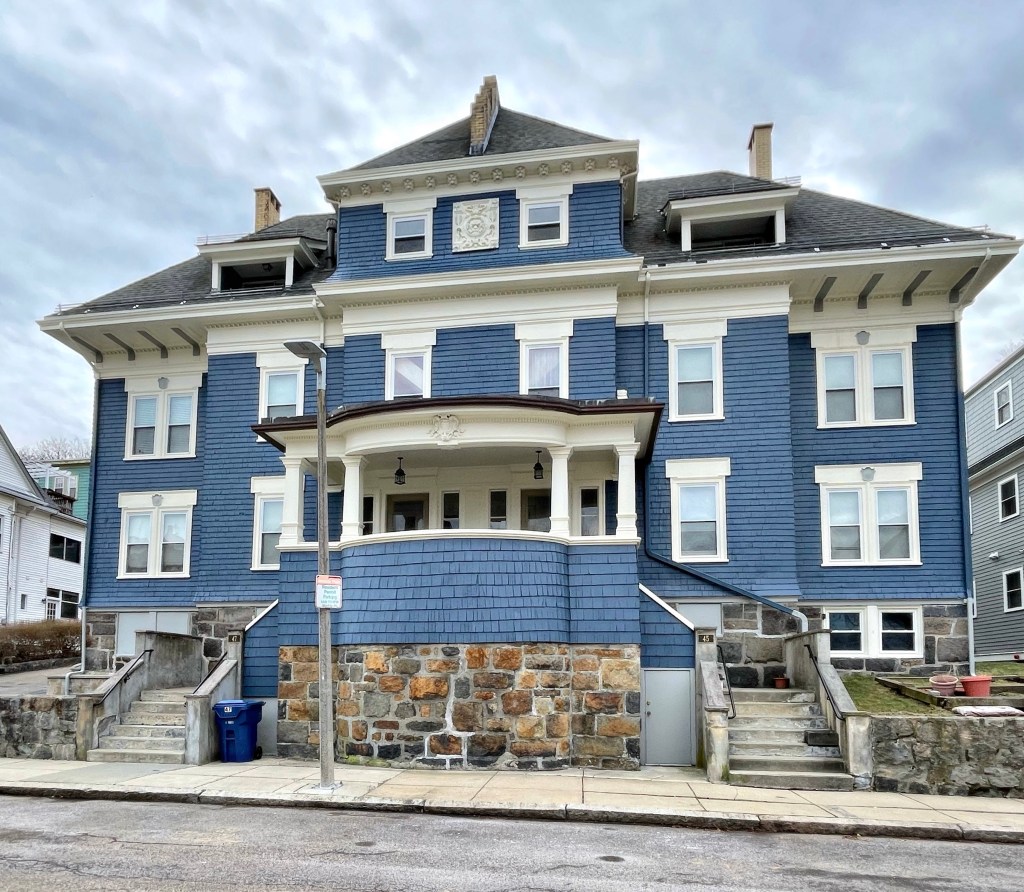
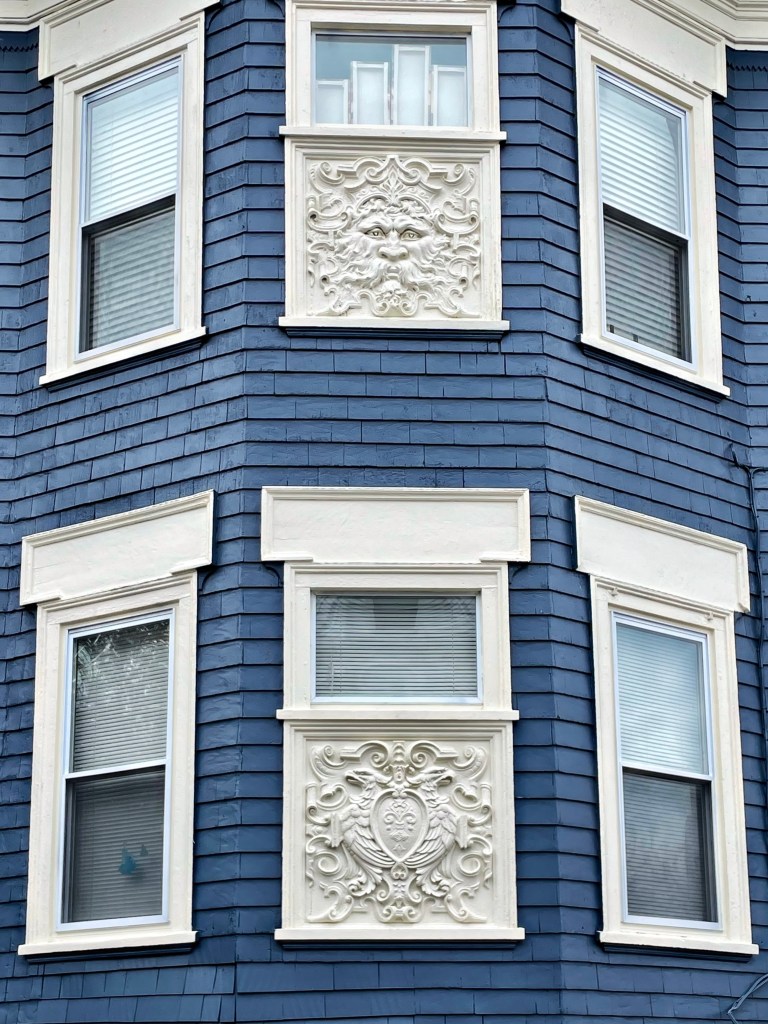
In 1896, architectural sculptor Charles Emmel purchased land in the rapidly developing Forest Hills section of Jamaica Plain, Boston. He hired local architect George Zimmer, to design a massive double-house which would serve as an income-producing investment, and could also be a sort of advertisement for his sculpture work. The result is this massive Colonial Revival style property, perched atop a puddingstone foundation. Architectural ornament has been lovingly preserved, a testament to the owners of the building today and the amazing work of the original owner, Mr. Emmel. I found myself staring at the building for a while when walking by, looking at all the hidden detail and architectural ornament which adds so much to the building.
Waban is full of eclectic homes from the end of the 19th century, and this example is probably my favorite! The Herbert and Georgia Stetson House was built in 1897 and demonstrates how elements of the Colonial Revival style were incorporated into a less rigid Queen Anne style plan. Herbert was a lumber dealer, and likely used his own product in his home. The mixture of ornament includes Colonial Revival style pedimented dormers, a Palladian motif window, oval windows, and a modillion cornice in combination with bays, oriels, a dramatically overshot gable roof, and a swept dormer reminiscent of the Queen Anne style. Together, the composition is perfection, and really makes you stop and analyze all the details!
Bar Harbor’s first library is believed to have been organized in 1875 by a group of summer residents. This collection of 176 volumes was assembled for the use of Mt. Desert’s permanent residents and made available to them for two nights per week. A small frame library was built in 1877. In 1883, the growing collection was turned into a subscription library with borrowing privileges charged at the rate of $1.00 per family, but the fee was dropped three years later. By the late 19th century, the village’s population boomed, especially in the summer months when wealthy families descended upon the sleepy town every year to take in the cooler climate and sweeping scenery of Mount Desert Island. Acknowledging the need for a more suitable library, Maria Van Antwerp DeWitt Jesup, the widow of Morris K. Jesup (1830-1908), a New York financier and long-time summer resident of Bar Harbor, gifted the town funds to erect a new building as a memorial to her late husband. The Colonial Revival style library was designed by the New York firm of Delano & Aldrich, and exhibits a beautiful centered entrance recessed in a limestone arch.
The marriage of Anna Perkins Pingree to Joseph Peabody in 1866 was a merging of two of the most influential and wealthy families of Salem, Massachusetts. The marriage however did not meet the mark, as the couple eventually had a large falling-out after purchasing a mansion in Boston’s Back Bay neighborhood in 1877. In her time away from her estranged husband, Anna became heavily involved in the arts, collecting hundreds of paintings and decorating her homes in Boston, Ipswich, and her new summer cottage in Bar Harbor. In 1896, she had her Bar Harbor cottage built on West Street, a road of substantial summer homes right next to downtown. The Colonial Revival “cottage” sits on the waterfront of Frenchman Bay and has only 12 bedrooms and 7 bathrooms, in 12,500 square feet.
Buildings of New England travels! Welcome to Schenectady, a great city in upstate New York, with an hard to spell and pronounce name! The name “Schenectady” is derived from the Mohawk word skahnéhtati, meaning “beyond the pines”. Schenectady was founded on the south side of the Mohawk River by Dutch colonists in the 17th century, many of whom were from the Albany area. In 1664 the English seized the Dutch New Netherland colony and renamed it New York. They established a monopoly on the fur trade around Albany, and issued orders to prohibit Schenectady from the trade through 1670 and later. The town grew mostly as an inland agricultural town until the Erie Canal was built in 1825, creating a navigable water route from New York City and the Atlantic Ocean to the Great Lakes, cutting through Schenectady. The town grew and became an industrial center, attracting a very diverse population of immigrants in the 19th century and African Americans as part of the Great Migration out of the rural South to northern cities for work. The community struggled (like many) in the mid 19th century but has seen a large resurgence as of late!
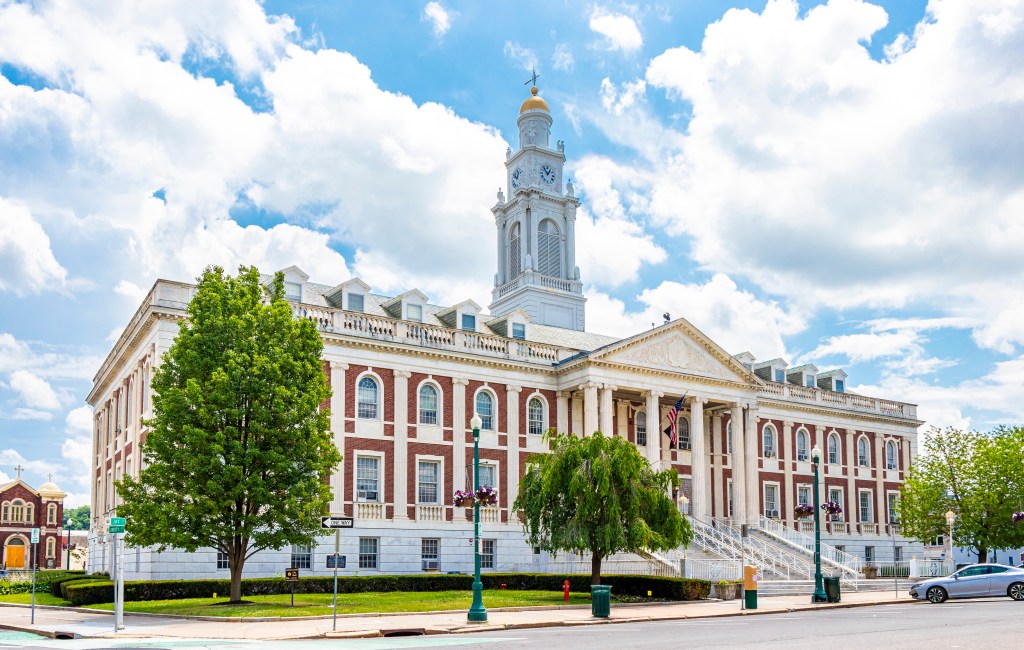
This building is the Schenectady City Hall, a massive architectural landmark which made my jaw drop when I saw it! The City of Schenectedy outgrew their old City Hall, and in the late 1920s, held a nationwide contest to select designs for a new City Hall. The contest was won by the prominent architectural firm McKim, Mead, and White. It appears that the designs were furnished by James Kellum Smith of the firm, the often overlooked genius of the MMW practice. The exorbitant cost of the project, which was undertaken during the Great Depression, caused the building to be dubbed “Fagal’s Folly” after Mayor Henry C. Fagal, who allowed all the cost increases while the city’s future was uncertain. He was not re-elected after this building was completed. The building is a pleasing mixture of Colonial and Classical Revival styles and features bold pilasters and a towering cupola
Located across the Town Green from the Tewksbury Town Hall (1920), this Colonial Revival style church with Classical elements, perfectly compliments the design motif seen here. The Tewksbury Congregational Church was established in 1734 by some 34 resident families who, after leaving the church in Billerica, established the new town of Tewksbury. Their first church was erected in 1736, and was replaced in 1824. The second church edifice (and much of the town center) suffered a catastrophic fire in 1918, destroying both structures, and resulting in a rebuilding campaign. Architect Curtis W. Bixby of Watertown, furnished designs for the church, which stands boldly beyond a large front lawn.
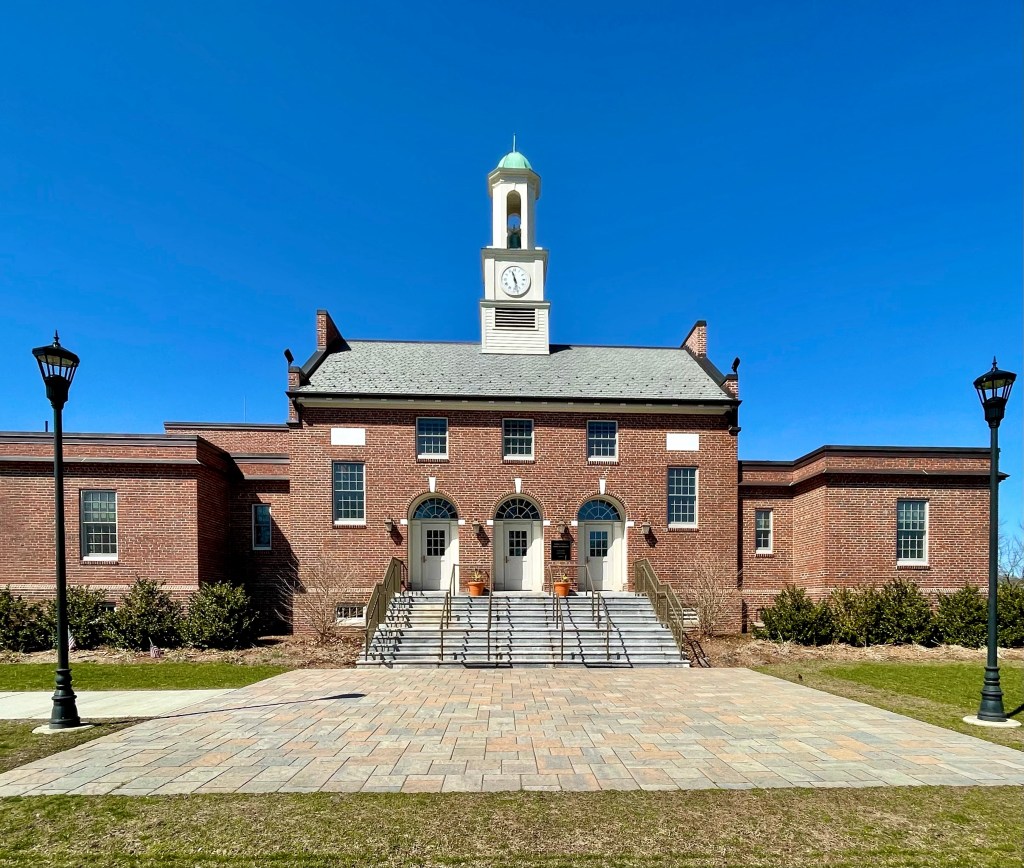
The town of Tewksbury, Massachusetts was colonized in 1637 and was officially incorporated in 1734 from the town of Billerica. The town was historically home to at least two raids by native peoples during the infamous King Phillip’s War, which killed dozens of men, women and children settlers. The town is named after Tewkesbury, England, likely inspired by some of the original settlers. The town grew as a rural village until it became a suburb of adjacent Lowell and Andover, Massachusetts. The town’s older Town Hall building burned in 1918, and funding was quickly acquired to erect a new, suitable building for the town. The Boston-based architectural firm of Kilham & Hopkins was hired and they designed this gorgeous Colonial Revival building. The symmetrical building features a main two-story block with a rear and side wings. The facade features three entrances with recessed fanlights above. A slate roof is capped by a towering cupola, which adds an additional flair to the building. The structure was so well-designed, it was featured in the Architectural Record in 1919, a national publication.
At a time when many public school buildings around Boston were designed in the Art Deco or early Modern styles, the Edith C. Baker School in South Brookline went back to basics and represents a nod back to Colonial era design. The whitewashed red brick building was designed and built in phases as the neighborhood surged in population, tied in with the re-emergence of the economy after the Great Depression. The opening of the West Roxbury Parkway in 1919 and the Hammond Pond Parkway in 1932, both precipitated subdivision of the farms in South Brookline for residential development. The first section was completed in 1937 (what is shown in the photo) by plans from the local architecture firm of Kilham, Hopkins and Greeley, who also designed an addition just a year later for the un-forecasted growth in the neighborhood. More additions were added in the decades following WWII, thankfully just as additions and not a scraping of the site which seems to be all the rage now. The school was named as a tribute to Edith C. Baker, a longtime member of the Brookline School Committee from 1900 to her death in 1942.




 Buildings of New England