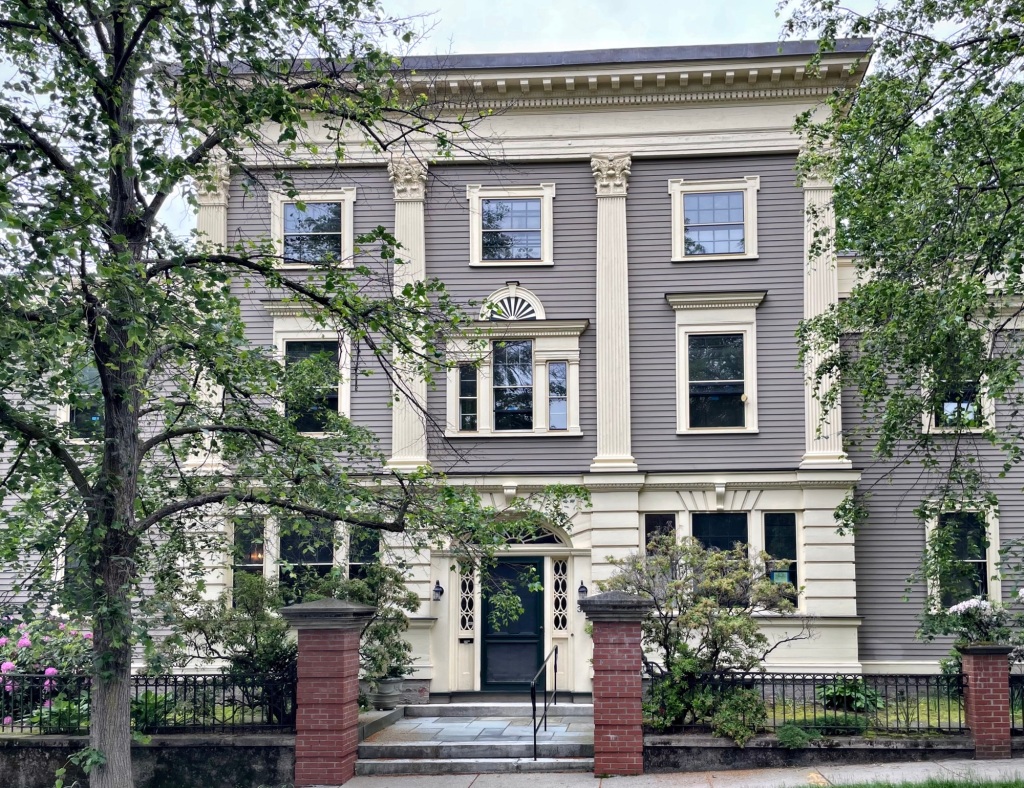
Sarah Bennett Matchett House // 1905

In 1905, Sarah A. Bennett Matchett (1833-1910), a widow, purchased a desirable house lot in the Longwood section of Brookline, Massachusetts. She inherited a large fortune upon the passing of her husband, William F. Matchett (1832-1901), who was the long time treasurer of the Boston and Roxbury Mill Corporation. The couple had no children, but she watched over her nieces and nephews following her brother’s death. Ms. Matchett hired architects Arthur Everett and Samuel Mead to design a large Colonial Revival style home on the lot, which was then built in 1905. Upon her death in 1910, she willed each of her four nieces and nephews $25,000 (roughly $800,000 (a piece) adjusted for inflation to today. She also willed $200,000 to Harvard College and funds to Massachusetts General Hospital and the Massachusetts Society for the Prevention of Cruelty to Animals. After her death, her Brookline residence was inherited by her eldest niece, Helen Maud (Bennett) Richardson and has been lovingly maintained over 110 years later!

Benjamin Green House // 1927

Located on Beech Road overlooking the “village common” of Longwood Mall, this 1920s Georgian Revival mansion showcases the curb appeal and perfect siting of suburban houses of the period . The home was built in 1927 for Benjamin Green, a real estate dealer and his family. The Green’s hired architect Harry Morton Ramsay, a noted area architect who specialized in suburban single-family homes of this period, to design the Georgian Revival style home. The brick residence features a symmetrical facade, half-round portico with Corinthian columns, round arched first floor and dormer windows, and decorative brickwork.

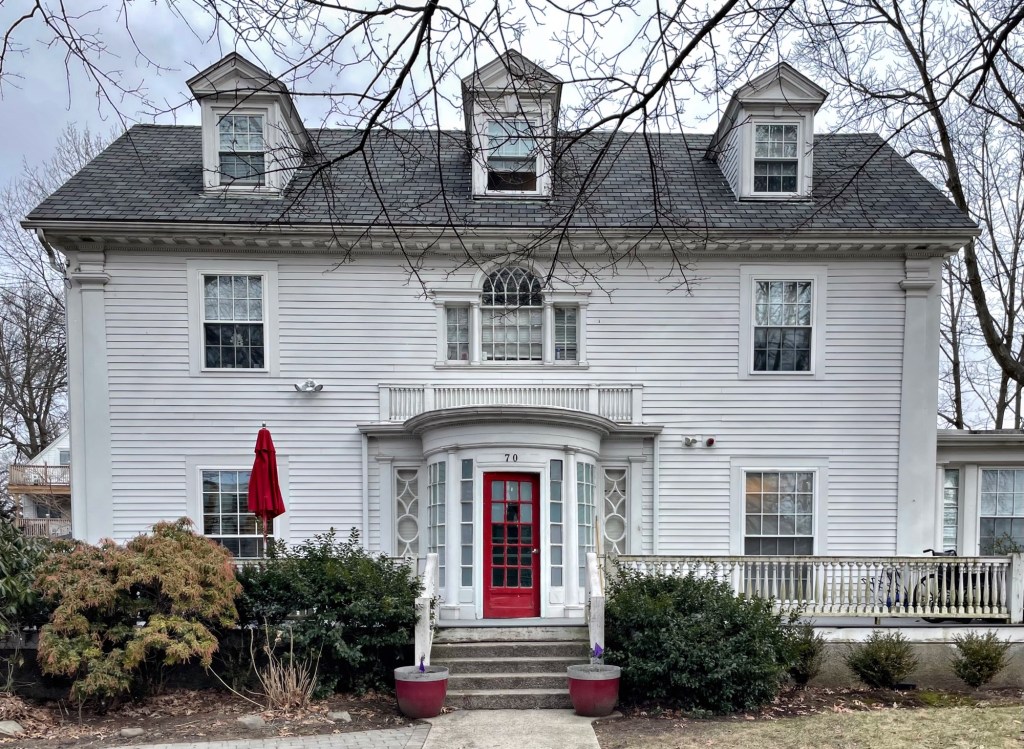
George G. Quincy House // 1909

If you love Colonial Revival style homes, the Longwood neighborhood in Brookline is a must-visit area to stroll around! This house is tucked away in the neighborhood and was a treat to stumble upon. This large home was designed by the underappreciated architect, James Templeton Kelley for a George G. Quincy. The Colonial Revival style dwelling is actually built of wood with a brick veneer and has an open pedimented entry with fanlight and transom surround. The round-headed windows on the first floor are especially notable.

Pope-Gardner-Robbins House // c.1870

Historians date the bones of this house in the Longwood section of Brookline, Massachusetts to the 1870s (or earlier), but its present appearance is definitely from the early 20th century. This is the Pope-Gardner-Robbins House on Colchester Street, a lovely span of stucco-sided homes in one of my favorite neighborhoods in the Boston area. An early (1874) map of the area shows this was the home of T. B. Pope, and later purchased by Harrison and Laura Gardner, husband and wife. Harrison Gardner was a founder (and served as treasurer) of the Boston Red Stockings of the new National Association of Professional Base Ball Players (NABBP). The Red Stockings eventually became the Boston Braves baseball team and are now the Atlanta Braves. The multi-lot property was likely rented by Gardner for supplemental income and was eventually sold to Annette R. Robbins, who seemingly had this home renovated in the 1920s and others nearby built or renovated as well. The house is today an excellent (and fairly uncommon) example of a Colonial Revival style house with stucco siding.

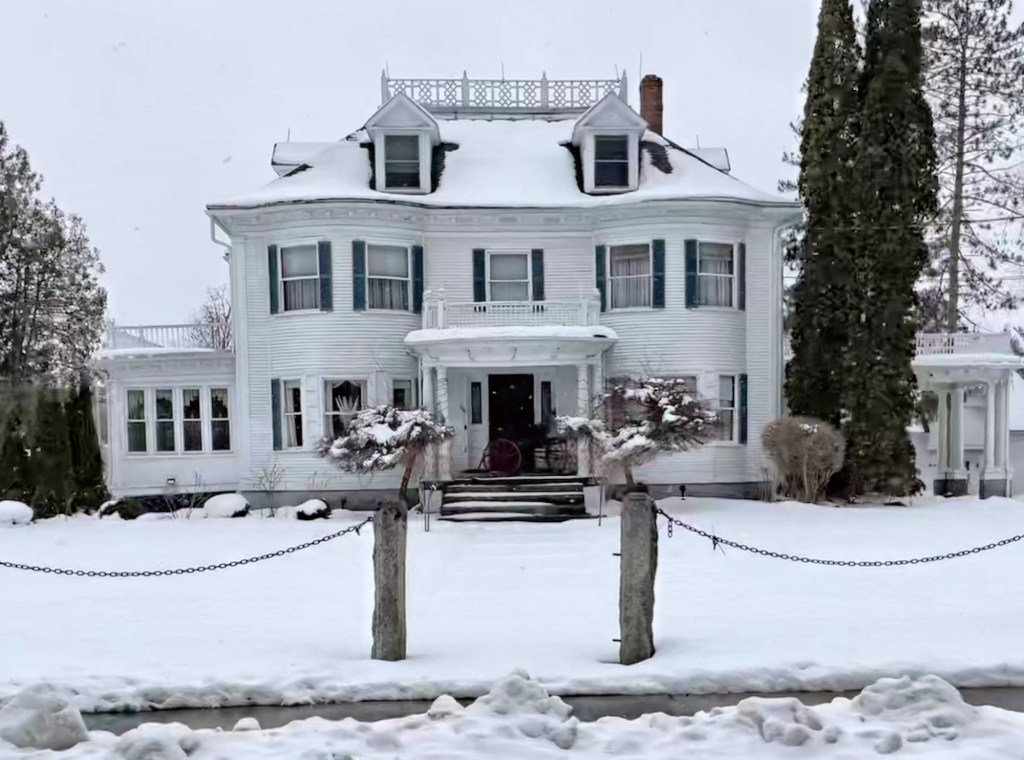
Butterfield Mansion – Derby Line Village Inn // 1903

Once described in a local history book as: “The largest, most glamorous home ever built in this [Derby Line] village”, the Butterfield Mansion is one of Northern Vermont’s best early 20th century houses. The house was built between 1901-1903 for Gen. Franklin G. Butterfield (1842-1916) who before this, received the country’s highest award for bravery during combat, the Medal of Honor, for his action at Salem Heights, Virginia on May 4, 1863 during the American Civil War. He would eventually move to Derby, Vermont, where he established the Butterfield Company, who specialized manufacturing axle cutters. Butterfield hired architects, James T. Ball and Gilbert H. Smith of Boston, who also designed the Haskell Free Library and Opera House in town that same year, to design his Colonial Revival mansion and intact carriage house. Today, the Butterfield Mansion is known as the Derby Line Village Inn.

Edgar-Wolfe-Moore House // 1864

At the head of Touro Park, this large home has stood since it was built in 1864 for Daniel Edgar of New York, who made it his summer home for eight seasons. It was designed by noted local architect, George Champlin Mason in the Italianate style and included a broad veranda, brackets, and other intricate details. In 1872, Edgar sold the property to Catherine Lorillard Wolfe, who occupied the house until 1883 when her property “Vinland” was completed on Ochre Point Avenue. In 1948, the house was purchased by Cornelius C. Moore, who remodeled the exterior in 1949-1950, removing its Italianate trim and replacing it with Neo-Federal detail we see today. The house was most-recently in use as the Touro Park Inn, but was recently purchased and is a single-family home.

Pinderhughes House // c.1916

As much of the streets north of Franklin Park were developed in the early 20th century, a mix of middle-class apartment buildings and stately single-family homes began to sprout up. Boston contractor Hugh Nawn hired architect Julius Adolphe Schweinfurth to design this house, seemingly on spec, as an income-producing venture. Schweinfurth was employed by the architectural firm of Peabody and Stearns and worked as chief designer there until 1895, when he opened his own practice. His design for Mr. Nawn was this stately Colonial Revival style mansion, similar to Nawn’s own home just across the street, which overlooked Franklin Park. After WWII, Roxbury’s population saw an increase in Black residents, who began to be pushed out of the South End due to increased cost of living. This home was purchased by Dr. Charles A. Pinderhughes (1919-1998), Chief of Psychiatry at the Veterans Administration Medical Center in West Roxbury who also taught at Boston University, Tufts, and Harvard. He was engaged in the local chapter of the NAACP and advocated for African American residents when Urban Renewal began to destroy much of the surrounding neighborhood by the Mayor and Boston Redevelopment Authority. The Pinderhughes House is a well-preserved architectural landmark that also has ties to a more recent and overlooked history of the neighborhood. I hope this house stays like this forever!

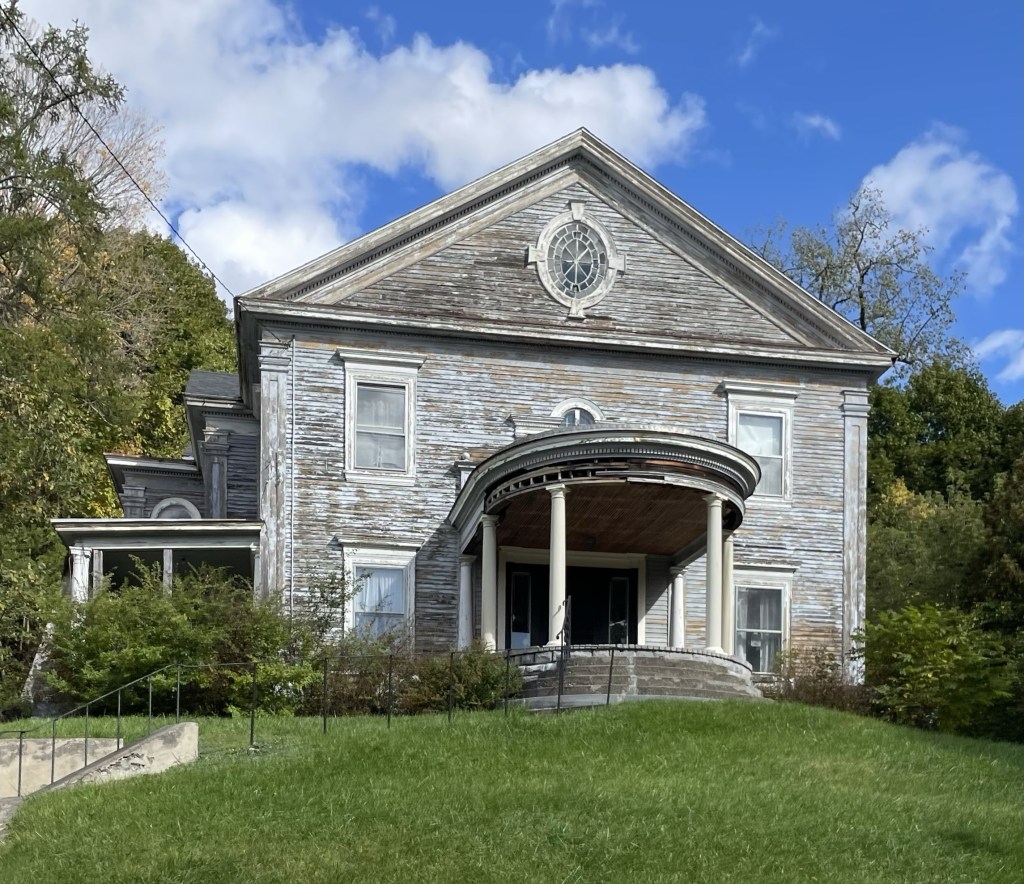
Ashe House // 1898

North Adams, like many formerly industrial towns and cities in New England has some amazing old Victorian and Colonial Revival houses built before the factories closed. Luckily for us, this town still has many unaltered residences, with some needing more love than others. This is the Ashe House, built in 1897-8 for Patrick J. Ashe and wife Katherine O’Brien. Classical details from many different styles make this house unique. An oval window dominates the traditional Greek facade which includes a pediment and side pilasters. A palladian window sits over the elliptical porch which is supported by columns. This one has so much potential!!

Stephen O. Metcalf House // 1892

I am on a Colonial Revival style kick lately, so bear with me on this recent span of posts on houses in the style! This estate house is an earlier example in Providence, built in 1892 for Stephen Olney Metcalf (1857-1950) a multi-millionaire who was in business in woolen textiles and insurance before diversifying his portfolio further serving as President of the Providence Journal and Evening Bulletin. To make an architectural statement, Mr. Metcalf called the renowned Boston firm of Andrews, Jacques and Rantoul to design his new residence. The oversized Colonial Revival house is an excellent example of how Revival architecture tend to be a more free interpretation of their prototypes, being larger and having exaggerated features and proportions. In his will, Stephen O. Metcalf bequeathed this residence to the Rhode Island School of Design (RISD), an institution his mother helped found, and his daughter served as President. The mansion remains the RISD President’s House to this day.

Henry Samuel Sprague House // 1902

Colonial Revival houses just exude New England charm! This house in Providence’s East Side/College Hill neighborhood was built at the turn of the 20th century in 1902 for Henry Samuel Sprague, a Providence grain dealer, for $15,000. Mr. Sprague clearly did well for himself financially as he could afford a house lot on one of the city’s most beloved streets, Prospect Street. The large mansion has many architectural details which stand out including contrasting brick and shingle on the first and second floors, a massive projecting portico covering a prominent entry, bold fluted pilasters at the center bay, and three pedimented dormers at the slate roof. Inside, this old house has some amazing woodwork and details too!