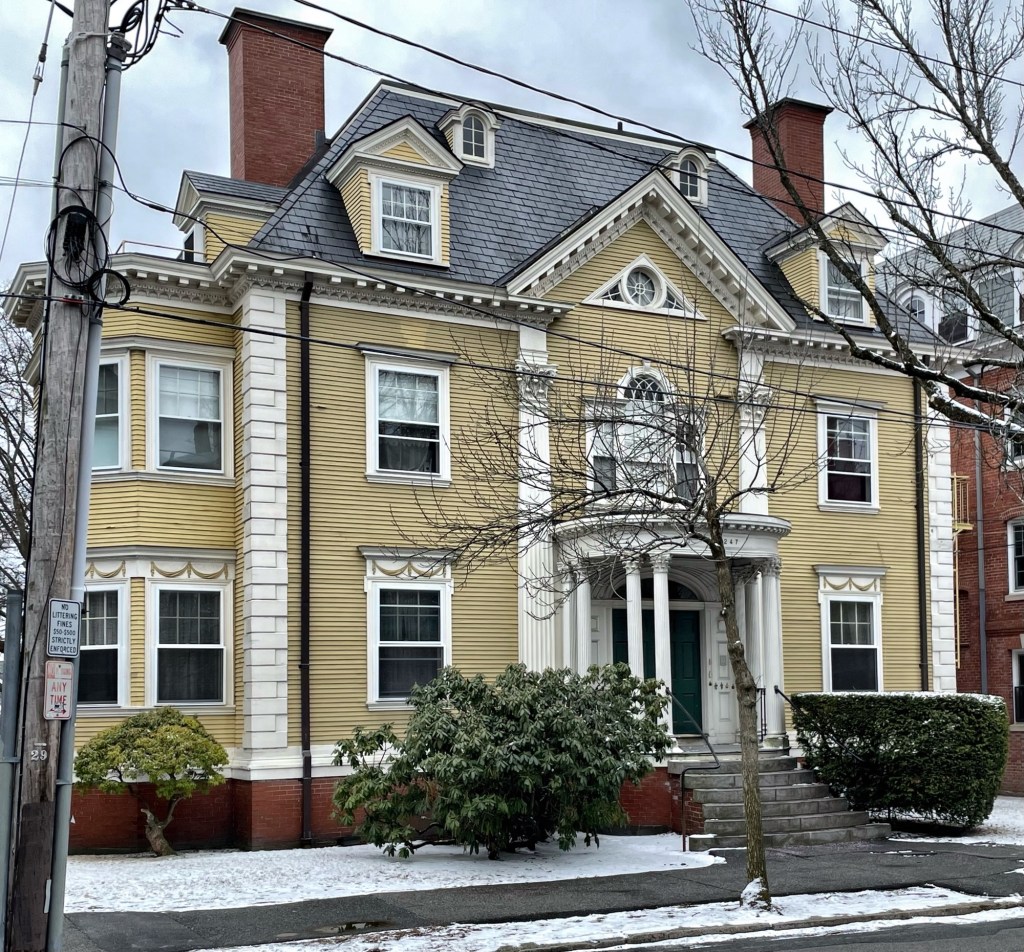
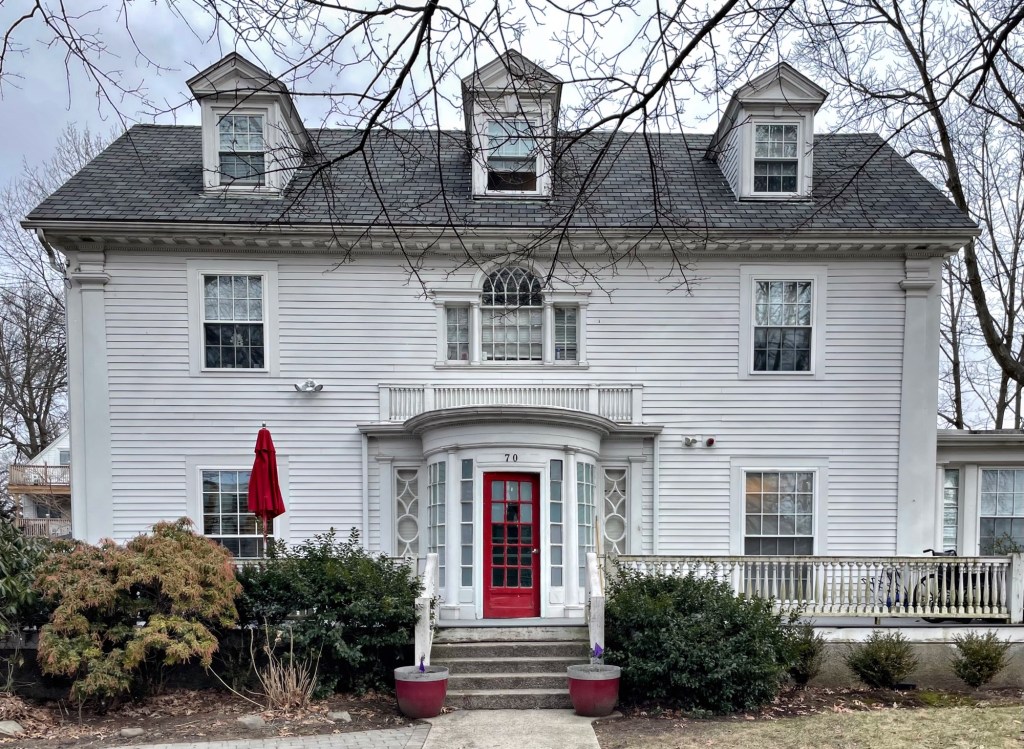
Briggs-Lyman House // 1903

Built in 1903 for Walter Briggs, this stately Colonial Revival style residence showcases the bold proportions and scale of the style. Located on Euston Street in the Cottage Farm neighborhood, this house was designed by Walter H. Kilham of the firm, Kilham & Hopkins, who specialized in large, suburban homes in the Boston area during the early decades of the 20th century. The symmetrical facade includes a projecting center vestibule, an arched window with blind fan above, bold window trim, and a shallow hip roof broken by two pedimented dormers. The house is so special that it was featured in a 1909 publication highlighting 100 country houses of various styles of the United States.

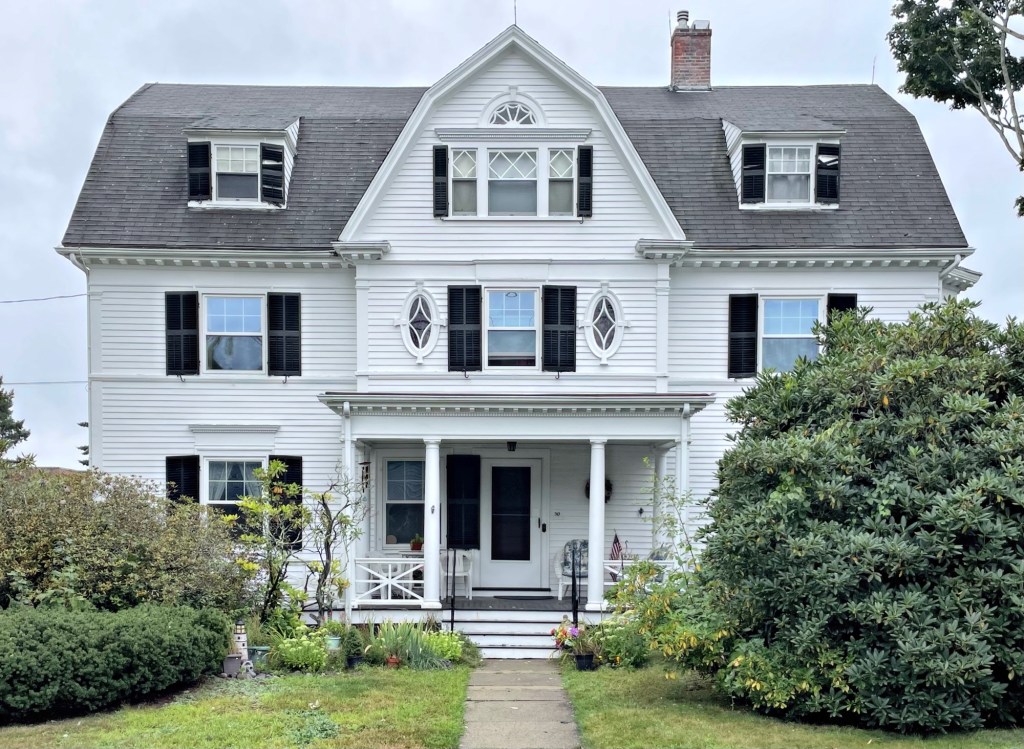
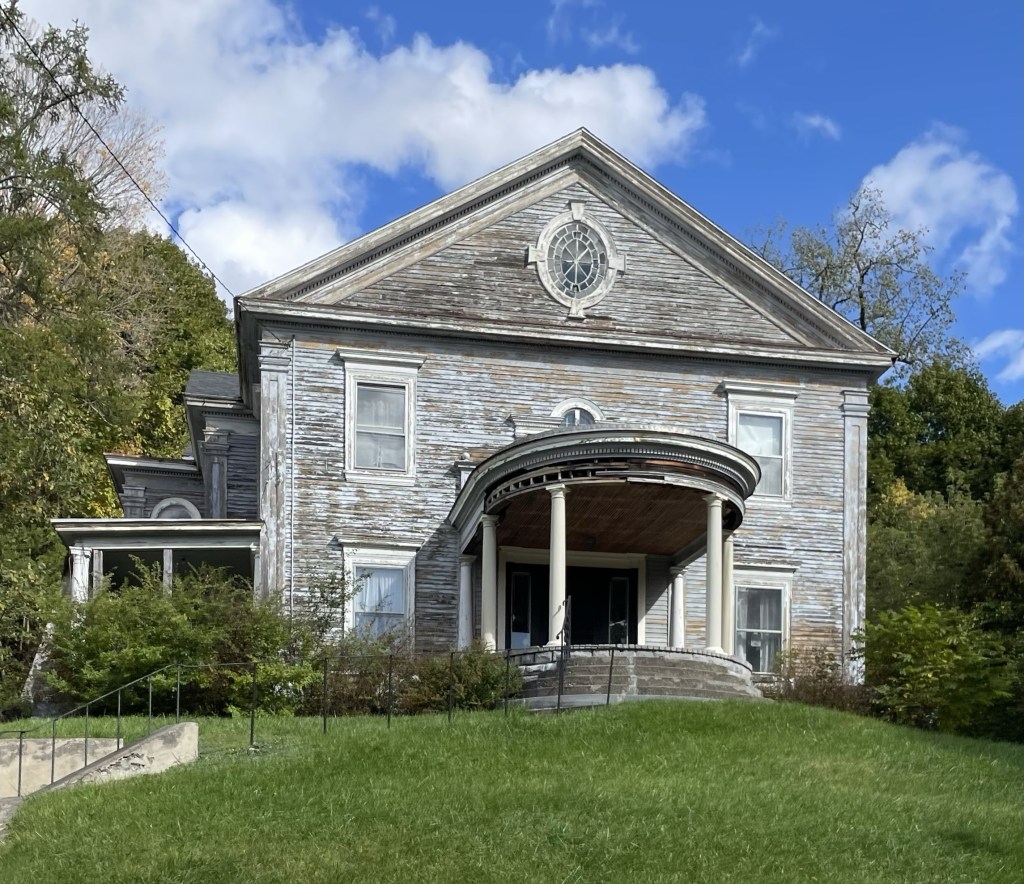
Rowe House // 1911

The Rowe House at 11 Mason Street is an over-the-top, and high-style example of the Colonial Revival style, showcasing the oversized proportions and scale that architects in the early 20th century followed when referencing Colonial American architecture. The house here was built in 1911 for Edward Prescott Rowe (1879-1936) and his wife, Eleanor Livingstone. Designed by the firm of Rowe & Keyes of Boston and New York, the commission was likely a relative of Mr. and Mrs. Rowe. The symmetrical house features a broad gambrel roof with Palladian windows in the side gable and central dormer at the facade, large pilasters breaking up the bays on the facade, a projecting Colonial Revival entry, and squat windows at the second floor terminating at the entablature above. The property even retains its Colonial Revival gateway.

Charles H. Owens House // 1906

This stately house on Powell Street in Brookline, Massachusetts, was built in 1906 for Charles H. Owens, Jr., and his wife, Nellie. Charles was a “house decorator”, who built the house next door just two years earlier before moving into this larger home in 1906. Both houses were designed by the architectural firm of Loring & Phipps, who Owens likely collaborated on commissions with in his career. The house is 2 1/2-stories with a shallow hip roof and is an excellent example of an academic interpretation of the Colonial Revival style. The principal facade has flush board siding with round-arched windows on the first floor along with a squat fanlight transom over the center entrance.

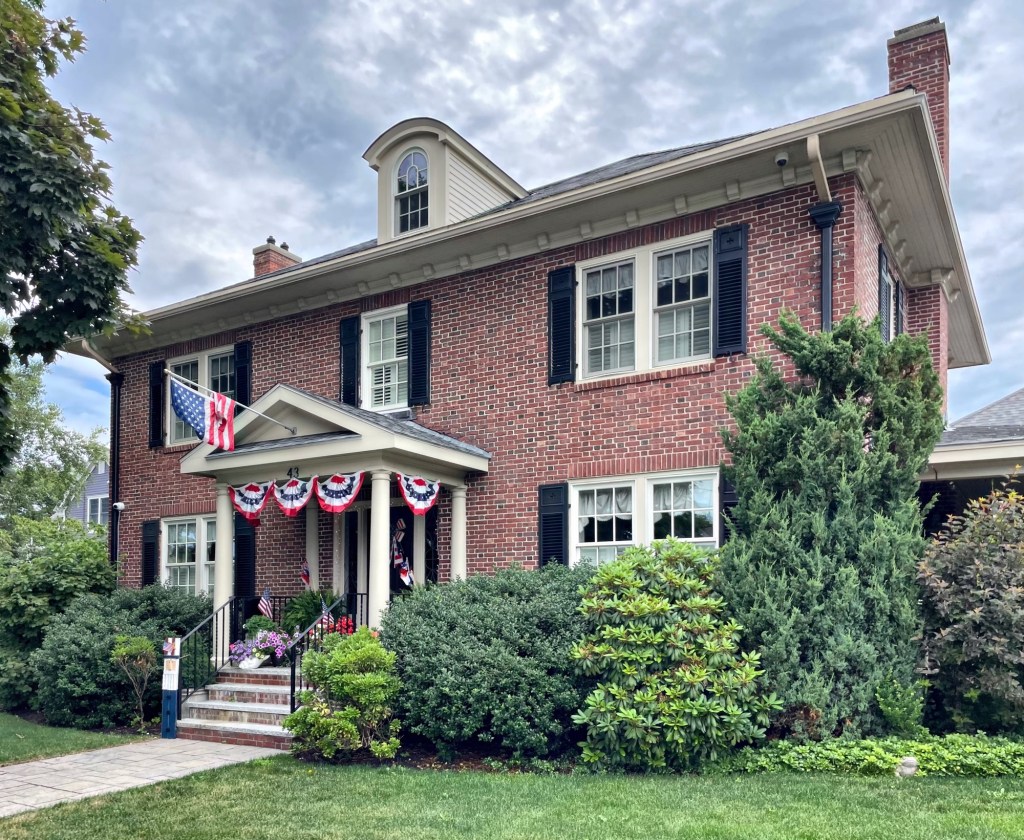
John R. Perry House // 1904

This lovely Colonial Revival style house on Powell Street in Brookline was built in 1904 for Charles H. Owens, Jr., an interior designer who just two years later, built another home next door that he would reside in with his own family. This house was rented to John R. Perry, who was also listed as a “decorator” in city directories and president of Perry, Lewis & Whitney, a design firm. The house (like its neighbor built two years later), was designed by the architectural firm of Loring and Phipps and was oriented southward to face the side yard. The Perry House features small projecting oriel windows, a broad gambrel roof, and an entrance portico supported by Tuscan columns.

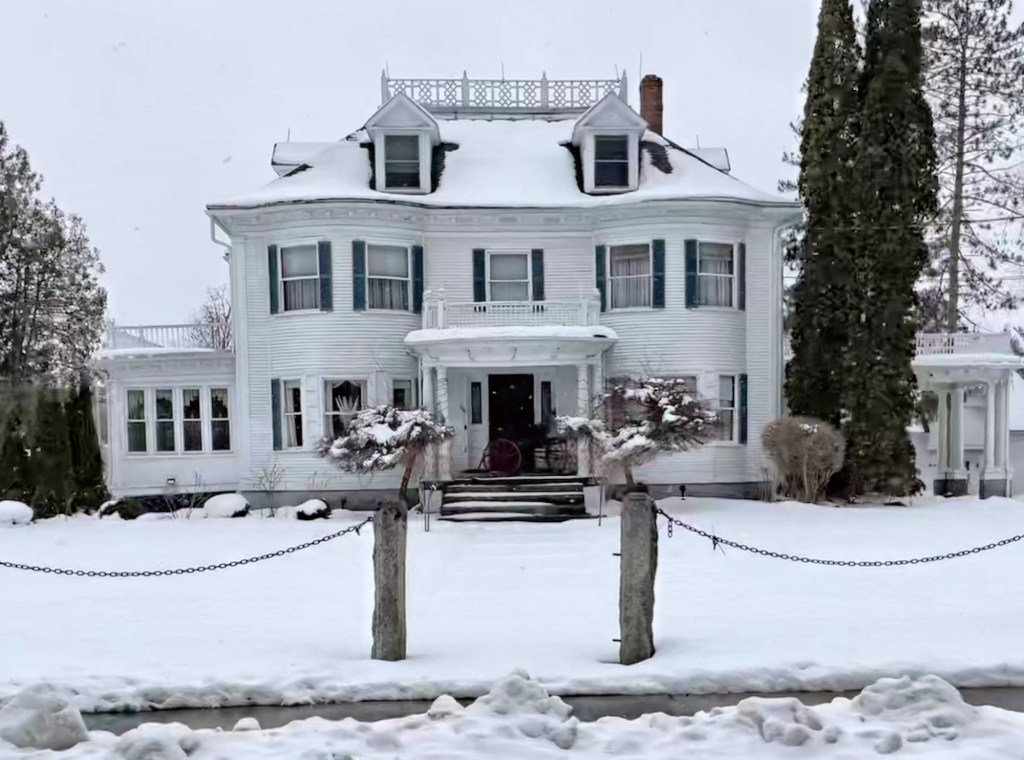
“The Pillars” // c.1780

Renovated in the early 20th century from a Federal style farmhouse, “The Pillars” in Canterbury, Connecticut, is an extravagant example of a Colonial Revival style residence in this quiet part of the state. The Pillars was the creation of Frank Edwin Miller (1856-1947) and his wife, Hattie Jenks Miller. The Miller’s retired here in 1913 after Hattie inherited the family homestead, which dated to the late 18th century, and they had the home renovated, adding the massive two-story columned porch and projecting entry. The house is a visual representation of the difference between Colonial and Colonial Revival styles as this home, the latter example, is a free interpretation of its prototype with exaggerated architectural details in a scale not seen centuries earlier.

Samuel B. Conant House // 1895

Built in 1895 for Samuel Conant, president of a Pawtucket printing firm, this stately residence is one of the finest Colonial Revival houses in Central Falls, Rhode Island. Designed by the Providence architectural firm of Stone, Carpenter & Willson, the house is brick on the first floor with clapboard siding above. The Contant house has a gambrel roof punctuated by several gable dormers. The main facade has two symmetrical round bays, which rise to the roof and are topped by low balustrades. A single-story porch extends between the center points of these bays, and is also topped by a low balustrade. Recognized for its architectural grandeur (inside and out), the house was individually listed on the National Register of Historic Places. The Conant House is now used as a nursing home and while the transition to this new use has required a number of interior alterations, these changes have been made with sympathy for the character of the house and many of them are reversible.

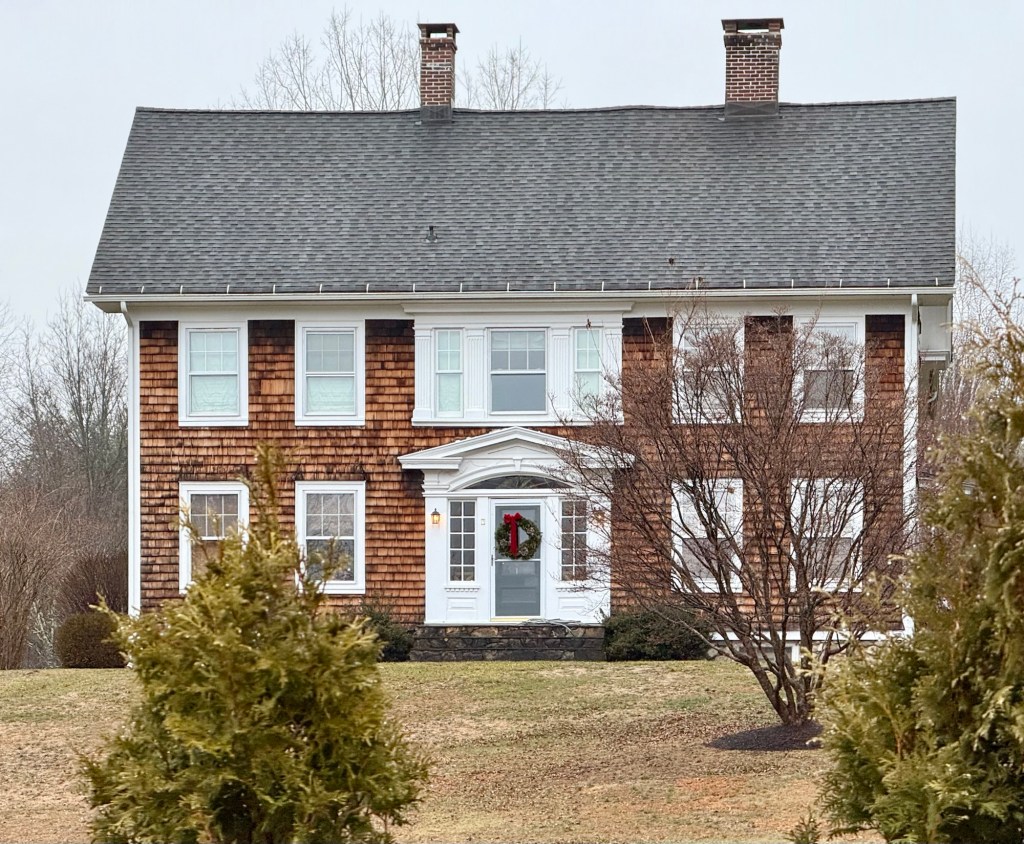
Kenneally House // 1913

While Salem, Massachusetts, is best-known for its Colonial and 19th century architecture, there are some great 20th century buildings that deserve attention. This is the Kenneally House at 3 Williams Street, just north of the Salem Common, a c.1913 Colonial Revival home with great curb appeal. The house was built for Maurice D. Kenneally, a teamster, who lived here with his wife, Mary, and son, Patrick. Symmetrically arranged, the house has a center entry , with sidelights and an elliptical fanlight. The front facade is dominated by a full-width first story porch on paired Doric columns and a gable roof with Palladian window.
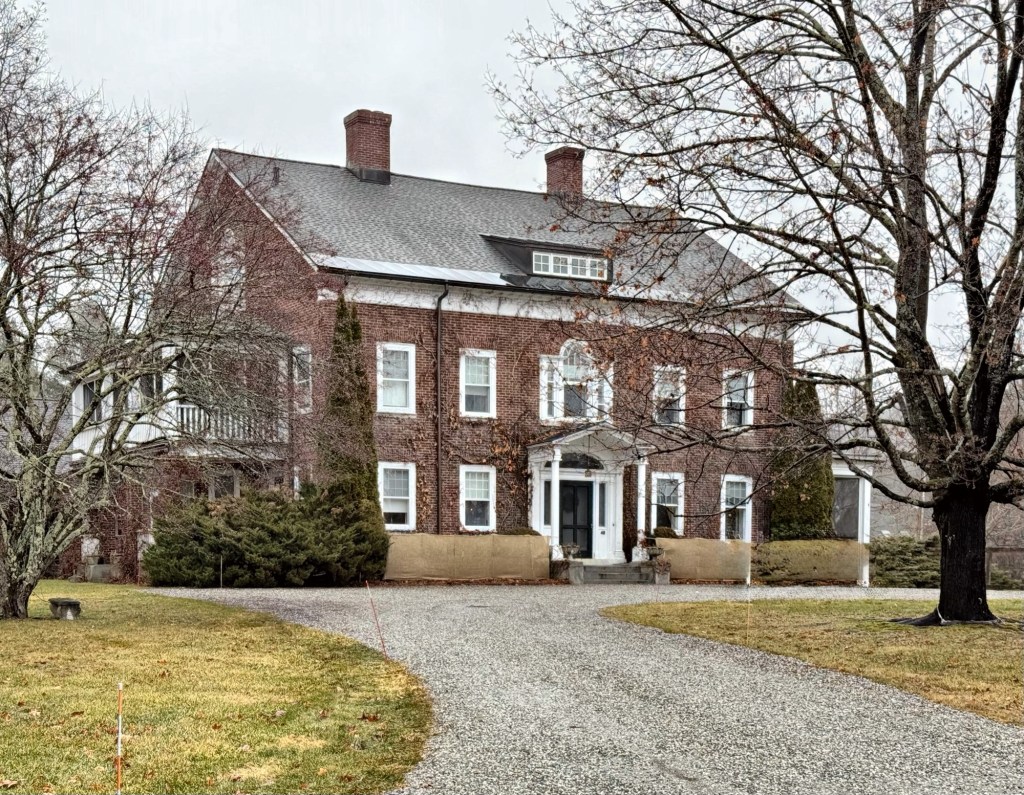
John E. Calhoun House // c.1912

This site, in the heart of Cornwall village, was once occupied by an early 19th century Federal style residence, built by the wealthy Pierce family in town. The Pierces’ large home was acquired by John E. Calhoun (1859-1940), a successful New York businessman, who retreated to his father’s hometown for summers away from the city. In 1911, a fire destroyed the home, which was wood-frame construction. This event mobilized Mr. Calhoun, who was untrained but interested in architecture, to begin planning a new summer residence, but of fireproof construction. Calhoun is said to have designed (and funded) the town’s library just years before, and modeled his home in line with the Colonial-era residences in the village, just larger and of brick. From the 1950s through the 1990s, the house was occupied by the headmaster and administration of the local Marvelwood School, but was re-established as a private home, a use that remains today.

Harriet Bennett House // c.1912

While most houses I have featured in Cornwall date to the early-mid 19th century, there are some great examples of early 20th century Colonial Revival dwellings, built at the time the town became eyed as a wealthy retreat for city-folk. This Colonial Revival residence was built for Ms. Harriet Bennett (1841-1928), an ardent suffragist and an active member of the Connecticut Woman Suffrage Association. Harriet was married to William C. Bennett and after his death in 1898, she devoted the rest of her life to charitable causes and giving back to others. As a widow and in her seventies, Harriet oversaw construction of this house, which was completed by 1912, in that same year, established the Cornwall Equal Suffrage League, hosting many of its events and meetings from this house. The League’s activities mirrored the efforts of suffragists throughout the nation. The house remains a well-preserved example of a house in the Colonial Revival style in town.

Francis and Sarah Cranston House // c.1895

The Francis and Sarah Cranston House is located on Bowen Street in the College Hill section of Providence, Rhode Island. Built circa 1895 for Francis Augusta Cranston (1837-1909) and his wife, Sarah (Hill) Cranston, the house is one of the best residential examples of Colonial Revival architecture in the city. Francis was the son of Barzillai Cranston, a descendant of Gov. Samuel Cranston, who held office from 1698 to 1727, being elected to office 30 times; serving as governor longer than any other individual in the history of Rhode Island. Francis worked as cashier of the Old National Bank of Providence for over fifty years and built this residence to settle into retirement. The residence is unique for its high-sloping hipped roof with two layers of dormers, corner quoins, Palladian window, and Ionic portico. I could not locate the architect, but if anyone knows, I’d love to give them their deserved credit!