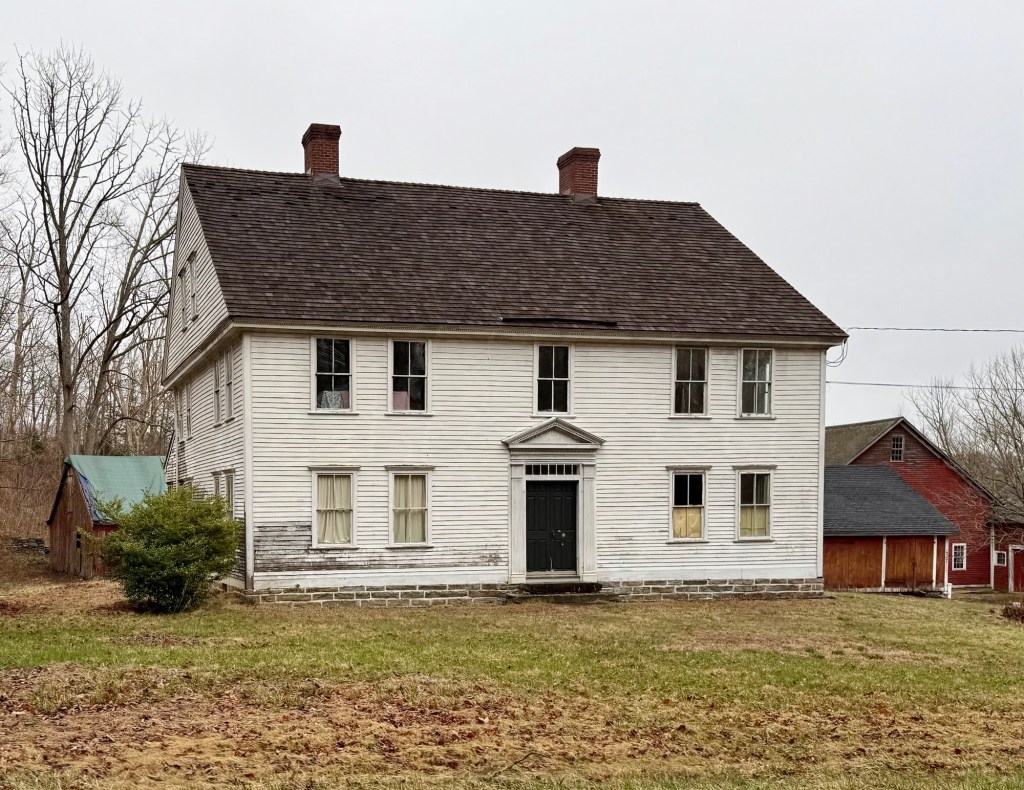
James Adams Farmhouse // c.1785

This handsome New England farmhouse is located in rural Canterbury, Connecticut, and showcases the type of farmhouses available to local wealthy residents in the late 18th and early 19th centuries. The construction dates to about 1785, just after James Adams, a Lieutenant in the American Revolution, purchased land here. The property remained in the Adams Family until 1859. The structure rests on
a fieldstone foundation and is sheathed with clapboards. The Georgian farmhouse incorporates a five-bay facade with central entry with five-light transom and a large stone central chimney and jettied gable ends on the sides.

Asa Bacon Farmhouse // 1783

Located in northern Canterbury, Connecticut, this rural farmhouse was built following the American Revolution, showcasing the emergence of the Federal style from the Colonial Georgian type farmhouses before. The house dates to 1783 and was built by Captain Asa Bacon (1735-1819), a wealthy farmer and captain in the Revolutionary War. The home was also occupied by his son, Asa Bacon Jr. (1771-1857) a Yale educated lawyer who practiced law in town before moving to Litchfield. Asa Jr. was a turnpike promoter, advocating for turnpikes through the formerly sleepy agricultural town, opening it up to trade and commerce. The early Federal-period home features a five-bay facade and central entry with triangular pediment and fluted pilasters. The house appears much like it would have when originally built besides the Victorian-era two-over-two window sashes installed in the late 19th century. The farm even retains a few 19th century barns, likely built when the windows were replaced by later owners.

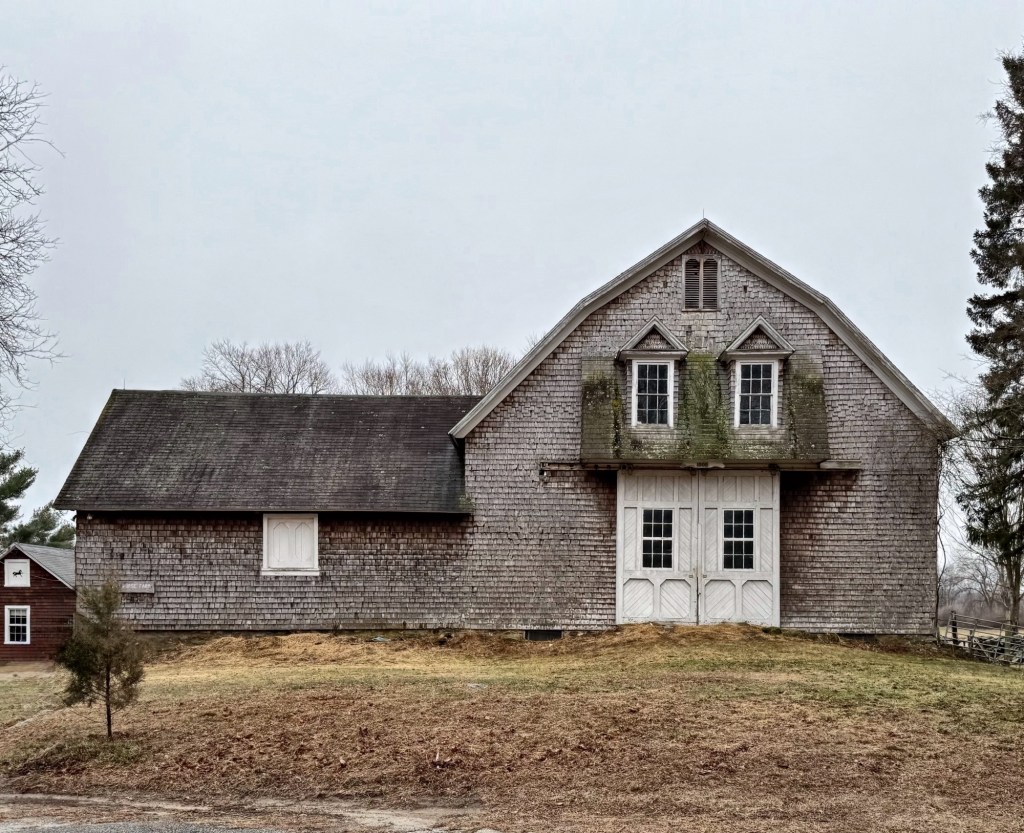
Gallup Farm Carriage House // 1906

This handsome Shingle style building was constructed in 1906 as a carriage house of a larger farm property in Scotland, Connecticut. The barn is said to have been built for Archie Gallup, who purchased the old Manning farm just west of the town green in Scotland. The 1 1/2-story carriage-house with a gambrel-roof stands out for its principal entry of paneled wooden doors and above, a large, flared hood featuring two pedimented gable-dormers. The entire building is clad with varied shingles to add complexity to the design, catching the attention of all who drive by.

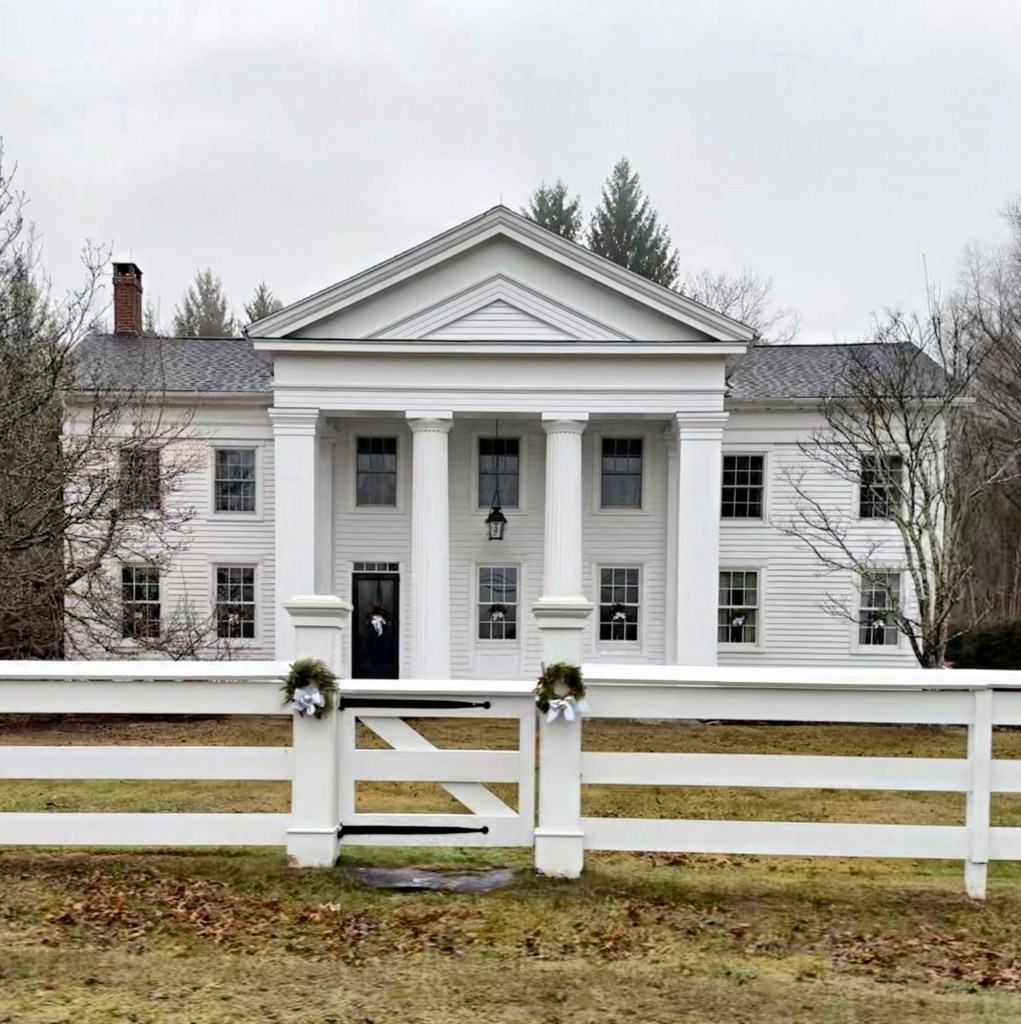
Dwight W. Pierce House // c.1850

On land he acquired from family, Dwight Wellington Pierce (1816-1901) erected this large, temple-front Greek Revival estate just outside Cornwall Village in Litchfield County, Connecticut. Mr. Pierce farmed this land and built barns across the street from his residence on Popple Swamp Road, where he kept his livestock. The Pierce house is unique in Cornwall as a temple-front Greek Revival style house and features a two-story portico with four Doric columns, the center two are rounded and fluted with the ends square. The elongated house is seven bays wide and must have been quite the sight when it was built in the mid-19th century.

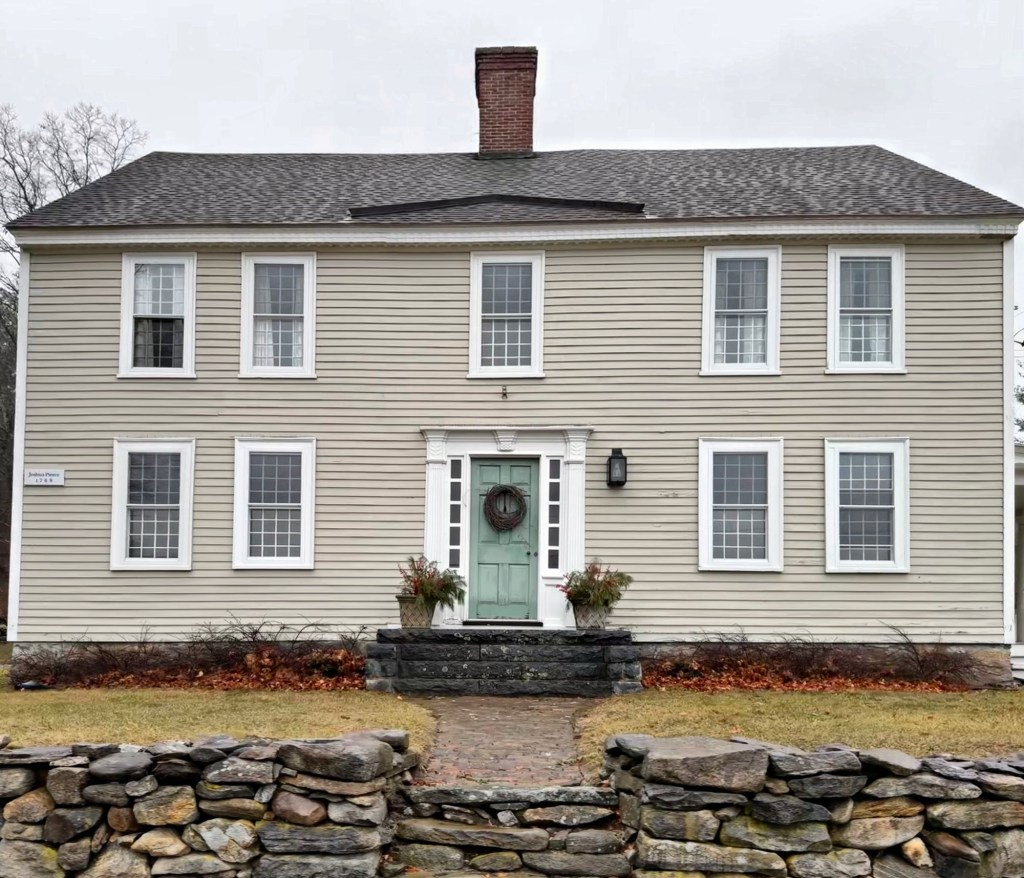
Pierce Homestead // c.1750

Built before the American Revolution, this large Georgian residence is one of the oldest extant houses in the charming town of Cornwall, Connecticut. Located on Popple Swamp Road just outside the central village, the Pierce Homestead dates to circa 1750 (the sign dates the house to 1768, but information from the town history mentions a house there earlier) and is a stellar example of a simple, two-story Georgian house with five-bay facade and 12-over-12 sash windows. This property was purchased by Joshua Pierce in 1748 and included over 300-acres of farmland, the farmhouse was likely built within a matter of years. The house was likely expanded and modernized by his son, Seth Pierce, who inherited the property in the 1790s. The farm remained in the Pierce Family for generations and was lovingly restored in the 20th century. It is a great example of a well-preserved 18th century farmhouse in Litchfield County, Connecticut.

Wright Homestead // 1767

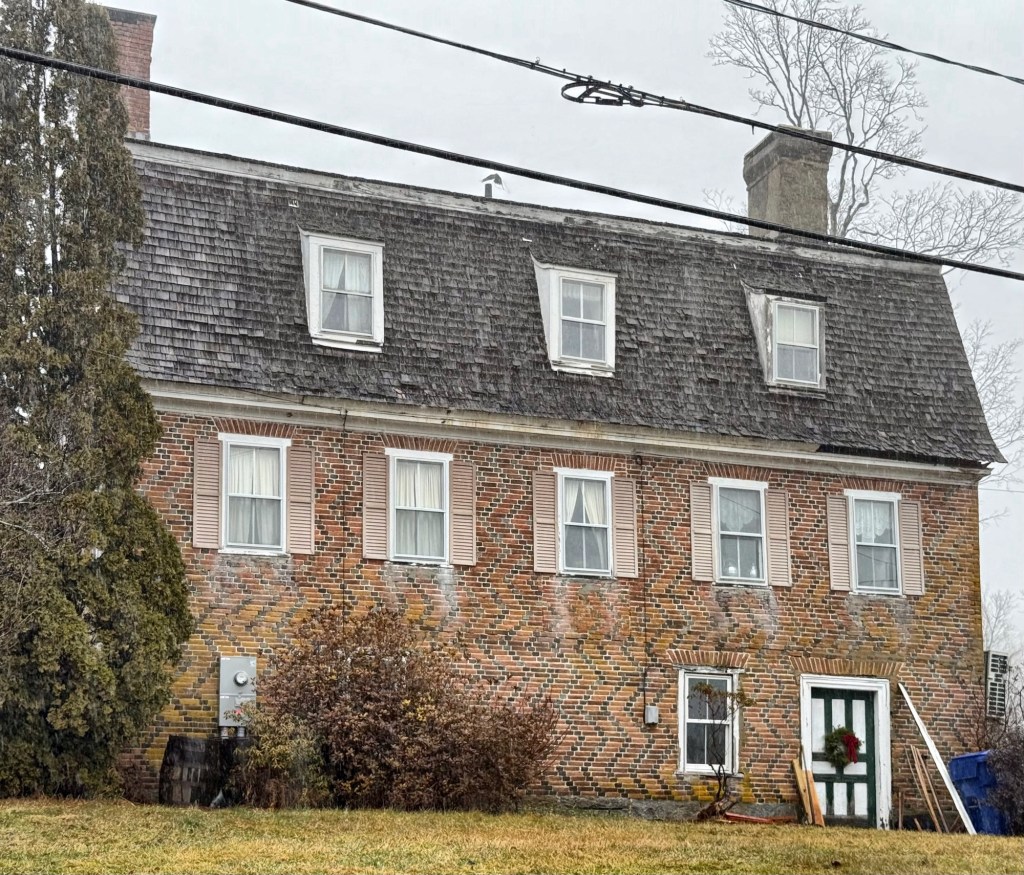
This large, brick gambrel-roofed Colonial home in West Goshen, Connecticut, was built over decades beginning before the American Revolution and has remained in the same family ever-since! In 1767, Captain Jabez Wright (1737-1813) married Martha Baldwin of Goshen, and began constructing this farmhouse of brick. When the war broke out, he fought in New York, he also served as captain of a company of Connecticut militia, turning out to repel the British forces at New Haven. He would largely complete the home by 1787, and ultimately died in 1813. After successive ownership of generations of the Wright family, the property was owned by Henry G. Wright (1831-1917), a farmer who represented Goshen in the state legislature and held many town positions. The first Methodist sermons in town were also held in the home. Henry Wright died at 86 years old on this property, after being attacked by a bull. When entertaining guests, he showed others a prized bull, and possibly fell into the pen, and was trampled and attacked. The Wright Homestead is unique for its brickwork with bonds and burned headers, resembling many Colonial-era homes in Virginia, but this house can be found on the back roads of Goshen, Connecticut!

Sumner-Carpenter House // 1806

I don’t think any state does the Federal style as well as Connecticut (Massachusetts is a close second)! This is the Sumner-Carpenter House, a high-style example of a Federal residence that is located on the backroads of the small town of Eastford, Connecticut. The house was built in 1806 for John Newman Sumner (1775-1831) who resided here until just before his death. The elaborate Federal period house was sold out of the family. After trading hands a half-dozen times, the property was purchased by David and Harriet Carpenter in 1881. The property remained in the Carpenter family for generations, and remained as such after Orlo Carpenter (1865-1938) was killed in the collapse of a barn during the hurricane of 1938. Architecturally, the house has all of the hallmarks of the Federal style, with the symmetrical main facade five bays wide, with a center entrance flanked by wide sidelights, and topped by a fanlight transom and corniced entablature. The window above the entrance is in the Palladian style, with a rounded center window flanked by narrower sashes. The house is very well preserved and was listed on the National Register of Historic Places for its architectural quality and preservation.

Bartlett House and Barns // c.1840

We featured Ashford, Connecticut, so now it’s time to explore some of neighboring Eastford! Settled in the early 1700s, the eastern portion of Ashford separated from its parent town in 1847, and became the town of Eastford. Prior to this, light industry, such as the production of cotton batting, twine, and wooden handles, complemented what would remain a predominantly rural agricultural community well into the 20th century. The winding back roads are lined with charming farmhouses bounded by rugged historic stone walls, making the town retain its rural feel. When driving through, I stumbled upon this postcard-worthy historic farm complex. Historic maps show that the property was owned by D. Bartlett in 1869, which appears to be Daniel Bartlett (1812-1898). The Bartlett property is enhanced by two historic barns sited nearby on a bluff overlooking the fields, which were likely once lined with trees or crops. By the 1900s, the property was owned by Nicholas and Clementine Dechand, the small road leading up to the farmhouse was named after the couple.

Michael Richmond House // c.1814

When the town of Ashford laid out a road across the land of Abner Richmond, he saw it as an opportunity to gift the newly organized plot across the road to his eldest son, Michael and his new wife, Polly as a wedding gift. Michael Richmond (1786-1881) built this Federal style house across the street from his father (see last post), likely employing the same builder, who employed similar design elements for both homes. In early life Michael learned saddle-making and afterward engaged in the manufacture of cloth, also axes. He was also engaged in staging and turnpike building, and in the mercantile business, until he retired at 60 years of age. He was a man of all trades! The house is now home to BOTL Farm, a pasture-based, sustainability-focused livestock farm that raises pigs, lambs, goats, and chickens ethically. Gotta love seeing farming coming back to Connecticut’s “Quiet Corner”!

Abner Richmond House // c.1803

This high-style Federal house sits across from the former Westford Baptist Church in Ashford, Connecticut. The house was built around 1803 for Abner Richmond (1761-1834) and his wife Eunice, who purchased 92-acres of land here one year earlier. Abner descended from John Richmond (1594-1664), one of the original white settlers of Taunton, Massachusetts in 1637. About ten years after he built his farmhouse, the town of Ashford paid the Richmond’s money for hardship caused by laying out a road right in front of the homestead. This 1812 occurrence possibly allowed the couple to invest further into the property, where they converted some of the rooms into a tavern, which was later accessible by the new Boston and Hartford Turnpike. The turnpike began in East Hartford and made its way through Ashford before winding its way to Boston. The house was documented as having 19th century stenciling on the walls, which survived underneath wallpaper (go figure). The new owners have clearly given the Richmond House some love and care, down to the perfect paint color.