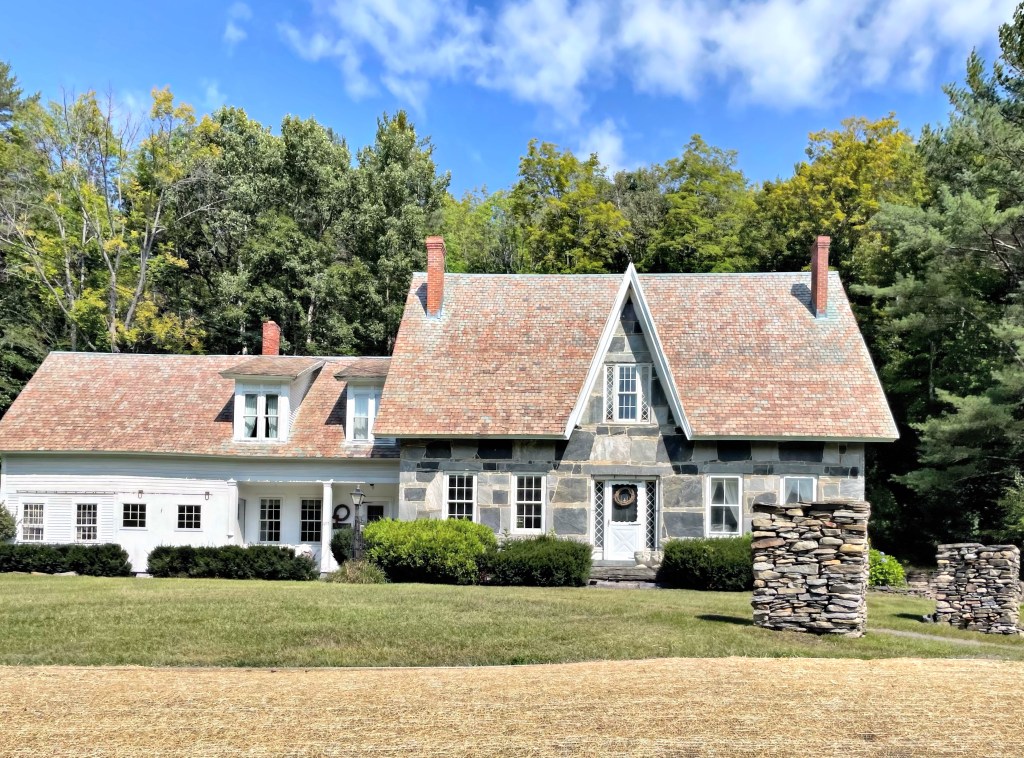
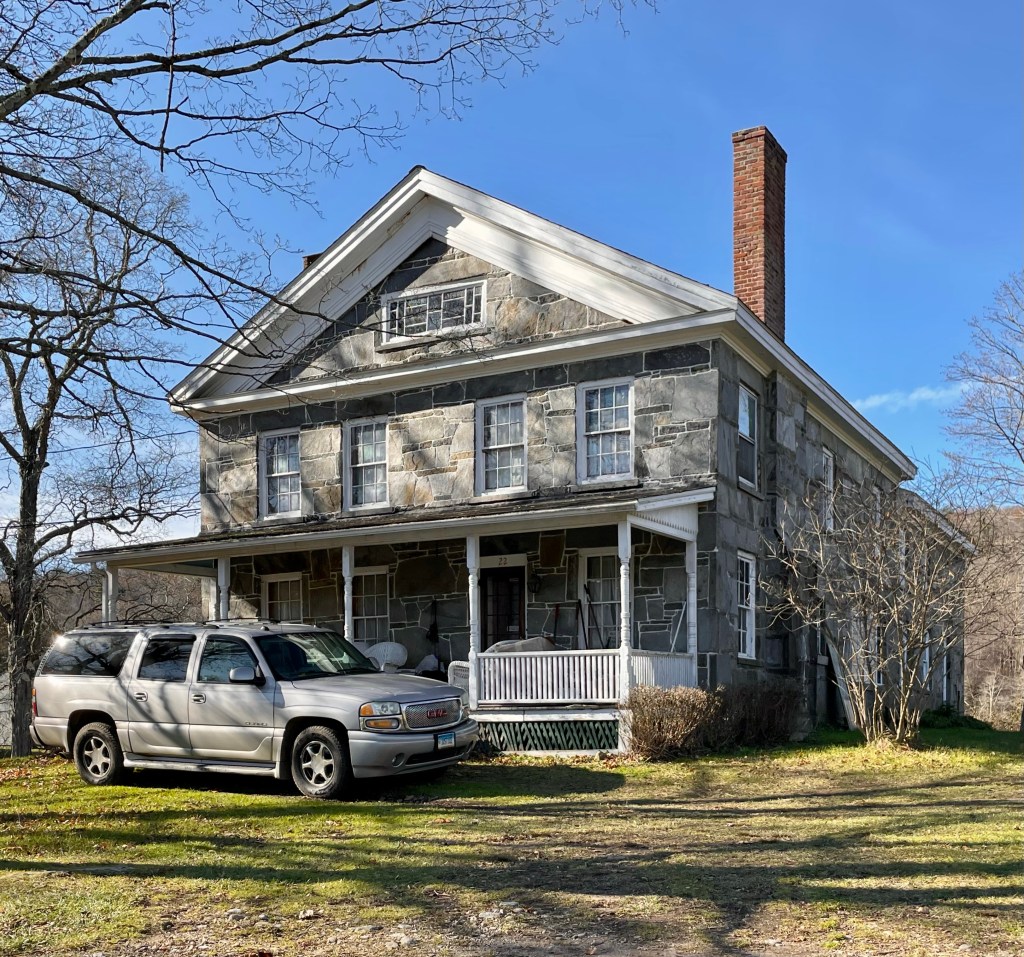
Scott Farm – Farmhouse // c.1845

Scott Farm, established as a working farm in the late 18th century and as a commercial apple orchard in 1911, is an excellent example of the vernacular architecture that Vermont is known for. The sprawling 571-acre farm was established in Dummerston in 1791 and purchased by Rufus Scott in the mid-1800s. In the 1840s, he built this farmhouse and many of the barn buildings soon after. The five bay Greek Revival house is in a Cape form and retains its historic slate roof and detailing. The property has been owned since 1995 by The Landmark Trust USA, a non-profit organization whose mission is to preserve historic properties through creative sustainable uses for public enjoyment and education. The farm sits a short drive to Naulakha and the Dutton Farmhouse (both featured previously) which are also managed by the Landmark Trust USA.

Dutton Farmhouse // c.1840

Another one of the Landmark Trust USA properties in Dummerston, Vermont is the Dutton Farmhouse, a meticulously restored Greek Revival farmhouse from around 1840. The gable-roof farmhouse was possibly an addition to an earlier dwelling built decades earlier as a one-and-a-half-story center-chimney home, seen at the rear today. The first known owner of the farmhouse was Asa Dutton who farmed off the large orchards. Generations later, the farmhouse served as a dormitory for migrant laborers who worked nearby, with the interior being altered. The property was eventually gifted to the Landmark Trust USA, who began a massive restoration project on the home, uncovering original detailing and even historic wallpaper! The house has since been meticulously restored and preserved and is available for short-term rentals! The charming interiors and near silence outside is a perfect getaway from city life.

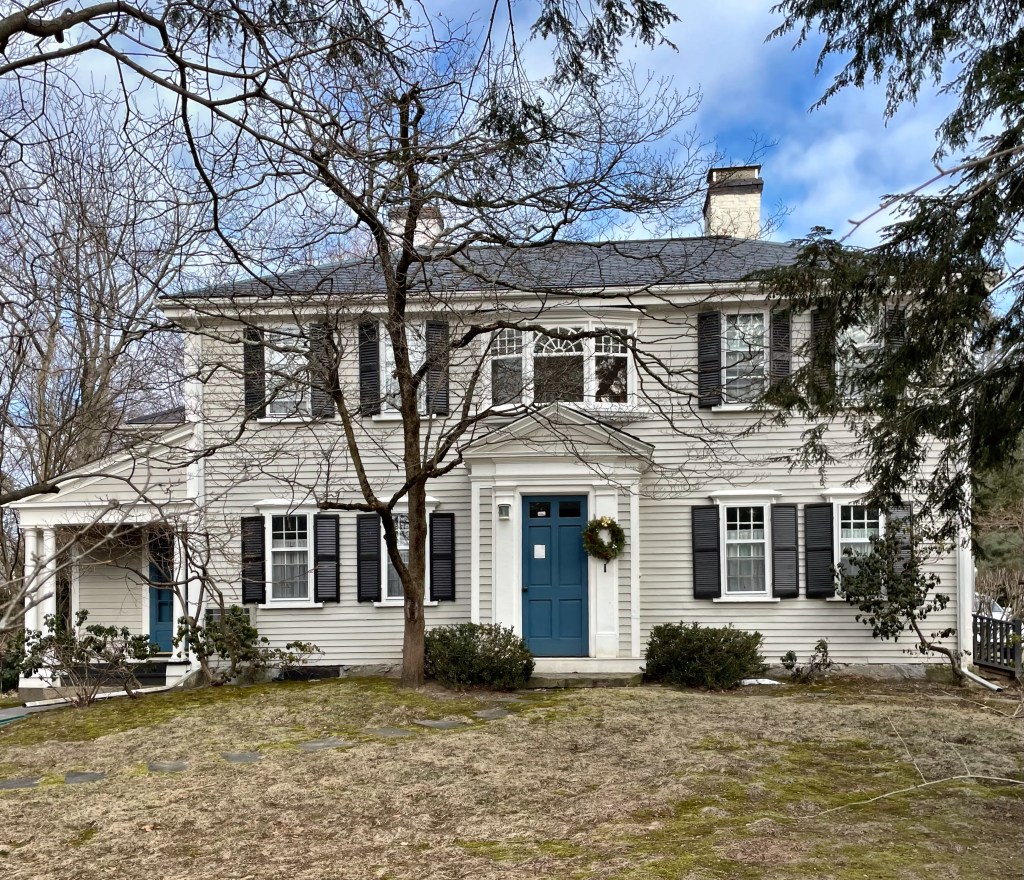
Tower-Wyman Farmhouse // pre-1790

One of the oldest extant homes in Waban Village, Newton, is this 18th century farmhouse which is an excellent example a Federal-period home in the Boston area. Dates of construction for this house have ranged from c.1765 to 1790. The earliest recorded ownership of 38 acres of land at this location is attributed to Eleazer Hyde (1664-1731), one of Newton’s earliest citizens and one of a long line of Hydes in Newton. From 1772 to 1791, the house was owned by Josiah Starr. Immediately after, this property was owned by a housewright named Capt. Ebenezer Richardson, who possibly built or re-built this house in the current configuration. Thaddeus Tower owned the land from 1844-1866, when the City of Boston took a portion of it in 1848 for the new Cochituate Aqueduct, which ran right behind his home. Not long after, Thaddeus sold the farm to Edward Wyman, a linen importer from Roxbury. He subsequently
sold it to his brother Dr. Morrill Wyman in 1869. Dr. Morrill Wyman sold 150-acre property to developers, never appearing to have lived in the home, after the railroad came west from Boston in 1886 and increased the value of the surrounding farmland, later known as the village of Waban. All of the land was developed with homes, and all that remains of the old farm is the farmhouse seen here.

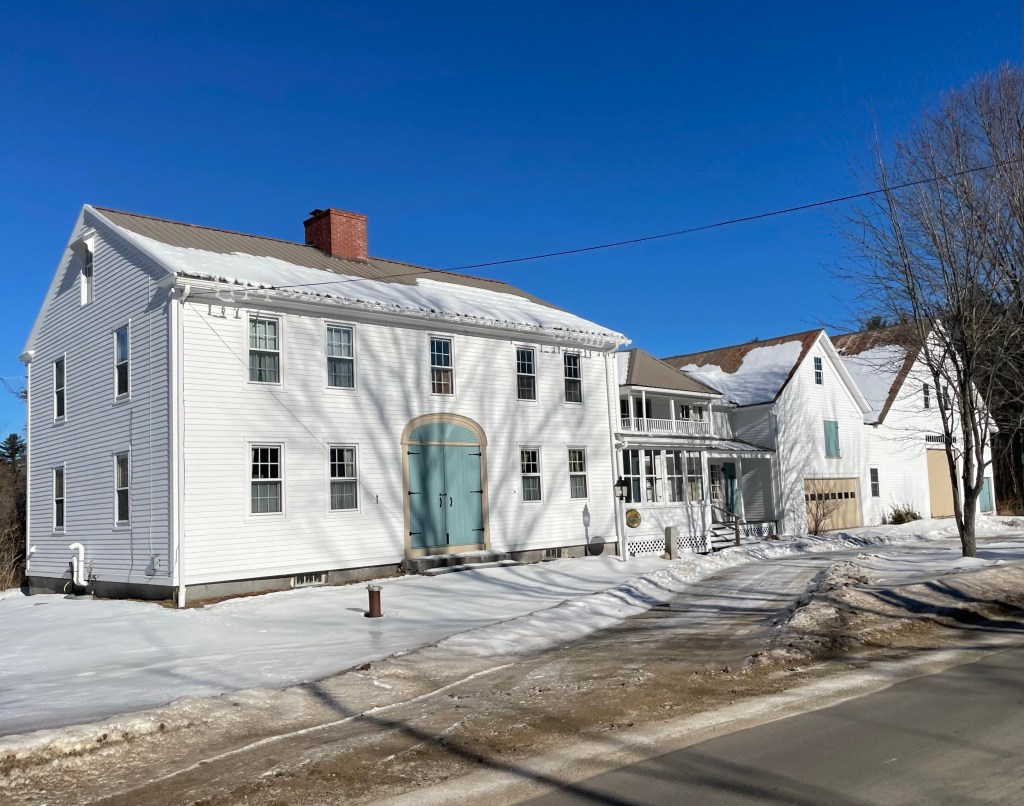
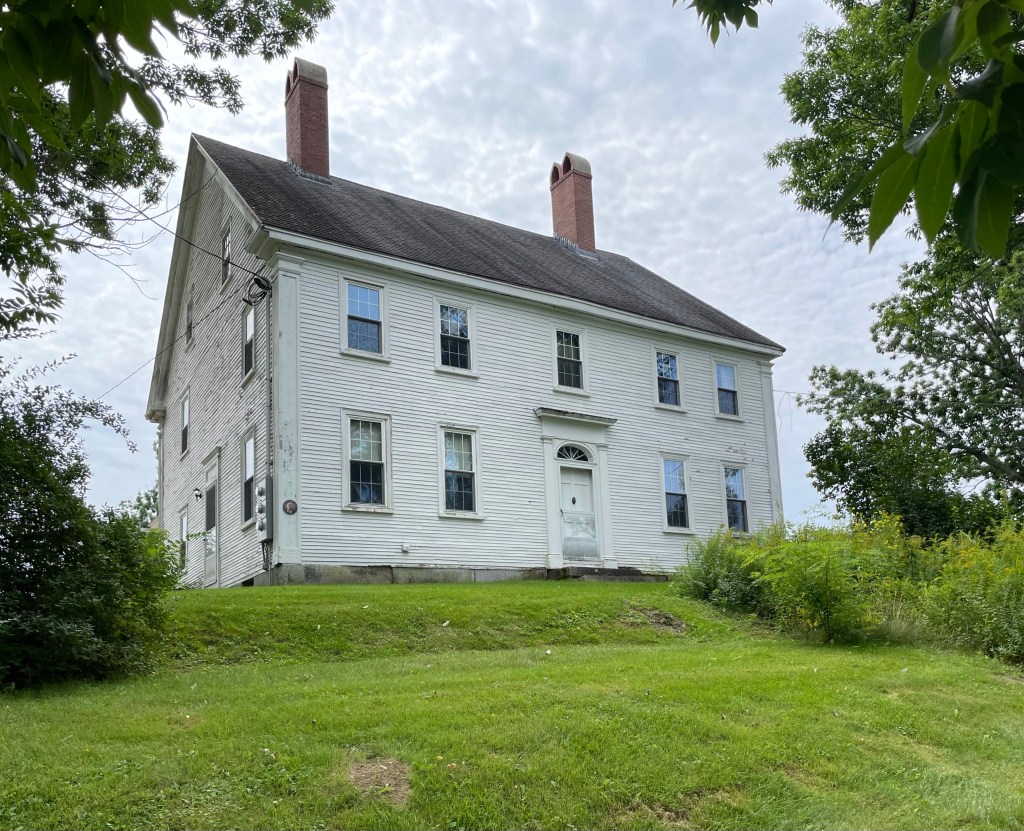
Nevers-Bennett Farmhouse // c.1820+

In 1820, just seven years after the incorporation of Sweden Maine, a homesteader, Amos Parker purchased fifty acres of land and began to erect a two-story, Federal house with a center chimney and a detached store beside it. Plagued by debt, Parker sold the unfinished house to Samuel Nevers circa 1833–1835, who purchased the property with the store for his recently married son, Benjamin. By 1860, Benjamin Nevers had a successful store and prospering farmstead. Benjamin died in 1883, and in the next two years, their daughter Charlotte, and her husband, Charles Bennett, dramatically remodeled and modernized the farmstead, adding a connected two-story ell building outward from the main house toward the old 1840 barn, connecting the entire property. I believe that the property remains in the Nevers-Bennett Family, as recently, Steve and Judy Bennett, recently negotiated an easement with the Maine Farmland Trust to protect their hay, beef, and maple sugaring acreage as farmland into the future.

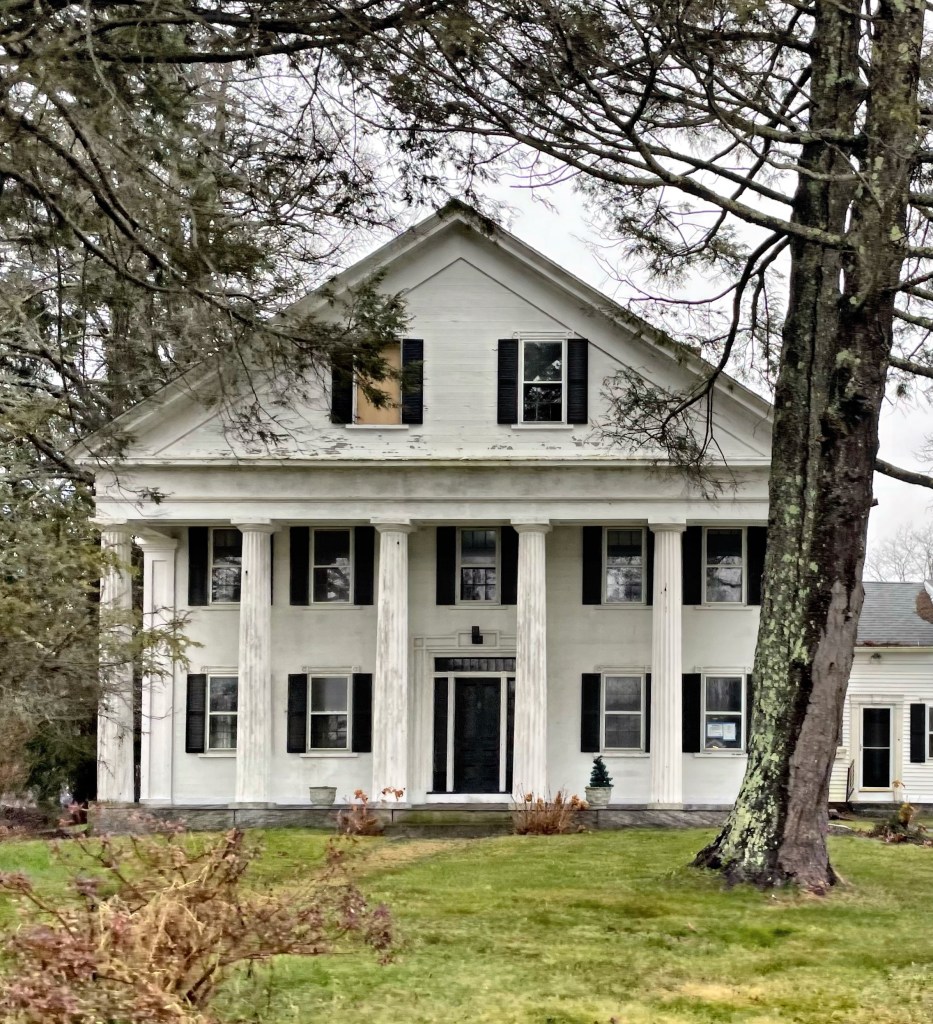
Elijah Waters House // 1845

Elijah Waters (1773-1846), a hardscrabble farmer in West Millbury inherited his father’s large farm and resided there for over thirty years before wanting something more his style. Unmarried and without children, Elijah (who was 72 at the time), had this impressive Greek Revival farmhouse constructed near his old family homestead. He was possibly looking to spend money saved up and without a wife or heirs to will it to. The massive temple-front Greek Revival mansion has a stunning doorway and six columns supporting a projecting pediment. Within a year after the home was built, Elijah died. The home was willed to his nephew, Jonathan Waters. The house is for sale for $384,000 which is a STEAL!

Bond Farmhouse // c.1800

This farmhouse is unreal… Located on a rural back road in Millbury, I came across this rambling old Cape house with a stone wall and everything! The home appears to have been built in the late 18th or early 19th century, possibly as a half-cape (with the door and two windows to the right) for Emery Bond, or possibly his father, Oliver Bond. The home (like many Cape houses) was added onto as the family grew and finances could necessitate a more substantial house. It likely added the two bays to the left of the front door next, then bumping out the sides by the 20th century to give it the present, elongated appearance. It’s not often that a once-modest Cape house stops me in my tracks!

Barber-Perry Farmhouse // 1843

Known locally in Canton as the “Stone House,” the Barber-Perry House was built in 1843 by two brothers, Volney and Linus Barber, seemingly for their brother, Samuel. They used local stone for the construction, that was quarried to the north of the property. The house was bought by George W. Lamphier in 1866 and by Thomas M. Perry in 1944. Perry was a physicist working on gears for naval ordinance during the war. He worked in a shop on his property and soon started the T.M. Perry Company in 1955. The property here is still a working dairy farm, known as Perrys Dairy, and is reportedly the last working dairy farm in town!

Wagon Hill Farm // 1804

Beginning in 1798, sea captain John Bickford (1765-1813), purchased a 127-acre farm which extended from the newly laid turnpike to the Oyster River. Bickford was a resident of Salem, Massachusetts, but owned his family’s homestead across the river on Durham Point and also purchased five other farms in the area but did not live on any of them. The Wagon Hill farmhouse was built in 1804 and is a great example of a vernacular Federal style house. In 1814 while on a voyage to the southern tip of Africa, Captain Bickford died. All of his New Hampshire property was sold except for this Durham farm which remained under the management of his widow, Mary Bickford. She worked as a housekeeper for Captain Joseph White in Salem, and rented out the Durham farm. In 1830, the farm was sold to Samuel Chesley, and it remained in the ownership of four generations of the Chesley family. Here, the family ran a diversified farm, from sheep, to ducks, to apple orchards. In 1960, the farm was sold to Loring and Mary Tirrell. Farming had ceased entirely by the time the Tirrells moved into the house but the fields were kept open and it’s agricultural past was honored by the placement of an old wagon on the crest of the hill. Over the years, the farm has become known to local residents as Wagon Hill Farm. It was purchased by the town in 1989, and serves as a lasting remnant of agricultural history and an amazing preserved open space in the town.

Wetherbee-Steele Farm // 1784

In 1775, Silas Wetherbee gave three acres of land in present day Boxborough, MA, to be used as a meetinghouse and burial ground site for the new town that he and 17 other outlying farmers of Stow, Harvard, and Littleton hoped to establish. That year, having formed a new religious society, they acquired the old meetinghouse in the nearby town of Harvard, dismantled it, and began to reconstruct it on land donated by Wetherbee. In 1783, the Town of Boxborough was officially incorporated, with the meetinghouse at its approximate center. That next year, Silas sold his son Levi, “60 acres of land, half of a building referred to as the “old house,” and half of a barn, all located just east of the townhouse. The farm was run by Levi until his death in 1829, when it came into the possession of his son, John Wetherbee (1800-1858). In 1908, the property was sold out of the family when it was purchased by Burpee Clark Steele, who owned it for the next seventeen years. Steele had immigrated from Nova Scotia to Boxborough in 1886, and he quickly became known for his expansive apple orchards. In 1925, Burpee Steele conveyed the farm to his son, Burpee Franklin Steele. Under his ownership, the old barn blew down in the Great Hurricane of 1938, and he constructed a new barn years later. Also a later addition, the Richardson Ice House was moved to the site by the local historical society in the 1990s. The farm today is protected by the town, but the buildings could use some better maintenance. Hopefully the town funds their preservation so they do not decay.

Littlefield Farm // c.1843

One thing I really love about small towns in New England is the prevalence of amazing old homes on the winding back roads. Located in Boxborough, MA, the Jacob Littlefield Farmhouse showcases the agricultural character and charm seen in the town. The farmhouse and outbuildings were built by Jacob Littlefield, who likely hired a housewright from town as the home is a near match to a home built on a nearby street. Mr. Littlefield was a farmer from Wells, Maine with seven children and a wife named Anna. After his death, his wife Anna owned the farm, until her death in 1896. Their son Albert ran the farm from about 1896-1922, after which time Jacob’s grandson Earl was the owner. Earl was taxed in 1928 for ownership of two horses, 17 cows, a bull, the house, barn and shed, tool house, ice house, root house, hen house, garage, and a second house on 101 acres. He resided here until 1929 when it was sold out of the family. Since then, subsequent owners have restored the home and the various outbuildings to maintain the architectural and historic integrity of the property. We need more stewards of old homes like this!