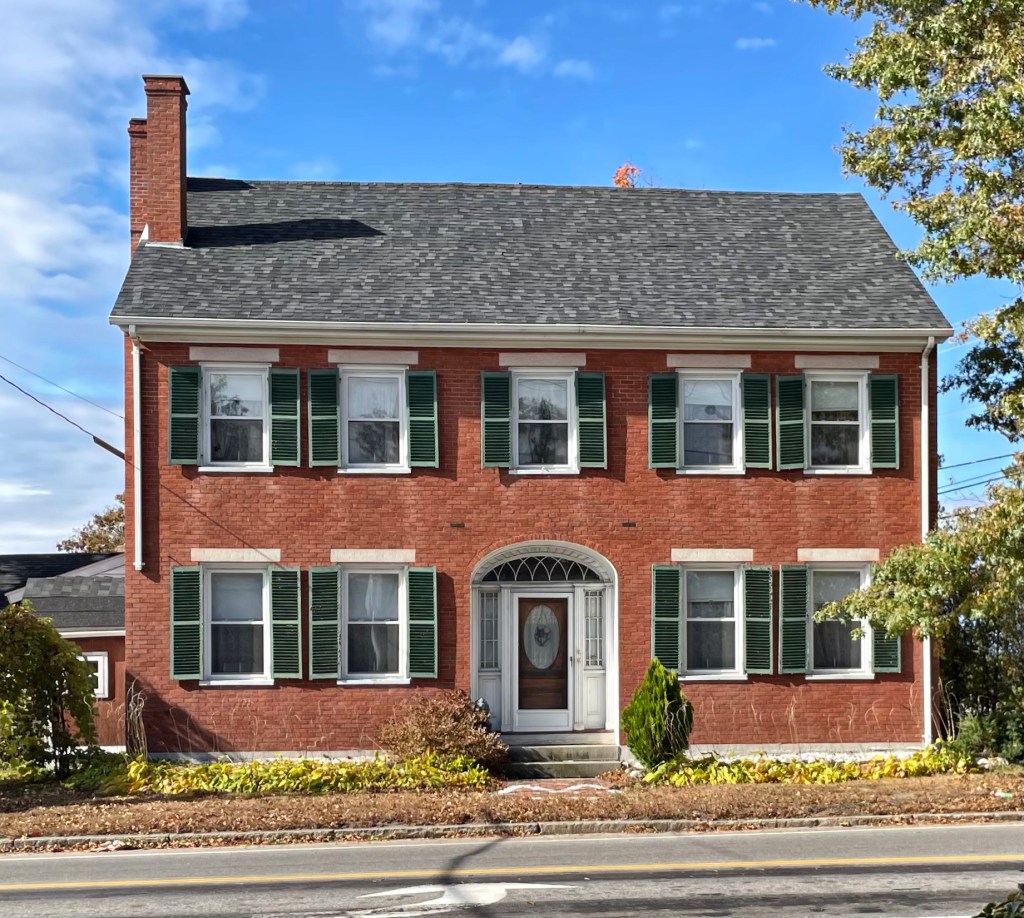
This stunning brick Federal style home sits in the center of Gray Village in Maine. The house dates to the early 19th century and was long-owned by members of the Morrill Family, seemingly first by William C. Morrill and remaining in the family for generations. The residence is a high-style example of the Federal style with recessed elliptical entrance with fanlight transom and sidelights with a Victorian-era front door. The house was likely built by a local mason or housewright who employed the designs of a Federal style plan book for the architectural detailing at the entry.
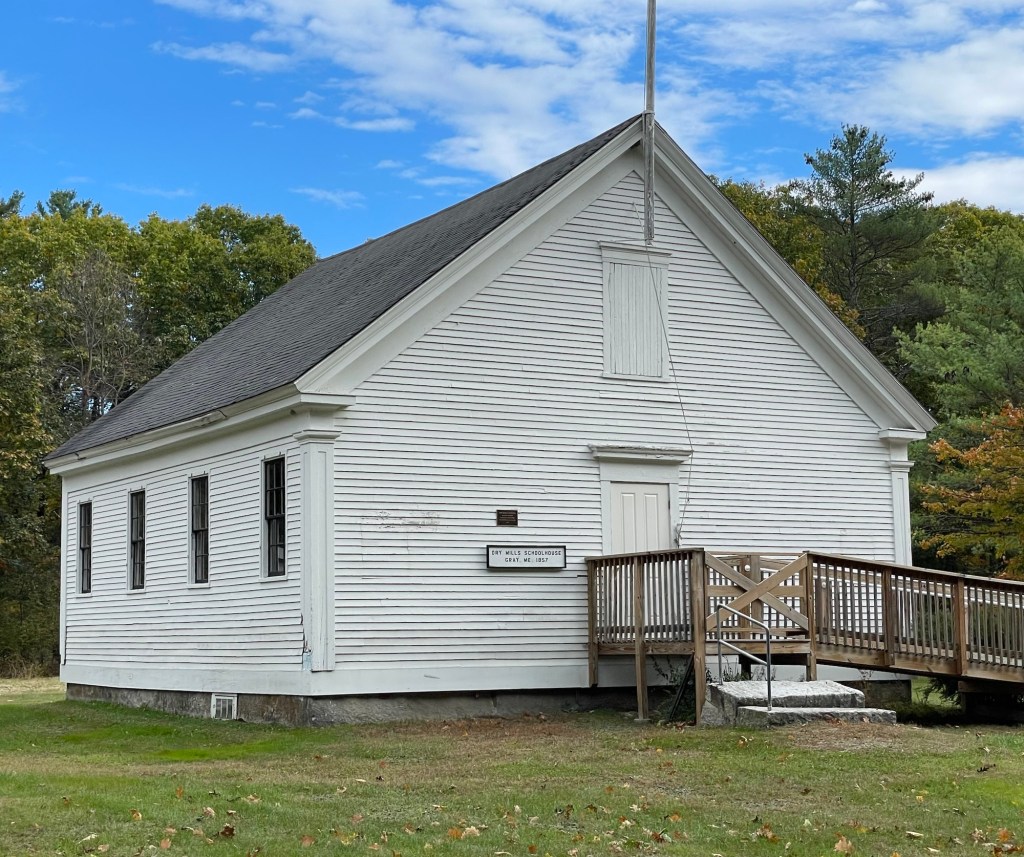
Before the use of automobiles for everyday use, the winding roads in towns all over New England were once lined by charming one-room schoolhouses, to educate children without forcing them to travel too long of distances (like many of our parents and grandparents who had to walk to school uphill both ways!) The Dry Mills School was built by 1858 and is the last one-room schoolhouse of twelve that were built in Gray, Maine. All of the others have been sold by the town, converted into houses, and/or torn down. The school was in operation from before the Civil War until it closed its doors to public education in 1958. In the early 1990’s, at a cost of $12,000, the building and the original granite slab foundation were moved to their current location on the Maine Wildlife Park Road and has been restored to its original appearance thanks to local residents who advocated for the preservation of the building. The interior retains an original chalkboard, period wood stove and furnishings. Today, it is a living museum, attesting to the educational environment in the mid 1800’s and was listed in the National Register of Historic Places.
Built around 1784 for Reverend Samuel Perley, this Federal style home is one of the finest in the town of Gray, Maine. Samuel Perley (1742-1830) was educated at Harvard College and while there, met and befriended John Adams, who would later become the second President of the United States. The two maintained a lifelong friendship. Perley came to Gray in 1784 as a pastor of Gray’s first church. He likely had this house built at the time or purchased an existing house and updated it and the house is said to have Moses Eaton stencilling inside. At one point, Rev. Perley and his wife lived on one side of the house while his son Isaac, his wife, and their twelve children lived on the other.
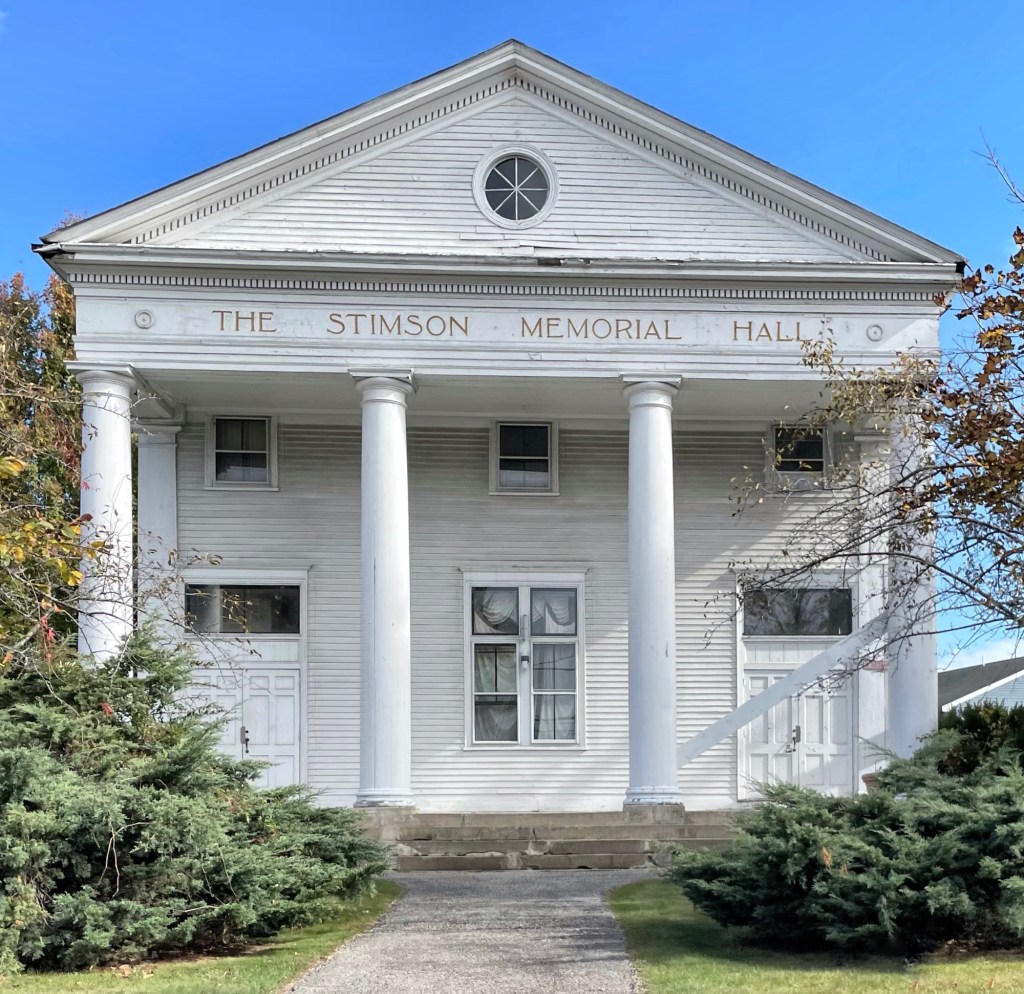
Stimson Memorial Hall is a historic, Neo-Classical building on Shaker Road in the center of Gray, Maine. Built in 1900, it served for many years as the town’s main public meeting space, and is a prominent landmark in the town center. The hall was built as a gift to the town, primarily through the efforts of Abbie Stimson Ingalls, who had moved to Cincinnati, Ohio with her husband, as a memorial to her late parents, Theophilus and Mary Stimson. The memorial hall was designed by Elzner and Anderson of Cincinnati, Ohio, and was built on land originally purchased by the local Universalist congregation. The upper level house the town library until the 1950s. The building was threatened in recent years, and as one of a handful of significant buildings remaining in the center of town, its preservation was important. It has some deferred maintenance but remains in good shape! Does anyone know what the building is/will be used for?
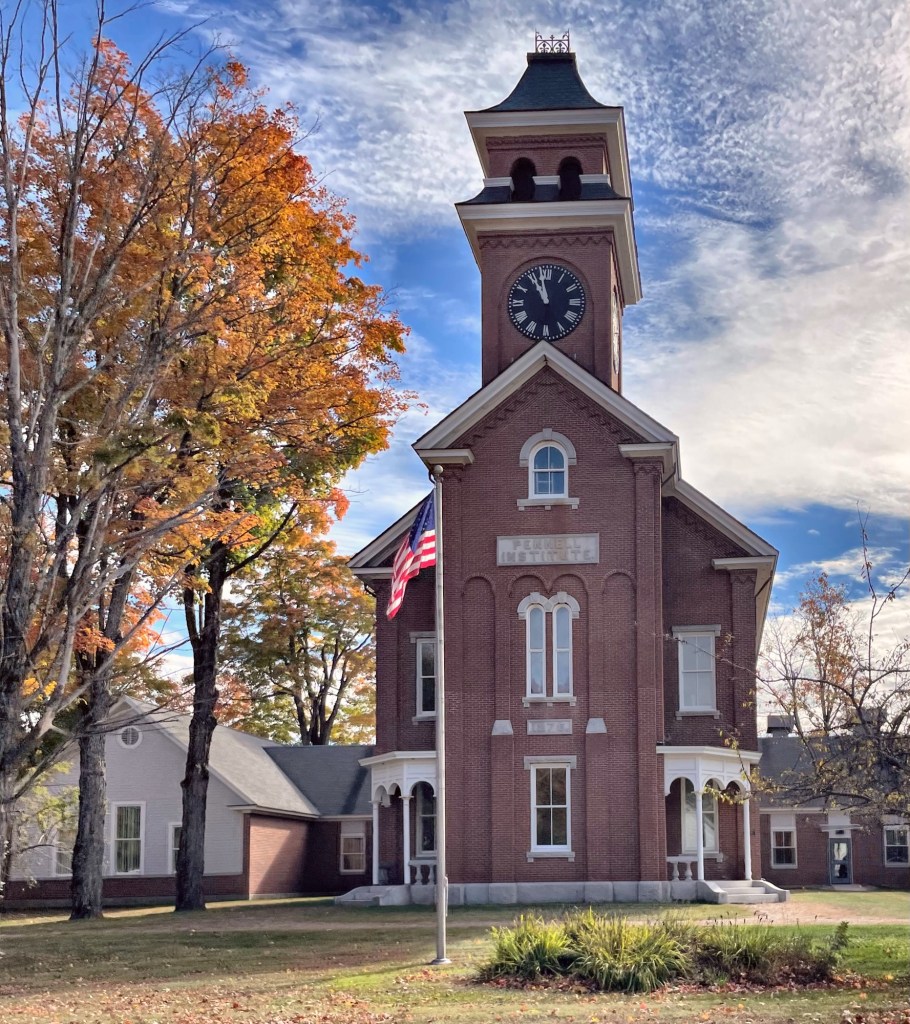
The Pennell Institute was built in 1886 as a privately funded, public school for the town of Gray, Maine. By 1870, Gray High School was located in the former Town Hall, and due to increased enrollment and ever-cramped quarters, demand for a standalone school was of grave importance. As a result, local resident Henry Pennell decided he would help his hometown. Henry Pennell (1803-1884) as a young man, worked as a butcher and traveled to Portland to sell his cuts of meat, later buying and selling livestock. After the Civil War, he dealt in real estate and mortgages, was sheriff of Cumberland County (1857-1858) and served in the State Senate (1872-1873), and became the richest man in the town of Gray. Mr. Pennell, who himself, never had received much formal education, saw the value in it for the youth of the town. Construction started on the school in 1876, where the foundation was laid, but it would take ten years until after the death and bequeathing of his estate in his will, that the building would be completed in 1886. Henry Pennell left the town the school building, the lot it stood on, a trust fund of $25,000 for the school’s general expenses, and a special fund of $5,000 for the library and for laboratory equipment and supplies. The school closed with students educated at a larger, modern building. After disputes between the Town of Gray and the local school district, the building has now been home to the Gray Town Hall, with the town clearly showing pride in their Italianate style building.

 Buildings of New England