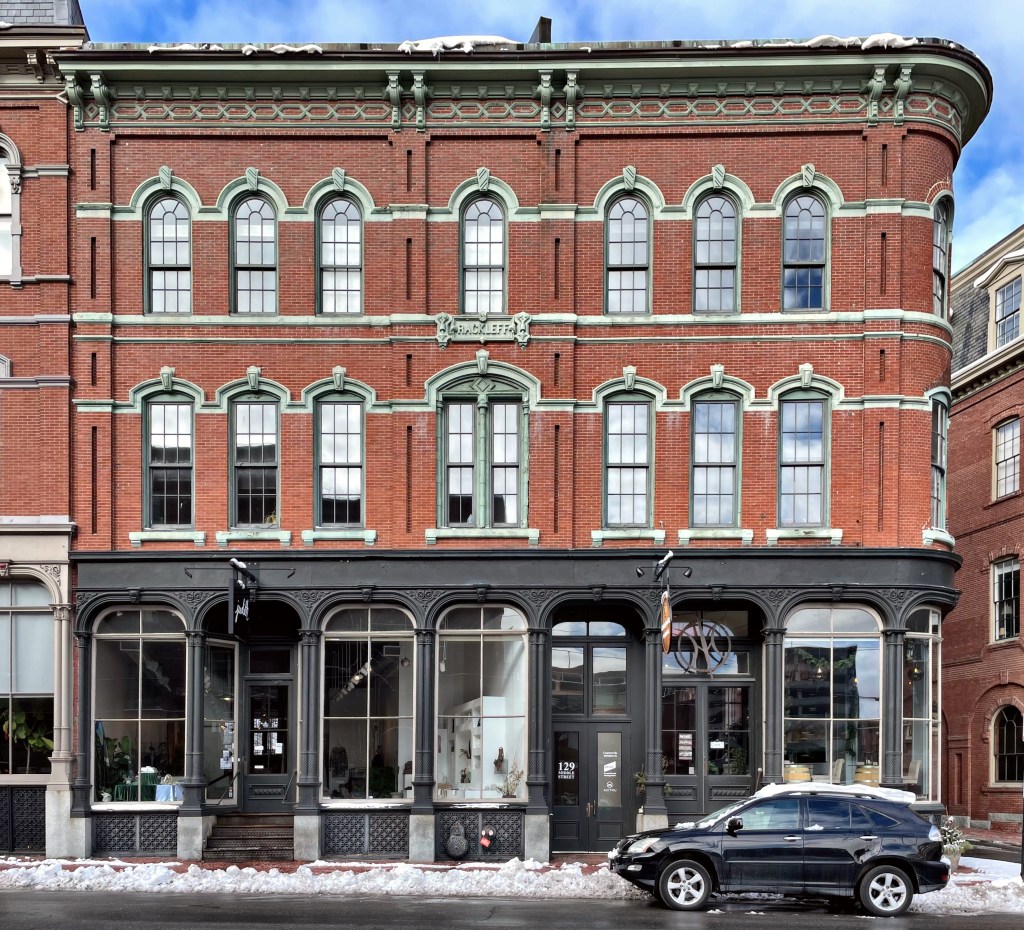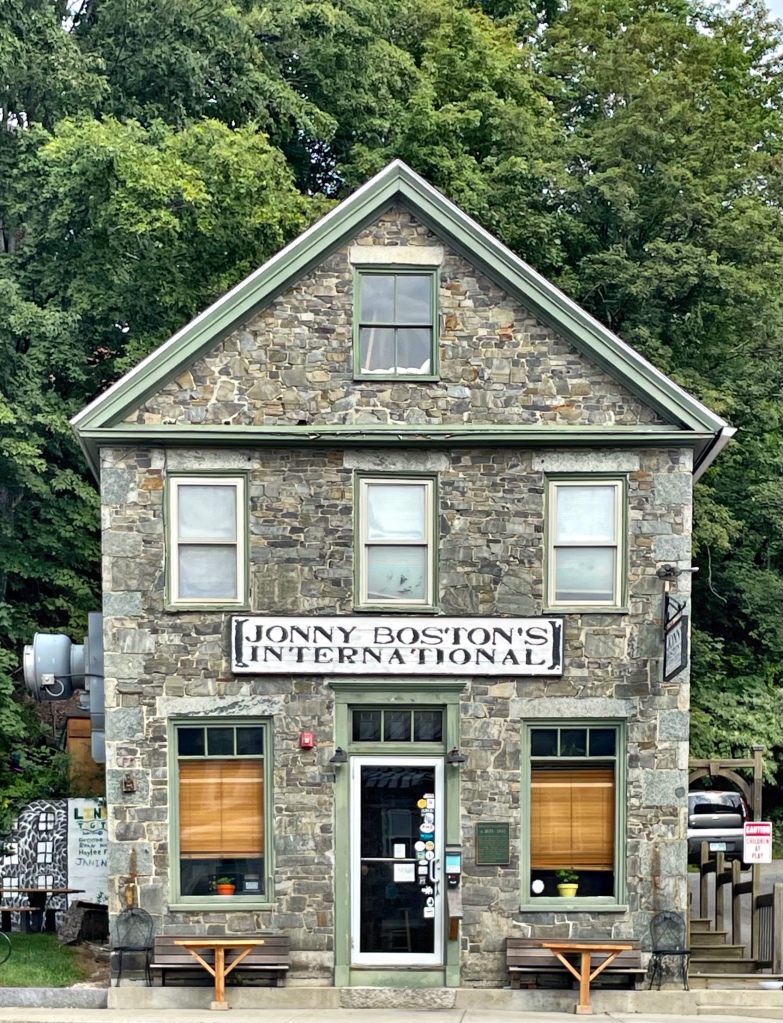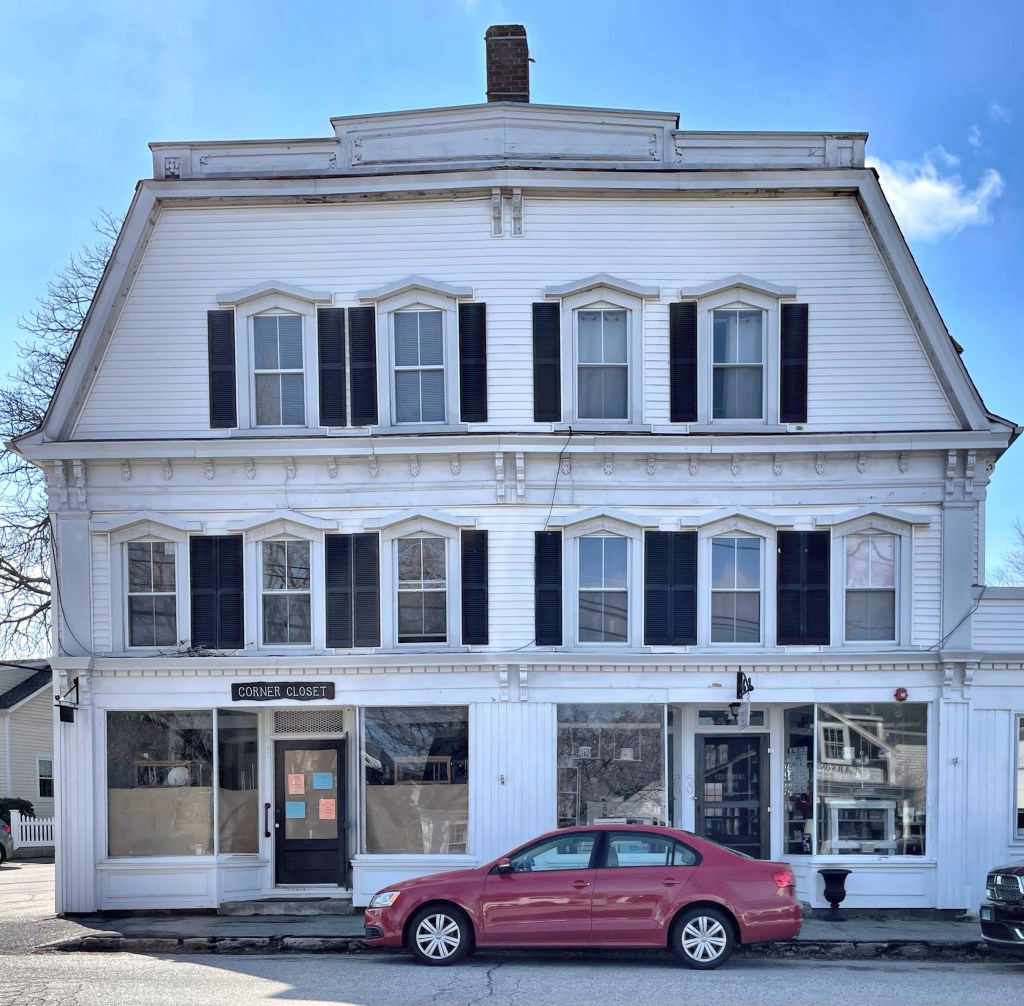
Rackleff Block // 1867

Late 19th century commercial architecture in downtowns all across New England always transport me to the past because they evoke the days of carriages in the streets and the hustle and bustle of post Civil War American cities. After Portland’s Great Fire of 1866, many standing or damaged wooden buildings were replaced with fireproof construction in the event of another conflagration. Five years before the Great Chicago Fire, this was the greatest fire yet seen in an American city. It started in a boat house then spread across the city. Amazingly, only two people died in the fire, but ten thousand people were made homeless and 1,800 buildings were burned to the ground. This is one of the buildings constructed in the rebirth of the downtown/waterfront of Portland. The Rackleff Block was built in 1867 from plans by architect George M. Harding, who designed the building with details reading Italianate and Victorian Gothic. The building retains its original cast iron storefronts and ornate cornice with brackets.

Peru Creamery House // 1895

The Creamery House in Peru, Vermont is perhaps the most “Vermont” building I have ever heard of. The building was constructed in 1895 George Richardson (1852-1920), a local farmer who operated the use as a place where cheese was made from the excess (unsold) milk of the area farmers. Eventually, the building was acquired by the Town of Peru and converted to a town hall, used for meetings, dances, dinners and parties, serving as the true town gathering place. The town relocated its offices to the former Peru Schoolhouse (featured previously) and this building went back to its roots and is presently home to the Peru Historical Society and the Main Street Makery, a community craft workshop and new town gathering place!

Crocker Tavern // c.1754

One of the largest pre-Revolution houses in Barnstable is this stunning Georgian manse, known as the Crocker Tavern. The c.1754 home was built along Main Street in Barnstable Village by Cornelius Crocker (1704-1784), who operated it as a tavern along the Old King’s Highway, the main stagecoach route through Cape Cod. Cornelius died in 1784, and he left the eastern half of his house and land to his grandsons Robert, Uriah, and Joseph Crocker; the western half of land and house went to his daughter Lydia, widow of Captain Samuel Sturgis who died at 25, she never remarried. The house was “to be divided through by the middle of the great chimney“, a feature which was likely removed under separate ownership. Lydia eventually acquired the other half of the house, and continued operation of the tavern as her father did before her, though it was known as Aunt Lydia’s Tavern. The property was passed down through the family until 1925, when the property was left to the Society for the Preservation of New England Antiquities (later renamed Historic New England) as a historic house museum. The Georgian house and property were eventually de-accessioned by Historic New England and the tavern can be rented out on AirBnb!

Denmark Odd Fellows Hall – Denmark Arts Center // 1884

This two-and-a-half-story building sits on Main Street in the small town of Denmark, Maine, and has contributed to the town’s cultural life since it was built in 1884. The Independent Order of Odd Fellows (IOOF) is a non-political and non-sectarian international fraternal group that promotes the ethic of reciprocity and charity. It was founded in 1819 by Thomas Wildey in Baltimore, Maryland, evolving from the Order of Odd Fellows founded in England during the 1700s. New buildings sprouted up all over the United States in the 19th century, in cities as large as New York City and towns as small as Denmark. This IOOF Hall is Italianate in style, with brackets at the cornice and hoods and round arched windows in the gable end; it also shows some Greek Revival details with corner pilasters and the pediment. When Raymond Hale, the last member of the IOOF Lodge passed away, the town purchased the old Odd Fellows Hall. The city could not maintain the property and had no good use for it. Residents in town voted in 1991 to sell the building rather than demolish it. Local residents bid on and won the building with the aim to convert it to a local arts center. In August 1994 the owners signed over the deed of the Odd Fellows Hall to the Denmark Arts Center, a non profit organization. From that time until present, the old building, now the Denmark Arts Center, has again served as a community focal point, providing cultural activities for the people of Denmark and surrounding towns.

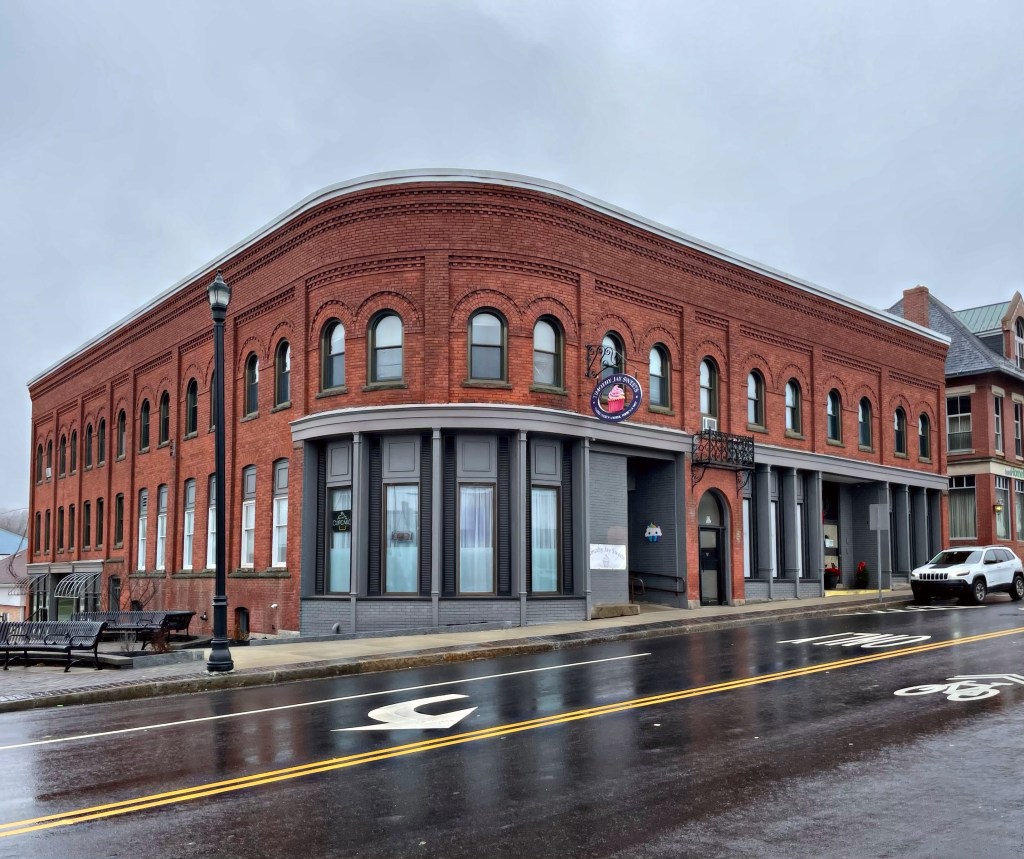
Cunningham Block // 1896

The Cunningham Block in Millbury was constructed by, and named for Winthrop P. Cunningham (1820-1895), and his son and business partner, Russell Clark Cunningham (1845-1907). Winthrop Cunningham had come to Millbury in about 1837 and worked for Waters, Flagg & Harrington prominent gun manufacturers in town. His foundry work there brought him into a partnership with Matthias Felton in the Millbury Foundry Company. The Cunningham Block is sited on a prominent corner lot and built into the slope of the hill which drops down toward the river. I am especially fond of the curved corner facade and repetition of the paired round-arched windows on the second floor.

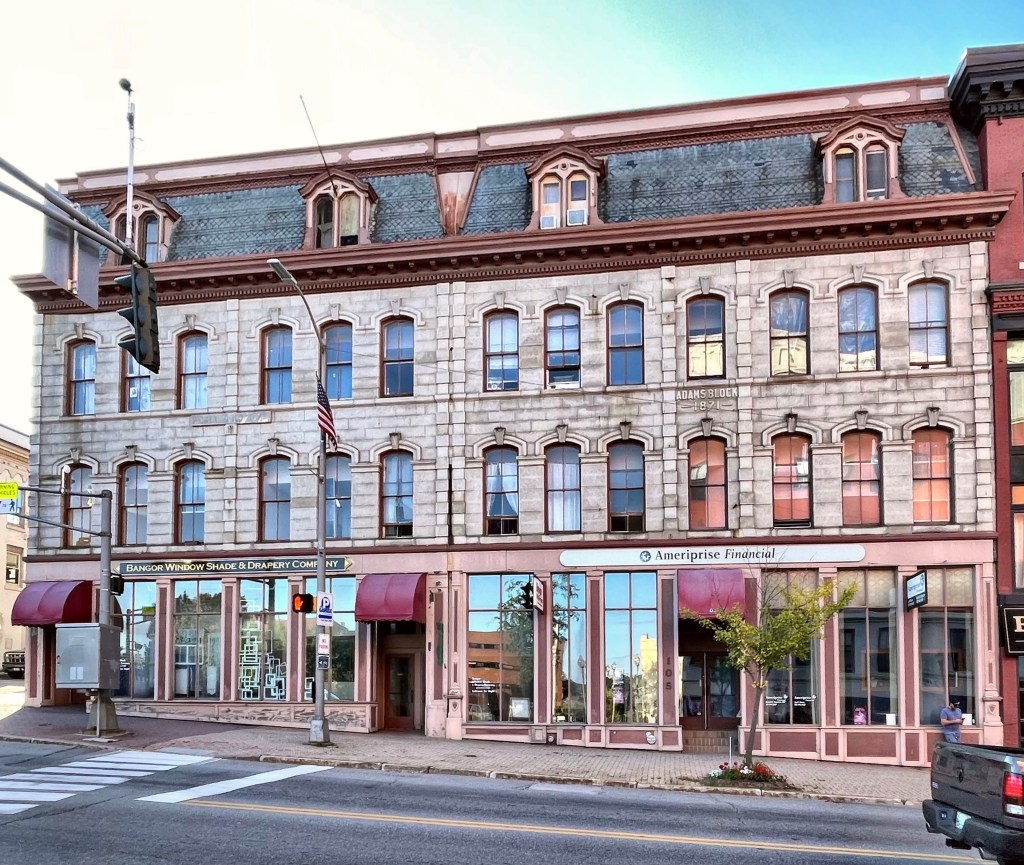
Adams-Pickering Block // 1871

Main Street USA! I just love historic Main Streets and Downtowns in New England, so many are full of old buildings and were designed for pedestrians, not cars (though some towns and villages have definitely caved to the automobile). Erected in 1871, the Adams-Pickering Block building was one of several grand, mansard roofed commercial structures which local architect George W. Orff designed for Bangor’s business district in the 1870’s. With its first-story cast iron front and its granite facade, from stone quarried nearby in Hallowell, Maine, the Adams-Pickering Block and its similar contemporaries were the most sophisticated Victorian commercial buildings in Eastern Maine. The Bangor Fire of 1911 and subsequent urban change, especially urban renewal in 1968, destroyed most of the city’s nineteenth century business district. The Adams-Pickering Block is a rare survivor and shows us how old buildings at a human scale can create vibrant, people-centric places.

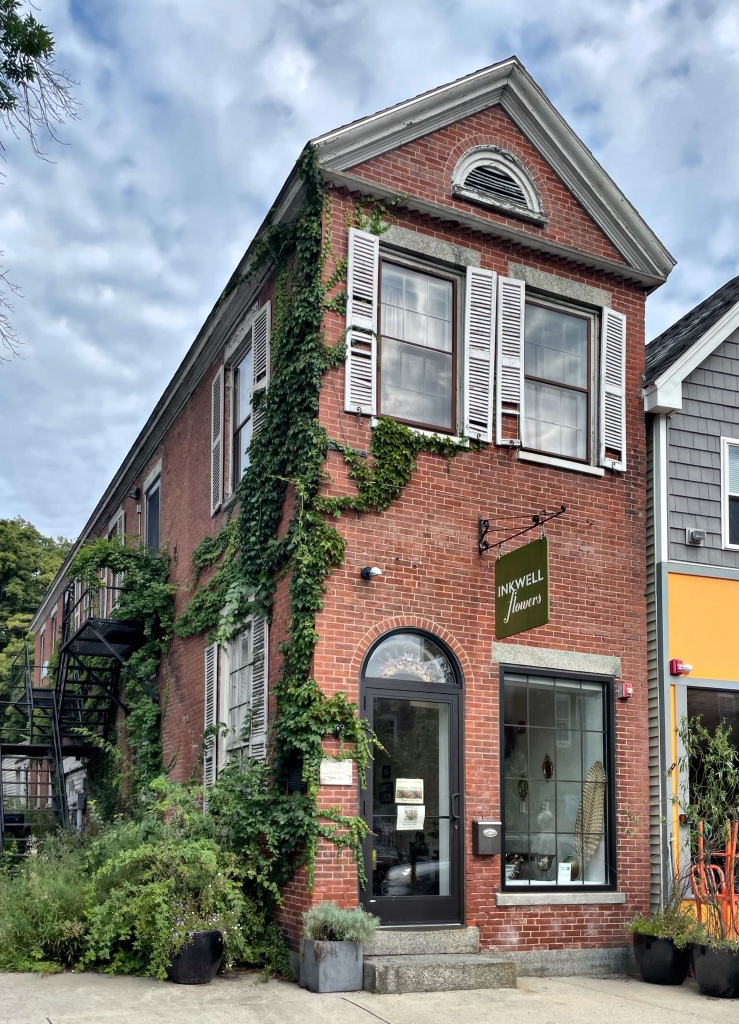
Murray Store // c.1825

Arguably the cutest little store in Newmarket is the Murray Store, right on the town’s vibrant Main Street. The brick building is one of the earliest such structures on the street and is a great example of a narrow Federal style building with a lunette in the gable end. The structure was built before 1830 and was occupied by a Ms. Charlotte Murray as a millinery (women’s hat store). Main Street USA! What is your favorite Main Street in New England?

Mathes Store // c.1835

Next door to the Mathes Block (previously featured) this stone commercial building is one of many such buildings that make Newmarket so beautiful and unique. Stone was harvested from the shores of the Lamprey River nearby and the beautiful coloring made them perfect for buildings in town. This building was constructed in the 1830s for Benjamin Mathes, a developer and businessman in town. The structure was occupied by the town post office in the early years, and now houses a restaurant.

Chester Tin Shop // c.1830

Located on the edge of the Chester Town Green, you can find this beautiful Federal style commercial building. The use of blind arches at the facade is a fairly common feature found in brick Federal style buildings in Vermont. The structure was built around 1830 and has served a variety of uses through its existence, the most notable being the tin shop owned by various members of the Miller and Hadley families that sold stoves and hardware during the latter half of the 19th century. The tin business in New England grew rapidly after 1820. Tin shop owners imported tinplated sheet iron from Great Britain, shaped it into a variety of forms, and distributed their finished goods through peddlers and country stores. They also sold tinware in their shops. Colanders, dippers, dish kettles, funnels, measures, and pans were in greatest demand. Other common items included lanterns, foot stoves, teapots, coffeepots, “tin kitchens”, skimmers, and sconces. After its use as a tin shop, the building was occupied as a telephone exchange and electric utility company office. It presently is home to an antique store.

DeWolf Block // 1893

Located next door to the Lewis Block (last post) on Main Street in Newport, NH, the DeWolf Block showcases late Victorian design before the more generic 20th century main street architecture took hold. The DeWolf Block was built in 1893 by Samuel DeWolf Lewis, who also erected the Lewis Block, both named after himself. As was traditional with many business blocks, fraternal organizations occupied the upper floor of the building, and retail uses were located on the ground floor. In the case of the DeWolf Block, it was the Knights of Pythias. By the 1950’s the DeWolf Block was home to J. S. Hirsch Department Store, operated by Joshua & Sally Hirsch, until it was purchased by the Hubert family in the 1970’s. The Huberts operated a clothing store
there until the building was purchased by Sullivan County and has since housed the county offices. The DeWolf Block is a modest Romanesque Revival style building with large, round arched windows at the third story.

Lewis Block // 1886

Following the granting of the royal charter in 1761, Newport, NH was incorporated and named after Henry Newport, a distinguished English soldier and statesman. With excellent soil for farming, and abundant water power from the Sugar River to run mills, Newport grew prosperous. The main street developed, leading to a proliferation of hotels and taverns that were soon situated along the length of Main Street to service the many travelers who stopped along the route, many such structures were wood frame construction. A fire devastated much of Main Street in Newport in 1885, leading to a massive rebuilding campaign by the town’s richest citizens. One of the earliest buildings constructed after the fire was the Lewis Block, developed by Frederick Lewis, who lived a block away, and his son Samuel DeWolf Lewis, who designed the block. The two-story building is broken up by brick pilasters with recessed corbelled detailing which give rise to buttresses capped by gablets (yes its a word), punctuating the flat roof profile.

Red Lion Inn // 1897

The largest building on Main Street in Stockbridge has to be the Red Lion Inn, a regional institution and one of the best places to rest your head in New England. The inn got its start just before the Revolutionary War. According to tradition, Silas Pepoon established a small tavern on the corner of Main Street in 1773, under the sign of a red lion. A year later, angry citizens gathered at the tavern to boycott English goods and to pass resolutions protesting the oppressive Acts of Intolerance levied against the colonies. Since its earliest days, the inn was a vital gathering place for locals and has continued to play an important role in the life of the community ever since. In 1862, the inn was owned by Mr. and Mrs. Charles Plumb, avid collectors of rare and fine items, who became renowned for their impressive compilation of colonial antiques. A fire in 1896 destroyed the building but its remarkable array of collectibles was saved and the inn was rebuilt within a year by designs from Harry E. Weeks, a Pittsfield-based architect.

Guerrieri Block // 1921

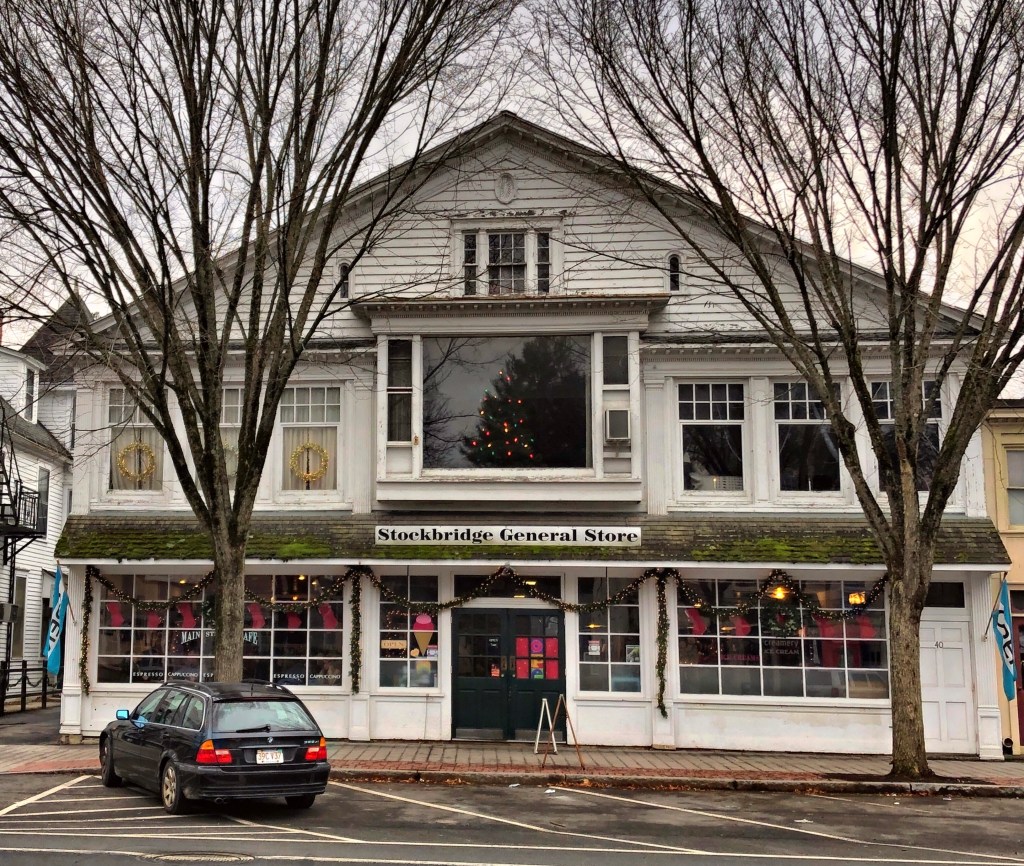
Norman Rockwell‘s ‘Home for Christmas’ painting in 1967 depicts the Main Street scene in Stockbridge, Massachusetts, and epitomizes the essence of Christmas in small towns across the country. In the iconic painting, you can find many landmarks (including the Town Offices building) that make up the quaint main street, that typifies many small New England towns. At the center of his painting, the Guerrieri Block can be seen with a Christmas tree lit up in the window on the second floor. The Guerrieri Block was built in 1921 by Antonio Guerrieri, a skilled woodworker who sold and repaired antiques in one of three street level shops in the block. He and his family lived in an apartment on the second floor. The next year he completed construction of a shop behind the block where he worked out of. In 1953, Norman Rockwell moved to Stockbridge and spoke with Antonio about using the second floor of his building as a studio. Antonio constructed a large central bay window with plate glass to flood the space with light and allow Rockwell to work while observing the street below. Rockwell used the space as his studio until 1957. The building has since been occupied as a general store.

Stockbridge Town Offices // 1884

Built in 1884, the Town Office Building on Main Street in Stockbridge, housed more conveniently located government offices and came equipped with a basement jail. The building was constructed of brick to protect town records from fire and the adjacent buildings. The architecture is Flemish Revival with its stepped gables, a tower, and terra cotta and stained glass ornaments, a distinctive and different type of architecture on Main Street. The building was occupied after the Town Hall, further down Main Street, was deemed inadequate. The building displays the words “Town Offices” with the date 1884 A.D. as the town was sure to label the building as town offices over ‘town hall’ so they could retain the former town hall building after a deal with the First Congregational Church. The town sold the building to private owners in 1960 and has since been used as commercial space.

First Stockbridge Town Hall // 1840

The Town of Stockbridge, MA was incorporated on June 22, 1739. After that time the town held meetings and conducted business in the First Congregational Meeting House until 1840 when this Greek Revival town hall building was erected on the church’s property as a gift. A stipulation was made that if the Town government constructed or moved to a new town hall building, the property ownership would revert to the Church. The town outgrew the building and constructed a new building toward the center of town, but named it Town Offices, a cheeky way to retain ownership of this building. Eventually, that building too was outgrown, and the town hired Pittsfield-based architect Harry E. Weeks to modify and enlarge the building in 1903, in the Neo-Classical style to compliment the original Greek detailing. As expected, the town moved again in the 2000s to a former school, on Main Street, but again retained the building.