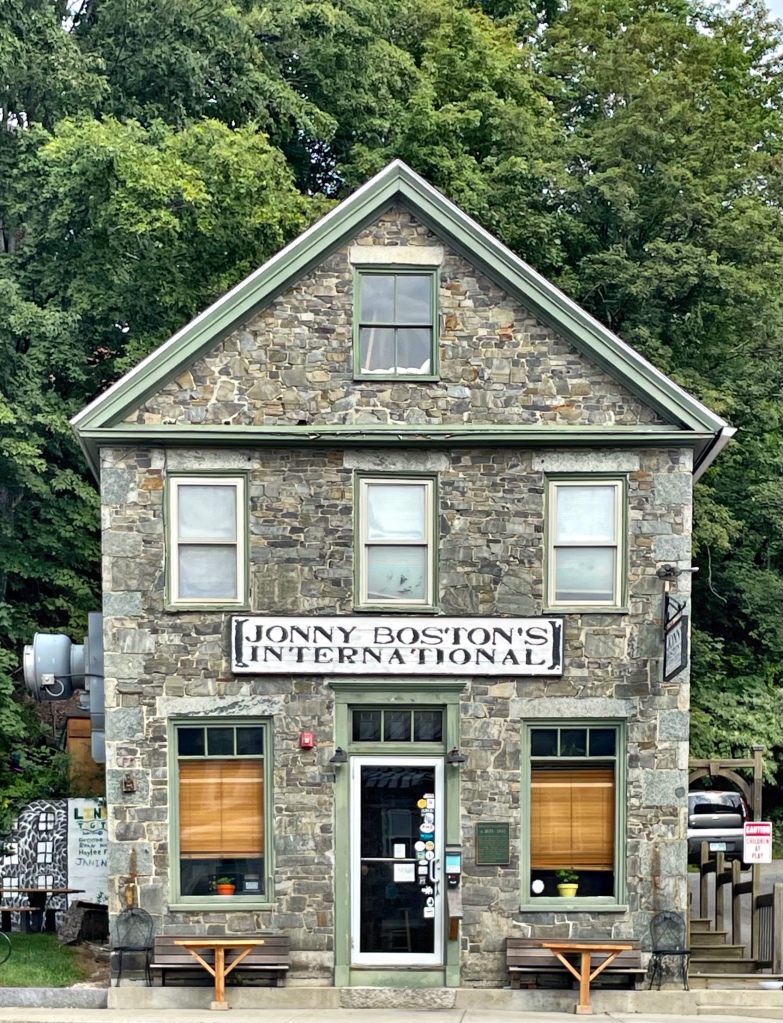
Next door to the Mathes Block (previously featured) this stone commercial building is one of many such buildings that make Newmarket so beautiful and unique. Stone was harvested from the shores of the Lamprey River nearby and the beautiful coloring made them perfect for buildings in town. This building was constructed in the 1830s for Benjamin Mathes, a developer and businessman in town. The structure was occupied by the town post office in the early years, and now houses a restaurant.
Located on the edge of the Chester Town Green, you can find this beautiful Federal style commercial building. The use of blind arches at the facade is a fairly common feature found in brick Federal style buildings in Vermont. The structure was built around 1830 and has served a variety of uses through its existence, the most notable being the tin shop owned by various members of the Miller and Hadley families that sold stoves and hardware during the latter half of the 19th century. The tin business in New England grew rapidly after 1820. Tin shop owners imported tinplated sheet iron from Great Britain, shaped it into a variety of forms, and distributed their finished goods through peddlers and country stores. They also sold tinware in their shops. Colanders, dippers, dish kettles, funnels, measures, and pans were in greatest demand. Other common items included lanterns, foot stoves, teapots, coffeepots, “tin kitchens”, skimmers, and sconces. After its use as a tin shop, the building was occupied as a telephone exchange and electric utility company office. It presently is home to an antique store.
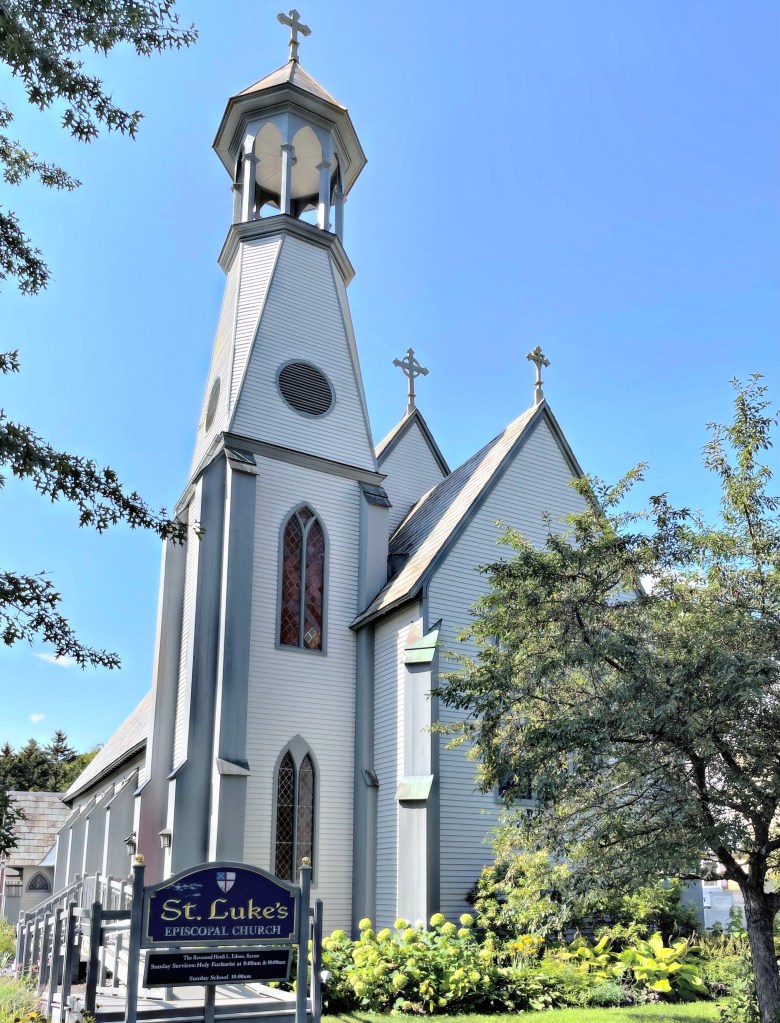
Next door to the Inn Victoria, the beautiful St. Luke’s Episcopal Church in Chester, VT, stands out as one of the only Gothic Revival buildings in the town. A small group of residents gathered in the 1860s to found a Episcopal church in the town, which already had a dominant Congregational church. They furnished money which was matched by the diocese, and Merrick Wentworth was named senior warden. Members of his family and that of Frederick Fullerton, his son-in-law, formed a large part of the congregation. Frederick and Philette Wentworth Fullerton donated a building site across the street from their home, and Mr. Wentworth’s nephew, Boston architect, William P. Wentworth, contributed plans for a Gothic-style frame church, which includes a tall corner belltower.
In 1899, the Bristol Young Men’s Christian Association (YMCA) selected architect Wallis E. Howe to design this five-bay, gable-roof, Tudor Revival building as its headquarters. Architect Howe created a rich effect with red brick and white mortar in combination with Tudor half-timbers in green, and buff-colored stucco. The building is a rare example of the Tudor style in Bristol, but is one of the most successful in the state (in my opinion), due to its strong presence and massing working with the use of materials and colors. The large central archway led upstairs to a library and gymnasium for use by YMCA members, while the ground floor featured four small businesses. In 1967, a new entrance and lobby, was constructed, linking the original YMCA to the since abandoned Bristol Customs House and Post Office.
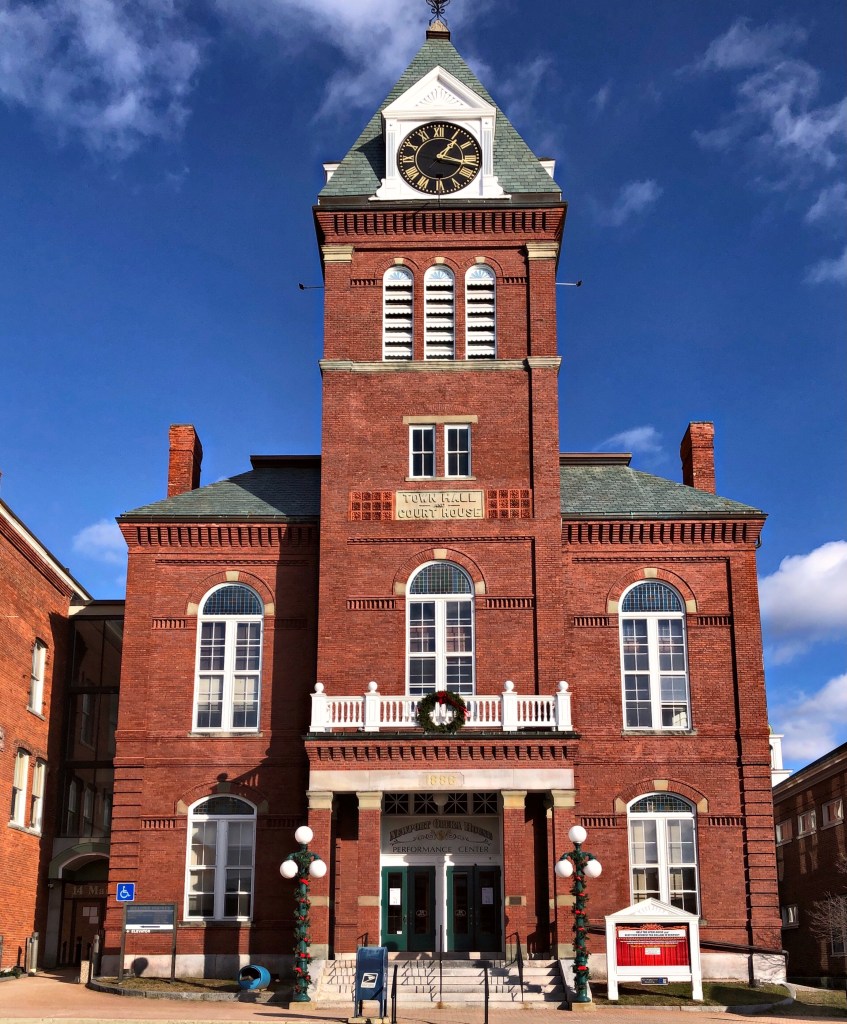
The architectural focal-point on Main Street in Newport, NH is the Newport Opera House, with its solid massing and prominent central tower. The town was growing after the American Civil War and its position as County Seat solidified that growth. A new large civic building was erected in 1872 which housed a new courthouse and town hall. A fire destroyed much of the buildings on Main Street in 1885, and destroyed the courthouse and town hall building. As a response to the loss of the building, a fire-proof structure was erected from designs by Hiram Beckwith, a regionally prominent architect from Claremont. The structure featured space for the county, town, and even an opera house! The jewel of the new building was the Opera House located on the second floor that housed a stage considered the largest north of Boston. The Newport Opera House soon became the center of entertainment in Sullivan County and patrons came from far away to enjoy the large variety of programs presented. The large hall played host to dances, boxing matches, weddings, political rallies, plays, school graduations and more! After a period of severe decline, a group of artists and residents of town worked together to restore the building and use the space as a performance center. It remains one of the finest buildings in this part of the state.
Located next door to the Lewis Block (last post) on Main Street in Newport, NH, the DeWolf Block showcases late Victorian design before the more generic 20th century main street architecture took hold. The DeWolf Block was built in 1893 by Samuel DeWolf Lewis, who also erected the Lewis Block, both named after himself. As was traditional with many business blocks, fraternal organizations occupied the upper floor of the building, and retail uses were located on the ground floor. In the case of the DeWolf Block, it was the Knights of Pythias. By the 1950’s the DeWolf Block was home to J. S. Hirsch Department Store, operated by Joshua & Sally Hirsch, until it was purchased by the Hubert family in the 1970’s. The Huberts operated a clothing store there until the building was purchased by Sullivan County and has since housed the county offices. The DeWolf Block is a modest Romanesque Revival style building with large, round arched windows at the third story.
Following the granting of the royal charter in 1761, Newport, NH was incorporated and named after Henry Newport, a distinguished English soldier and statesman. With excellent soil for farming, and abundant water power from the Sugar River to run mills, Newport grew prosperous. The main street developed, leading to a proliferation of hotels and taverns that were soon situated along the length of Main Street to service the many travelers who stopped along the route, many such structures were wood frame construction. A fire devastated much of Main Street in Newport in 1885, leading to a massive rebuilding campaign by the town’s richest citizens. One of the earliest buildings constructed after the fire was the Lewis Block, developed by Frederick Lewis, who lived a block away, and his son Samuel DeWolf Lewis, who designed the block. The two-story building is broken up by brick pilasters with recessed corbelled detailing which give rise to buttresses capped by gablets (yes its a word), punctuating the flat roof profile.
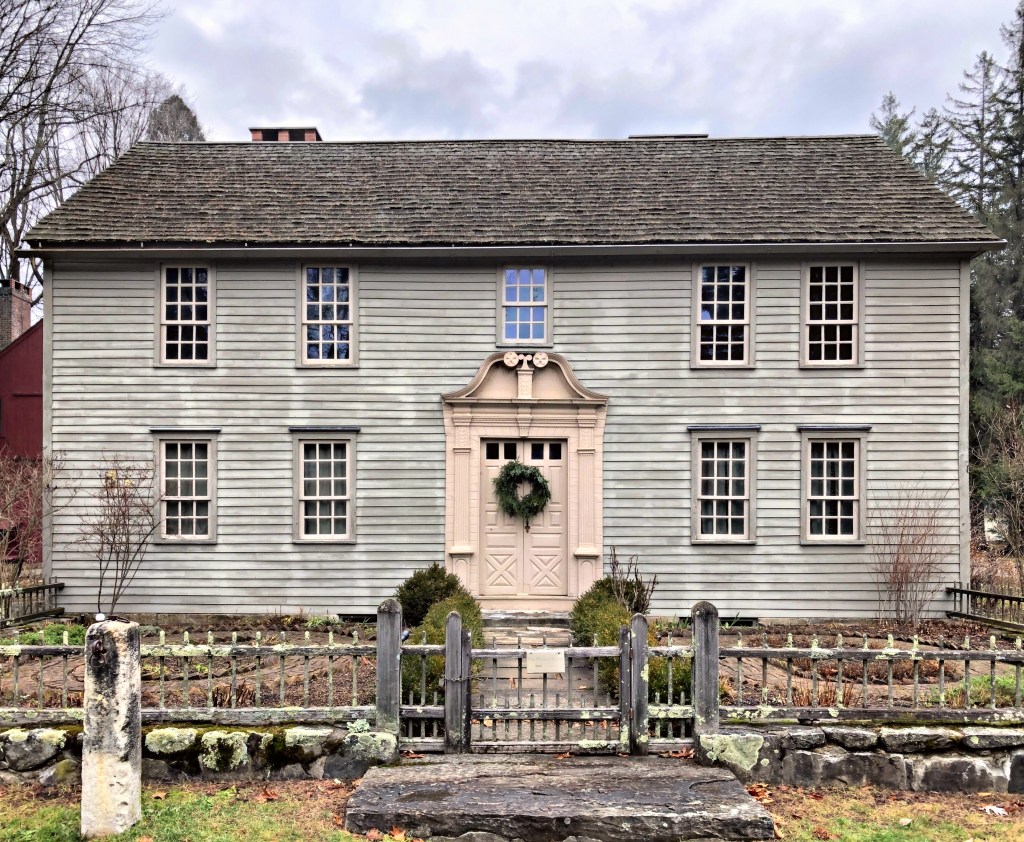
The Mission House, erected by the Reverend John Sergeant in 1739 on Prospect Hill in Stockbridge, Massachusetts, is an excellent and little-altered example of Georgian architecture as constructed on the New England frontier. The home is a lasting remnant of early missionary efforts toward the local Mohican tribe. Reverend John Sergeant, the first missionary to the Housatonic Indians, moved to Stockbridge and preached to the native people here and at the Congregational Church. Sergeant and his wife Abigail moved to town, but she had made it clear that she wished to live on the hill, away from the village and the native people. Sergeant then built this home, a spacious and distinguished house for its frontier location. Though covered in part by a grant from the General Court, the cost of constructing such a house must have been a severe strain on Sergeant’s slender financial resources, as his salary at that time was 100 pounds per year. The home remained in the family until the 19th century. In 1928, long unoccupied and badly in need of repair, the house was purchased by Miss Mabel Choate, daughter of noted lawyer and former Ambassador to Great Britain, Joseph H. Choate. The house was taken down piece by piece, moved and reconstructed, on Main Street, in its current location. The Mission House was furnished with pieces appropriate to Sergeant’s economic status and his wife’s taste, many of them dating from the 1750’s or earlier. Since 1948, the home has been owned by the Trustees of Reservations.
The largest building on Main Street in Stockbridge has to be the Red Lion Inn, a regional institution and one of the best places to rest your head in New England. The inn got its start just before the Revolutionary War. According to tradition, Silas Pepoon established a small tavern on the corner of Main Street in 1773, under the sign of a red lion. A year later, angry citizens gathered at the tavern to boycott English goods and to pass resolutions protesting the oppressive Acts of Intolerance levied against the colonies. Since its earliest days, the inn was a vital gathering place for locals and has continued to play an important role in the life of the community ever since. In 1862, the inn was owned by Mr. and Mrs. Charles Plumb, avid collectors of rare and fine items, who became renowned for their impressive compilation of colonial antiques. A fire in 1896 destroyed the building but its remarkable array of collectibles was saved and the inn was rebuilt within a year by designs from Harry E. Weeks, a Pittsfield-based architect.
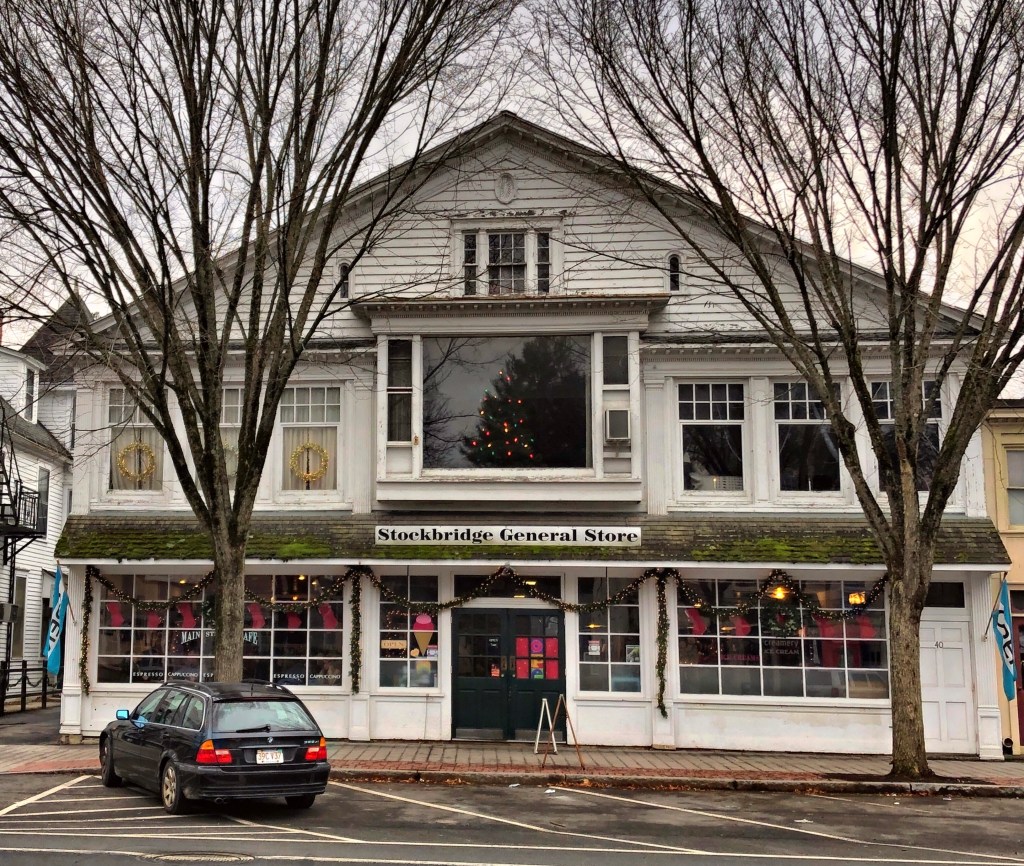
Norman Rockwell‘s ‘Home for Christmas’ painting in 1967 depicts the Main Street scene in Stockbridge, Massachusetts, and epitomizes the essence of Christmas in small towns across the country. In the iconic painting, you can find many landmarks (including the Town Offices building) that make up the quaint main street, that typifies many small New England towns. At the center of his painting, the Guerrieri Block can be seen with a Christmas tree lit up in the window on the second floor. The Guerrieri Block was built in 1921 by Antonio Guerrieri, a skilled woodworker who sold and repaired antiques in one of three street level shops in the block. He and his family lived in an apartment on the second floor. The next year he completed construction of a shop behind the block where he worked out of. In 1953, Norman Rockwell moved to Stockbridge and spoke with Antonio about using the second floor of his building as a studio. Antonio constructed a large central bay window with plate glass to flood the space with light and allow Rockwell to work while observing the street below. Rockwell used the space as his studio until 1957. The building has since been occupied as a general store.
Built in 1884, the Town Office Building on Main Street in Stockbridge, housed more conveniently located government offices and came equipped with a basement jail. The building was constructed of brick to protect town records from fire and the adjacent buildings. The architecture is Flemish Revival with its stepped gables, a tower, and terra cotta and stained glass ornaments, a distinctive and different type of architecture on Main Street. The building was occupied after the Town Hall, further down Main Street, was deemed inadequate. The building displays the words “Town Offices” with the date 1884 A.D. as the town was sure to label the building as town offices over ‘town hall’ so they could retain the former town hall building after a deal with the First Congregational Church. The town sold the building to private owners in 1960 and has since been used as commercial space.
The Town of Stockbridge, MA was incorporated on June 22, 1739. After that time the town held meetings and conducted business in the First Congregational Meeting House until 1840 when this Greek Revival town hall building was erected on the church’s property as a gift. A stipulation was made that if the Town government constructed or moved to a new town hall building, the property ownership would revert to the Church. The town outgrew the building and constructed a new building toward the center of town, but named it Town Offices, a cheeky way to retain ownership of this building. Eventually, that building too was outgrown, and the town hired Pittsfield-based architect Harry E. Weeks to modify and enlarge the building in 1903, in the Neo-Classical style to compliment the original Greek detailing. As expected, the town moved again in the 2000s to a former school, on Main Street, but again retained the building.
Samuel Cummings (1709-1772) married Prudence Lawrence (1715-1796) and moved to Hollis, NH from Groton, MA. The couple had a home built in town and raised at least four children, Samuel Jr., Mary, Sibbel, and Prudence. The original house built by Cummings was a single-story, four room, center chimney type. After his death in 1772, the property passed to Cummings’ son, Samuel Cummings, Jr., an acknowledged Tory. Interestingly, Samuel’s sister Prudence was an ardent patriot, who moved to Pepperell, MA and married a militia man, David Wright. While the Revolutionary War was raging, Prudence visited her brother in the old family home, when she overheard her brother Samuel talk to his friend, a British army officer about passing information to the British. Prudence returned to Pepperell and gathered the women of the town. Then a 35-year-old mother of five, she organized 30 or 40 of them into a militia called ‘Mrs. David Wright’s Guard.’ The women dressed in their husbands’ clothes and carried whatever they could for weapons. As the men had probably taken muskets with them, the women probably used farm implements such as pitchforks. The women patrolled the roads leading into town. The group eventually captured two British soldiers on horseback and let them go only once they agreed to never come back to the colony. Due to this event, Prudence never spoke to her loyalist brother again.
In the 1850s, the house was owned by Superintendent of Schools, Levi Abbott and his wife, Matilda. It was the Abbotts who reportedly added a second story to the house with a hip roof, cornice and corner pilasters, giving it the appearance we see today.
The Copeland Block is Enfield’s only brick commercial block. It is located on the bank of the river which cuts through the village and terminates at Mascoma Lake. Ira Copeland built the block for $10,000, during the final years of his life. He had lived in Enfield since 1853. He and his wife Elsina lived on her parent’s farm on Shaker Hill for many years. After her death in 1897, he abruptly moved to town, moved into a home on Depot Street, and built this commercial block with his lasting money. He died just years later. The Copeland Block contained a dmgstore, millinery shop and offices over its history, with an I.O.O.F. meeting space upstairs.
Located on Main Street in North Adams, you’ll find this monstrous commercial block looking like it belongs in New York, not in Western MA. North Adams in the early 20th century was booming as an industrial center with a rapidly growing population. Due to this, business owners had the capital and clientele needed to erect large commercial buildings. A man named Jencks Kimbell owned a couple large parcels of land on Main Street and ran a livery stable there until his death in 1858. The business was ran by his sons until their death and the property was willed to their widows Clara and Lydia who saw the potential for the site to make them money. In 1902, the two widows erected this magnificent block on Main Street, with a stone facade. Built on top of a quicksand pit, it was the first building in North Adams to be built on steel pilings. I could find no information on the architect, but it is Eclectic to say the least! It has Romaneque arches, monumental pilasters with Corinthian capitals, and a Swan’s neck broken pediment at the parapet.