Printer’s Exchange Building // 1866

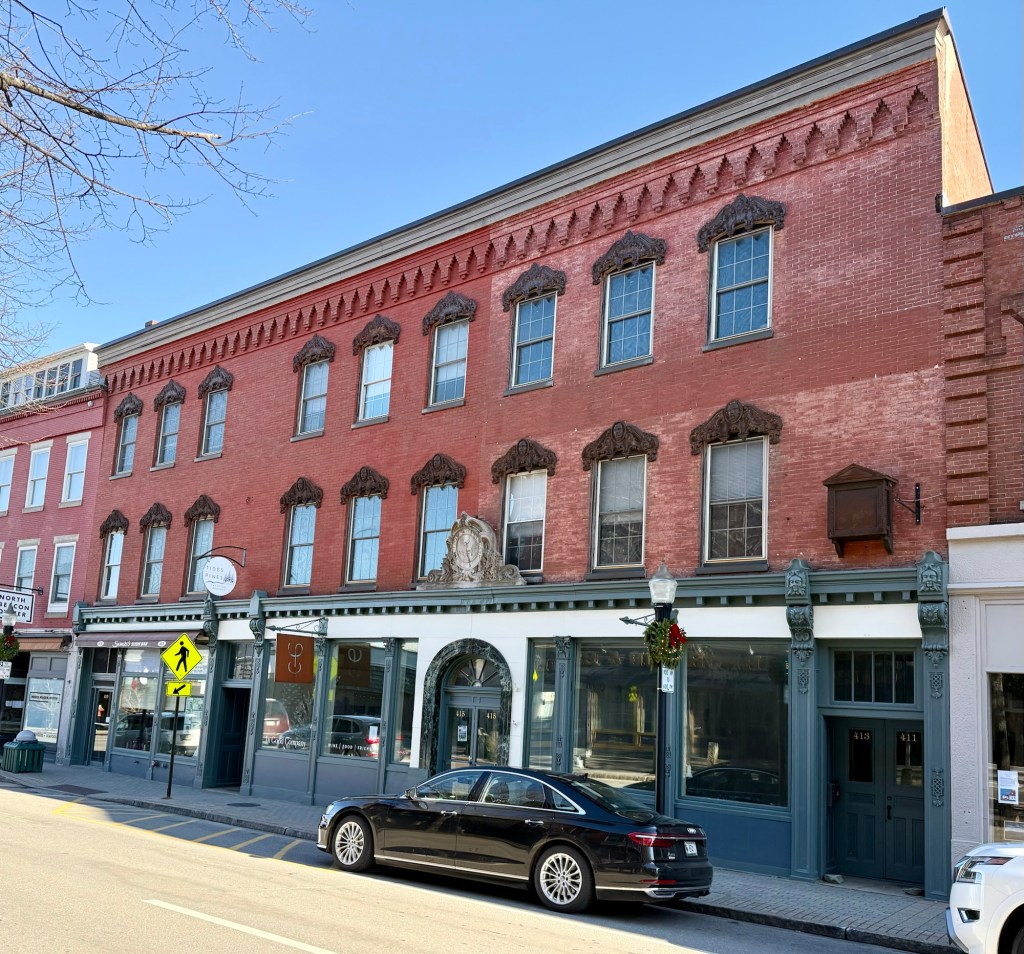
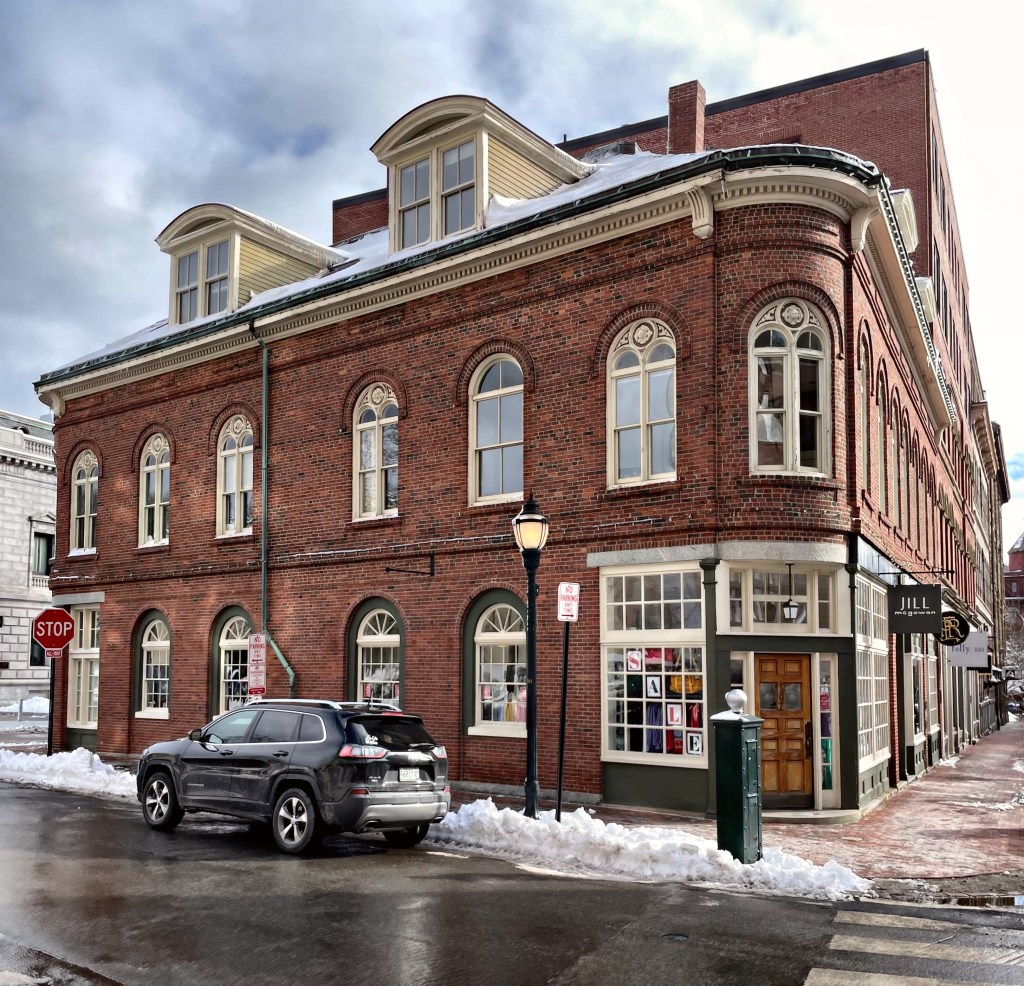
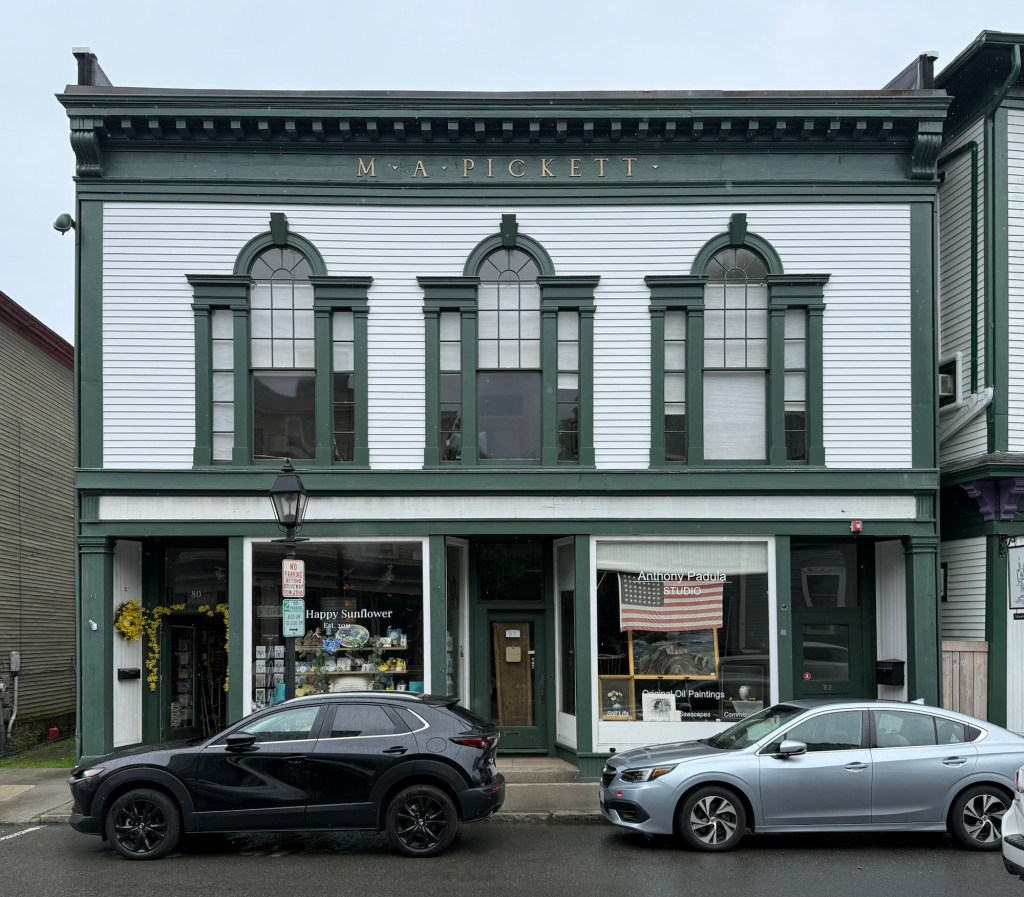
Why is commercial architecture from the second half of the 19th century so perfect? This structure in Downtown Portland is known as the Printer’s Exchange Building and was built in 1866, amongst the ashes of the buildings lost in the Great Fire of 1866. Charles Quincy Clapp is credited as the designer of the structure, which is Italianate in style with the paired round arched windows set into larger openings. The rounded corners are a really subtle but splendid touch in the design. The building got its name as it was home to the Eastern Argus and the Portland Daily Press, among other newspapers who rented the space from owner, Horatio Nelson Jose. I really like this one!

Thompson Block // 1868

Another of Portland’s stunning mid-19th century commercial blocks is the Thompson Block, built in 1868. The structure is one of the most high-style commercial buildings in Maine and is in a great state of preservation. The building was designed by George M. Harding, a VERY busy architect after the disastrous Great Fire of 1866, which destroyed much of Downtown Portland. The building stands three-stories tall with a polychrome slate mansard roof providing a full fourth floor, a subtle and great way to get extra height without making a building too overbearing. The mansard is broken up at the facade by dormers with round-arch windows and keystoned and eared hoods. If only all cities held off urban renewal, we would have so many more structures like this!

Congregational Church of Peru // 1845

The centerpiece of the Village of Peru, Vermont is the Congregational Church, a stunning edifice and example of Greek Revival architecture in the small town. Construction on the church began on the Fourth of July in 1845, with contractor and resident J.J. Hapgood utilizing much of the timbers of the former church building in the new church. Since the interior of the old church had been left natural, they decided that wood in the new building should be left unpainted as well. The bell was financed by contributions, most particularly by J.J. Hapgood. In 1853, a tornado swept through Peru, damaging the west end of the church and moving it from the foundation, it survived. The church remains a center of Village life in Peru and is well-maintained by the congregation.

Peru Creamery House // 1895

The Creamery House in Peru, Vermont is perhaps the most “Vermont” building I have ever heard of. The building was constructed in 1895 George Richardson (1852-1920), a local farmer who operated the use as a place where cheese was made from the excess (unsold) milk of the area farmers. Eventually, the building was acquired by the Town of Peru and converted to a town hall, used for meetings, dances, dinners and parties, serving as the true town gathering place. The town relocated its offices to the former Peru Schoolhouse (featured previously) and this building went back to its roots and is presently home to the Peru Historical Society and the Main Street Makery, a community craft workshop and new town gathering place!

Old Peru Schoolhouse // 1864

In 1816, the turnpike to Manchester, Vermont was completed and ran through the small town of Peru. As a result, inns and taverns were built, and the young village of Peru began to grow, with farming and lumber businesses being the most common employment in town. A village school was built here and in the town’s other school districts. By the end of the 19th century, the lure of moving to the Western U.S. and cities for industrial work caused some population decline in Peru, and a larger, consolidated school was built in the town village. This schoolhouse on the hill was constructed in 1864, replacing the former one-room schoolhouse on the lot. The school consolidated again in the mid-20th century when further population decline necessitated a school district encompassing Peru and nearby towns. This building was later converted to town offices, a use that remains to this day.

The good news is that the town’s population is seeing a resurgence, led by both tourism and the Bromley Mountain Ski Resort as an anchor.

Crocker Tavern // c.1754

One of the largest pre-Revolution houses in Barnstable is this stunning Georgian manse, known as the Crocker Tavern. The c.1754 home was built along Main Street in Barnstable Village by Cornelius Crocker (1704-1784), who operated it as a tavern along the Old King’s Highway, the main stagecoach route through Cape Cod. Cornelius died in 1784, and he left the eastern half of his house and land to his grandsons Robert, Uriah, and Joseph Crocker; the western half of land and house went to his daughter Lydia, widow of Captain Samuel Sturgis who died at 25, she never remarried. The house was “to be divided through by the middle of the great chimney“, a feature which was likely removed under separate ownership. Lydia eventually acquired the other half of the house, and continued operation of the tavern as her father did before her, though it was known as Aunt Lydia’s Tavern. The property was passed down through the family until 1925, when the property was left to the Society for the Preservation of New England Antiquities (later renamed Historic New England) as a historic house museum. The Georgian house and property were eventually de-accessioned by Historic New England and the tavern can be rented out on AirBnb!

Lounsbury House // 1896

One of the (many) stately homes on Ridgefield’s Main Street, this massive Neo-Classical mansion is also among the most visited in Fairfield County. Lounsbury House was built in 1896 by former Connecticut Governor Phineas C. Lounsbury. While attending the 1893 Chicago World’s Fair, Governor Lounsbury was so taken by the Connecticut State Building that he built a replica to serve as his family home. The Connecticut State Building was designed by Waterbury-based architect, Warren R. Briggs at a cost of $112,000! Gov. Lounsbury loved this house, which he named “Grovelawn” until his death in 1925. After his death, his heirs were unable to maintain the massive home, and it started to decay. The Town of Ridgefield did not want to see the mansion demolished, and in an early example of historic preservation, the town purchased Lounsbury House in 1945. A school was built behind and nearly ten years later, the home was leased to the The Ridgefield Veterans’ Memorial Community Association. The home is now managed by a board and rented for weddings and community events.

King Mansion // 1894

After the American Revolution, Lt. Joshua King settled in Ridgefield and built the King Mansion in 1801, a Federal style home that commanded the Main Street lot. King was born in Bridgewater, Massachusetts and fought in the Revolutionary War near the border of Connecticut and New York. After the war, he settled in Ridgefield and married one of the most eligible bachelorettes in town Anne Ingersoll. Anne was the daughter of the Rev. Jonathan Ingersoll, pastor of the Congregational Church of Ridgefield. After a long life running a store and raising a family, Joshua died in 1839, a year after his wife. The mansion was inherited by their son Joshua Jr. until his death in 1887. In 1889, a fire destroyed much of the house. When it burned down, The New York Times described it as “the grandest old mansion in the village.” It was quickly replaced by the current house, modeled after the original but larger, which was placed much farther back from the road in the Colonial Revival style. Fire damaged the house again in the 1990s, and the present structure was restored and enlarged from 2002-2004, its HUGE!

Denmark Odd Fellows Hall – Denmark Arts Center // 1884

This two-and-a-half-story building sits on Main Street in the small town of Denmark, Maine, and has contributed to the town’s cultural life since it was built in 1884. The Independent Order of Odd Fellows (IOOF) is a non-political and non-sectarian international fraternal group that promotes the ethic of reciprocity and charity. It was founded in 1819 by Thomas Wildey in Baltimore, Maryland, evolving from the Order of Odd Fellows founded in England during the 1700s. New buildings sprouted up all over the United States in the 19th century, in cities as large as New York City and towns as small as Denmark. This IOOF Hall is Italianate in style, with brackets at the cornice and hoods and round arched windows in the gable end; it also shows some Greek Revival details with corner pilasters and the pediment. When Raymond Hale, the last member of the IOOF Lodge passed away, the town purchased the old Odd Fellows Hall. The city could not maintain the property and had no good use for it. Residents in town voted in 1991 to sell the building rather than demolish it. Local residents bid on and won the building with the aim to convert it to a local arts center. In August 1994 the owners signed over the deed of the Odd Fellows Hall to the Denmark Arts Center, a non profit organization. From that time until present, the old building, now the Denmark Arts Center, has again served as a community focal point, providing cultural activities for the people of Denmark and surrounding towns.

Cunningham Block // 1896

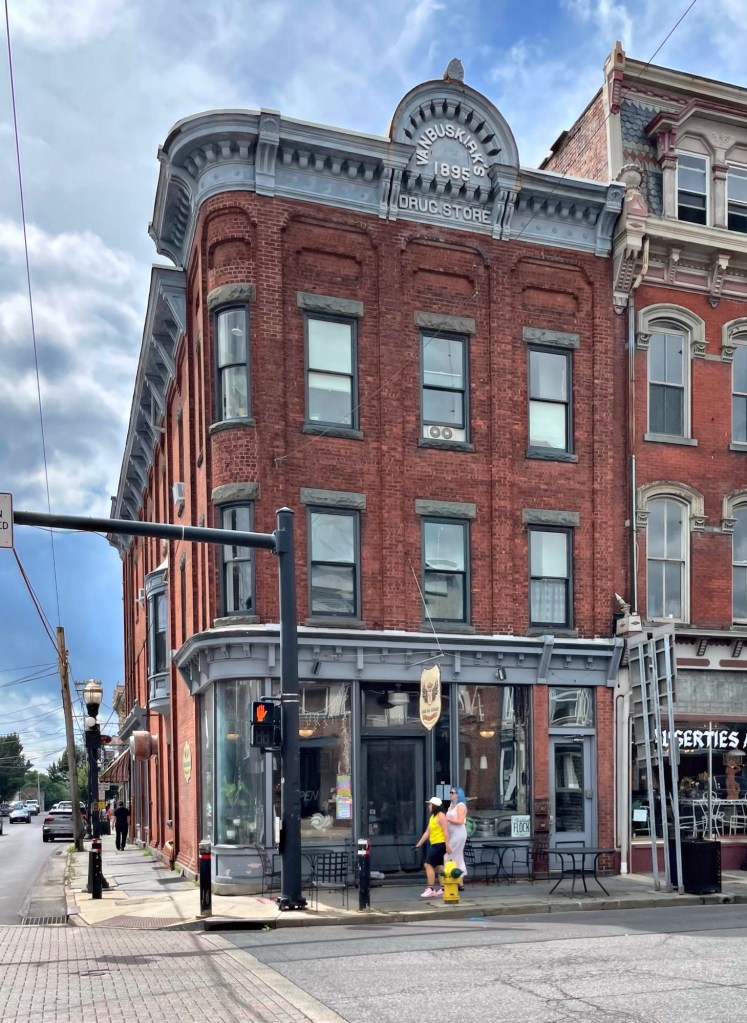
The Cunningham Block in Millbury was constructed by, and named for Winthrop P. Cunningham (1820-1895), and his son and business partner, Russell Clark Cunningham (1845-1907). Winthrop Cunningham had come to Millbury in about 1837 and worked for Waters, Flagg & Harrington prominent gun manufacturers in town. His foundry work there brought him into a partnership with Matthias Felton in the Millbury Foundry Company. The Cunningham Block is sited on a prominent corner lot and built into the slope of the hill which drops down toward the river. I am especially fond of the curved corner facade and repetition of the paired round-arched windows on the second floor.

Valley House // 1868

This massive Second Empire structure on Main Street in Collinsville, CT, was built in 1868 by the Collins Company, the major industry in town as housing and stores. In the 19th and early 20th centuries, large industrial employers often provided affordable housing for workers in close proximity to factories to incentivize the long days and difficult working conditions. The Valley House was known as a hotel, but was essentially an apartment hotel, where workers and visitors could reside in a room without a set lease or contract. At the ground floor, retail shops would provide goods and services to residents of the building and the greater village. Today, the rooms have been converted to condominiums.

Adams-Pickering Block // 1871

Main Street USA! I just love historic Main Streets and Downtowns in New England, so many are full of old buildings and were designed for pedestrians, not cars (though some towns and villages have definitely caved to the automobile). Erected in 1871, the Adams-Pickering Block building was one of several grand, mansard roofed commercial structures which local architect George W. Orff designed for Bangor’s business district in the 1870’s. With its first-story cast iron front and its granite facade, from stone quarried nearby in Hallowell, Maine, the Adams-Pickering Block and its similar contemporaries were the most sophisticated Victorian commercial buildings in Eastern Maine. The Bangor Fire of 1911 and subsequent urban change, especially urban renewal in 1968, destroyed most of the city’s nineteenth century business district. The Adams-Pickering Block is a rare survivor and shows us how old buildings at a human scale can create vibrant, people-centric places.

Murray Store // c.1825

Arguably the cutest little store in Newmarket is the Murray Store, right on the town’s vibrant Main Street. The brick building is one of the earliest such structures on the street and is a great example of a narrow Federal style building with a lunette in the gable end. The structure was built before 1830 and was occupied by a Ms. Charlotte Murray as a millinery (women’s hat store). Main Street USA! What is your favorite Main Street in New England?

Mathes Store // c.1835

Next door to the Mathes Block (previously featured) this stone commercial building is one of many such buildings that make Newmarket so beautiful and unique. Stone was harvested from the shores of the Lamprey River nearby and the beautiful coloring made them perfect for buildings in town. This building was constructed in the 1830s for Benjamin Mathes, a developer and businessman in town. The structure was occupied by the town post office in the early years, and now houses a restaurant.

Chester Tin Shop // c.1830

Located on the edge of the Chester Town Green, you can find this beautiful Federal style commercial building. The use of blind arches at the facade is a fairly common feature found in brick Federal style buildings in Vermont. The structure was built around 1830 and has served a variety of uses through its existence, the most notable being the tin shop owned by various members of the Miller and Hadley families that sold stoves and hardware during the latter half of the 19th century. The tin business in New England grew rapidly after 1820. Tin shop owners imported tinplated sheet iron from Great Britain, shaped it into a variety of forms, and distributed their finished goods through peddlers and country stores. They also sold tinware in their shops. Colanders, dippers, dish kettles, funnels, measures, and pans were in greatest demand. Other common items included lanterns, foot stoves, teapots, coffeepots, “tin kitchens”, skimmers, and sconces. After its use as a tin shop, the building was occupied as a telephone exchange and electric utility company office. It presently is home to an antique store.