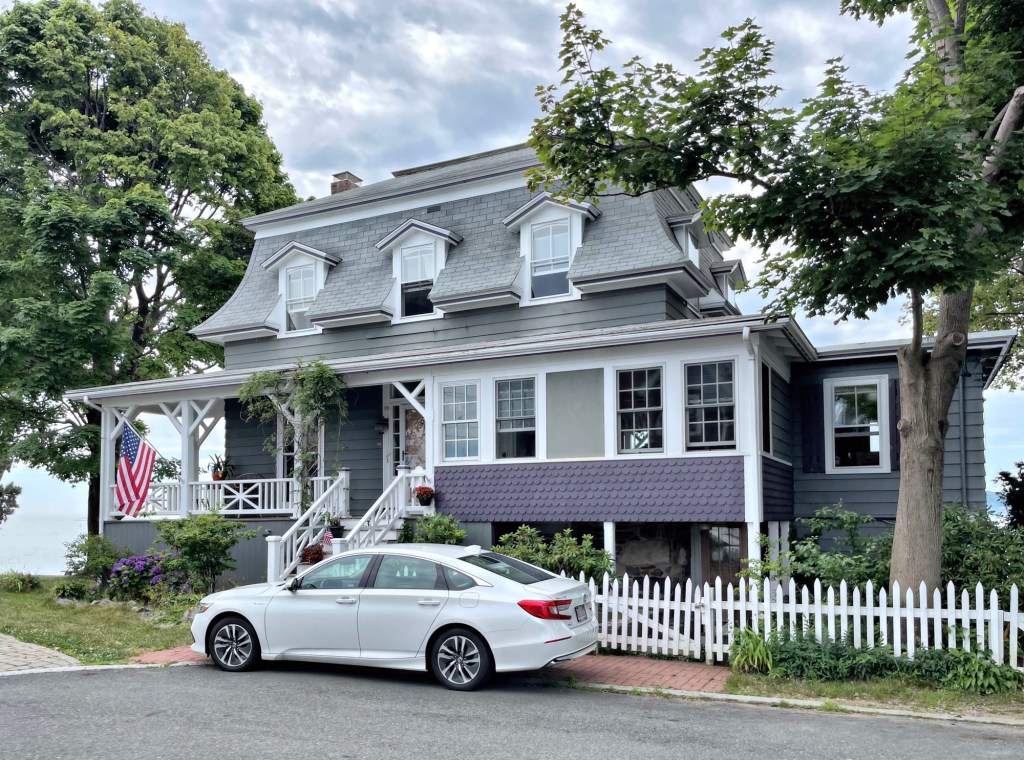
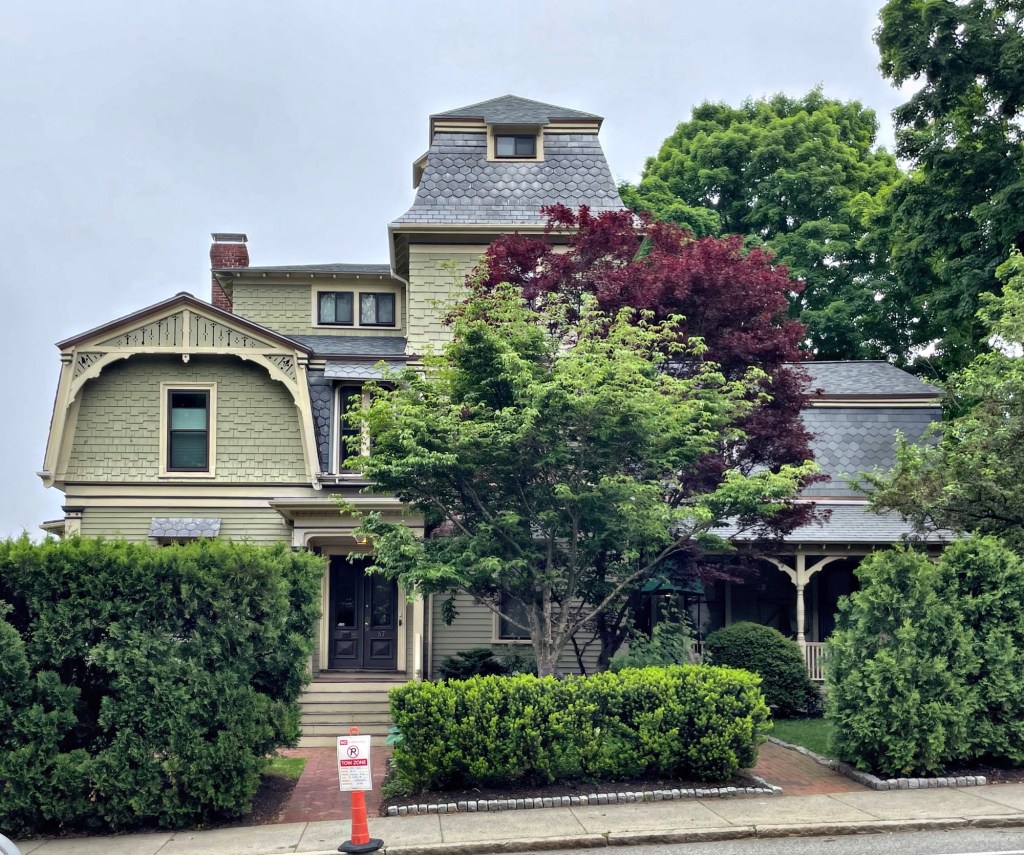
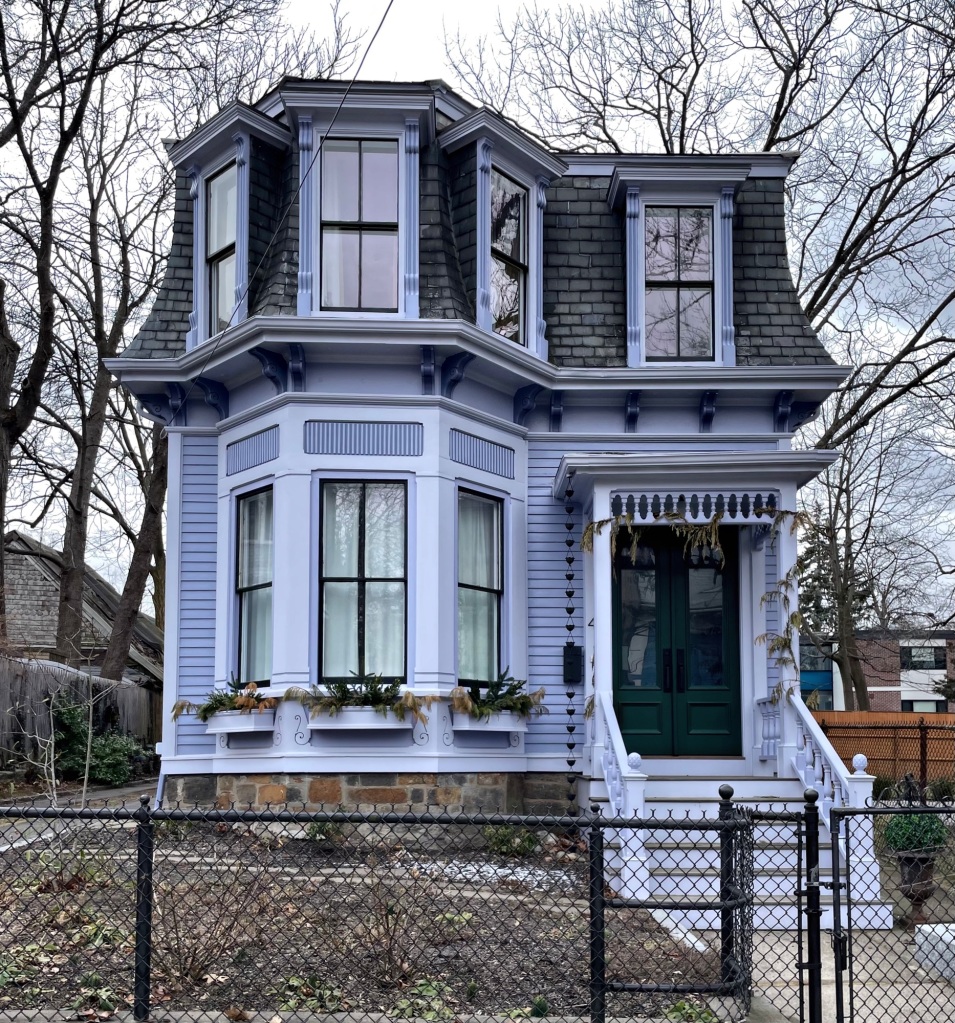
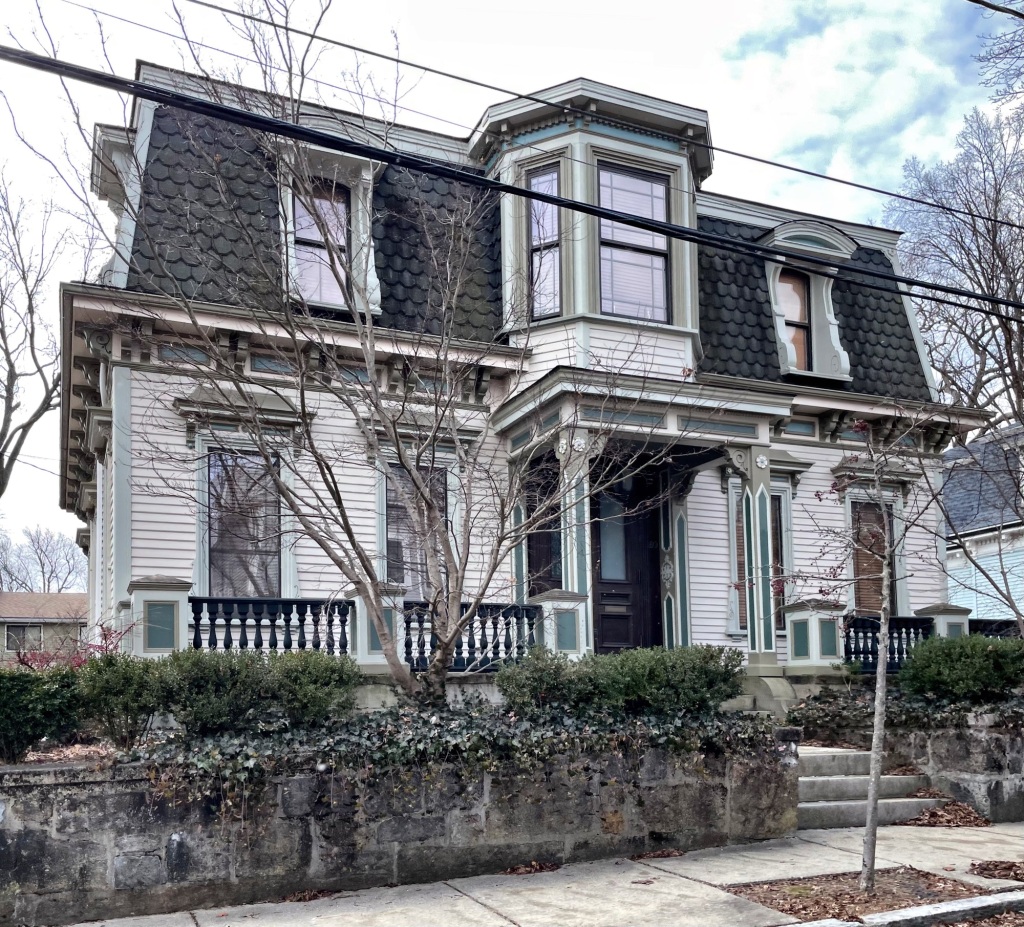
Betteley Cottage // c.1883

Albert Cabot Betteley (1816-1893) was an inventor and coal dealer in Boston. He invented an elevator to hoist goods into a warehouse, a peat grinder for the speedy drying of peat for fuel, and even patented wooden pavement…seriously. He eventually would build this home on Cobden Street in Roxbury where he and his wife Mary Jane would live out their retirement. While he didn’t “make it big” persay with his inventions, he exemplified the typical middle-class resident of Roxbury at the time and built this modest home, with its two-story form with octagonal bay, bracketed cornice, and mansard roof. The cottage was recently repainted the purple color, which I really enjoy!

H. H. Fitch House // c.1870

Henry Hubbard Fitch (1833-1888) was born in Cornish, New Hampshire, but made Roxbury, Massachusetts his home. He moved to Boston at an early age and later entered into business with Francis V. B. Kern under the firm Kern & Fitch, working as a conveyancer. By 1873, he was also a justice of the peace, notary public, and was Boston manager of the Equitable Mortgage Company. In about 1870, he and his wife, Eliza Anne, had this charming Second Empire style cottage built in the Washington Park neighborhood of Roxbury, a fashionable part of the “suburbs” at the time. They would later relocate, before Henry died in 1888 at the age of 55. The house is one of the best preserved in the neighborhood and a survivor from the wrecking ball that destroyed much of Washington Park.

Lewis June House // 1865

The Lewis June House sits on North Salem Road in northern Ridgefield, Connecticut, and is one of the finest Second Empire style homes in this part of the state. The c.1865 home was built for Lewis June (1824-1888), who was in the circus business, and it replaced an earlier home on the site that burned. Lewis June was a partner in the June, Titus and Angevine & Co. Circus that as early as 1842 toured 85 towns in six states. The circus wintered in Ridgefield. Past owners have since found many horseshoes, largely of small horses, on the property, suggesting that June kept the circus’ horses and ponies on this property. The home has been preserved thoughtfully and was listed on the National Register of Historic Places in 1984.

George Cobb House // c.1865

While most of the early homes in Newton Centre were built by a few landowners and rented to tenants, this charming Mansard cottage was owner-occupied from the start. Tucked away on the quiet (and appropriately named) Pleasant Street, the George Cobb House is one of the most beautiful old Victorians in the neighborhood. An early resident was George Washington Cobb (1840-1925) was a druggist who ran an apothecary in East Boston, and he made the long commute there every day from this house. The property has a mansard roof with pedimented dormer and three-story tower capped by a bell-cast mansard roof. Paneled pilasters and brackets add a lot of detail to the primary facade.

Bowen-Newton-Tobin House // c.1825

Who would have ever imagined that the Federal and Second Empire architectural styles could work so well together?! This is the Bowen-Tobin House on Spring Street in Newport, Rhode Island. The house was originally built around 1825 by Stephen Bowen as a typical two-story Federal style house with five-bay facade and entry with pedimented fanlight above. The property and it remained in the Bowen Family until 1892, when it was sold by his heirs to Mary Bailey Newton, the wife of Dudley Newton, a prominent local architect who designed dozens of summer cottages for wealthy residents in Newport. Dudley Newton “modernized” this house, adding a towered mansard roof, bracketed cornice, new two-over-two windows, and a full-length front porch wrapping around the side. The couple later moved the house, which was formerly set back behind a front garden, to the side and at the sidewalk to lay out Green Place (originally Bowen Ct.) and house lots behind this home, removing the front porch in the process. The house was later sold to the Tobin Family.

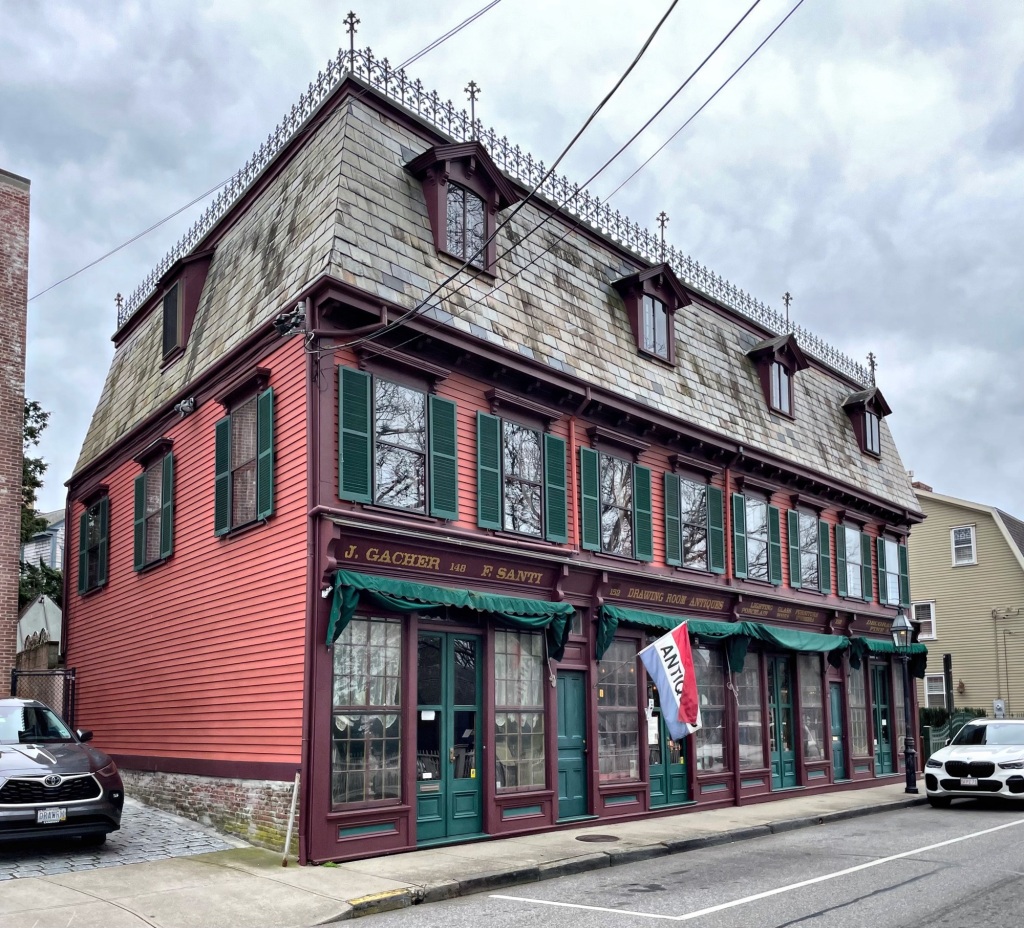
Theodore Helme Block // 1875

One of the finest commercial blocks in Newport is this building, the Theodore Helme Block, located on Spring Street, just behind Trinity Church. The block was built for Helme by 1875 and was possibly an early design by Dudley Newton, a local architect. The Second Empire style block has a slate roof with rare intact iron cresting and small dormers. The building was restored by Federico Santi & John Gacher, who operate The Drawing Room Antiques here.

Cushing-Fearing Townhouse // 1862

168 Beacon in the Back Bay was built ca. 1861, one of two contiguous houses for Robert Maynard Cushing and his older brother, John Gardiner Cushing (more on the house nextdoor in the next post). This home was Robert Cushing’s home for him and his new wife Olivia Donaldson Dulany (m.1863). They also maintained a home, The Ledges, in Newport. The Cushing Family owned the townhouse until 1908, when it was sold following Robert’s death in 1907 by his estate to George Richmond Fearing, Jr., an investment banker. He also served as President of the Free Hospital for Women from 1910 to 1936. The home was recently renovated with a darker, brownstone facade, new copper gutters and downspouts and slate roof. It presently houses three condo units inside.

Freeman House // c.1870

One of my favorites in Dorchester is this Second Empire manse, built c.1870 for cotton broker Freeman S. Packer. The house at 14 Everett Street in the Clam Point/Harrison Square neighborhood is a handsome, formal example of a Luther Briggs-designed Italianate Mansard residence. Although today sheathed in vinyl siding, much of the original siding and trim detail are likely still under there, preserved. Set back from the street facing an ample hedge-enclosed front yard, the three bay main façade exhibits a center pavilion and full-length front porch which undoubtedly appealed to summer guests who vacationed here when this house was known at the Russell House, an apartment hotel during the 1890s and early 1900s.

Vadner House // 1874

This elegant estate which stands on the corner of E. Quincy and Pleasant streets in North Adams, Massachusetts was originally built for Samuel Vadner in 1874, by architect Frank Davis the architect. Samuel Vadner established his carriage repository in town in 1870, which saw immediate success. His company manufactured carriages, sleighs, wagons, harnesses, and more, during a period of wealth for the industrial city. The high-style Second Empire style house features a bellcast style mansard roof with broad overhanging eaves, a small entry portico, and a three-tier entry tower that is capped by a convex mansard roof.

R.J. Walden House // c.1872

Located on the appropriately named Pleasant Street in North Adams, Massachusetts, this charming Second Empire style house is one of the finest in town. The house was built sometime between 1869-1875 for an R.J. Walden, who was listed in directories as a Deputy Sheriff for Berkshire County, an auctioneer, and real estate agent. Interestingly, the mansard roof is broken by a truncated corner tower with a flat roof. This is a unique one!