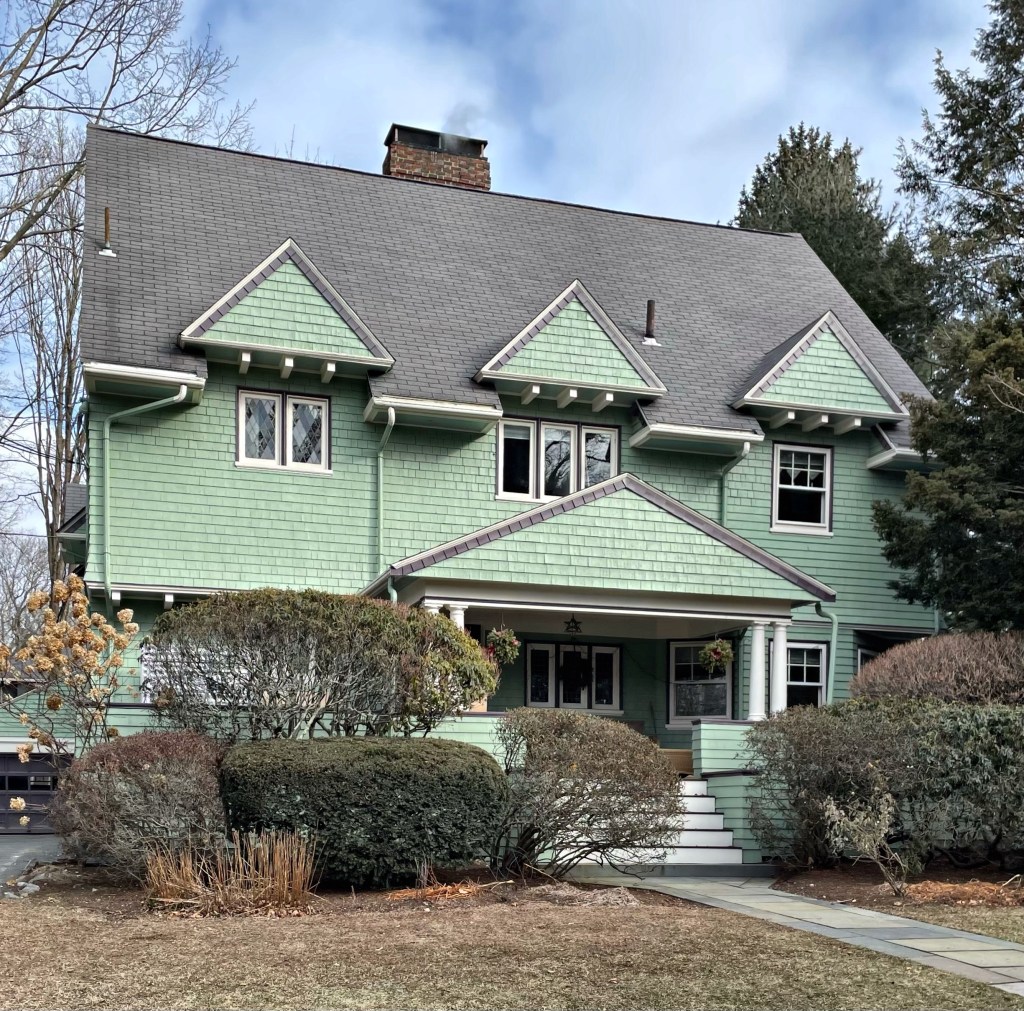
George and Effie Mead House // 1911

Prominently sited upon a hill on a dead-end street in West Acton, Massachusetts, this Craftsman Bungalow is a very elaborate and well-preserved example of the style. The house was built in 1911 for George Varnum Mead (1861-1940) and his wife Effie Wright Mead (1860-1926) as their summer home when they weren’t living in Somerville. Mr. Mead was born in West Acton to Varnum Balfour Mead, who operated the A. O. W. Mead Company, a produce marketing business in Acton and Boston. Varnum’s brother built an elaborate Second Empire style mansion in town which was featured on here yesterday. George Mead followed his father’s footsteps and worked in the family business, which was in operation starting in the 1840s. The A. O. W. Mead Company gathered produce from farmers all over West Acton, kept the produce in cold storage facilities erected by the family, and sent it to Boston for sale at Quincy Market until George’s death in 1940. The Craftsman style house has a fieldstone base, low, overhanging flared gable roof, and is sheathed in shingle siding. Characteristic features include the multiple dormers, exposed rafter tails, grouped windows, and the large fieldstone chimney.

Thomas D. Hamson House // c.1895

Marblehead, Massachusetts is better known for its Colonial-era homes, but there are definitely some amazing old Victorians interspersed in the warren of narrow streets and alleys. This Queen Anne style house was built in the 1890s for Thomas D. Hamson, who was listed in directories as a shoe manufacturer. Queen Anne style Victorians typically exhibit asymmetrical plans, varied projecting and receding planes, varied siding materials and forms, turned posts and porches, and towers and turrets. This house has it all!

Reverend Whitwell House // c.1756

Another of the stunning gambrel-roofed Georgian homes in Marblehead is this beauty located on High Street in the village. This house was built around 1756 but is best known for its resident from 1766-1779, as the home of the Reverend William Whitwell (1737-1781), who was the fourth minister of the Old North Church, located just a stone’s throw away. Although this Georgian dwelling looks like a single-family house from the outside, it is actually divided into two houses with separate owners, likely since its construction. Later dormers crowd the roof, but its still a pretty amazing Pre-Revolution home in one of the most charming towns in New England!

Enoch Fuller Octagon // c.1850

Oh the Octagon! The very rare Octagon house was a unique house style briefly popular in the 1850s in the United States and Canada. The style can generally be traced to the influence of one man, amateur architect and phrenologist Orson Squire Fowler. In his book, The Octagon House: A Home for All of 1848 (and reprinted with more photos in 1853), Fowler advocated for the shape’s benefits for buildings in that the octagon allowed for additional living space, received more natural light, was easier to heat, and remained cooler in the summer. These benefits all derive from the geometry of an octagon: the shape encloses space efficiently, minimizing external surface area and consequently heat loss and gain, building costs etc. Some were convinced and built Octagon houses, but the style and its brief period of popularity, died by the 1860s. This example in Stoneham, Massachusetts was built around 1850 for and by Enoch Fuller, a close personal friend of P. T. Barnum, founder of the Barnum & Bailey Circus. Fuller visited Barnum’s octagonal home in Bridgeport, Connecticut and he decided to construct an octagon house in Stoneham. The home was owned by Col. Gerrry Trowbridge not long after completion. The home was built with a fireplace in every room, a spiral, “flying” staircase, and a sweeping veranda.

Doucette Ten-Footer // c.1850

Here is a building type many of you may not know of… the Ten-Footer! This 10 x 10-foot square building is a well preserved example of a kind of shop historically used by many shoemakers in the late-18th to mid-19th centuries. In Stoneham during the 19th century there were many such shops scattered throughout the town as the area became a sort of hub for shoemaking. In the age before and just after the Industrial Revolution, many Massachusetts residents had home shops in the yards where family and neighbors could earn extra part-time money by doing piece work on shoes. These cottage industry shoe workers were paid for each pair of shoes delivered to the local distributor. Usually, the owner-shoemaker worked alone or with family members in the cramped space with materials like leathers, rubber, and straps stored in the attic space in a loft in the gable. This ten-footer was built in the mid 19th century and later owned by Peter Doucette, who ran a shoe shop here. The small building was eventually acquired by the Stoneham Historical Society and was moved behind their building, restored and it can better tell the story of the town’s rich shoemaking history.

Gorham Hussey House // c.1820

This Colonialized Federal period house sits just down Vestal Street from the Maria Mitchell Association campus on the ever-charming island of Nantucket. The home was built around 1820 for Gorham Hussey (1797-1879), who would have been around 23 at the time. He married Lydia Macy in 1820 and the couple had twin daughters that same year, likely right after this house was completed (talk about a busy year)! The home was later owned by photographer John W. McCalley, who photographed this and other houses in the area. The home retains a high-style Colonial Revival fanlight over the door, likely added in the first three decades of the 20th century as colonial homes were romanticized.

Ellen Banning Ayer Country Estate – “Ledgebrook” // c.1905

Ellen Banning Ayer (1853-1918) of Minnesota married Frederick Ayer in 1884 and her life completely changed. Frederick Ayer was one of the richest men in New England and he was involved in the patent medicine business, but is better known for his work in the textile industry. After buying the Tremont and Suffolk mills in Lowell, Massachusetts, he bought up many textile operations in nearby Lawrence, combining them in 1899 into the American Woolen Company, of which he was the first president. The couple had at least three houses in Lowell, Boston, Pride’s Crossing and had three children (one of whom Beatrice, later married the famed general George Patton). As the Ayer Mansion on Commonwealth Avenue was being built, the family was looking for a country house near the city. One year, Frederick asked Ellen what she wanted for a gift and she said “roses”. Frederick purchased an old farmhouse on Nahanton Street in Newton and had greenhouses and a stable built immediately, followed by a Colonial Revival country house for his wife Ellen. The mansion held lavish parties for the Ayers, who loved to entertain and it was passed down to their eldest daughter Katharine Ayer Merrill. The property was purchased in the 1920s by Clive and Mona Lacy for decades until it sold in the 1980s. The large site was eyed for redevelopment. The architectural firm of Dimella Shaffer was hired, and they restored the Ayer House, and designed forty residential units on the site, all tucked into the woods gently peering out here and there. The old Ayer House remains as the clubhouse of the Ledgebrook Condominiums Association.

Quabbin Lookout Tower // 1940

After the Quabbin Reservoir was filled (more on the history in my last post), the cleared land and body of water, with its over 181 miles of coastline, was seen as not only an engineering marvel, but a place of natural beauty and splendor. Upon a rise in the land and the edge of the reservoir, they saw a perfect location to build a tower that could serve many purposes. The Metropolitan District Water Supply Commission hired the firm of Densmore, LeClear & Robbins to design a tower that would serve as a radio tower, fire station and observation tower to view the reservoir. The structure, while designed in the Arts and Crafts mode, is of modern construction and is comprised of two main parts. The lower portion, is constructed of stone and concrete, with metal casement windows, granite lintels and sills and bronze doors. This section was used for radio equipment. The interior has glazed tile walls and cement floors. The six-story tower has five floors of metal and concrete stairs. At the top is a two-level, glass enclosed observation tower.

Quabbin Park Cemetery Building // 1940

By the early 1900s, metropolitan Boston’s demands for freshwater began exceed its supply, causing the state legislature to look for other sources of water to supply the metro’s population growth. A 1922 study endorsed the Swift River Valley (Quabbin area) as the best location for a new reservoir that could supply Massachusetts with fresh water, but there was one issue, there were towns and people living there. To create the Quabbin Reservoir, the depressed land would need to be flooded, this required over 80,000 acres of land to be purchased or seized by eminent domain by 1938. Four towns: Dana, Enfield, Greenwich, and Prescott were disincorporated and their excess land not flooded was added to surrounding municipalities. In total, an estimated 2,500 residents lost their homes as part of the flooding. Not all elements of the towns were destroyed, however. Town memorials and cemeteries in the four towns were moved to Quabbin Park Cemetery, in Ware, a short distance from the Quabbin Reservoir. Many other public buildings were moved intact to other locations (like those in Dorset, Vermont featured previously). In the over 80,000 acres that were flooded, the Commonwealth had to relocate an estimated 7,500 burials in over 35 cemeteries in these flooded towns. Bodies were removed from their respective locations, and intered in the new Quabbin Park Cemetery, built by the Commission in 1932 with grounds designed by landscape architect Arthur A. Shurcliff. An area for unknown graves and a memorial area at the entrance to the cemetery also contains public war monuments from the abandoned towns. This service building was added to the cemetery from designs by architect Frederick Kingsbury who died during its construction.

United Church of Ware // 1926

The East Congregational Church in Ware was established in 1826, spurred by the industrial growth and subsequent immigrant population boom in the village of Ware, Massachusetts. The Ware Manufacturing Company, a major player in town, contributed $3,000 to towards the construction of a new congregational church in the village, which was matched by residents. The original church was built in 1826, following plans prepared by Isaac Damon, a noted church architect from Northampton, in the Federal style, popular at the time. In 1925, just a year before its centennial, the church burned to the ground. Plans to rebuild the church formulated immediately. Due to changes to the neighborhood since 1826 (notably the construction of tenement housing adjacent to the church), the decision was made to locate the new church setback from the street. Plans were drawn by Frohman, Robb and Little of Boston for the new building, which was to be Federal Revival, a nod to the former church building. The grounds in front were landscaped by the prominent landscape architect Arthur A. Shurtleff. After WWII, population decline and dwindling membership of some churches in town required a few congregations to consolidate, creating a union or united church here. The United Church of Ware came into being in 1969 when the East Congregational Church, United Church of Christ and the Ware Methodist Church, United Methodist Church joined together and became one federated church with ties to two denominations.