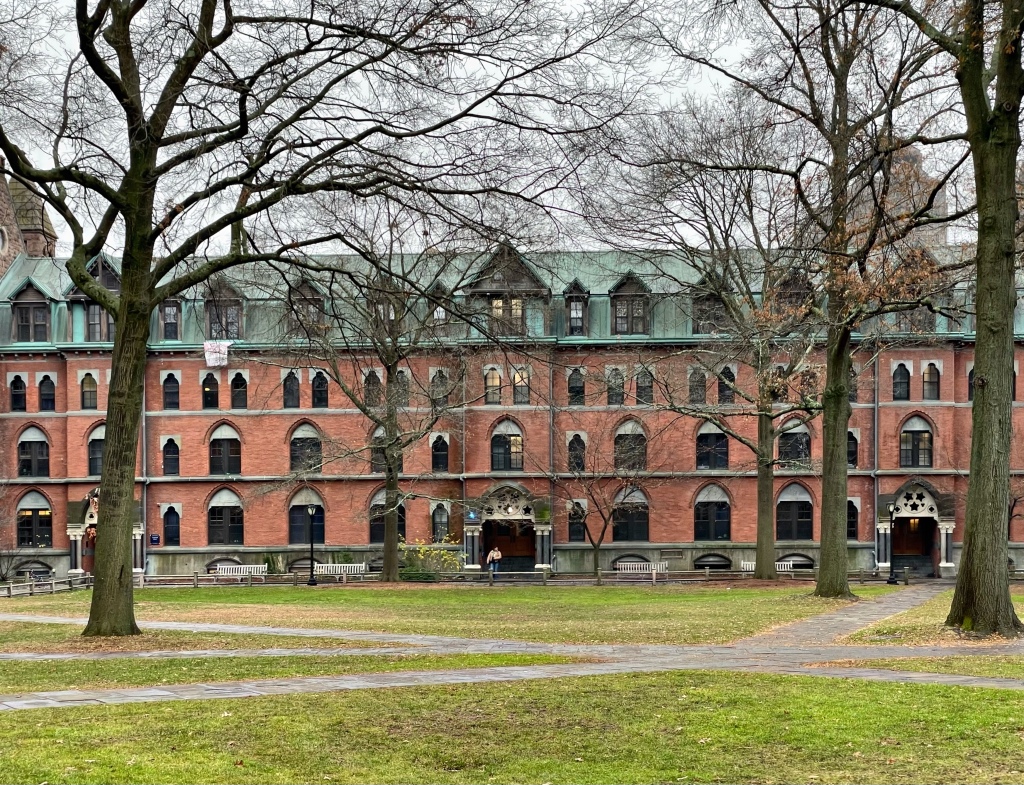
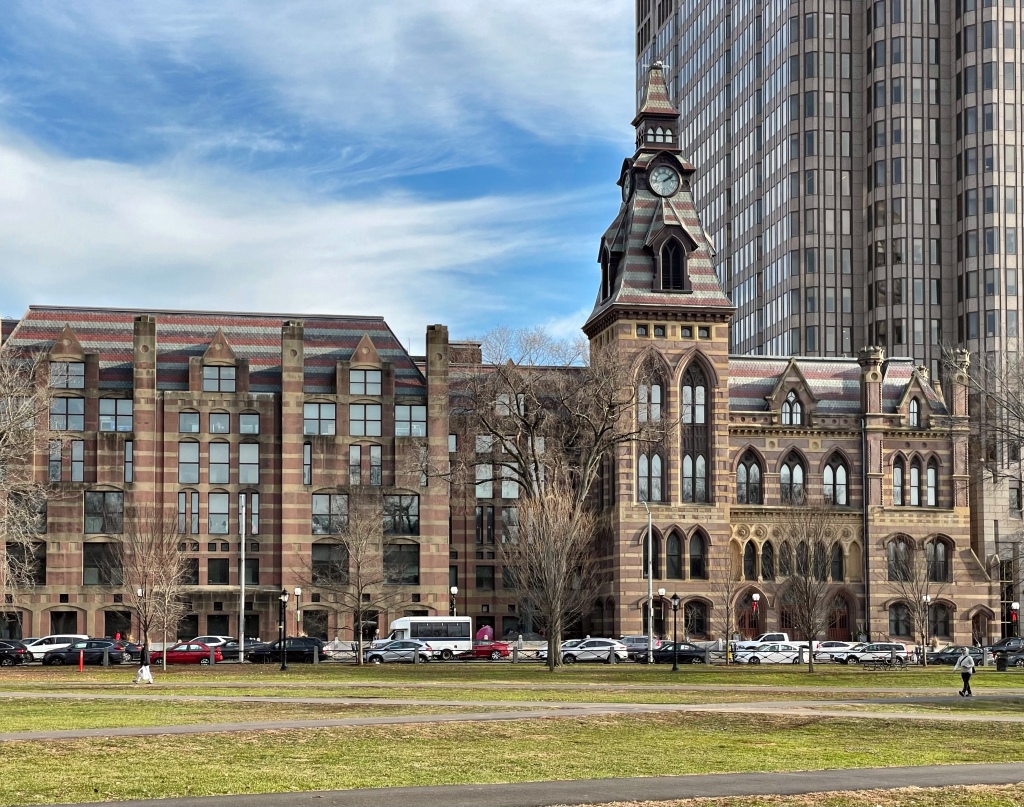
As Yale University continued to enclose its Old Yard with elongated dormitories in the second half of the 19th century, the proprietors began to experiment with slight deviations to the prototypical Victorian Gothic piles built in the previous decades. Following a financial gift from Pierce N. Welch, an 1862 graduate of Yale College, and his sisters in memory of their late father, Harmanus M. Welch, the college hired architect Bruce Price to furnish plans for the new dormitory. Welch Hall is built of Longmeadow Freestone, the building is more Romanesque in style with arched masonry openings, the rough hewn stone walls, and pointed dormers projecting through the eave lines.
As the Old Campus of Yale was being enclosed at its north and east by Farnam and Durfee halls, architect Russell Sturgis was again tasked to design a new building, but for a corner site; though this time, he would design a college chapel. Built between 1874–76, it was funded primarily with gifts from Joseph Battell. Succeeding two previous chapel buildings on Yale’s Old Campus, it provided space for daily chapel services, which were mandatory for Yale students until 1926, which were all-male and mostly Protestant. The large stone chapel is constructed of New Jersey brownstone with decorative elements in sandstone. The design of the Victorian Gothic chapel is great, but how it sits with the entrance unceremoniously dumping out to the end wall of Durfee Hall leaves much to be desired.
Farnam Hall is Yale University’s oldest dormitory still in use. Designed by New York architect Russell Sturgis in a Ruskinian High Victorian Gothic style, Farnam Hall is considered Sturgis’s most important work and was completed in 1871, marking a new direction toward an enclosed campus, shielded off from the surrounding downtown district of New Haven. Named for Henry Farnam, its construction required the removal of the Second President’s House and a section of the Yale Fence, which was met with some trepidation. The red brick, four-story building originally consisted of twenty suites and ten common rooms on each floor. Sturgis, who was influenced by John Ruskin’s ideals put forward in his Seven Lamps of Architecture, used a variety of brick and stone on the facade all with hand carved detailing. Farnam Hall was renovated in 1977 by architect Edward Larrabee Barnes and today serves as a dormitory for first-year students belonging to Yale’s Jonathan Edwards College.
One of my (many) favorite buildings at Yale University is Bingham Hall, a monumental and landmark example of the Collegiate Gothic architecture style. Built in 1928, replacing the 1888 Osborn Hall (last post), Bingham Hall was constructed as an inward-facing freshman dormitory by architect, Walter B. Chambers, who had just overseen the completion of his first building at Yale, the Colonial Revival style McClellan Hall. Built of Longmeadow brownstone, Bingham Hall largely constructed from funds donated by the children of Charles W. Bingham (Yale, 1868), a Cleveland based businessman. The building stands five stories with a massive nine-story corner tower and helped solidify Yale’s iconic Collegiate Gothic architecture for the future buildings and growth as well.
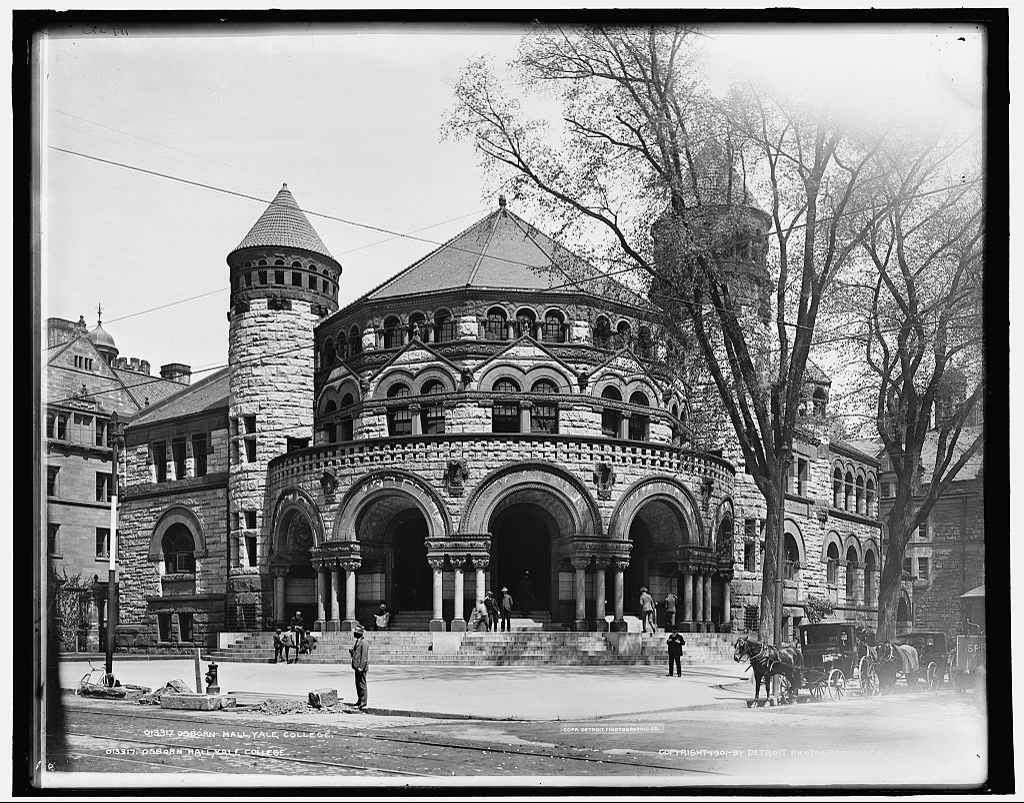
One of the biggest architectural losses at Yale was the demolition of the grandiose Osborn Hall in 1926, after standing less than 38 years! The building was constructed in 1888 at the southeast corner of the Old Yard at Yale, at the corner of College and Chapel streets, and was a landmark example of the Richardsonian Romanesque style of architecture. Designed by architect Bruce Price, the building was designed to face outward and was said to resemble a “squating toad with an open lip”. While architecturally stunning, the building was immediately met with criticism. Its construction necessitated the removal of the cherished Yale fence and the outward-facing design made it hard for students to focus on lectures while the sounds of horses and carriages on the cobblestone streets just outside. The short-lived Osborn Hall was razed in 1926 for Bingham Hall (next post), a prominently designed, but inward-facing building.
Just 15 years after the Chittenden Memorial Library (last post) was constructed to provide overflow space for Yale’s Old Library, the college overseers sought to expand yet again. Linsly Hall was built in 1906 as an addition to the 1880s Richardsonian Romanesque Chittenden library building, but in the Collegiate Gothic style, which was quickly becoming a preferred architecture style for the campus. Linsly Hall was built as a connector between the two library buildings with a tunnel-like passage between the structures. This was quickly deemed inadequate for a college of this stature, and the 1930s Sterling Library was built outside of the yard decades later. Architect Charles C. Haight designed Linsly Hall following the same design elements as his popular Vanderbilt Hall, built 10 years prior nearby. Today, the Linsly Hall (and the adjoining Chittenden Hall) is classroom space.
As Yale’s 1842 Old Library was outgrown by larger class sizes and a growing college library collection, overseers began planning for a new library annex which could support the programming. Architect J. Cleaveland Cady was commissioned to design the Chittenden Memorial Library, this underappreciated structure, which is today hemmed into a cramped space in the yard between a later addition (Linsly Hall) and McClennan Hall. The Chittenden Memorial Library was a gift to the college by U.S. Representative Simeon Baldwin Chittenden in memory of his only daughter, Mary Chittenden Lusk (1840-1871) nearly two decades following her untimely death. The handsome Richardsonian Romanesque style library building also retains its original stained glass window titled, “Education” by Louis Tiffany which today is in the building’s former reading room, now a large classroom. When the library moved to a new building in the 1930s, Chittenden Memorial Library became Chittenden Hall and is classroom space.
Like many other buildings on campus, Vanderbilt Hall is named for its wealthy sponsors, but its foundation is one of family tragedy. One of Yale’s stunning Collegiate Gothic structures, the building is named after William Henry Vanderbilt II (1870-1892), who attended Yale in the early 1890s. William contracted typhoid fever from a water pump while touring the western United States and died during his junior year. His father, railroad tycoon Cornelius Vanderbilt, constructed Vanderbilt Hall in 1894 as a memorial to his son and donated it to the University. The highly prized Vanderbilt room, which is located above the archway, is apparently one of the finest residential spaces on the campus. Architect Charles C. Haight designed the building which enclosed the southern edge of the yard, created a gateway, and is one of the early architectural statement pieces for the campus in the Collegiate Gothic style. Haight would receive later commissions at Yale based on his work on Vanderbilt Hall.
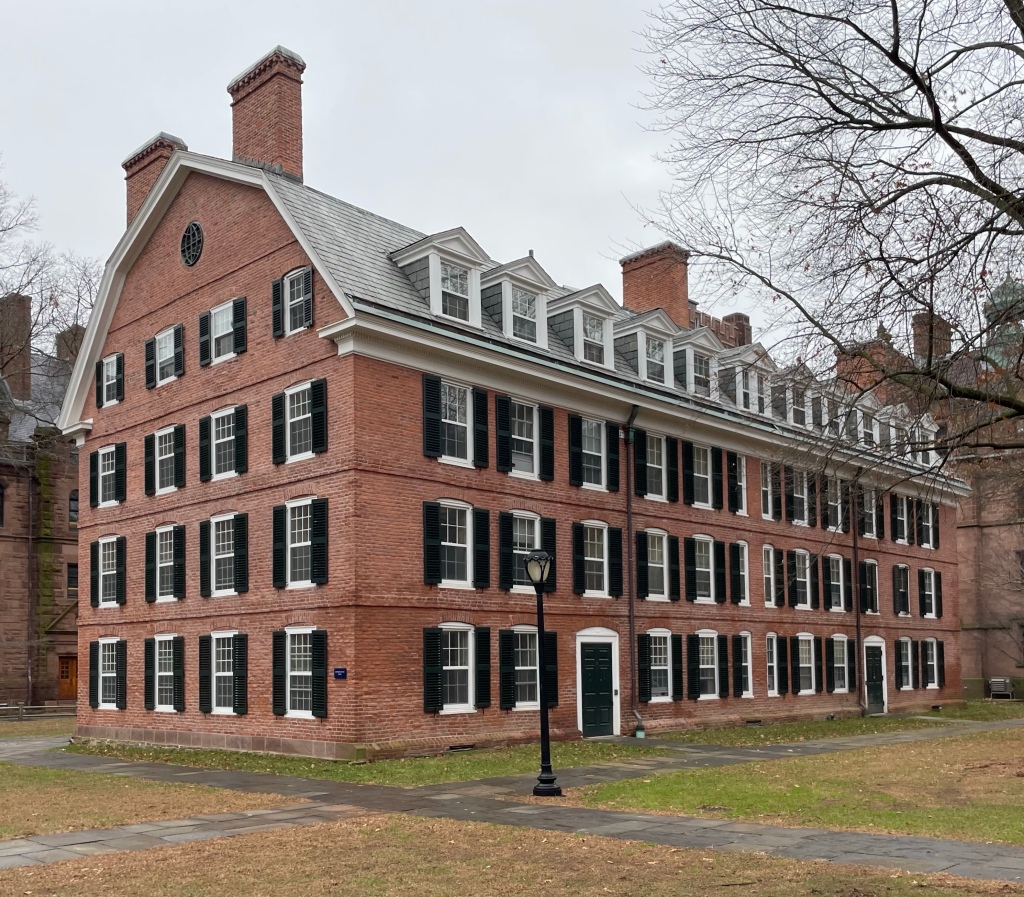
Welcome to Yale! When Yale College, one of the nine Colonial Colleges moved to New Haven in 1718, a wooden building was soon constructed and known as the College House. By 1747, the College House held less than half of the college’s enrolled students, and college presidentThomas Clap announced that funds would be raised from the Colony of Connecticut for a “new College House” of three stories. The design followed the traditional Georgian appearance of Harvard College’s Massachusetts Hall, but by the 1790s, it was already outdated. The building was threatened with demolition, but Connecticut Hall was instead given an additional story and a new gambrel roof by 1820, being incorporated into the Brick Row, fronting the Green along College Street. But by the middle of the century the Brick Row was out of style and Connecticut Hall was being described as “dilapidated, scabby and malodorous.” After the Civil War Yale decided to raze all its old Georgian architecture and redevelop the West side of the Green with larger and more modern buildings. Luckily for us, by the 1890’s the Colonial Revival style was booming in popularity and before Connecticut Hall could be demolished, a group of alumni organized to save and restore it. Connecticut Hall stands today as the third-oldest of only seven surviving American colonial-era college buildings, and the second-oldest structure built for Yale College in New Haven (the oldest exant). It was built, in part, by at least five enslaved Africans, including one of whom was owned by Yale president Thomas Clap.
The Connecticut Financial Center is the tallest building in New Haven, Connecticut, and the sixth tallest building in the state. The 383-foot postmodernskyscraper was designed by the Toronto architectural firm Crang and Boake and completed in 1990, replacing the Powell Building (last post), New Haven’s first skyscraper. The Connecticut Financial Center is sited facing the New Haven Green wedged between the iconic New Haven City Hall and Federal Courthouse, and dwarfs both in size, creating a really unpleasant addition to the block. The building is at least clad in stone, a subtle nod to the adjacent buildings and has a more traditional first floor lobby set back from the street.
Even skyscrapers face the wrecking-ball…The Powell Building was among New Haven’s first building recognized as a “skyscraper.” Built in 1921, the commercial building is Neo-Gothic Revival in style with the two bottom stories and the two top stories are detailed in Gothic motifs, with eight more plain floors between. The resulting shaft-like appearance distinguishes the Powell Building from other contemporary commercial structures in the city, which are essentially heightened versions of various historical styles. The architect, Roy W. Foote, was among New Haven’s leading architects in the first half of the 20th century, largely due to his local efforts in high-rise construction. The Powell Building was erected as a speculative venture by Albert H. Powell, whose primary business was a wholesale coal dealership. Early occupants were professional offices and a bank at the first floor. The building historically was located at the New Haven Green, between the Victorian Gothic City Hall and Classical Federal Courthouse. The building was sadly razed by 1990 by the New Haven Redevelopment Authority, who were VERY active in town knocking down neighborhoods in the second half of the 20th century. It was replaced by the Connecticut Financial Center skyscraper, currently New Haven’s tallest building.
Historically, inns and taverns offered short-term stays for visitors to New Haven, Connecticut. As the town developed and Yale College grew, land-owners began to realize the potential for larger, centrally located hotels. Established in 1824 and fronting the Town Green, the Tontine Hotel stood for less than 100 years, but was a prominent establishment in the city. The hotel was designed by architect David Hoadley and it hosted many well-known individuals including Native American chief and orator Red Jacket, who gave a speech here in 1829, and Daniel Webster, who came here in 1832. When more modern hotels were built in the early 20th century, the Tontine saw declining and less fancy clientele. The site was slated for redevelopment and the block was demolished in 1913 for the new Federal Courthouse and Post Office (last post).
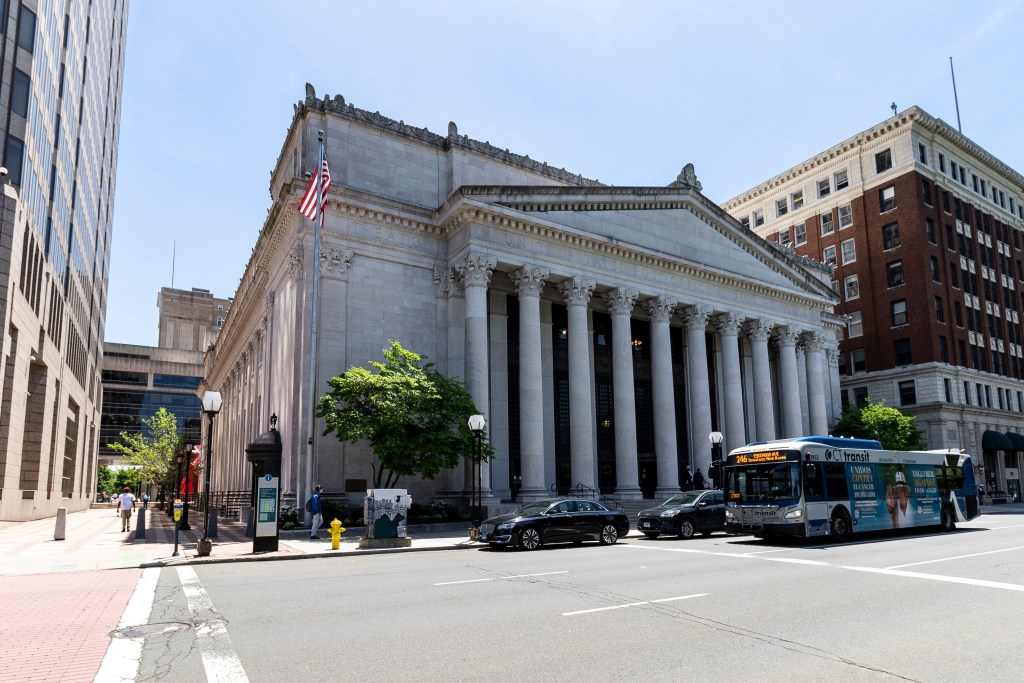
The monumental Richard C. Lee U.S. Courthouse is located on the west side of the Town Green in New Haven, Connecticut, a stone’s throw from the New Haven City Hall. The building is an excellent example of Classical Revival architecture. The building originally served both as a courthouse and post office, although the post office moved to another location in 1979. James Gamble Rogers designed the building, which was constructed between 1913 and 1919. Rogers was also the architect for structures at Yale University, his alma mater (more on some of those later). The building was the last to be designed under the auspices of the Tarsney Act (1890-1912), which allowed the Treasury Department to hire private architects rather than use only designers employed by the federal government. Classical architecture was commonly seen in federal building design during the early twentieth century because officials believed it conveyed the dignity of the federal government. The New Haven courthouse displays several hallmarks of the style, including the colossal portico and pediment with columns capped by Corinthian capitals. The courthouse was slated for demolition in the 1960s as part of an urban renewal plan. However, a coalition of federal judges and local historic preservationists rallied to save it. In 1998, the building was renamed to honor Richard C. Lee, a former New Haven mayor who was a pivotal figure in the building’s preservation as well as the city’s revitalization.
Less than four centuries ago the area which is now New Haven, Connecticut, was the home of a small tribe of Native Americans, the Quinnipiac. White settlers arrived by 1638 and made a deal with the local sachem (leader) to protect the native Quinnipiac from raiding bands of Pequots and Mohawks in return of purchasing some of the tribe’s land by the Puritans. By 1640 a complete government had been established and the settlement, originally called Quinnipiac, was renamed Newhaven (later New Haven). The town plan was based on a grid of nine squares. In accordance with old English custom, the central square, now the Green, was designated a public common. By 1718, in response to a large donation from East India Company merchant Elihu Yale, an early college relocated from Old Saybrook to New Haven, and its name was changed to Yale College. The city grew exponentially with industry, education, and commerce, becoming one of the wealthiest and diverse cities in the state. As the city grew after the Civil War, a new City Hall was built. The New Haven City Hall was constructed in 1861-2 and was designed by local architect Henry Austin. To the left of City Hall and set back further from the street was the old Courthouse (1871-3) designed by David R. Brown (1831-1910). Together the buildings provide a united facade marking the first phase of the High Victorian Gothic Style in America. By the 1980s, plans for a new Government Center were discussed following decades of deferred maintenance and a decaying building. Luckily, cooler heads prevailed, and the facades of the building were preserved with a modern structure constructed behind to house city offices, from plans by local architect Herbert S. Newman. The Victorian Gothic and Post-Modern building stands proudly today, anchoring the east end of the Town Green.