Samuel P. Tilton Cottage // 1880

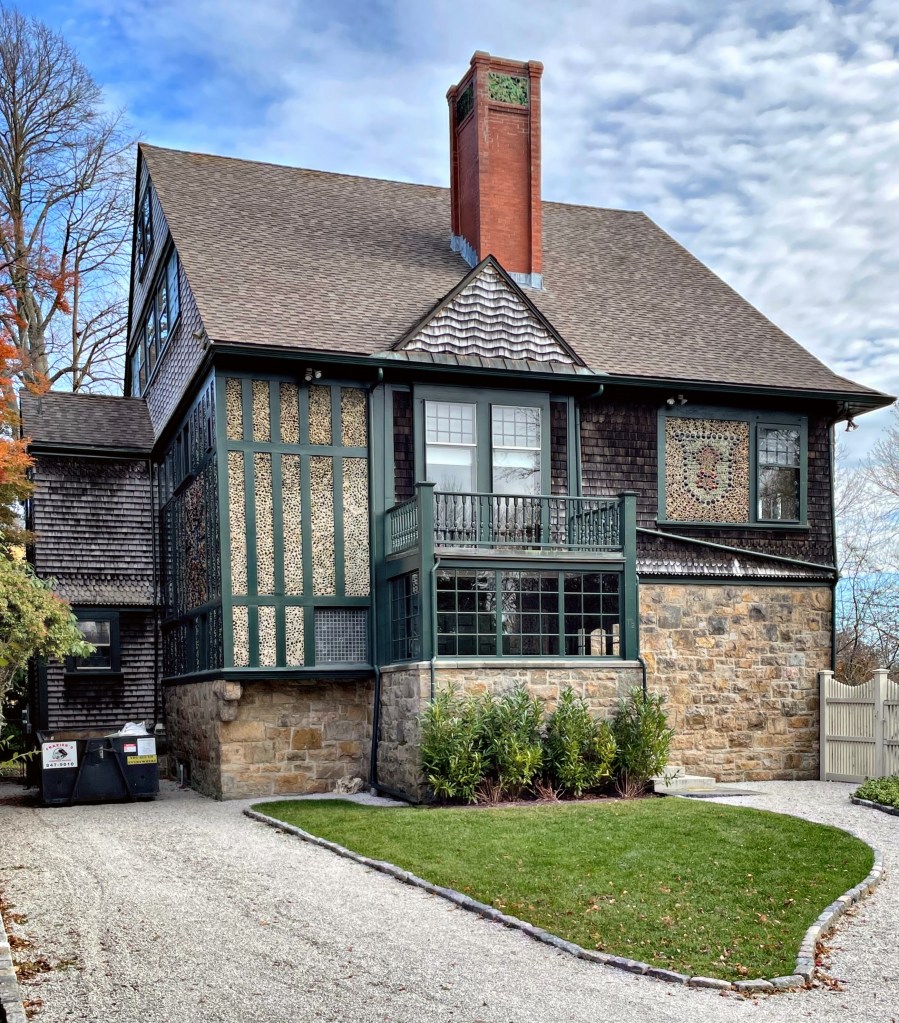
One of the most well-designed and least-pretentious summer cottages in Newport is this charming dwelling on a dead end street. The Samuel P. Tilton Cottage was designed in 1880 by the prestigious firm of McKim, Mead & White as an idiosyncratic blending of Queen Anne and Shingle architectural styles. Mr. Tilton was a milliner (maker and seller of women’s hats) with stores in Boston and Paris, France. He had this cottage built to summer close to the nation’s wealthiest, likely marketing some hats at elaborate Gilded Age events. The facade is assertively Queen Anne with its massing and decorative panels, with shingled side elevation seemingly sprouting from the earth. The architectural terminology for these unique decorative panels is “sgraffito” where here, cement or plaster siding is set and adorned with shells, pebbles, colored glass, and pieces of coal into a cartouche design. The house is one of the finest in Newport, and shows that bigger isn’t always better!

“Snug Harbor” – Charles H. Baldwin Cottage // 1877

One of the finest Queen Anne style residences New England is this 1877 summer cottage, named “Snug Harbor”. The mansion was designed by architects William Appleton Potter and Robert Henderson Robertson for Charles H. Baldwin, a prominent admiral in the United States Navy. The design utilizes a brick first floor with shingle siding above, a high cross-gabled roof, panels and half-timbering, asymmetrical form, and a porte cochere at the entry. Later owner Arakel Bozyan, painted the entire exterior a deep red color and renamed the house “Gamir Doon”, Armenian for “Red House”. The house was restored back to a traditional color scheme and sold in 2020. The interiors are STUNNING!

The Anchorage Cottage // 1878

This charming Victorian cottage in Newport was built in 1878 for Henrietta and Dr. Stephen Cambreleng Powell as their summer cottage. The well-connected couple hired New Haven architect David R. Brown to design the residence, which is an excellent example of the Queen Anne and Stick/Eastlake architecture styles. David Brown, the architect, apprenticed under the famed Henry Austin for years in New Haven, Connecticut before becoming a partner of the firm. As any good summer cottage needs a fun name, the couple named their cottage “The Anchorage”. The cottage is now known as the Old Beach Inn, and is among Newports many charming old inns.

Ms. Grace Weston House // c.1898

At the end of the 19th century, much of Boston’s suburban communities saw rapid development where country estates and farmhouses were razed and their properties laid out for residential development. This house in Newton was built around 1898 as a late Queen Anne and it has so many details and intricacies. The earliest known owner was Grace M. Weston who was mentioned often in local newspapers as an expert on antiques.

T. C. Sullivan House // 1898

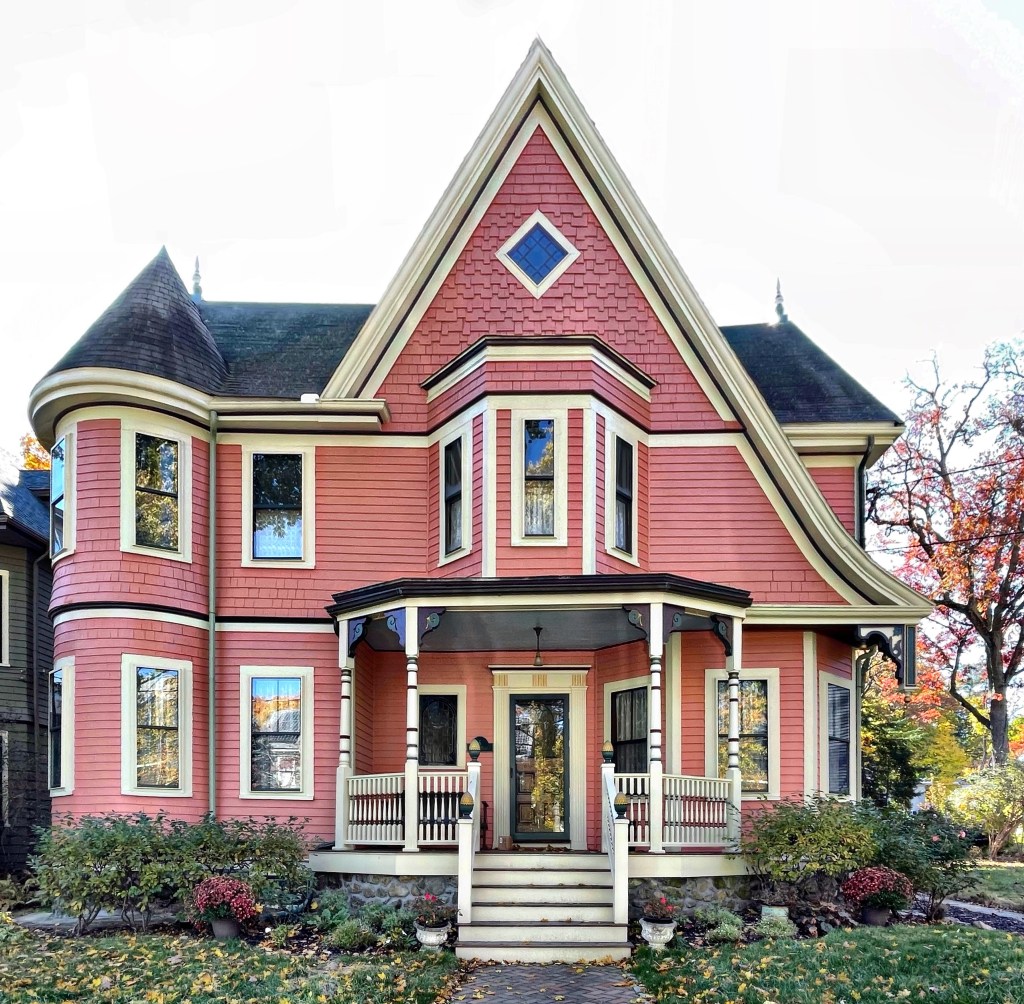
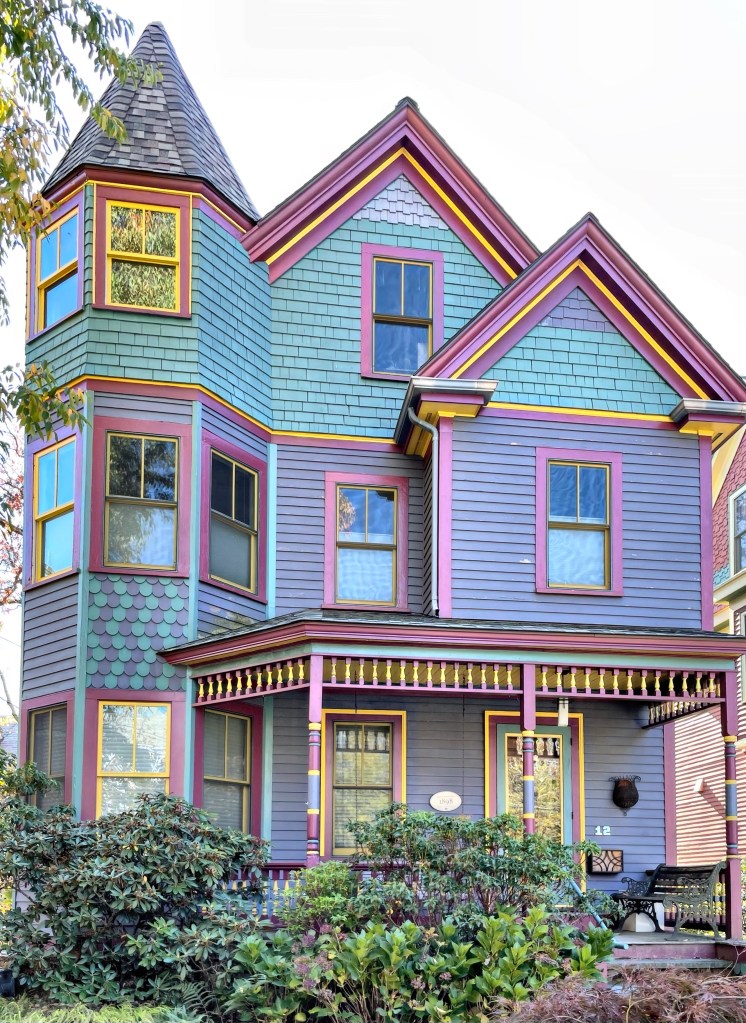
Behold this Queen Anne painted lady in all her glory! This home was constructed in 1898 as a late Victorian addition to Newton’s built landscape. The home’s earliest known owner was a T. C. Sullivan, who left the property to his family upon his death. The house is painted some pretty bold colors, which does an effective job at highlighting the many architectural details and intricacies in the design, but the home would have never been painted like this historically. A little history lesson: the “painted lady” trend took off in San Francisco when after WWII, disinvestment in the urban core led many Victorian homes there to be demolished, altered and covered with siding, and many were painted gray with war-surplus Navy paint (battleship gray). In 1963, San Francisco artist Butch Kardum began combining intense blues and greens on the exterior of his Italianate-style Victorian house. His house was criticized by some, but other neighbors began to copy the bright colors on their own houses. Kardum became a color designer, and he and other artists / colorists began to transform dozens of gray houses into Painted Ladies. By the 1970s, the colorist movement, as it was called, had changed entire streets and neighborhoods. This process continues to this day. The trend took off all over the United States as urban centers saw re-investment and gentrification. While not historically appropriate, the Painted Ladies can really make people happy and show pride in ownership.

Barrows-Goddard House // 1898

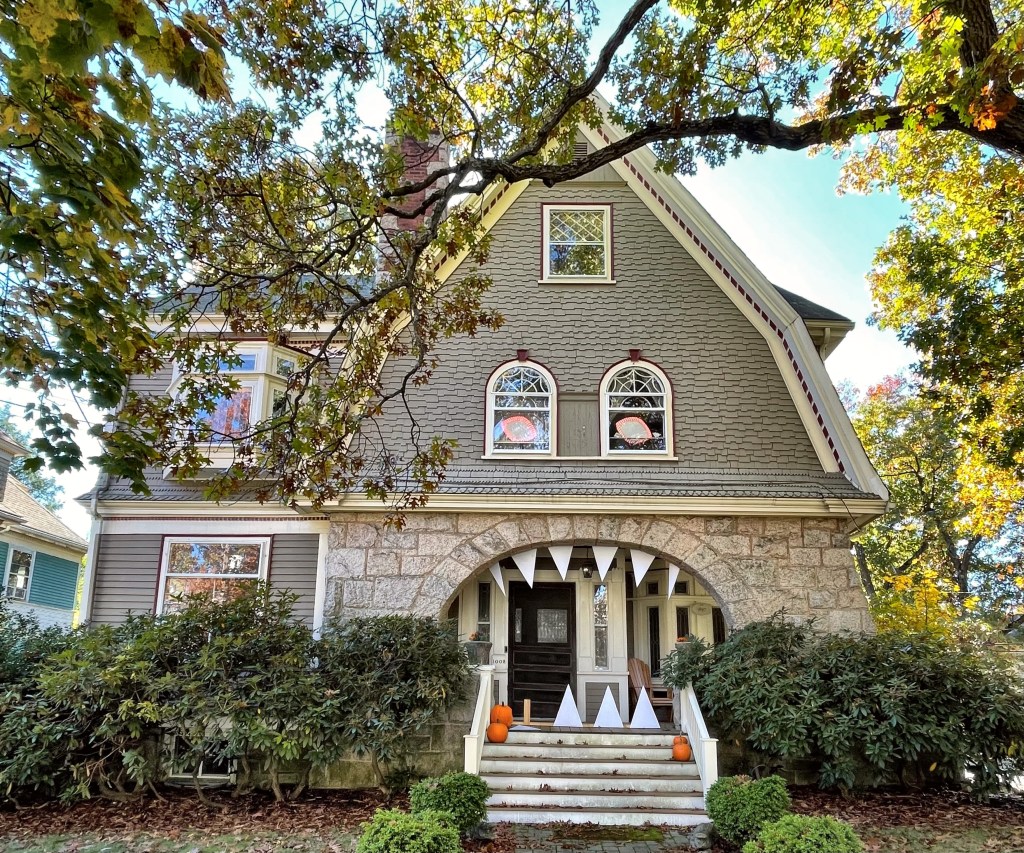
Happy Halloween! To celebrate I wanted to feature one of the more creatively decorated houses in the Boston area, which blends spookiness with architecture! This is the Barrows-Goddard House, so named after its first two owners. The house is located in Newton and was built in 1898 as an eclectic Queen Anne/Shingle style home. The original owner was Joseph Barrows, who developed the property and sold it within a year, relocating to a new home on a less busy street. The property was owned next by Christopher Goddard, an insurance agent with offices in Boston. Architecturally, the gable roof of the main block is intersected by an over-scaled gambrel cross-gable clad in patterned cut wood shingles. The focal point of the design is the Syrian-arched entrance porch of coursed, dressed fieldstone which this time of year, eats trick-o-treaters!

Oscar and Maud Rice House // 1895

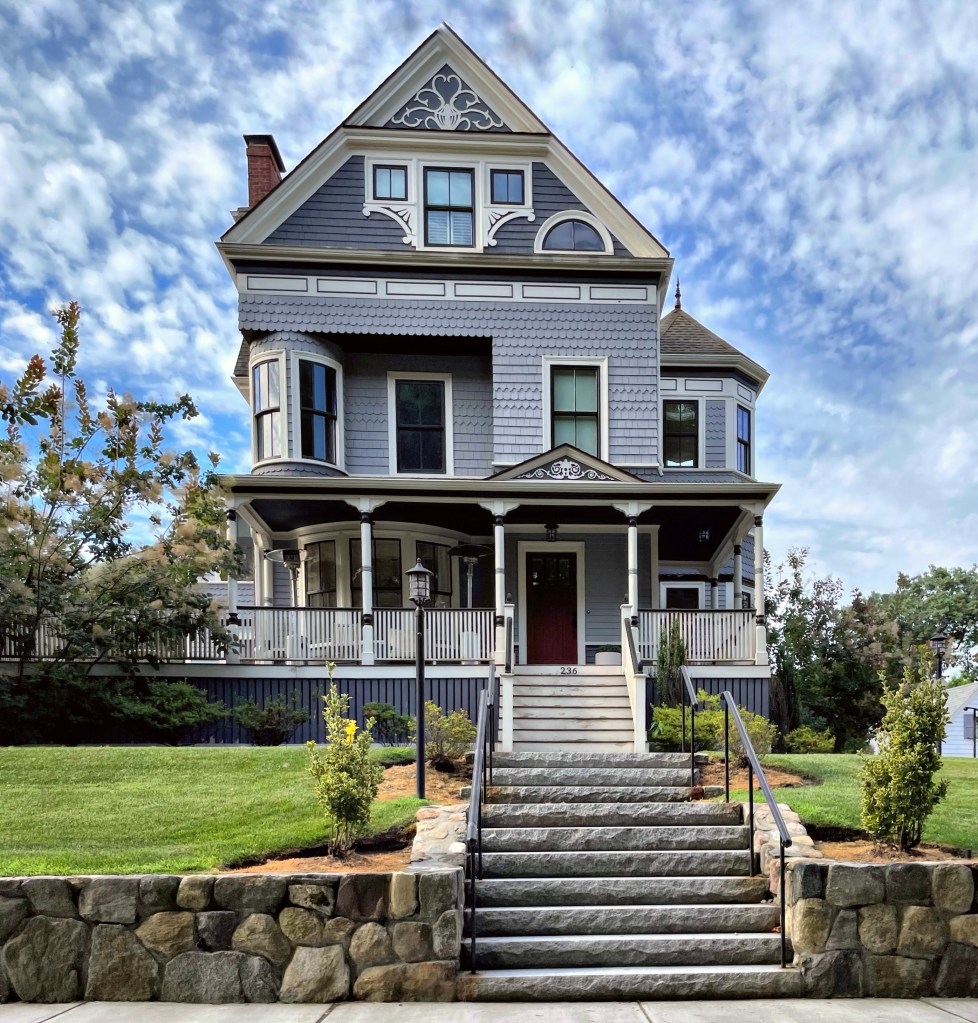
In 1895, when the Queen Anne style was no longer in vogue among architects and builders in the Boston area, the Allston Real Estate Company took a gamble and built this house in a scarcely developed section of Waban Village in Newton on spec, hoping to find a buyer. They found one in Oscar Raymond Rice and his wife Maud Lois Sargent Rice. Oscar worked as a salesman, and Maud volunteered locally with various causes. The family home is a great example of Queen Anne Victorian architecture with varied siding styles, asymmetry, a tower, rounded bay window, porch with turned posts, and applied decoration in the gables. The house underwent a large renovation about five years ago and it still looks great! The listing from 2017 gives me serious house envy.

Ernest Zeiss House // 1897

Another eclectic house in Waban is this beauty, a blending of Queen Anne and Colonial Revival styles under an impressive gambrel roof. The home was occupied by Ernest L. Zeiss, a salesman. Waban, which was once a neighborhood within the reach of the middle-class, has since become one of the most desirable neighborhoods in one of the most exclusive towns in the Boston metro. It is safe to say an ordinary 9-5 salesman would not be able to afford a house like this today!

Jacob Cropley House // 1884

Marblehead is known for its Colonial-era architecture, so its always fun to find a stellar Queen Anne house in town! In 1884, Jacob M. Cropley, a shoe manufacturer, built one of Marblehead’s finest victorian residences on a hill overlooking the harbor. Cropley ran shoe and leather mills in Massachusetts and Wolfeboro, NH, making great money. The house was located on a prominent site on Pleasant Street, and was purchased by the U.S. Government in 1904 about the time that Cropley and his family moved to Boston. The house was purchased by David Lefevour, a grocer, who moved it back on the lot, saving the house from the wrecking ball. On the former house site, a post office was built by the U.S. Government.

Frederick Colony House // c.1885

When you look up Queen Anne architecture on Google, this house in Wilton, NH should pop up! The Frederick Colony House was built around 1885 for the mill-owner who built a large cotton mill (last post) in town at the same time. Frederick Colony (1850-1925) was from a prominent textile and cotton mill-owning family based in Massachusetts and Keene, New Hampshire. Colony purchased land along the Souhegan River and built a new mill, there to make his own fortune, and that he did! The Frederick Colony House remains as one of the best-preserved homes in Wilton, and recently sold. Those interiors!

The Tower Cottage // 1880

Tower Cottage was built in 1880 and is one of the best examples of Queen Anne architecture in the town of Ridgefield, CT. The home was designed and built by Charles Betts Northrup, a carpenter and builder who grew up in town. The home was eventually occupied as a summer retreat for Maude Bouvier Davis, who would spend some summers at the house away from the big city. In Ridgefield, Maude was sometimes visited by her niece, Jackie Bouvier, later known as Jackie Kennedy Onassis, First Lady to President John F. Kennedy. Maude owned the property until 1972 and the home has been lovingly preserved since.

Rockwell House // c.1850

Built in 1850, likely as a late-Greek Revival or Italianate style home, this property on Main Street in Ridgefield was completely “modernized” in the 1880s in the Queen Anne style popular at the time. The home was originally built for Francis Asbury Rockwell (1818-1881), a tin-smith, wine-maker and inventor who married Mary Lee Everest, who also had deep roots in the community and was a daughter of a local Revolutionary War captain. The couple built a home on Main Street and raised their children there until Francis and Mary died in 1881 and 1883 respectively. The family home was inherited by their eldest son, Charles Lee Rockwell, who became the director of the First National Bank in town. Charles updated the house to give it the Queen Anne Victorian flair we see today.

Beckwith House – Partridge Hall // 1882

Henry Truman Beckwith (1808-1893) was born in Providence and (of course) enrolled at Brown University. He left school after two years and wished to see the world. He began to work as a cargo clerk aboard ships for a cotton merchant of Macon, Georgia. He traveled between Boston and Calcutta at least twice, bringing aboard novels from American and British authors, spending much of his time reading. Being well-read and without a family of his own (he never married), he devoted much of his time to clubs and organizations including: the Providence Athenaeum, Rhode Island Historical Society, and the Rhode Island Horticultural Society. In the later years of his life, Henry had this Queen Anne style home built in College Hill, on the same block as the Historical Society where he was a member. The Beckwith House was eventually acquired by Brown University and has since been known as Partridge Hall. The building is now home to the Brown Center for Students of Color, an organization that was established after a series of student protests in 1968 and 1975. Amid the civil rights movement of the late 1960s and 1970s, a group of Black students walked out of Brown University in December 1968 in protest of fierce racism on campus. The mission of the Brown Center for Students of Color has evolved over the years, but its current mission statement reads “Visualize. Vocalize. Mobilize”, they remain an integral piece of the campus and provide much-needed space for students of color to build a sense of community on campus.

Stetson House // 1897

Waban is full of eclectic homes from the end of the 19th century, and this example is probably my favorite! The Herbert and Georgia Stetson House was built in 1897 and demonstrates how elements of the Colonial Revival style were incorporated into a less rigid Queen Anne style plan. Herbert was a lumber dealer, and likely used his own product in his home. The mixture of ornament includes Colonial
Revival style pedimented dormers, a Palladian motif window, oval windows, and a modillion cornice in combination with bays, oriels, a dramatically overshot gable roof, and a swept dormer reminiscent of the Queen Anne style. Together, the composition is perfection, and really makes you stop and analyze all the details!

Louis K. Harlow House // 1888

One of the best houses in Waban Village in Newton is this absolutely stunning Shingle style/Queen Anne home perched high on Moffat Hill. This house was built in 1888 for Louis K. Harlow, who began his career as a professional artist in 1880 and traveled Europe to study the work of prominent painters. Back in the Boston area, Harlow painted nature and landscapes and produced etchings that were shown in the Boston Art Club and sold worldwide. He later got into poetry and published multiple works. Harlow hired the firm of Longfellow, Alden, and Harlow, to design this country retreat. I assume there is a relation between Louis K. and the architect Alfred Branch Harlow, but I would love to find out the connection! The design is quintessentially Queen Anne, with the asymmetry, complex roof form, varied siding types, and diamond window sashes. The shingled second floor overhangs the fieldstone first floor which to me, evokes the Shingle style where the house seems to have grown out from the earth. I can only imagine how spectacular the interior is!