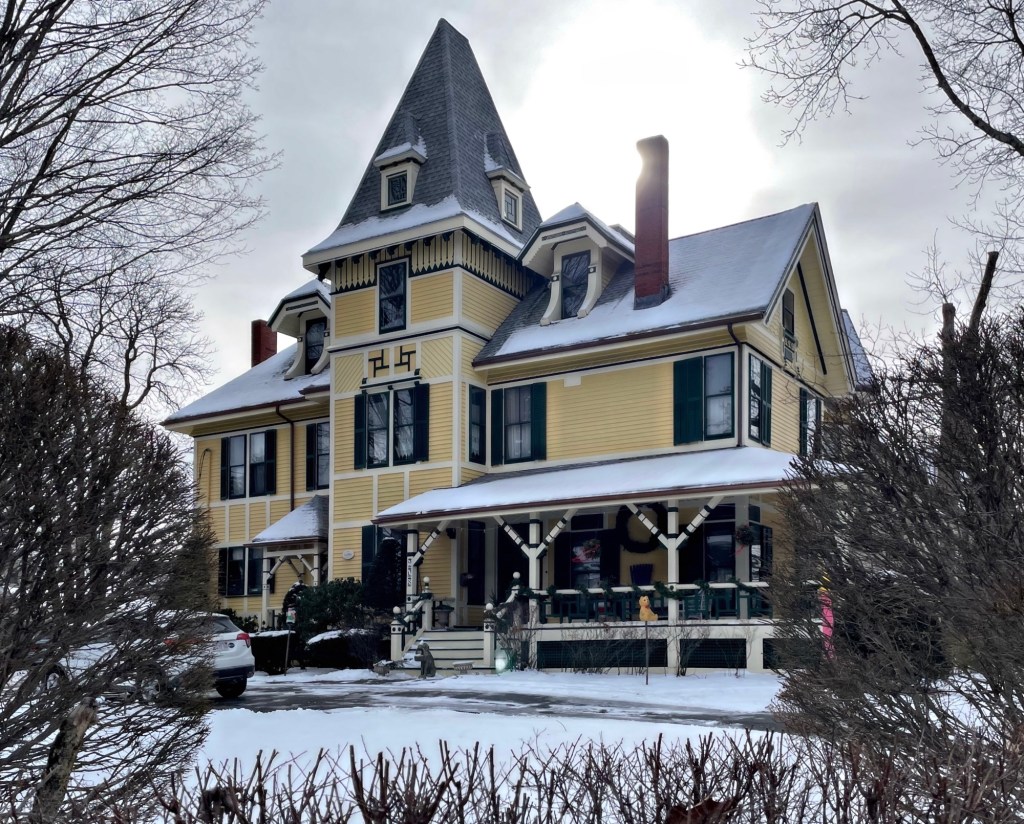
Andrew F. Leatherbee (1842-1920), a wealthy lumber dealer in Boston, built this large Stick style victorian house in Newton Center around 1870, likely using his own lumber products! The large frame house is prominently sited on a corner lot on Beacon Street, a short walk to Crystal Lake, a natural pond in the center of town. I could not find information as to who the architect was, but it was likely a notable local firm. As Andrew got older, he downsized and relocated to a smaller apartment in Cambridge. Upon his death in 1920, the property was sold by his heirs to Mae Van Dusen. The house is a high-style example of the Stick style of architecture, with large half-timbers, heavy porch bracing, and a central tower with pyramidal roof. Swoon!!!
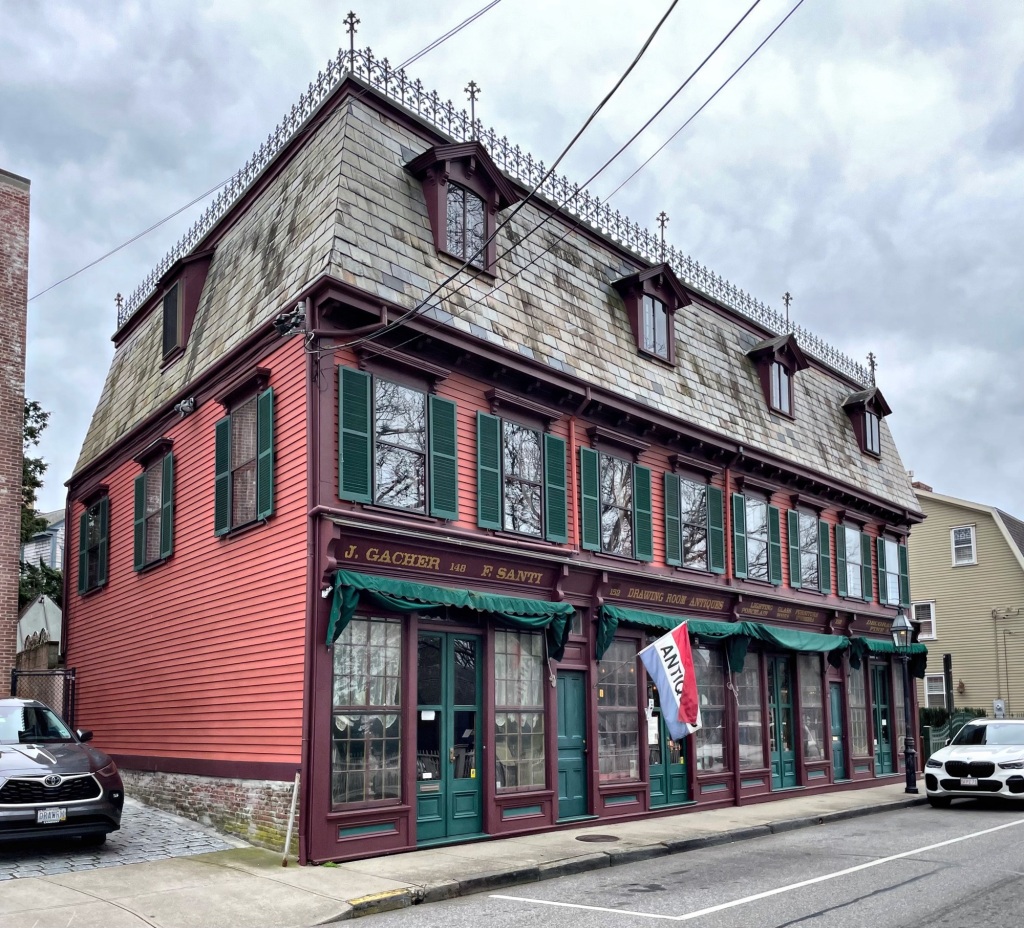
One of the finest commercial blocks in Newport is this building, the Theodore Helme Block, located on Spring Street, just behind Trinity Church. The block was built for Helme by 1875 and was possibly an early design by Dudley Newton, a local architect. The Second Empire style block has a slate roof with rare intact iron cresting and small dormers. The building was restored by Federico Santi & John Gacher, who operate The Drawing Room Antiques here.
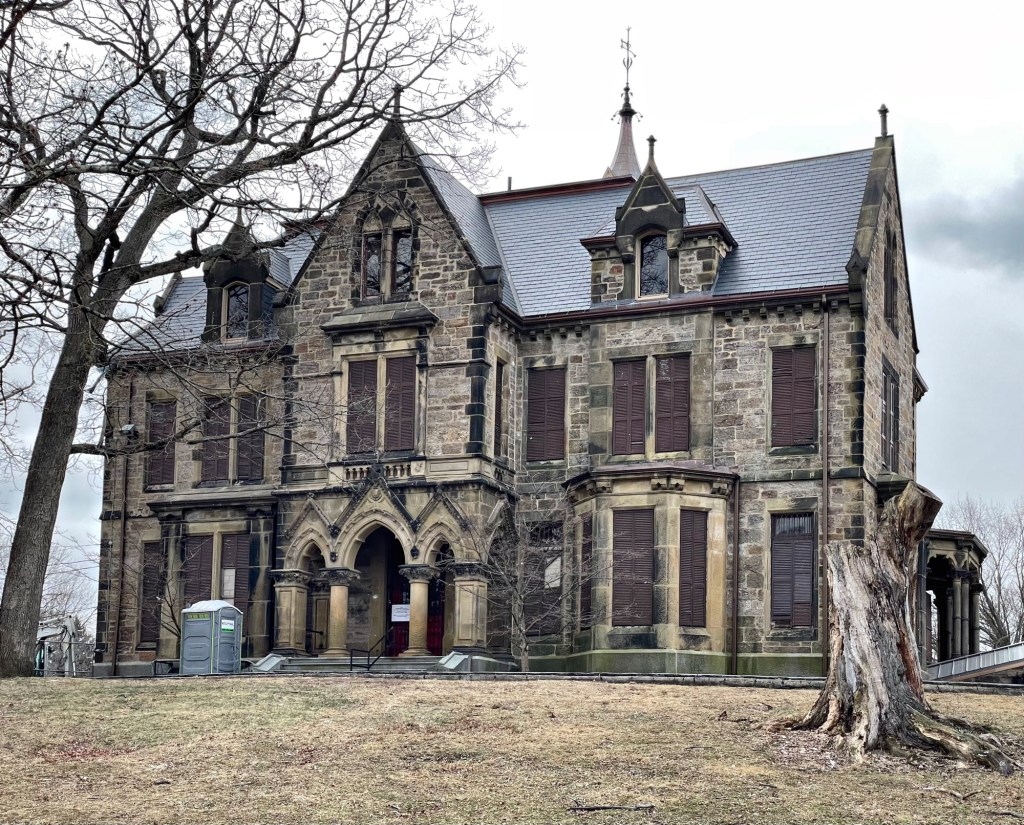
Originally known as Cloister Hall, this ornate building on Hillhouse Avenue in New Haven, Connecticut is one of the most interesting I have seen. The building was constructed in 1887-8 as a residence hall for members of the Book and Snake, a secret society at Yale University. Architect H. Edwards Ficken designed the ornate brownstone Cloister which was completed in 1888. At the time, it was considered “one of the most picturesque buildings on the Yale campus.” The society added a matching rear addition in 1915, which is a heavier mass, but compliments the original structure. Yale University would eventually acquire the building after the society no longer needed a separate lodging house for members. Today, the building is called Warner House, and Yale does a great job at maintaining this beauty.
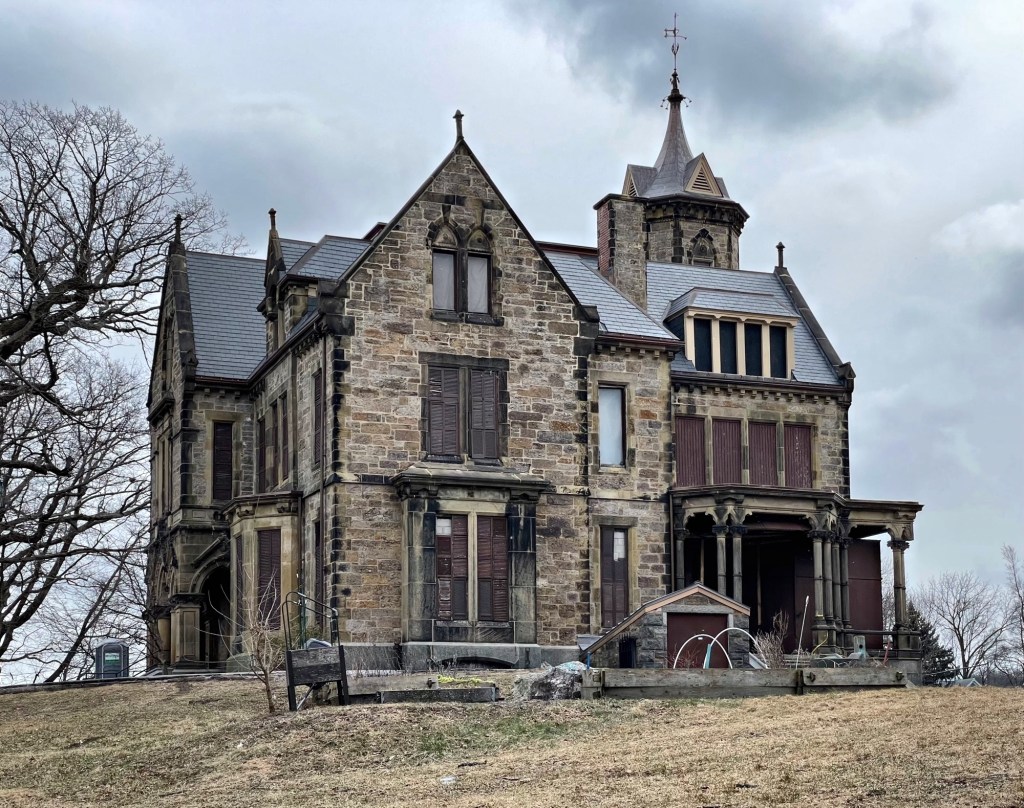
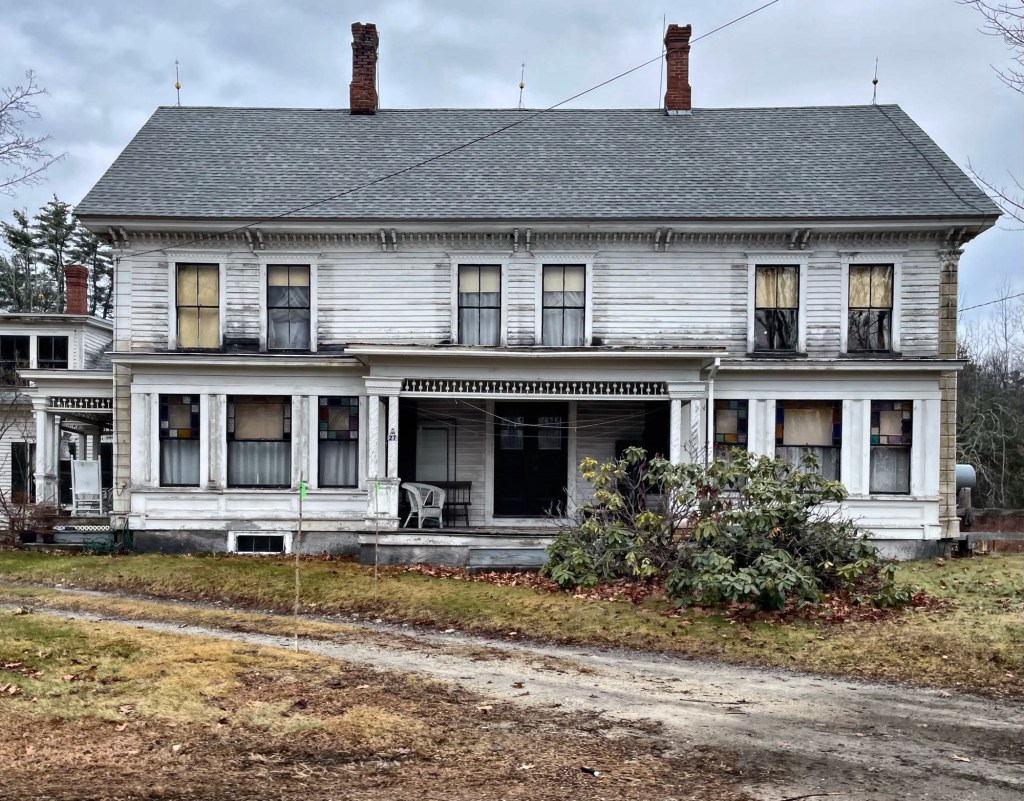
One of the larger homes in Weare, New Hampshire is this sprawling mid-19th century residence, seemingly built around 1850 for Sumner Stanley and his wife, Ruth. Stanley and Ruth (née Dow) acquired land from Ruth’s family and they built their home here. By 1856, Stanley sold a small piece of land to town just to the east of his house for the construction of the North Weare Schoolhouse. The Italianate style house with its Stick style attached barn structure have some amazing detailing!
Closing out this series on Yale’s Old Campus, I present one of the finest Victorian Gothic collegiate buildings in the United States, Street Hall. Street Hall was designed by Peter B. Wight (who had just completed the Venetian Gothic style National Academy of Design in New York City) and opened in 1866. The building opened as the Yale School of the Fine Arts, which was the first art school on an American college campus. The building was named after Augustus Russell Street (1791–1866), a Yale graduate and New Haven businessman who donated the funds for the building’s construction on the condition that all residents of the city could enroll in the school, wanting a bridge between citizens of New Haven (“Town”) and the college “Gown”). Augustus Street and his wife, Caroline Leffingwell had seven daughters together, all of whom predeceased them. It was likely the fact he was around so many women in his life that he also required the Yale School of the Fine Arts to admit both male and female students (Yale would become co-educational and admit women to all programs in 1969.) Street Hall is a landmark example of the Victorian/Venetian Gothic style with lancet arches, polychromatic stone, and trefoil and quatrefoil stone medallions. Street Hall is now connected to, and is a part of the Yale University Art Gallery.
As the Old Campus of Yale was being enclosed at its north and east by Farnam and Durfee halls, architect Russell Sturgis was again tasked to design a new building, but for a corner site; though this time, he would design a college chapel. Built between 1874–76, it was funded primarily with gifts from Joseph Battell. Succeeding two previous chapel buildings on Yale’s Old Campus, it provided space for daily chapel services, which were mandatory for Yale students until 1926, which were all-male and mostly Protestant. The large stone chapel is constructed of New Jersey brownstone with decorative elements in sandstone. The design of the Victorian Gothic chapel is great, but how it sits with the entrance unceremoniously dumping out to the end wall of Durfee Hall leaves much to be desired.
Farnam Hall is Yale University’s oldest dormitory still in use. Designed by New York architect Russell Sturgis in a Ruskinian High Victorian Gothic style, Farnam Hall is considered Sturgis’s most important work and was completed in 1871, marking a new direction toward an enclosed campus, shielded off from the surrounding downtown district of New Haven. Named for Henry Farnam, its construction required the removal of the Second President’s House and a section of the Yale Fence, which was met with some trepidation. The red brick, four-story building originally consisted of twenty suites and ten common rooms on each floor. Sturgis, who was influenced by John Ruskin’s ideals put forward in his Seven Lamps of Architecture, used a variety of brick and stone on the facade all with hand carved detailing. Farnam Hall was renovated in 1977 by architect Edward Larrabee Barnes and today serves as a dormitory for first-year students belonging to Yale’s Jonathan Edwards College.
Merry Christmas to those who celebrate! As there is no snow on the ground in Boston, I wanted to share a house with a prominent pine tree, which resembles an oversized urban Christmas tree on Beacon Street. This house at the corner of Beacon and Fairfield streets was built in 1871 by architect and builder Frederick B. Pope on speculation. It did not sell as quickly as he would have hoped, and it took two years for it to finally sell at public auction in 1873. The relatively modest brick Second Empire style house was bought and sold numerous times until March 1905, when the residence was purchased by Clarence Walker Barron, a prominent publisher and journalist. In 1903, he purchased Dow Jones & Company and from 1912 until his death in 1928, he was its president. During this period, he was also de facto manager of The Wall Street Journal, he expanded its daily circulation, modernized its printing press operations, and deepened its reporting capabilities. In 1921, he founded Barron’s National Financial Weekly, later renamed Barron’s Magazine. Barron pushed for the intense scrutiny of corporate financial records, and for this reason is considered by many to be the founder of modern financial journalism. In 1920, he investigated Charles Ponzi, inventor of the “Ponzi scheme”. His aggressive questioning and common-sense analysis helped lead to Ponzi’s arrest and conviction. For his Boston townhouse, Barron hired the firm of Cram, Goodhue & Ferguson to completely renovate the dwelling with an extra floor, limestone facades, and more bold roof design.